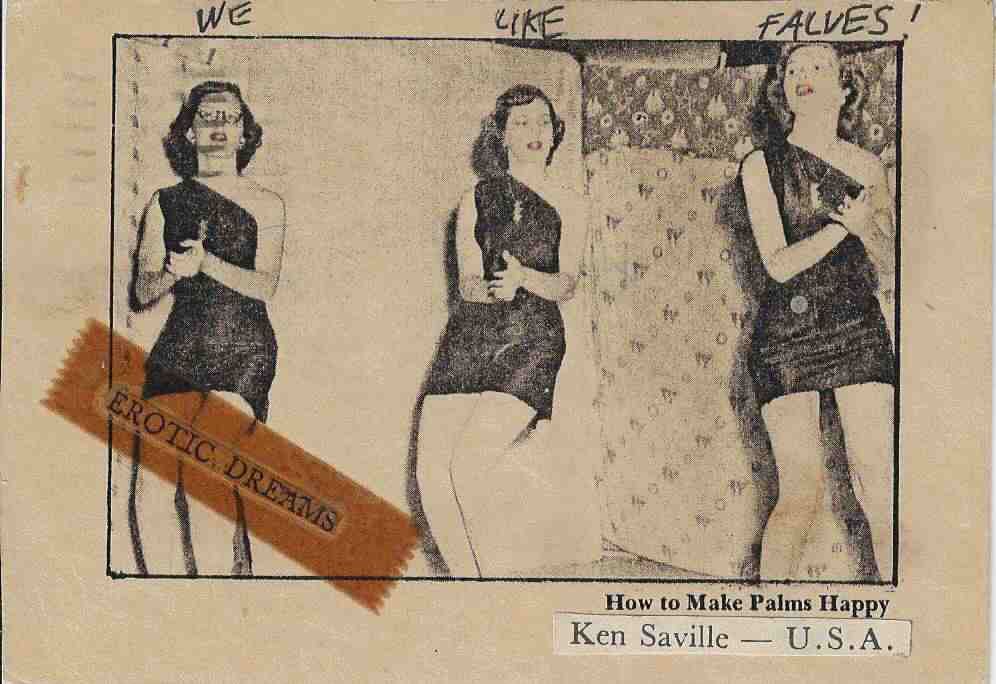
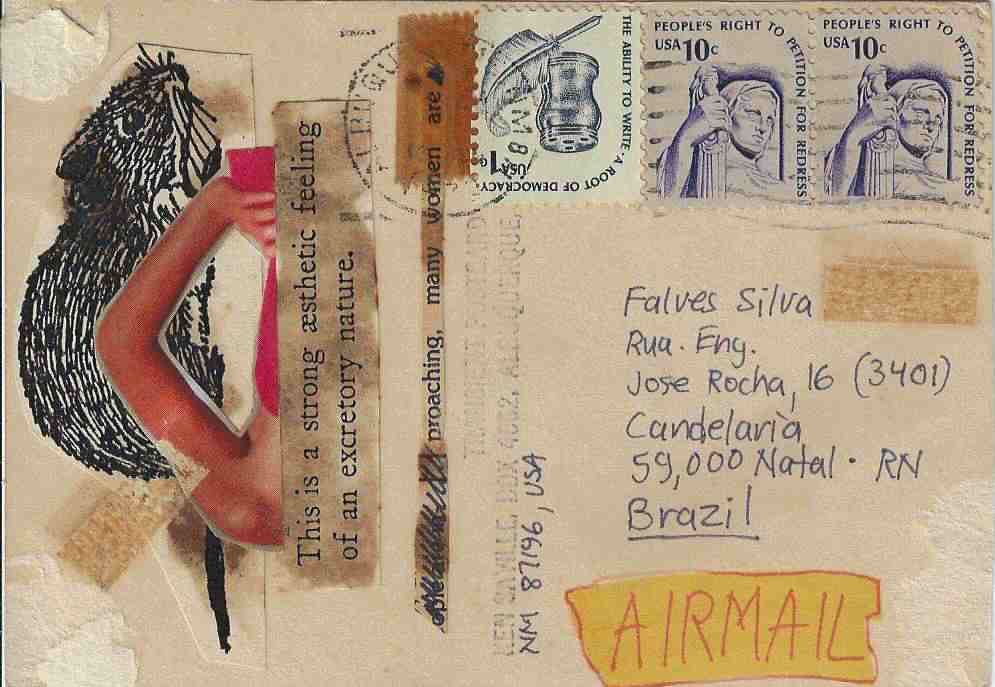
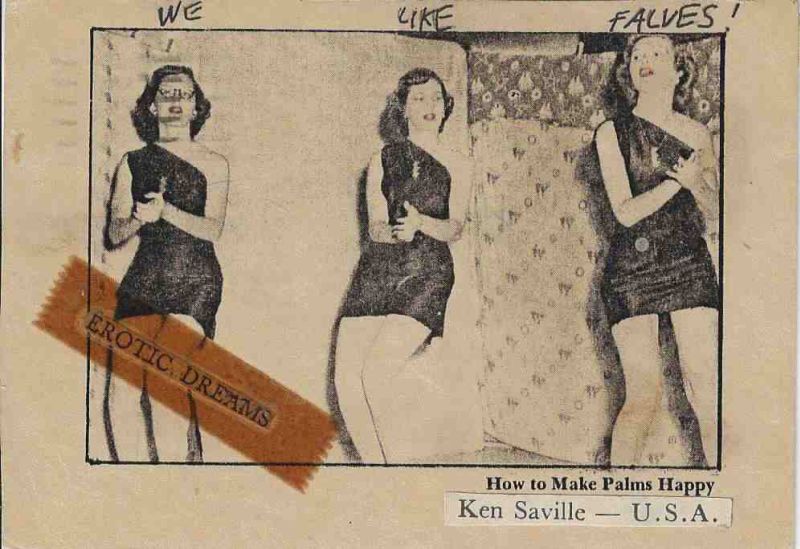
Envelope de Arte Postal criado pelo artista norte americano Ken Saville e enviado de Albuquerque, Novo México, Estados Unidos, para Falves Silva, em Natal, Rio Grande do Norte, Brasil. A peça é datada de 1977
Ken Saville - Ken Wayne Saville - USA
Categoria: Mail Art
Acervo: 03935
Data: 1977
Dimensões: 8,7 x 12,5 cm
Texto para o programa Salsa em portuguêsEnvelope de Arte Postal criado pelo artista norte americano Ken Saville e enviado de Albuquerque, Novo México, Estados Unidos, para Falves Silva, em Natal, Rio Grande do Norte, Brasil. A peça é datada de 1977 segundo a documentação do acervo e apresenta colagens, fragmentos de textos impressos, imagens apropriadas, intervenções manuscritas, selos postais e marcas produzidas durante sua circulação internacional.A face principal apresenta uma imagem impressa com três fotografias sucessivas de uma mulher usando vestido escuro. Sobre a borda superior, Ken Saville acrescentou manualmente as palavras WE LIKE FALVES. A frase dirige a composição ao destinatário e pode ser traduzida como Nós gostamos de Falves. O nome de Falves Silva é incorporado à própria imagem, transformando o envelope em mensagem personalizada e obra destinada a um participante específico da rede internacional de Arte Postal.A repetição da figura feminina cria uma sequência semelhante a fotogramas, estudos de movimento ou imagens de apresentação de uma modelo. As três posições apresentam pequenas alterações de gesto, postura e enquadramento. A organização serial aproxima fotografia, narrativa gráfica e montagem, criando uma percepção de passagem temporal dentro de uma única superfície.Na parte inferior esquerda foi colada uma faixa de papel de tonalidade alaranjada com a expressão Erotic Dreams. O fragmento introduz uma referência direta ao desejo e ao imaginário erótico, mas sua relação com as fotografias permanece aberta. O procedimento de apropriação desloca uma expressão originalmente pertencente a outro contexto editorial e a reinsere em uma nova composição.Na margem inferior aparecem os fragmentos How to Make Palms Happy e Ken Saville USA. A expressão How to Make Palms Happy pode ser traduzida como Como tornar as palmas das mãos felizes. O texto acrescenta humor e ambiguidade ao conjunto, podendo sugerir toque, gesto, prazer, trabalho manual, leitura tátil ou uma instrução impossível. A identificação de Ken Saville e dos Estados Unidos funciona simultaneamente como assinatura, autoria e localização de origem.A outra face do envelope apresenta uma colagem mais fragmentada e corporal. Uma imagem recortada mostra o braço e parte do corpo de uma mulher diante de uma forma gráfica escura semelhante a cabelos, linhas ou uma silhueta. Sobre a figura foram aplicados recortes verticais e horizontais de textos impressos, fita adesiva e pequenos campos cromáticos.Entre os fragmentos verbais legíveis aparece a frase This is a strong aesthetic feeling of an excretory nature. O texto pode ser traduzido como Este é um forte sentimento estético de natureza excretória. A aproximação entre estética e excreção produz um contraste deliberado entre linguagem crítica, corpo, desejo e funções orgânicas. O fragmento desloca a noção tradicional de beleza e introduz uma dimensão irônica, corporal e provocadora.Outro fragmento contém as palavras approaching many women. A construção pode ser compreendida como aproximando se de muitas mulheres. Sua presença reforça as referências ao corpo feminino e ao desejo, embora o contexto original da frase não esteja preservado. Ken Saville utiliza textos incompletos como unidades visuais e semânticas, permitindo que as lacunas produzam associações inesperadas.A colagem também inclui a palavra feeling, que significa sentimento, e outros fragmentos parcialmente encobertos. Os diferentes tamanhos de letras, orientações, texturas e materiais interrompem qualquer leitura linear. A mensagem é construída por aproximação entre partes, e não por meio de uma narrativa completa.O endereço do remetente aparece verticalmente na região central do envelope. É possível identificar Ken Saville, caixa postal 1662, Albuquerque, Novo México, código postal 87196, Estados Unidos. O registro confirma Albuquerque como base de atuação e circulação postal do artista no período.O destinatário foi identificado como Falves Silva, Rua Engenheiro José Rocha, número 16, referência 3401, Candelária, código postal 59000, Natal, Rio Grande do Norte, Brasil. O endereço manuscrito documenta uma correspondência direta entre Ken Saville e Falves Silva e comprova a integração de Natal à rede internacional de Arte Postal.Na parte inferior direita aparece a palavra AIRMAIL, escrita em letras vermelhas dentro de uma forma recortada e colada. A indicação postal torna se parte da composição visual e reforça o deslocamento aéreo internacional da peça entre os Estados Unidos e o Brasil.O envelope conserva três selos postais norte americanos. Um deles apresenta a imagem de uma mão escrevendo e a frase The Ability to Write, A Root of Democracy, associando escrita e democracia. Os outros dois selos apresentam a frase People
s Right to Petition for Redress, referência ao direito popular de solicitar reparação ou apresentar petições ao governo. Os três selos introduzem temas ligados à escrita, à comunicação pública, à cidadania e à liberdade de expressão.Esses elementos postais dialogam diretamente com a função do envelope. A escrita aparece simultaneamente como direito político, gesto artístico e instrumento de conexão entre pessoas geograficamente distantes. O sistema postal não atua apenas como meio de transporte, pois seus selos, carimbos, inscrições e marcas integram a forma final da obra.As fitas adesivas, manchas, perdas e alterações visíveis pertencem à história material do objeto. Elas podem ter sido produzidas durante a montagem, o fechamento, a abertura, a exposição ou o arquivamento da correspondência. Em uma obra de Arte Postal, esses vestígios registram o percurso físico e não devem ser separados de sua interpretação documental.O envelope aproxima erotismo, humor, cultura impressa, fotografia, corpo, linguagem e comunicação postal. A fragmentação impede uma interpretação única. Expressões relacionadas a sonhos eróticos, sentimentos estéticos, mulheres, mãos e funções corporais são reorganizadas como matéria poética e visual.A relação entre Ken Saville e Falves Silva é explicitada pela inscrição WE LIKE FALVES e pela personalização do endereço. O uso do pronome coletivo WE sugere uma voz plural, real ou imaginada, que pode representar o artista, um grupo de colaboradores, as figuras da fotografia ou a própria comunidade internacional de correspondência.Falves Silva foi um dos participantes históricos do Poema Processo e desenvolveu ampla produção em poesia visual, xerografia, livro de artista, colagem e Arte Postal. O envio de Ken Saville demonstra a comunicação entre a produção experimental de Albuquerque e o circuito artístico de Natal durante a década de 1970.Ken Saville não foi integrante documentado do movimento Poema Processo. Entretanto, este envelope estabelece uma relação direta com um artista central do movimento e apresenta características próximas às investigações processuais brasileiras. A fragmentação verbal, a integração entre texto e imagem, a apropriação de materiais cotidianos, a participação do destinatário e a circulação como parte da obra aproximam a peça da poesia visual, da poesia experimental e da arte conceitual.O envelope Erotic Dreams e WE LIKE FALVES possui importância artística, histórica e arquivística por preservar uma intervenção original de Ken Saville destinada a Falves Silva. A peça comprova o intercâmbio entre Albuquerque e Natal e documenta como imagens populares, fragmentos editoriais, inscrições pessoais e elementos do sistema postal eram transformados em uma obra única de comunicação internacional.Text for the Salsa program in EnglishMail Art envelope created by the American artist Ken Saville and sent from Albuquerque, New Mexico, United States, to Falves Silva in Natal, Rio Grande do Norte, Brazil. The piece is dated 1977 according to the archive documentation and presents collage, fragments of printed texts, appropriated images, handwritten interventions, postage stamps and marks produced during its international circulation.The main side contains a printed image with three successive photographs of a woman wearing a dark dress. Along the upper border, Ken Saville manually added the words WE LIKE FALVES. The phrase directly addresses the recipient and incorporates the name of Falves Silva into the image, transforming the envelope into a personalized message and an artwork intended for a specific participant in the international Mail Art network.The repetition of the female figure creates a sequence resembling film frames, movement studies or photographs of a model. The three positions present subtle changes in gesture, posture and framing. This serial organization connects photography, graphic narrative and montage, producing a sense of temporal progression within a single surface.An orange paper strip bearing the words Erotic Dreams was attached to the lower left area. The fragment introduces a direct reference to desire and erotic imagination, although its relationship with the photographs remains open. Through appropriation, an expression originally belonging to another editorial context is displaced and inserted into a new composition.The lower margin contains the fragments How to Make Palms Happy and Ken Saville USA. How to Make Palms Happy adds humor and ambiguity and may suggest touch, gesture, pleasure, manual activity, tactile reading or an impossible instruction. The identification of Ken Saville and the United States functions simultaneously as signature, authorship and indication of origin.The reverse side presents a more fragmented and bodily collage. A cutout image shows the arm and part of the body of a woman positioned in front of a dark graphic form resembling hair, lines or a silhouette. Vertical and horizontal fragments of printed text, adhesive tape and small areas of color were applied over the image.One of the legible verbal fragments reads This is a strong aesthetic feeling of an excretory nature. The combination of aesthetics and excretion produces a deliberate contrast among critical language, the body, desire and organic functions. The phrase challenges conventional ideas of beauty and introduces an ironic, physical and provocative dimension.Another fragment contains the words approaching many women. Its presence reinforces references to the female body and desire, although the original context of the sentence has not been preserved. Saville employs incomplete texts as visual and semantic units, allowing the missing portions to generate unexpected associations.The collage also includes the word feeling and other partially covered fragments. Differences in letter size, direction, texture and material interrupt linear reading. Meaning is constructed through the proximity of separate elements rather than through a complete narrative.The sender
s address is printed vertically near the center of the envelope. It identifies Ken Saville, Post Office Box 1662, Albuquerque, New Mexico, postal code 87196, United States. This record confirms Albuquerque as the artist
s postal base during the period.The recipient is identified as Falves Silva at Rua Engenheiro José Rocha, number 16, reference 3401, Candelária, postal code 59000, Natal, Rio Grande do Norte, Brazil. The handwritten address documents direct correspondence between Ken Saville and Falves Silva and confirms the participation of Natal in the international Mail Art network.The word AIRMAIL appears in red letters within a cut and attached paper shape in the lower right area. The postal instruction becomes part of the visual composition and emphasizes the international air circulation of the piece between the United States and Brazil.The envelope preserves three American postage stamps. One depicts a hand writing and bears the phrase The Ability to Write, A Root of Democracy, connecting writing with democracy. The other two stamps carry the phrase People
s Right to Petition for Redress, referring to the public right to petition the government. Together, the stamps introduce themes of writing, public communication, citizenship and freedom of expression.These postal elements directly interact with the function of the envelope. Writing appears simultaneously as a political right, an artistic gesture and an instrument connecting geographically distant individuals. The postal system does not function solely as transportation because its stamps, cancellations, inscriptions and physical traces form part of the completed artwork.Adhesive tape, stains, losses and visible alterations belong to the material history of the object. They may have resulted from assembly, sealing, opening, display or archival storage. In Mail Art, these traces document the physical journey of the piece and should remain part of its interpretation.The envelope brings together eroticism, humor, printed culture, photography, the body, language and postal communication. Its fragmentation prevents a single definitive interpretation. Expressions involving erotic dreams, aesthetic feeling, women, hands and bodily functions are reorganized as visual and poetic material.The relationship between Ken Saville and Falves Silva is made explicit by the inscription WE LIKE FALVES and by the personalized address. The collective pronoun WE suggests a plural voice, whether real or imagined, that may represent the artist, a group of collaborators, the photographed figures or the international correspondence community itself.Falves Silva was a historical participant in the Brazilian Process Poem Movement and developed an extensive practice involving visual poetry, photocopy art, artists books, collage and Mail Art. Saville
s mailing documents communication between experimental production in Albuquerque and the artistic circuit of Natal during the 1970s.Ken Saville was not a documented member of the Process Poem Movement. Nevertheless, this envelope establishes a direct relationship with a central participant in the movement and presents characteristics related to Brazilian process based research. Verbal fragmentation, the integration of text and image, the appropriation of everyday materials, the participation of the recipient and circulation as part of the artwork connect the piece with visual poetry, experimental poetry and conceptual art.The Erotic Dreams and WE LIKE FALVES envelope has artistic, historical and archival importance because it preserves an original intervention by Ken Saville addressed to Falves Silva. The work confirms an exchange between Albuquerque and Natal and documents how popular imagery, editorial fragments, personal inscriptions and postal elements were transformed into a unique work of international communication.
Texto de observação em portuguêsEnvelope de Arte Postal criado por Ken Saville e enviado de Albuquerque, Novo México, para Falves Silva em Natal, Rio Grande do Norte, com data atribuída de 1977. Uma das faces apresenta três imagens sucessivas de uma mulher, a inscrição manuscrita WE LIKE FALVES, o fragmento Erotic Dreams e os textos How to Make Palms Happy e Ken Saville USA. A outra face reúne colagem com figura feminina, fragmentos verbais sobre sentimento estético, natureza excretória e mulheres, além do endereço de Ken Saville na caixa postal 1662, Albuquerque, código postal 87196. O envelope conserva o endereço de Falves Silva na Rua Engenheiro José Rocha, número 16, Candelária, Natal, inscrição AIRMAIL e três selos norte americanos relacionados ao direito de escrever e ao direito de petição. A peça documenta a comunicação direta entre Ken Saville e Falves Silva e integra fotografia, apropriação editorial, erotismo, humor, poesia visual e circulação postal.Observation text in EnglishMail Art envelope created by Ken Saville and sent from Albuquerque, New Mexico, to Falves Silva in Natal, Rio Grande do Norte, Brazil, with an attributed date of 1977. One side presents three successive images of a woman, the handwritten inscription WE LIKE FALVES, the fragment Erotic Dreams and the texts How to Make Palms Happy and Ken Saville USA. The reverse combines a female figure with verbal fragments concerning aesthetic feeling, excretory nature and women, together with Ken Saville
s address at Post Office Box 1662, Albuquerque, postal code 87196. The envelope preserves Falves Silva
s address at Rua Engenheiro José Rocha, number 16, Candelária, Natal, an AIRMAIL inscription and three American postage stamps related to the ability to write and the right to petition. The piece documents direct communication between Ken Saville and Falves Silva and combines photography, editorial appropriation, eroticism, humor, visual poetry and postal circulation.
Proveniência
Coleção Falves SilvaInglês
Mail Art envelope created by the American artist Ken Saville and sent from Albuquerque, New Mexico, United States, to Falves Silva in Natal, Rio Grande do Norte, Brazil. The piece is dated 1977
Dimensions: 3,4 x 4,9 in