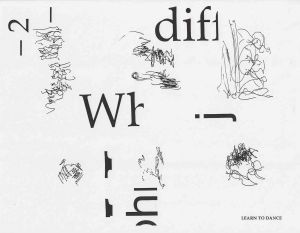
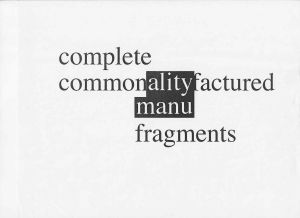
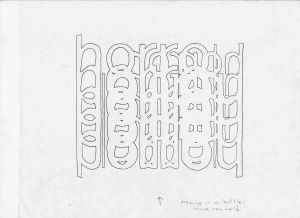
Poesia visual do artista norte americano Crag Hill construída por meio de desenho, escrita manual, fragmentação verbal e sobreposição de diferentes camadas gráficas. A composição apresenta uma grande forma oval branca sobre fundo preto, preenchida por palavras, frases, linhas, curvas, figuras humanas e gestos caligráficos que se cruzam em várias direções
Crag Hill - USA
Categoria: Poesia Visual
Acervo: 03878
Dimensões: 21,6 x 27,8 cm
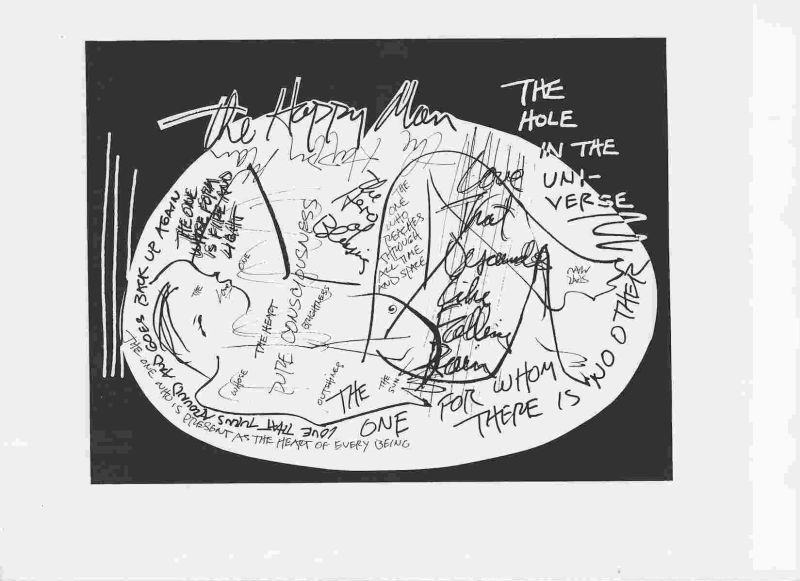
Poesia visual do artista norte americano Crag Hill construída por meio de desenho, escrita manual, fragmentação verbal e sobreposição de diferentes camadas gráficas. A composição apresenta uma grande forma oval branca sobre fundo preto, preenchida por palavras, frases, linhas, curvas, figuras humanas e gestos caligráficos que se cruzam em várias direções.Na parte superior aparece com destaque a expressão The Happy Man, que pode ser traduzida como O Homem Feliz. A escrita possui dimensões maiores e funciona como possível título interno, ponto de entrada ou personagem central da composição. As letras são alongadas, inclinadas e atravessadas por outras marcas, impedindo uma leitura totalmente linear.Na região direita aparece a expressão The Hole in the Universe, distribuída em diferentes linhas e com a palavra Universe dividida graficamente. A frase pode ser traduzida como O Buraco no Universo. A separação de Universe em blocos visuais transforma a palavra em matéria espacial e reforça a relação entre texto, vazio, ruptura e fragmentação.A forma oval central pode ser interpretada como planeta, cápsula, campo mental, universo, recipiente, olho ou espaço fechado. O fundo preto cria forte contraste e faz com que a área branca funcione como território autônomo no qual palavras e figuras se acumulam.No interior da composição aparecem pelo menos duas figuras humanas desenhadas em perfil ou em posição reclinada. A figura da esquerda parece estar deitada, com a cabeça voltada para cima. Outra forma humana ocupa a região central e direita, atravessada por linhas, palavras e grandes gestos caligráficos.Os corpos não são representados como figuras isoladas. Eles funcionam como superfícies para a escrita. Palavras aparecem sobre o rosto, o pescoço, o peito, os braços, o abdômen e as pernas. Essa integração transforma o corpo em página, mapa, território verbal e estrutura de pensamento.Entre os fragmentos mais legíveis encontram se palavras e expressões relacionadas a consciência, vazio, felicidade, amor, solidão, coração, corpo e universo. Aparecem visualmente elementos como consciousness, love, happiness, heart, solitary man, universe e fragments, embora parte das inscrições esteja encoberta pelas sobreposições e não possa ser transcrita com segurança.Uma frase central parece relacionar love, surrounds e solitary man. A leitura integral permanece incerta devido ao cruzamento das linhas e à grafia gestual. O conjunto sugere uma reflexão sobre o amor que envolve, atravessa ou isola o indivíduo.Na região inferior aparece uma estrutura verbal próxima de The One Pot Within There Is Two Others. A palavra Pot também pode apresentar outra leitura, pois a caligrafia e a sobreposição dificultam sua identificação. A frase deve ser preservada como leitura parcial e não como transcrição definitiva.Na borda inferior esquerda é possível perceber uma frase relacionada ao presente e ao coração de cada ser, com estrutura visual próxima de The Present as the Heart of Every Being. Parte do texto encontra se comprimida junto ao limite da forma oval, exigindo exame direto do original para confirmação.A obra não organiza as frases em linhas regulares. A leitura ocorre por aproximações, desvios e retornos. O observador pode começar pelo título superior, seguir pelas palavras da direita, percorrer os corpos ou acompanhar as linhas que atravessam a composição.A escrita apresenta diferentes intensidades. Algumas palavras possuem traço fino e pequeno. Outras foram produzidas com gestos amplos, rápidos e expressivos. Essa variação cria hierarquias visuais, mas também impede que uma única voz domine a obra.O trabalho combina escrita legível e escrita quase ilegível. Em certos pontos, a palavra transmite significado verbal. Em outros, converte se em linha, textura, movimento ou ruído gráfico. Essa passagem entre linguagem e desenho constitui uma característica fundamental da poesia visual.As sobreposições sugerem simultaneidade de pensamentos, vozes, lembranças e sensações. A página não representa uma narrativa ordenada. Ela se aproxima de um campo de consciência no qual diferentes ideias surgem ao mesmo tempo e disputam o mesmo espaço.A expressão The Happy Man pode adquirir sentido irônico ou ambíguo. O homem feliz está cercado por fragmentos, corpos, consciência, vazio, solidão e um buraco no universo. A felicidade não aparece como estado simples, mas como condição atravessada por conflitos internos e perguntas existenciais.A expressão The Hole in the Universe introduz uma imagem de ausência dentro de uma composição extremamente cheia. Embora o interior da forma oval esteja ocupado por palavras e linhas, o texto menciona um buraco, criando tensão entre excesso e vazio.O uso da palavra universe amplia a escala da obra. O poema parte do corpo humano e alcança uma dimensão cósmica. Corpo, consciência e universo passam a funcionar como estruturas relacionadas, cada uma contendo vazios, fragmentos e outras formas de existência.As figuras reclinadas podem sugerir repouso, sonho, meditação, nascimento, morte ou estado de suspensão. O documento não oferece elementos suficientes para definir uma única narrativa. A interpretação deve permanecer aberta.A composição possui afinidades com poesia visual, poesia gestual, desenho textual, escrita assêmica e arte conceitual. A escrita assêmica é sugerida pelas regiões em que os sinais parecem linguagem, mas não oferecem leitura verbal estável.A obra também apresenta proximidade com mapas mentais e diagramas de consciência. As linhas conectam palavras, partes do corpo e diferentes zonas da composição, produzindo relações que não dependem de uma ordem convencional.O contraste entre fundo preto e campo oval branco reforça a ideia de interior e exterior. O interior concentra corpo, pensamento e linguagem. O exterior aparece como silêncio escuro, espaço desconhecido ou universo que envolve a estrutura central.Crag Hill transforma a superfície em ambiente participativo. O observador precisa selecionar palavras, reconstruir frases, aceitar áreas ilegíveis e criar relações entre elementos distantes. A leitura torna se uma ação de montagem.Não foram apresentados verso, assinatura, endereço, data, numeração, título catalográfico ou informações editoriais. A expressão The Happy Man pode funcionar como título visual, mas isso não pode ser confirmado sem documentação adicional.A obra relaciona se ao campo da arte postal e das publicações independentes pela produção gráfica reproduzível e pela trajetória de Crag Hill nas redes internacionais de poesia visual. Entretanto, a imagem apresentada não contém elementos postais que comprovem envio pelo correio.Não há indicação de que Crag Hill tenha integrado formalmente o movimento Poema Processo. A aproximação ocorre pelas afinidades entre palavra e imagem, fragmentação do código verbal, participação do leitor, espacialização da linguagem e transformação do poema em estrutura visual.Para indexação, recomenda se utilizar os termos Crag Hill, The Happy Man, The Hole in the Universe, poesia visual, visual poetry, poesia experimental norte americana, desenho textual, escrita gestual, escrita assêmica, corpo e linguagem, consciência, felicidade, amor, solidão, universo, fragmentação verbal, arte conceitual, palavra imagem, publicação de artista, arte postal e Poema Processo.TEXT FOR THE SALSA PROGRAM IN ENGLISHVisual poem by the American artist Crag Hill constructed through drawing, handwriting, verbal fragmentation and the superimposition of several graphic layers. The composition presents a large white oval form against a black background, filled with words, phrases, lines, curves, human figures and calligraphic gestures moving in several directions.The expression The Happy Man appears prominently in the upper area. Its larger scale allows it to function as a possible internal title, point of entry or central character. The elongated and inclined letters are crossed by other marks, preventing a completely linear reading.The phrase The Hole in the Universe appears on the right, distributed across several lines and with Universe graphically divided. The separation of the word transforms language into spatial material and reinforces relationships among text, emptiness, rupture and fragmentation.The central oval may be interpreted as a planet, capsule, mental field, universe, container, eye or enclosed space. The black background creates strong contrast and makes the white area function as an autonomous territory in which words and figures accumulate.At least two human figures appear within the composition in profile or reclining positions. The figure on the left appears to be lying down with the head turned upward. Another human form occupies the central and right areas and is crossed by lines, words and large calligraphic gestures.The bodies are not presented as isolated figures. They operate as surfaces for writing. Words appear over the face, neck, chest, arms, abdomen and legs. This integration transforms the body into a page, map, verbal territory and structure of thought.Among the more legible fragments are words and expressions connected with consciousness, emptiness, happiness, love, solitude, the heart, the body and the universe. Visual elements appear to include consciousness, love, happiness, heart, solitary man, universe and fragments, although several inscriptions are obscured by overlapping lines and cannot be securely transcribed.A central phrase appears to connect love, surrounds and solitary man. The complete reading remains uncertain because of intersecting marks and gestural handwriting. The group suggests a meditation on love as something that surrounds, crosses or isolates the individual.The lower area contains a verbal structure resembling The One Pot Within There Is Two Others. Pot may admit another reading because handwriting and superimposition make identification difficult. The phrase should be preserved as a partial reading rather than a definitive transcription.Near the lower left edge is a sentence apparently concerning the present and the heart of every being, visually resembling The Present as the Heart of Every Being. Part of the text is compressed against the boundary of the oval and requires direct examination of the original for confirmation.The work does not organize phrases into regular lines. Reading proceeds through approaches, deviations and returns. The viewer may begin with the upper title, continue through the words on the right, move across the bodies or follow the lines crossing the composition.The writing displays different degrees of intensity. Some words are small and made with thin strokes. Others use broad, rapid and expressive gestures. This variation creates visual hierarchies while preventing a single voice from dominating the work.The composition combines legible and nearly illegible writing. In some areas, words communicate verbal meaning. In others, they become lines, textures, movement or graphic noise. This movement between language and drawing is fundamental to the visual poem.The superimpositions suggest the simultaneity of thoughts, voices, memories and sensations. The page does not represent an ordered narrative. It resembles a field of consciousness in which several ideas emerge at once and occupy the same space.The Happy Man may acquire an ironic or ambiguous meaning. The happy man is surrounded by fragments, bodies, consciousness, emptiness, solitude and a hole in the universe. Happiness is not shown as a simple condition but as a state crossed by internal conflict and existential questions.The Hole in the Universe introduces an image of absence into an extremely crowded composition. Although the interior of the oval is filled with words and lines, the text refers to a hole, creating tension between excess and emptiness.The use of universe enlarges the scale of the work. The poem begins with the human body and reaches a cosmic dimension. Body, consciousness and universe become related structures, each containing voids, fragments and other forms of existence.The reclining figures may suggest rest, dreaming, meditation, birth, death or suspension. The document does not provide sufficient evidence to establish a single narrative, and interpretation should remain open.The composition has affinities with visual poetry, gestural poetry, textual drawing, asemic writing and conceptual art. Asemic writing is suggested by areas in which marks resemble language without offering stable verbal interpretation.The work also approaches mental maps and diagrams of consciousness. Lines connect words, body parts and different areas of the composition, producing relationships that do not depend on conventional order.The contrast between the black background and the white oval reinforces the distinction between interior and exterior. The interior concentrates bodies, thought and language. The exterior appears as dark silence, unknown space or a universe surrounding the central structure.Crag Hill transforms the surface into a participatory environment. The viewer must select words, reconstruct phrases, accept illegible areas and establish connections among distant elements. Reading becomes an act of montage.No reverse, signature, address, date, edition number, catalogue title or editorial information has been supplied. The Happy Man may function as the visual title, but this cannot be confirmed without additional documentation.The work is related to mail art and independent publishing through its reproducible graphic character and Crag Hill
s activity within international visual poetry networks. The presented image, however, contains no postal elements confirming circulation through the mail.No evidence indicates that Crag Hill formally participated in the Brazilian Process Poem Movement. The relationship is based on affinities involving word and image, fragmentation of verbal codes, reader participation, spatial organization of language and transformation of the poem into a visual structure.Recommended indexing terms include Crag Hill, The Happy Man, The Hole in the Universe, visual poetry, American experimental poetry, textual drawing, gestural writing, asemic writing, body and language, consciousness, happiness, love, solitude, universe, verbal fragmentation, conceptual art, word image, artists publication, mail art and Process Poem Movement.
TEXTO DE OBSERVAÇÃO EM PORTUGUÊSPoesia visual de Crag Hill formada por escrita manual, desenho e sobreposição de palavras sobre figuras humanas inseridas em uma grande forma oval branca sobre fundo preto.A expressão The Happy Man aparece na região superior e pode funcionar como título interno da composição. À direita encontra se The Hole in the Universe, com a palavra Universe fragmentada graficamente.A obra contém palavras e frases relacionadas a felicidade, consciência, amor, solidão, corpo, coração, vazio e universo. Parte das inscrições está encoberta ou apresenta grafia de difícil leitura, impossibilitando transcrição integral segura.As figuras humanas funcionam como superfícies de escrita. Linhas e palavras atravessam rostos, braços, troncos e pernas, transformando o corpo em campo verbal e visual.Não foram apresentados verso, assinatura, data, numeração, endereço ou informações editoriais. A vinculação postal deste exemplar não pode ser confirmada apenas pela imagem.A obra deve ser catalogada como poesia visual, desenho textual, escrita gestual, composição verbo visual e possível material relacionado às redes de poesia experimental e arte postal de Crag Hill.OBSERVATION TEXT IN ENGLISHVisual poem by Crag Hill formed through handwriting, drawing and the superimposition of words across human figures contained within a large white oval against a black background.The expression The Happy Man appears in the upper area and may function as the internal title of the composition. The Hole in the Universe appears on the right, with Universe divided graphically.The work contains words and phrases connected with happiness, consciousness, love, solitude, the body, the heart, emptiness and the universe. Several inscriptions are obscured or difficult to read, preventing a secure complete transcription.Human figures function as writing surfaces. Lines and words cross faces, arms, torsos and legs, transforming the body into a verbal and visual field.No reverse, signature, date, edition number, address or editorial information has been supplied. Postal circulation of this example cannot be confirmed from the image alone.The work should be catalogued as visual poetry, textual drawing, gestural writing, verbal visual composition and possible material connected with Crag Hill
s experimental poetry and mail art networks.
Inglês
Visual poem by the American artist Crag Hill constructed through drawing, handwriting, verbal fragmentation and the superimposition of several graphic layers. The composition presents a large white oval form against a black background, filled with words, phrases, lines, curves, human figures and calligraphic gestures moving in several directions.
Dimensions: 8,5 x 10,9 in