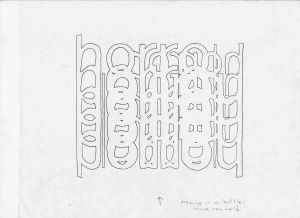
Poesia visual do artista norte americano Crag Hill, identificada como exemplar número 63 de uma edição de 99. A obra utiliza exclusivamente palavras, tipografia, contraste e organização espacial para construir uma composição em que leitura verbal e percepção visual acontecem simultaneamente.
Crag Hill - USA
Categoria: Poesia Visual
Acervo: 03877
Dimensões: 21,5 x 28 cm
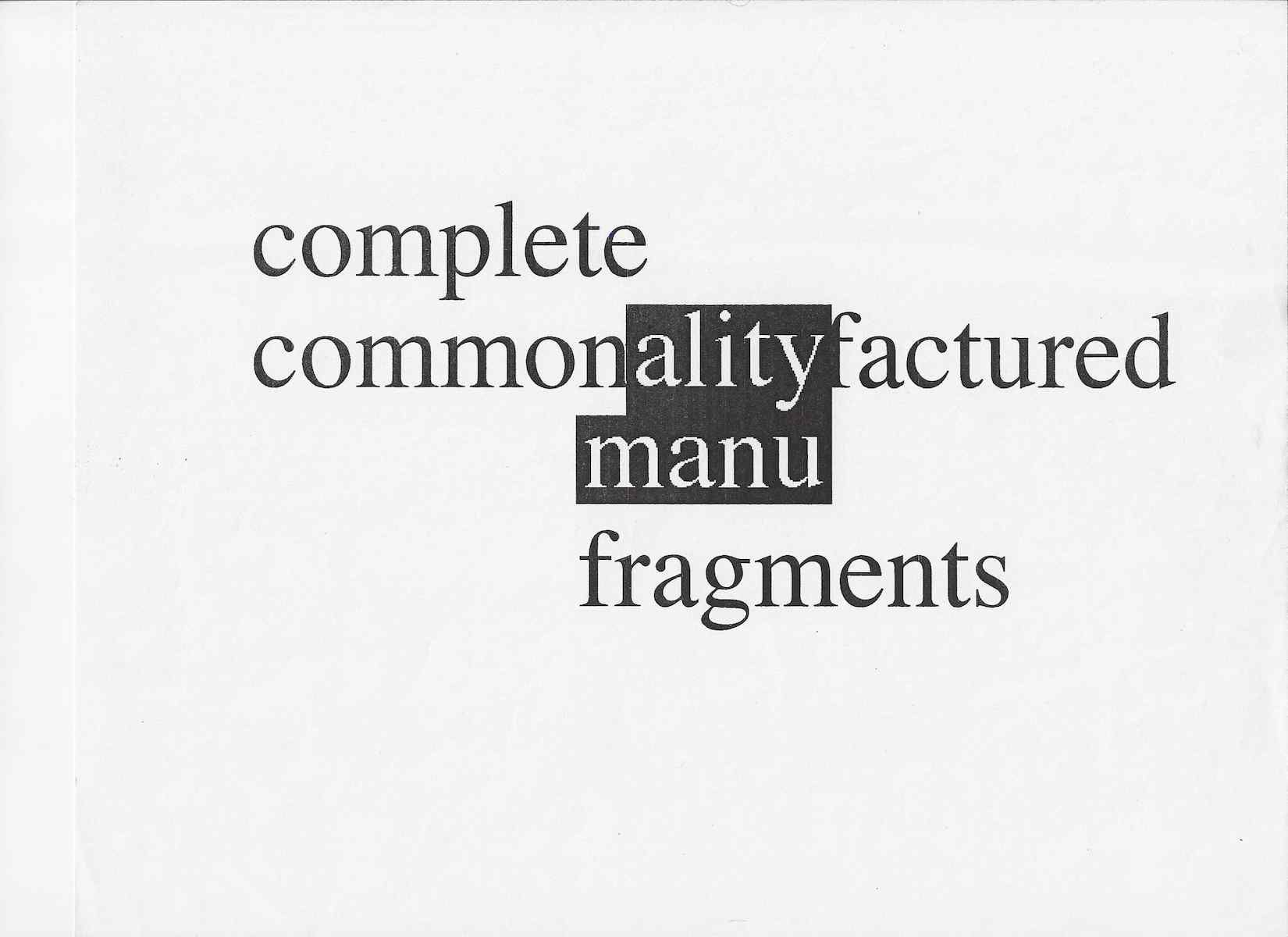
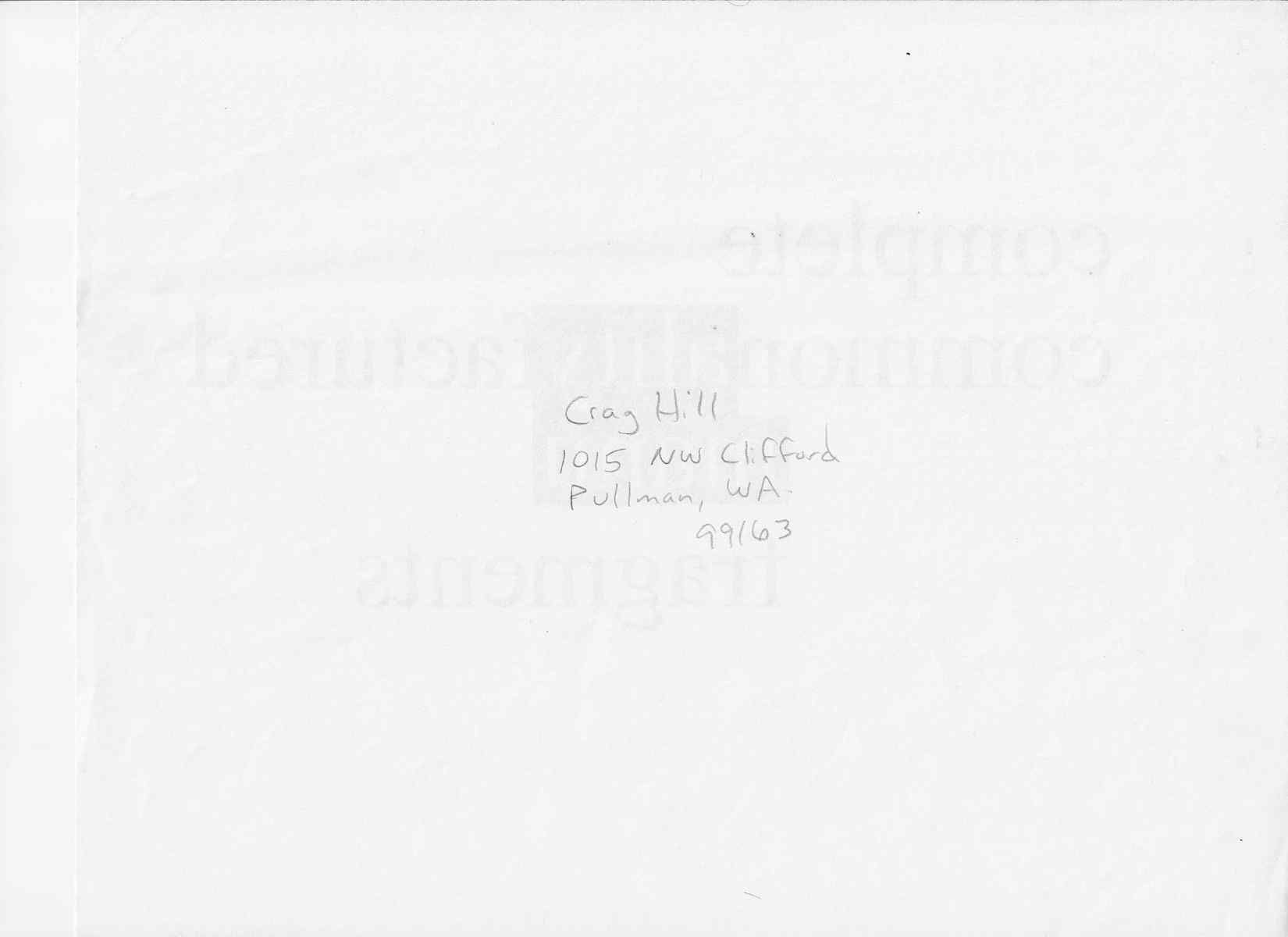
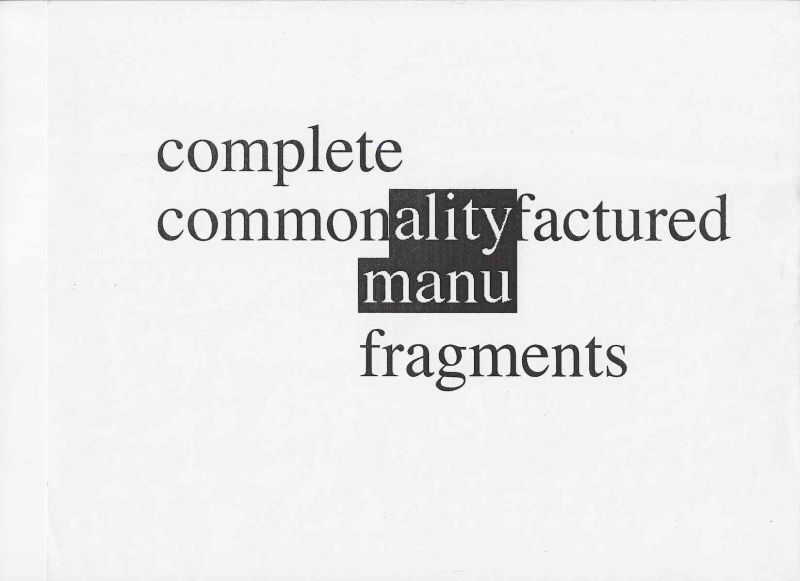
Poesia visual do artista norte americano Crag Hill, identificada como exemplar número 63 de uma edição de 99. A obra utiliza exclusivamente palavras, tipografia, contraste e organização espacial para construir uma composição em que leitura verbal e percepção visual acontecem simultaneamente.No campo principal aparecem as palavras complete, common, ality, factured, manu e fragments. Os elementos ality e manu estão impressos em branco sobre uma área retangular preta, enquanto as demais palavras aparecem em preto sobre o fundo branco do papel. A diferença cromática destaca os fragmentos internos e permite que o leitor recombine as partes de diferentes maneiras.A aproximação entre common e ality forma a palavra commonality, que pode ser traduzida como característica comum, condição compartilhada ou elemento de união. A aproximação entre manu e factured forma manufactured, palavra relacionada a algo fabricado, produzido ou construído. A palavra fragments introduz a ideia de partes separadas, restos ou unidades provenientes de uma totalidade rompida.A composição permite a leitura de uma estrutura próxima de complete commonality manufactured fragments. Essa construção reúne ideias aparentemente contraditórias. Complete sugere totalidade. Fragments indica divisão. Commonality aponta para aquilo que é compartilhado. Manufactured acrescenta a noção de fabricação ou construção artificial.Crag Hill transforma essas palavras em matéria visual. A obra não apresenta uma frase organizada segundo a sintaxe convencional. As palavras são deslocadas, sobrepostas e repartidas. O observador precisa decidir como unir ou separar os componentes, assumindo uma função ativa no processo de leitura.A palavra commonality é atravessada visualmente pela área escura que contém ality. A terminação é retirada do fluxo tipográfico comum e destacada como unidade independente. Essa operação revela que as palavras podem ser desmontadas em partes menores que conservam significado gráfico e sonoro.A palavra manufactured também aparece dividida. Manu está posicionada abaixo de ality, dentro do mesmo campo preto, enquanto factured permanece na linha superior. Para formar manufactured, o leitor precisa reorganizar mentalmente a ordem espacial dos fragmentos.O procedimento aproxima a obra da montagem, da colagem tipográfica e da poesia concreta. Entretanto, não há imagens figurativas nem elementos decorativos. Toda a tensão visual nasce das próprias palavras, de sua fragmentação, de sua posição e da oposição entre preto e branco.O espaço vazio ocupa grande parte da folha. Essa área branca amplia a presença da composição central e cria silêncio visual ao redor das palavras. A concentração do texto em uma região relativamente pequena reforça a percepção de que os elementos foram agrupados, comprimidos ou retirados de um discurso maior.A obra investiga a relação entre totalidade e fragmentação. Complete e fragments aparecem em posições separadas, mas orientam a leitura do conjunto. A composição sugere que algo pode ser completo apenas pela reunião de fragmentos ou que uma aparente totalidade pode ter sido artificialmente fabricada a partir de partes.A expressão manufactured commonality pode ser interpretada como referência a uma condição comum produzida, imposta ou construída. Essa leitura pode envolver comunicação de massa, linguagem padronizada, identidade coletiva, cultura, sociedade ou sistemas políticos. O trabalho não determina uma interpretação única e mantém abertas diferentes relações entre as palavras.A poesia visual também questiona a estabilidade do significado. Uma mesma sequência de letras pode pertencer a mais de uma estrutura. Ality completa commonality. Factured completa manufactured. Manu aparece visualmente associado tanto à área preta quanto à palavra fragments posicionada abaixo.O leitor percorre a obra em diferentes direções. A leitura pode começar em complete e seguir horizontalmente. Também pode descer pela região central, ligando ality, manu e fragments. Essa possibilidade de múltiplos percursos transforma a página em um campo de navegação.O uso de letras serifadas aproxima a composição da tipografia editorial de livros, jornais e publicações tradicionais. Crag Hill retira essa tipografia de sua função habitual e a reorganiza como imagem. O aspecto convencional das letras contrasta com a instabilidade da frase.A área preta funciona como bloco, interrupção, encaixe e ponto de concentração. As palavras brancas parecem recortadas ou inseridas nesse campo. O contraste cria uma diferença material entre as partes, embora toda a obra tenha sido produzida no mesmo suporte.A composição pode ser compreendida como poema, imagem verbal, experimento tipográfico e reflexão sobre a linguagem. Seu sentido não está apenas nas definições das palavras, mas também no modo como elas são separadas e reunidas.O verso apresenta a identificação manuscrita Crag Hill e o endereço 1015 NW Clifford, Pullman, Washington 99163, Estados Unidos. Esse registro relaciona a obra ao período de atuação do artista em Pullman, no estado de Washington, e documenta sua utilização de endereço pessoal para circulação de poesia visual e intercâmbio artístico.A folha não apresenta mensagem pessoal, destinatário, selo postal ou carimbo dos correios nas imagens fornecidas. Por isso, não é possível confirmar se este exemplar circulou isoladamente pelo sistema postal, se acompanhou outra correspondência ou se foi distribuído diretamente como publicação de artista.A identificação número 63 de 99 informa que o exemplar pertence a uma edição limitada de 99 unidades. A numeração individual reforça sua condição de obra múltipla e publicação de artista. Não foram observados na imagem título formal, data de produção, técnica declarada, editora ou assinatura manuscrita na face principal.A obra relaciona se à arte postal pela possibilidade de reprodução, envio e distribuição entre artistas. O endereço no verso confirma sua ligação com os sistemas de contato utilizados por Crag Hill nas redes de poesia visual, pequenas publicações e intercâmbios internacionais.Não há indicação de que Crag Hill tenha integrado formalmente o movimento Poema Processo. A aproximação ocorre pelas afinidades com a transformação da palavra em estrutura visual, a fragmentação do código verbal, a participação do leitor, a serialidade e a circulação independente.A obra constitui um exemplo significativo da poesia visual de Crag Hill por demonstrar como pequenas alterações tipográficas podem produzir múltiplas leituras. A divisão de commonality e manufactured transforma palavras conhecidas em estruturas móveis e evidencia que a linguagem pode ser simultaneamente completa, fragmentada, comum e fabricada.Para indexação, recomenda se utilizar os termos Crag Hill, poesia visual, visual poetry, poesia experimental norte americana, arte postal, mail art, exemplar 63 de 99, complete, commonality, manufactured, fragments, tipografia, fragmentação verbal, montagem tipográfica, poesia concreta, publicação de artista, edição limitada, Pullman, Washington, Estados Unidos, linguagem visual, palavra imagem e Poema Processo.TEXT FOR THE SALSA PROGRAM IN ENGLISHVisual poem by the American artist Crag Hill, identified as copy number 63 from an edition of 99. The work uses only words, typography, contrast and spatial organization to construct a composition in which verbal reading and visual perception occur simultaneously.The principal field contains the words complete, common, ality, factured, manu and fragments. The elements ality and manu are printed in white within a black rectangular area, while the remaining words appear in black against the white paper. This contrast emphasizes the internal fragments and allows the reader to recombine the parts in different ways.The connection between common and ality forms commonality, a word referring to a shared characteristic, condition or element. The connection between manu and factured forms manufactured, which describes something fabricated, produced or constructed. Fragments introduces the idea of separated parts, remains or units originating from a disrupted whole.The composition permits a reading close to complete commonality manufactured fragments. This construction brings together apparently contradictory ideas. Complete suggests totality. Fragments indicates division. Commonality refers to what is shared. Manufactured adds the idea of artificial production or construction.Crag Hill transforms these words into visual material. The work does not present a sentence organized according to conventional syntax. Words are displaced, divided and spatially rearranged. The viewer must decide how to connect or separate the components and therefore assumes an active role within the reading process.Commonality is visually interrupted by the dark field containing ality. The ending is removed from the regular typographic flow and emphasized as an independent unit. This operation reveals that words may be dismantled into smaller parts that retain graphic and phonetic significance.Manufactured is also divided. Manu is positioned beneath ality within the same black field, while factured remains on the upper line. To reconstruct manufactured, the reader must mentally reorganize the spatial order of the fragments.The procedure connects the work with montage, typographic collage and concrete poetry. No figurative imagery or decorative element is present. The entire visual tension emerges from the words themselves, their fragmentation, their location and the opposition between black and white.Empty space occupies most of the sheet. This white field intensifies the presence of the central composition and creates visual silence around the words. The concentration of text within a limited area suggests that the elements have been grouped, compressed or extracted from a larger discourse.The work investigates the relationship between totality and fragmentation. Complete and fragments occupy separate positions but direct the interpretation of the whole. The composition suggests that something may become complete only through the gathering of fragments or that an apparent totality may have been artificially manufactured from separate parts.Manufactured commonality may be interpreted as a reference to a shared condition that has been produced, imposed or constructed. Such a reading may concern mass communication, standardized language, collective identity, culture, society or political systems. The work does not establish a single interpretation and keeps the relationships among the words open.The visual poem also questions the stability of meaning. The same sequence of letters may participate in more than one structure. Ality completes commonality. Factured completes manufactured. Manu is visually connected both with the black field and with fragments positioned below it.The reader may move through the composition in several directions. Reading may begin with complete and continue horizontally. It may also descend through the central area by connecting ality, manu and fragments. These multiple pathways transform the page into a field of navigation.The use of serif type connects the work with the conventional typography of books, newspapers and traditional publications. Crag Hill removes this typography from its ordinary function and reorganizes it as an image. The familiar appearance of the letters contrasts with the instability of the sentence.The black area operates as a block, interruption, insertion and point of concentration. The white words appear to be cut from or inserted into this field. The contrast creates a material distinction between the parts even though the entire work occupies the same support.The composition may be understood as a poem, verbal image, typographic experiment and reflection on language. Meaning exists not only in the definitions of the words but also in the ways they are separated and reassembled.The reverse contains the handwritten identification Crag Hill and the address 1015 NW Clifford, Pullman, Washington 99163, United States. This information connects the work with the artist
s period of activity in Pullman and documents his use of a personal address for visual poetry circulation and artistic exchange.The supplied images contain no personal message, recipient, postage or postal cancellation. It is therefore not possible to determine whether this example circulated independently through the postal system, accompanied another mailing or was distributed directly as an artists publication.The identification number 63 of 99 establishes that this copy belongs to a limited edition of 99 units. Individual numbering reinforces its status as a multiple artwork and artists publication. No formal title, production date, declared technique, publisher or handwritten signature is visible on the principal face.The work is related to mail art through its reproducible character and its potential for mailing and distribution among artists. The address on the reverse confirms its connection with the systems of contact used by Crag Hill within visual poetry, small press and international exchange networks.No evidence indicates that Crag Hill formally participated in the Brazilian Process Poem Movement. The relationship is based on affinities involving the transformation of words into visual structures, fragmentation of verbal codes, viewer participation, serial production and independent circulation.The work is a significant example of Crag Hill
s visual poetry because it demonstrates how minor typographic interventions may generate multiple readings. The division of commonality and manufactured transforms familiar words into mobile structures and reveals that language may be simultaneously complete, fragmented, shared and fabricated.Recommended indexing terms include Crag Hill, visual poetry, American experimental poetry, mail art, copy 63 of 99, complete, commonality, manufactured, fragments, typography, verbal fragmentation, typographic montage, concrete poetry, artists publication, limited edition, Pullman, Washington, United States, visual language, word image and Process Poem Movement.
Poesia visual de Crag Hill identificada como exemplar número 63 de uma edição de 99 unidades.A composição apresenta as palavras complete, common, ality, factured, manu e fragments. Os fragmentos ality e manu aparecem em branco dentro de uma área retangular preta. As demais palavras foram impressas em preto sobre fundo branco.A organização permite formar commonality pela união de common e ality e manufactured pela reorganização de manu e factured. A leitura resulta em uma estrutura relacionada a complete commonality manufactured fragments.A obra explora totalidade, fragmentação, fabricação, identidade comum e instabilidade da linguagem. O sentido depende da participação do observador, que precisa recombinar mentalmente as partes.No verso aparecem manuscritos o nome Crag Hill e o endereço 1015 NW Clifford, Pullman, Washington 99163, Estados Unidos.Não aparecem nas imagens título formal, data, mensagem, destinatário, selo postal ou carimbo dos correios. A forma de circulação do exemplar não pode ser confirmada somente pelo documento apresentado.O suporte apresenta discretas marcas, pequenas irregularidades e sinais compatíveis com manuseio e armazenamento. A obra deve ser catalogada como poesia visual, publicação de artista, obra múltipla e possível material de circulação em redes de arte postal.OBSERVATION TEXT IN ENGLISHVisual poem by Crag Hill identified as copy number 63 from an edition of 99 units.The composition contains the words complete, common, ality, factured, manu and fragments. The fragments ality and manu appear in white within a black rectangular area. The remaining words are printed in black against a white background.The arrangement allows the reader to form commonality by joining common and ality and manufactured by reorganizing manu and factured. The resulting structure is related to complete commonality manufactured fragments.The work explores totality, fragmentation, manufacture, shared identity and the instability of language. Meaning depends on the participation of the viewer, who must mentally recombine the separated parts.The reverse carries the handwritten name Crag Hill and the address 1015 NW Clifford, Pullman, Washington 99163, United States.No formal title, date, message, recipient, postage or postal cancellation is visible in the supplied images. The precise method of circulation cannot be confirmed through the presented document alone.The support displays minor marks, small irregularities and indications of handling and storage. The work should be catalogued as visual poetry, an artists publication, a multiple artwork and possible material circulated through mail art networks.
Inglês
Visual poem by the American artist Crag Hill, identified as copy number 63 from an edition of 99. The work uses only words, typography, contrast and spatial organization to construct a composition in which verbal reading and visual perception occur simultaneously.
Dimensions: 8,5 x 11 in