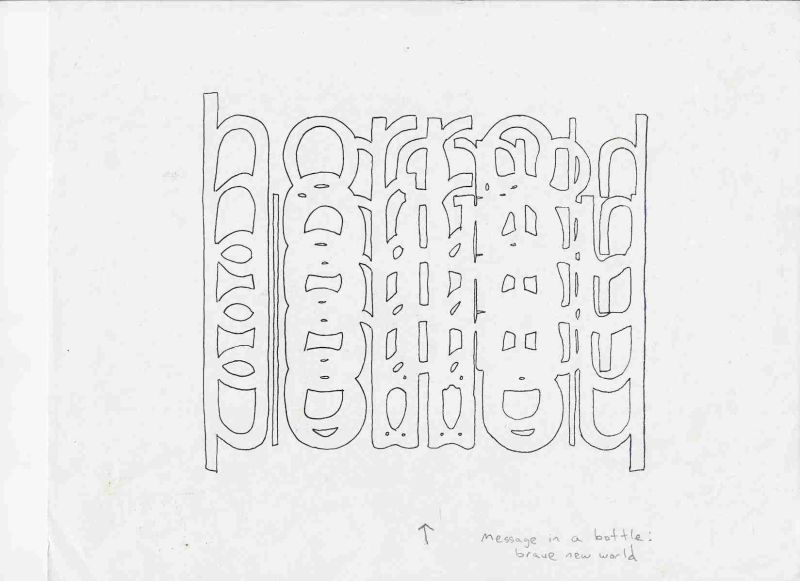
Message in a Bottle Brave New World é uma poesia visual do artista norte americano Crag Hill construída pela repetição, sobreposição e deformação de letras.
Crag Hill - USA
Categoria: Poesia Visual
Acervo: 03880
Dimensões: 21,6 x 28 cm
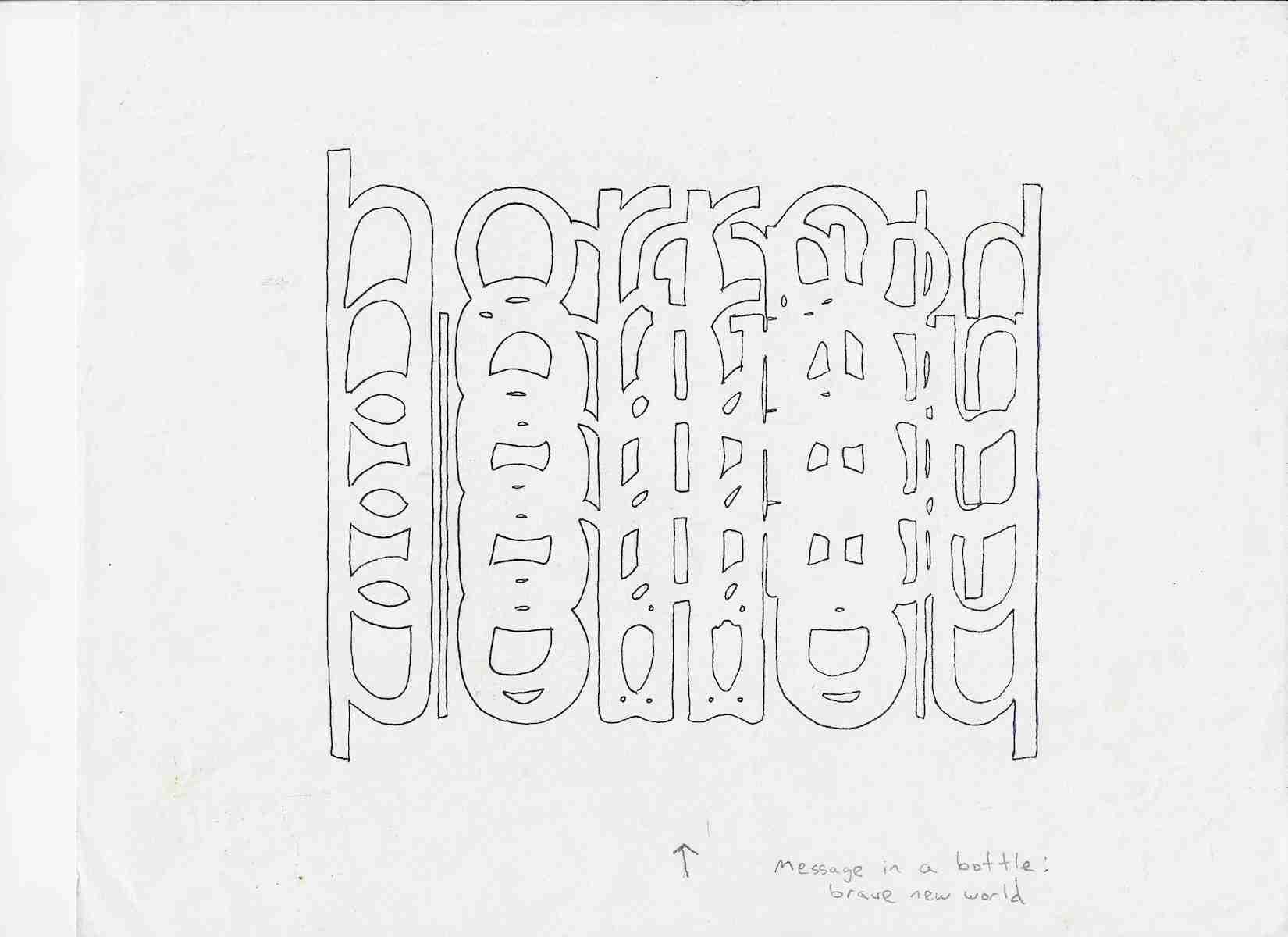
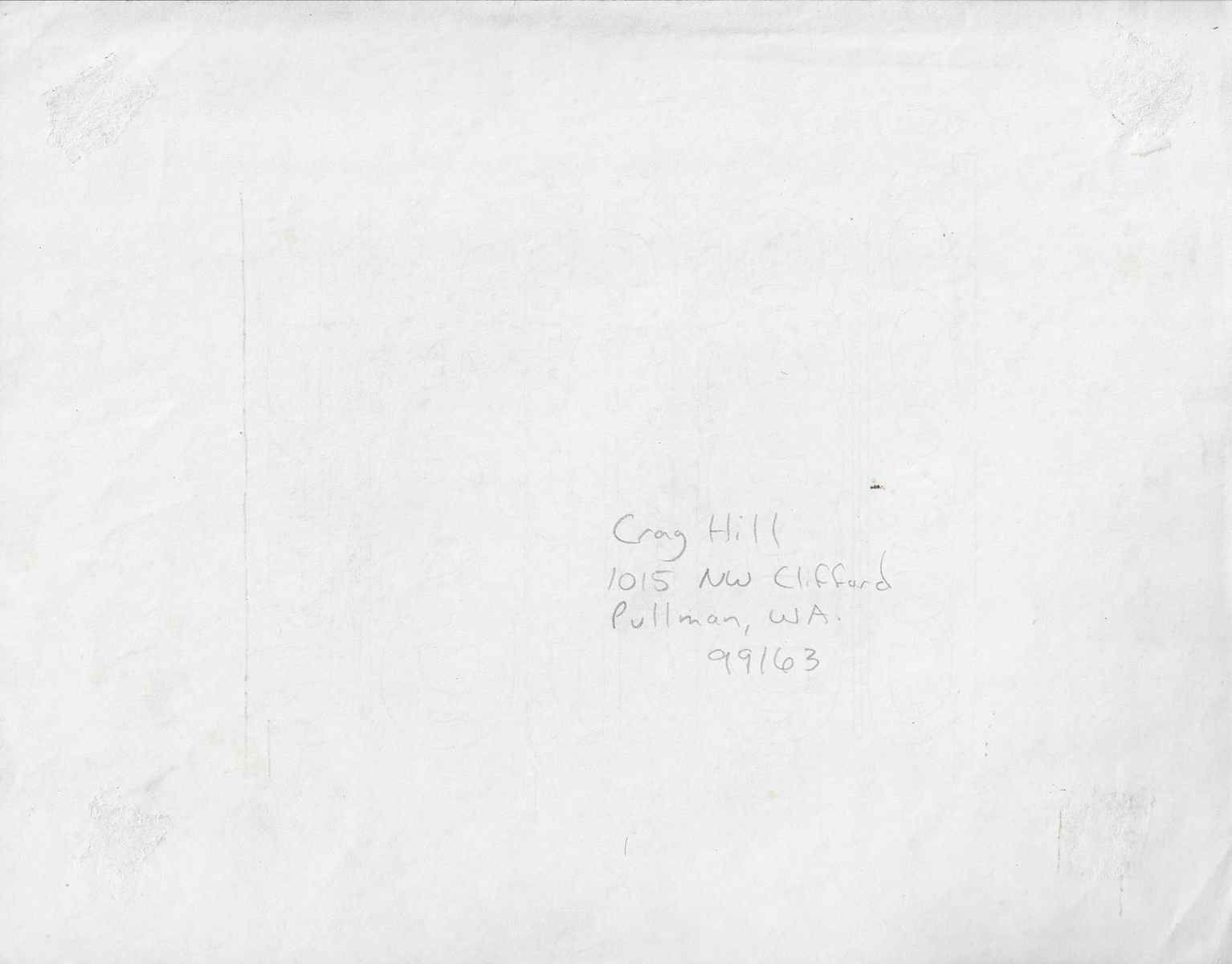
Message in a Bottle Brave New World é uma poesia visual do artista norte americano Crag Hill construída pela repetição, sobreposição e deformação de letras. A obra ocupa uma área central da folha e apresenta uma estrutura compacta formada por caracteres alongados, curvas internas, linhas verticais e vazios que se repetem como módulos.Na região inferior aparece uma anotação manuscrita acompanhada por uma seta que aponta para a composição. O texto identifica a obra como message in a bottle e brave new world. Essas expressões podem ser traduzidas como mensagem em uma garrafa e admirável mundo novo.A expressão message in a bottle remete à prática de colocar uma mensagem dentro de uma garrafa e lançá la ao mar. Nesse tipo de comunicação, o remetente não conhece o destinatário, o percurso nem o momento da leitura. A mensagem depende do acaso, do deslocamento e da possibilidade de ser encontrada.Essa ideia estabelece forte relação com a arte postal. Assim como uma garrafa lançada ao mar, uma obra enviada por correio atravessa distâncias, sistemas e fronteiras até alcançar outro participante. O percurso da comunicação torna se parte do significado do objeto.A expressão brave new world amplia o campo interpretativo. Ela pode indicar um mundo novo, transformado por sistemas tecnológicos, sociais e culturais. Também pode funcionar como referência crítica à expressão literária associada a sociedades organizadas pelo controle, pela padronização e pela fabricação de comportamentos.A composição central parece formada pela palavra world, repetida, comprimida e transformada em estrutura gráfica. Algumas letras podem ser reconhecidas na região superior, enquanto outras são alongadas verticalmente e atravessadas por formas semelhantes.A repetição produz uma espécie de grade verbal. As letras deixam de funcionar apenas como unidades de uma palavra e passam a construir uma arquitetura. A palavra world transforma se em parede, código, recipiente, cidade ou sistema de compartimentos.As linhas verticais criam limites entre diferentes áreas. Curvas e formas fechadas aparecem em sequência e lembram cavidades, janelas, rostos, recipientes ou garrafas. Essa ambiguidade permite que a linguagem seja percebida simultaneamente como palavra e imagem.A estrutura pode ser interpretada como uma garrafa formada por letras ou como uma mensagem aprisionada dentro de uma organização tipográfica. A obra não desenha uma garrafa de maneira convencional. Ela constrói a ideia do recipiente por meio da densidade, da repetição e do fechamento visual.A palavra world parece multiplicar se dentro do próprio mundo representado. Essa repetição sugere que a mensagem não está apenas dentro de uma garrafa, mas dentro de uma linguagem que também funciona como recipiente.O espaço branco ao redor da composição é amplo. Esse vazio isola o bloco central e reforça sua aparência de objeto autônomo. A estrutura parece flutuar sobre a folha como uma mensagem lançada em um espaço desconhecido.A seta manuscrita cria uma ligação entre o título e a forma visual. Ela conduz o olhar da anotação inferior para o bloco de letras e funciona como indicação de leitura. O gesto também aproxima a obra de um estudo, diagrama ou projeto em processo.A escrita principal apresenta contornos finos e regulares, mas não corresponde a uma tipografia impressa convencional. As letras foram desenhadas, alteradas e combinadas manualmente. Essa condição mantém visíveis pequenas irregularidades e diferenças entre os módulos.A repetição não produz cópias idênticas. Cada forma possui pequenas variações. Algumas aberturas são maiores. Certas linhas se aproximam ou se afastam. Alguns caracteres permanecem mais reconhecíveis, enquanto outros se tornam quase abstratos.Essas alterações podem sugerir que uma mensagem se transforma durante seu percurso. Assim como um objeto lançado ao mar sofre desgaste e deslocamento, as palavras também podem perder clareza, mudar de forma e adquirir novos sentidos.A obra investiga os limites da legibilidade. O observador reconhece partes de letras e possíveis palavras, mas não encontra uma frase convencional. A leitura depende da capacidade de perceber estruturas, repetições e relações espaciais.A composição possui afinidade com poesia visual, poesia concreta, desenho tipográfico, escrita assêmica e arte conceitual. A escrita assêmica aparece nas áreas em que os sinais preservam aparência de linguagem sem oferecer leitura verbal estável.A relação com a poesia concreta ocorre pela utilização da palavra como matéria visual. O significado não está apenas no vocabulário, mas também no tamanho, na posição, na repetição, no ritmo e na organização espacial dos caracteres.A obra também pode ser entendida como reflexão sobre comunicação e isolamento. Uma mensagem existe porque alguém deseja transmiti la. Entretanto, a garrafa indica distância, incerteza e ausência de contato imediato.Brave new world pode representar o destino imaginário da mensagem. A obra parece dirigir se a um mundo futuro ou desconhecido, onde a linguagem talvez precise ser reconstruída por quem a encontrar.O poema visual sugere uma comunicação entre tempos diferentes. O remetente produz uma estrutura no presente, mas a recepção pode ocorrer em outro momento. Esse intervalo transforma a obra em arquivo, vestígio e tentativa de sobrevivência da linguagem.A repetição de world também pode sugerir multiplicação de mundos. Cada módulo visual funciona como uma variação ou possibilidade. O mundo não aparece como unidade estável, mas como conjunto de estruturas semelhantes e diferentes.O título permite ainda uma leitura relacionada à globalização, à comunicação de massa e aos sistemas tecnológicos. A palavra world repetida pode indicar um mundo produzido por padrões, redes e modelos que se reproduzem.Ao mesmo tempo, as irregularidades manuais impedem a completa padronização. A presença do gesto do artista introduz diferença dentro da série e demonstra que a linguagem permanece aberta à transformação.A obra não apresenta imagem figurativa, personagem ou narrativa tradicional. Sua construção depende exclusivamente de letras, vazios, linhas, repetição e anotação manuscrita. Essa economia de elementos concentra a atenção sobre a própria estrutura da comunicação.A relação com a arte postal está presente no conceito de mensagem enviada a um destinatário desconhecido e no histórico de Crag Hill nas redes internacionais de poesia visual. Entretanto, não aparecem na imagem selo, endereço, carimbo postal ou destinatário que confirmem a circulação deste exemplar pelo correio.Não foram apresentados verso, assinatura, data, numeração, técnica declarada ou informações editoriais. A anotação inferior constitui a principal identificação visível da obra.Não há indicação de que Crag Hill tenha integrado formalmente o movimento Poema Processo. A aproximação ocorre pelas afinidades entre palavra e imagem, repetição modular, fragmentação do código verbal, participação do observador e transformação do poema em estrutura visual.Para indexação, recomenda se utilizar os termos Crag Hill, Message in a Bottle, Brave New World, poesia visual, visual poetry, poesia experimental norte americana, mensagem em uma garrafa, admirável mundo novo, palavra world, repetição tipográfica, desenho de letras, escrita assêmica, poesia concreta, comunicação, linguagem, arte postal, mail art, publicação de artista, arte conceitual e Poema Processo.TEXT FOR THE SALSA PROGRAM IN ENGLISHMessage in a Bottle Brave New World is a visual poem by the American artist Crag Hill constructed through the repetition, superimposition and deformation of letters. The work occupies the central area of the sheet and presents a compact structure formed by elongated characters, internal curves, vertical lines and repeated empty spaces.A handwritten note appears in the lower area together with an arrow pointing toward the composition. The text identifies the work as message in a bottle and brave new world.Message in a bottle refers to the practice of placing a written communication inside a bottle and releasing it into the sea. In this form of communication, the sender does not know the recipient, the route or the time of discovery. The message depends upon chance, movement and the possibility of being found.This idea establishes a strong relationship with mail art. Like a bottle released into the sea, a work sent through the post crosses distances, systems and borders before reaching another participant. The journey becomes part of the meaning of the object.Brave new world expands the interpretive field. It may indicate a new world transformed by technological, social and cultural systems. It may also function as a critical reference to the literary expression associated with societies organized through control, standardization and the manufacture of behaviour.The central composition appears to be formed from the word world, repeated, compressed and transformed into a graphic structure. Some letters remain recognizable in the upper area, while others are extended vertically and intersected by similar forms.Repetition produces a verbal grid. Letters cease to operate only as units within a word and begin to construct an architecture. World becomes a wall, code, container, city or system of compartments.Vertical lines establish boundaries among different areas. Curves and enclosed shapes appear in sequence and may resemble cavities, windows, faces, containers or bottles. This ambiguity allows language to be perceived simultaneously as word and image.The structure may be interpreted as a bottle formed from letters or as a message trapped within a typographic organization. The work does not draw a bottle conventionally. It constructs the idea of a container through density, repetition and visual enclosure.World appears to multiply within the world represented. This repetition suggests that the message is contained not only within a bottle but also within language, which itself becomes a vessel.The extensive white space surrounding the composition isolates the central block and reinforces its appearance as an autonomous object. The structure seems to float on the sheet like a message released into an unknown space.The handwritten arrow connects the title with the visual form. It directs the eye from the lower note toward the block of letters and functions as an instruction for reading. The gesture also makes the work resemble a study, diagram or project in progress.The principal writing has thin and regular outlines but does not correspond to conventional printed typography. The letters were drawn, altered and manually combined. Small irregularities and differences remain visible among the repeated modules.Repetition does not produce identical copies. Each form contains slight variations. Some openings are larger. Certain lines move closer together or farther apart. Some characters remain recognizable, while others become nearly abstract.These changes may suggest that a message is transformed during its journey. Like an object released into the sea and subjected to wear and displacement, words may lose clarity, change form and acquire new meanings.The work investigates the limits of legibility. The viewer recognizes parts of letters and possible words but does not encounter a conventional sentence. Reading depends on the perception of structures, repetitions and spatial relationships.The composition has affinities with visual poetry, concrete poetry, typographic drawing, asemic writing and conceptual art. Asemic writing appears in the areas where marks retain the appearance of language without providing a stable verbal reading.Its relationship with concrete poetry is based on the use of the word as visual material. Meaning resides not only in vocabulary but also in scale, position, repetition, rhythm and the spatial organization of the characters.The work may also be understood as a reflection on communication and isolation. A message exists because someone wishes to transmit it. The bottle, however, introduces distance, uncertainty and the absence of immediate contact.Brave new world may represent the imagined destination of the message. The work appears to address a future or unknown world in which language may need to be reconstructed by whoever discovers it.The visual poem suggests communication between different moments in time. The sender creates a structure in the present, but reception may occur later. This interval transforms the work into an archive, trace and attempt to preserve language.The repetition of world may also suggest the multiplication of worlds. Each visual module functions as a variation or possibility. The world does not appear as a stable unity but as a group of structures that are similar and different.The title permits another reading connected with globalization, mass communication and technological systems. The repeated word world may indicate a world produced through patterns, networks and reproducible models.At the same time, manual irregularities prevent complete standardization. The gesture of the artist introduces difference within the sequence and demonstrates that language remains open to transformation.The work contains no conventional figure, character or narrative. Its construction depends entirely on letters, empty spaces, lines, repetition and handwritten notation. This economy of elements concentrates attention on the structure of communication itself.Its relationship with mail art is present in the concept of a message sent toward an unknown recipient and in Crag Hill
s activity within international visual poetry networks. However, the image contains no postage, address, postal cancellation or recipient confirming that this particular example circulated through the mail.No reverse, signature, date, edition number, declared technique or editorial information has been supplied. The handwritten note provides the principal visible identification.No evidence indicates that Crag Hill formally participated in the Brazilian Process Poem Movement. The relationship is based on affinities involving word and image, modular repetition, fragmentation of verbal codes, viewer participation and the transformation of poetry into a visual structure.Recommended indexing terms include Crag Hill, Message in a Bottle, Brave New World, visual poetry, American experimental poetry, message in a bottle, word world, typographic repetition, letter drawing, asemic writing, concrete poetry, communication, language, mail art, artists publication, conceptual art and Process Poem Movement.
Poesia visual de Crag Hill identificada pela anotação manuscrita message in a bottle e brave new world.A composição central apresenta letras desenhadas, repetidas, sobrepostas e alongadas verticalmente. A palavra world parece funcionar como uma das matrizes da estrutura gráfica.Os caracteres formam uma grade compacta com curvas, vazios e linhas que podem lembrar recipientes, janelas, rostos ou uma mensagem contida em uma garrafa.Uma seta manuscrita liga a anotação inferior à composição principal e orienta a interpretação da obra.A peça explora comunicação, acaso, distância, transformação da linguagem, repetição, mundo futuro e instabilidade da leitura.Não foram apresentados verso, assinatura, data, numeração, endereço, selo postal ou informações editoriais. A circulação postal deste exemplar não pode ser confirmada apenas pela imagem.A obra deve ser catalogada como poesia visual, desenho tipográfico, escrita assêmica, composição verbo visual e possível material relacionado às redes internacionais de poesia visual e arte postal de Crag Hill.OBSERVATION TEXT IN ENGLISHVisual poem by Crag Hill identified through the handwritten note message in a bottle and brave new world.The central composition contains drawn letters that are repeated, superimposed and vertically elongated. The word world appears to function as one of the graphic matrices of the structure.The characters form a compact grid containing curves, empty spaces and lines that may resemble vessels, windows, faces or a message enclosed within a bottle.A handwritten arrow connects the lower note with the principal composition and directs interpretation of the work.The piece explores communication, chance, distance, transformation of language, repetition, a future world and instability of reading.No reverse, signature, date, edition number, address, postage or editorial information has been supplied. Postal circulation of this example cannot be confirmed through the image alone.The work should be catalogued as visual poetry, typographic drawing, asemic writing, verbal visual composition and possible material connected with Crag Hill
s international visual poetry and mail art networks.
Proveniência
Coleção Poema ProcessoInglês
Message in a Bottle Brave New World is a visual poem by the American artist Crag Hill constructed through the repetition, superimposition and deformation of letters.
Dimensions: 8,5 x 11 in