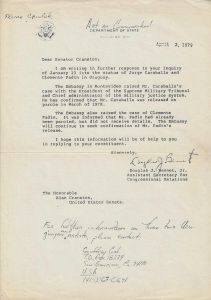
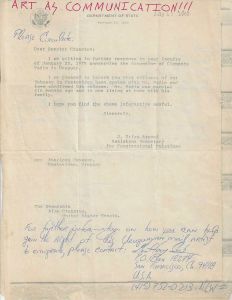
Carta do Department of State dos Estados Unidos, datada de 27 de julho de 1978, em Washington DC, contendo informações oficiais sobre a prisão dos artistas uruguaios Clemente Padín e Jorge Caraballo González durante a ditadura civil militar do Uruguai.Cabaret Voltaire
Geoffrey Cook - USA
Categoria: Mail Art
Acervo: 03810
Data: 27 de Julho 1978
Dimensões: 28 x 21 cm
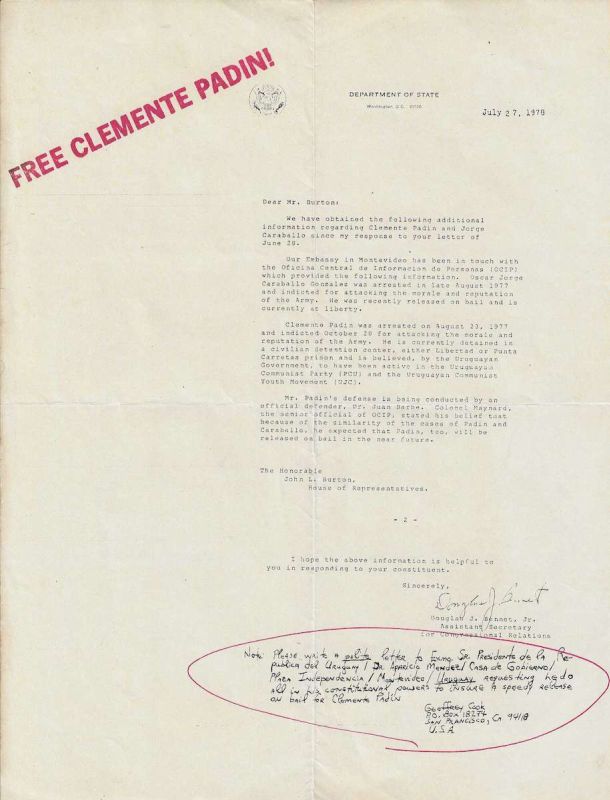
Carta do Department of State dos Estados Unidos, datada de 27 de julho de 1978, em Washington DC, contendo informações oficiais sobre a prisão dos artistas uruguaios Clemente Padín e Jorge Caraballo González durante a ditadura civil militar do Uruguai. O documento foi produzido em resposta a uma consulta encaminhada ao governo norte americano e registra informações obtidas pela Embaixada dos Estados Unidos em Montevidéu junto à Oficina Central de Información de Personas, OCIP, órgão uruguaio responsável por informações relativas a pessoas consideradas de interesse pelas autoridades do regime.A carta informa que Jorge Caraballo González havia sido preso no final de agosto de 1977 e acusado de atacar a moral e a reputação do Exército uruguaio. Segundo o Department of State, Caraballo havia sido recentemente libertado mediante fiança e encontrava se em liberdade na data do documento.O texto fornece informações particularmente importantes sobre Clemente Padín. Registra que o artista foi preso em 23 de agosto de 1977 e formalmente acusado em 20 de outubro de 1977 também sob a alegação de atacar a moral e a reputação do Exército. Em julho de 1978 Padín continuava detido em um centro civil de detenção. O documento indica como possibilidades o Penal de Libertad ou a prisão de Punta Carretas.A correspondência registra ainda que, segundo informações atribuídas ao governo uruguaio, Clemente Padín era considerado ativo no Partido Comunista del Uruguay, PCU, e na Unión de la Juventud Comunista, UJC. Esta informação deve ser entendida dentro do contexto documental e político da repressão uruguaia, pois a carta relata a posição transmitida pelas autoridades governamentais do período e não constitui por si só uma comprovação independente de filiação política.A defesa de Clemente Padín estava sendo conduzida pelo defensor oficial Dr. Juan Barbe. A carta relata também manifestação do Coronel Maynard, identificado como alto funcionário da Oficina Central de Información de Personas. Segundo ele, devido à semelhança entre os casos de Jorge Caraballo e Clemente Padín, havia expectativa de que Padín também fosse libertado mediante fiança em um futuro próximo.O documento está dirigido a Mr. Burton e menciona uma correspondência anterior datada de 28 de junho de 1978, demonstrando que existia uma mobilização internacional e uma sequência de contatos com autoridades norte americanas para obtenção de informações sobre a situação dos dois artistas uruguaios.Na parte inferior da folha existe uma intervenção manuscrita associada a Geoffrey Cook. A anotação solicita que sejam enviadas cartas ao Presidente da República Oriental do Uruguai, Dr. Aparicio Méndez, na Casa de Gobierno, Plaza Independencia, Montevidéu, pedindo que utilizasse seus poderes constitucionais para assegurar a rápida libertação de Clemente Padín mediante fiança. Geoffrey Cook aparece acompanhado de endereço postal em San Francisco, Califórnia, Estados Unidos.A inscrição FREE CLEMENTE PADIN em grandes letras vermelhas transforma o documento administrativo em material de campanha política, solidariedade internacional e circulação cultural. A peça relaciona diretamente arte postal, ativismo, redes internacionais de artistas, defesa dos direitos humanos e resistência às ditaduras latino americanas durante a década de 1970.Clemente Padín e Jorge Caraballo foram figuras fundamentais da poesia experimental, poesia visual, arte conceitual e arte postal no Uruguai. A prisão dos dois artistas em 1977 provocou ampla mobilização internacional entre artistas, escritores, organizações culturais e participantes das redes de Mail Art. Este documento constitui importante evidência material dessa campanha de solidariedade e demonstra como correspondência diplomática, comunicação postal e redes artísticas internacionais se cruzaram na defesa da liberdade de expressão e da libertação de artistas perseguidos politicamente.Documento relacionado a Clemente Padín, Jorge Caraballo González, Geoffrey Cook, Department of State, United States Department of State, Embaixada dos Estados Unidos em Montevidéu, Oficina Central de Información de Personas, OCIP, Aparicio Méndez, Juan Barbe, Coronel Maynard, Partido Comunista del Uruguay, PCU, Unión de la Juventud Comunista, UJC, ditadura uruguaia, direitos humanos, presos políticos, liberdade de expressão, arte postal, Mail Art, poesia visual, poesia experimental, arte conceitual, solidariedade internacional, Uruguai, Estados Unidos, Montevidéu, Washington DC e San Francisco.Documento de grande relevância histórica para o estudo da perseguição política sofrida por Clemente Padín e Jorge Caraballo no Uruguai e da mobilização internacional formada em defesa dos artistas. A carta oficial do Department of State dos Estados Unidos, datada de 27 de julho de 1978, registra dados específicos sobre as prisões, acusações, situação judicial e condições de detenção dos dois artistas.Jorge Caraballo González aparece como preso no final de agosto de 1977, acusado de atacar a moral e a reputação do Exército e posteriormente libertado mediante fiança. Clemente Padín aparece como preso em 23 de agosto de 1977, acusado formalmente em 20 de outubro do mesmo ano e ainda detido em julho de 1978. O documento menciona o Penal de Libertad e Punta Carretas como possíveis locais de sua detenção.A informação sobre suposta atividade de Padín no Partido Comunista del Uruguay e na Unión de la Juventud Comunista é apresentada na carta como posição do governo uruguaio e deve ser catalogada preservando essa atribuição histórica, evitando tratá la como fato independente comprovado.A anotação manuscrita atribuída a Geoffrey Cook amplia o significado da peça ao transformar uma resposta diplomática em instrumento de mobilização. Cook pede que sejam enviadas cartas ao presidente uruguaio Aparicio Méndez solicitando a rápida libertação de Clemente Padín mediante fiança. A inscrição FREE CLEMENTE PADIN confirma a utilização do documento dentro de uma campanha internacional de solidariedade.A peça é especialmente importante para pesquisas sobre Clemente Padín, Jorge Caraballo, arte postal uruguaia, Mail Art latino americana, poesia experimental, poesia visual, censura, repressão política, direitos humanos, redes de solidariedade artística, relações entre arte e política e circulação internacional de documentos durante as ditaduras do Cone Sul.
Letter from the United States Department of State dated July 27, 1978, in Washington DC, containing official information concerning the imprisonment of Uruguayan artists Clemente Padín and Jorge Caraballo González during the civil military dictatorship in Uruguay. The document was produced in response to an inquiry submitted to the United States government and records information obtained by the United States Embassy in Montevideo from the Oficina Central de Información de Personas, OCIP, a Uruguayan government office responsible for information concerning individuals regarded as being of interest to the authorities of the regime.The letter states that Jorge Caraballo González had been arrested in late August 1977 and indicted for attacking the morale and reputation of the Uruguayan Army. According to the Department of State, Caraballo had recently been released on bail and was at liberty when the document was written.The document provides particularly significant information concerning Clemente Padín. It records that the artist was arrested on August 23, 1977, and indicted on October 20, 1977, also for allegedly attacking the morale and reputation of the Army. In July 1978 Padín remained detained in a civilian detention center. The letter identifies either Libertad or Punta Carretas prison as possible places of detention.The correspondence also states that according to information attributed to the Uruguayan government, Clemente Padín was believed to have been active in the Partido Comunista del Uruguay, PCU, and the Unión de la Juventud Comunista, UJC. This statement must be understood within the documentary and political context of repression in Uruguay, since the letter records information supplied by government authorities of the period and does not by itself constitute independent confirmation of political affiliation.Clemente Padín was being represented by the official defender Dr. Juan Barbe. The letter also records a statement by Colonel Maynard, identified as a senior official of the Oficina Central de Información de Personas. Because the cases of Jorge Caraballo and Clemente Padín were considered similar, Maynard reportedly expected Padín to be released on bail in the near future.The letter is addressed to Mr. Burton and refers to an earlier letter dated June 28, 1978, demonstrating an ongoing international effort and a sequence of contacts with United States authorities to obtain information about the situation of both Uruguayan artists.A handwritten intervention at the bottom of the document is associated with Geoffrey Cook. The note asks recipients to write to the President of the Oriental Republic of Uruguay, Dr. Aparicio Méndez, at the Casa de Gobierno in Plaza Independencia, Montevideo, requesting that he use his constitutional powers to ensure the speedy release of Clemente Padín on bail. Geoffrey Cook is identified together with a postal address in San Francisco, California, United States.The large red inscription FREE CLEMENTE PADIN transforms the official diplomatic correspondence into an instrument of political campaigning, international solidarity and cultural circulation. The document directly connects Mail Art, artistic networks, political activism, human rights advocacy and resistance to Latin American dictatorships during the 1970s.Clemente Padín and Jorge Caraballo were central figures in Uruguayan experimental poetry, visual poetry, conceptual art and Mail Art. Their imprisonment in 1977 generated an extensive international solidarity campaign involving artists, writers, cultural organizations and participants in international postal art networks. This document is important material evidence of that campaign and demonstrates how diplomatic correspondence, postal communication and international artistic networks intersected in the defense of freedom of expression and the release of politically persecuted artists.Document related to Clemente Padín, Jorge Caraballo González, Geoffrey Cook, United States Department of State, United States Embassy in Montevideo, Oficina Central de Información de Personas, OCIP, Aparicio Méndez, Juan Barbe, Colonel Maynard, Partido Comunista del Uruguay, PCU, Unión de la Juventud Comunista, UJC, Uruguayan dictatorship, human rights, political prisoners, freedom of expression, Mail Art, visual poetry, experimental poetry, conceptual art, international solidarity, Uruguay, United States, Montevideo, Washington DC and San Francisco.TEXTO DE OBSERVAÇÃO ENGLISHDocument of major historical importance for the study of the political persecution of Clemente Padín and Jorge Caraballo in Uruguay and the international mobilization organized in defense of the artists. The official United States Department of State letter dated July 27, 1978, records specific information concerning the arrests, accusations, legal status and detention of both artists.Jorge Caraballo González is recorded as having been arrested in late August 1977, accused of attacking the morale and reputation of the Army and subsequently released on bail. Clemente Padín is recorded as having been arrested on August 23, 1977, formally indicted on October 20 of that year and still detained in July 1978. The document mentions Libertad and Punta Carretas as possible places of detention.The information concerning alleged activity by Padín in the Partido Comunista del Uruguay and the Unión de la Juventud Comunista is presented in the letter as the position of the Uruguayan government and should be catalogued with this historical attribution preserved rather than treated as independently established fact.The handwritten note attributed to Geoffrey Cook expands the significance of the object by transforming diplomatic correspondence into a tool for international mobilization. Cook asks recipients to write to Uruguayan President Aparicio Méndez requesting the speedy release of Clemente Padín on bail. The prominent FREE CLEMENTE PADIN inscription confirms the circulation of the document within an international solidarity campaign.The document is especially relevant to research concerning Clemente Padín, Jorge Caraballo, Uruguayan Mail Art, Latin American Mail Art, experimental poetry, visual poetry, censorship, political repression, human rights, international artistic solidarity networks, relationships between art and politics and the international circulation of documents during the dictatorships of the Southern Cone.
Inglês
Letter from the United States Department of State dated July 27, 1978, in Washington DC, containing official information concerning the imprisonment of Uruguayan artists Clemente Padín and Jorge Caraballo González during the civil military dictatorship in Uruguay.Cabaret Voltaire
Dimensions: 11 x 8,3 in