Carta oficial do Departamento de Estado dos Estados Unidos, datada de 3 de abril de 1979, relativa à situação dos artistas uruguaios Clemente Padín e Jorge Caraballo durante a ditadura civil militar no Uruguai.Cabaret Volteire
Geoffrey Cook - USA
Categoria: Mail Art
Acervo: 03811
Data: 3 de Abril de 1979
Dimensões: 29,7 x 20,9 cm
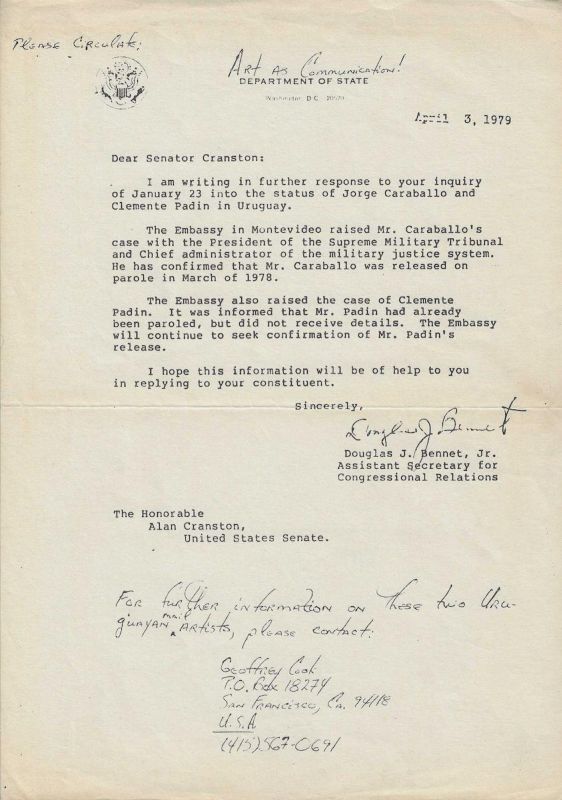
Carta oficial do Departamento de Estado dos Estados Unidos, datada de 3 de abril de 1979, relativa à situação dos artistas uruguaios Clemente Padín e Jorge Caraballo durante a ditadura civil militar no Uruguai. O documento foi enviado por Douglas J. Bennet Jr., Secretário Assistente para Relações com o Congresso, ao senador norte americano Alan Cranston, em resposta a uma consulta apresentada em 23 de janeiro de 1979 sobre a condição jurídica e a liberdade dos dois artistas.A carta informa que a Embaixada dos Estados Unidos em Montevidéu havia apresentado o caso de Jorge Caraballo ao presidente do Supremo Tribunal Militar e administrador chefe do sistema de justiça militar uruguaio. Segundo a confirmação recebida pela Embaixada, Caraballo havia sido libertado sob regime de liberdade condicional em março de 1978.O Departamento de Estado também registra que a Embaixada tratou do caso de Clemente Padín. As autoridades informaram que Padín já havia recebido liberdade condicional, embora não tenham fornecido detalhes sobre as circunstâncias ou a data exata de sua libertação. A carta declara que a Embaixada continuaria buscando a confirmação oficial da soltura de Padín.O documento demonstra a circulação internacional de informações e ações de solidariedade relacionadas à prisão dos dois artistas, conhecidos por sua atuação na poesia experimental, poesia visual, arte postal, arte conceitual e comunicação alternativa. A correspondência também evidencia o envolvimento de representantes políticos e diplomáticos dos Estados Unidos no acompanhamento das violações de direitos humanos praticadas pelo regime uruguaio.Na parte superior aparece a anotação manuscrita Please Circulate, acompanhada de um pequeno carimbo gráfico. Sobre o cabeçalho oficial foi acrescentada a frase manuscrita Art As Communication, que aproxima o documento diplomático das práticas de arte postal e comunicação artística. Na parte inferior existe uma nota manuscrita solicitando que, para obter outras informações sobre os dois artistas uruguaios, fosse contatado Geoffrey Cook, em San Francisco, Califórnia. Essa intervenção indica que a carta foi colocada em circulação dentro de uma rede internacional de artistas, ativistas e defensores dos direitos humanos.Preservada no contexto do Cabaret Voltaire, a carta constitui um documento histórico sobre Clemente Padín, Jorge Caraballo, a repressão política no Uruguai, a diplomacia dos Estados Unidos, o senador Alan Cranston, a Embaixada dos Estados Unidos em Montevidéu e as redes internacionais de solidariedade artística no final da década de 1970TEXT FOR THE SALSA PROGRAM IN ENGLISHOfficial letter from the United States Department of State dated April 3, 1979, concerning the situation of the Uruguayan artists Clemente Padín and Jorge Caraballo during the civil military dictatorship in Uruguay. The document was sent by Douglas J. Bennet Jr., Assistant Secretary for Congressional Relations, to United States Senator Alan Cranston in response to an inquiry submitted on January 23, 1979, regarding the legal status and release of the two artists.The letter states that the United States Embassy in Montevideo raised the case of Jorge Caraballo with the president of the Supreme Military Tribunal and chief administrator of the Uruguayan military justice system. According to the confirmation received by the Embassy, Caraballo had been released on parole in March 1978.The Department of State also reports that the Embassy raised the case of Clemente Padín. It was informed that Padín had already been paroled, although no details were provided regarding the circumstances or exact date of his release. The letter states that the Embassy would continue seeking official confirmation of the release of Padín.The document records the international circulation of information and solidarity actions connected with the imprisonment of the two artists, who were recognized for their work in experimental poetry, visual poetry, mail art, conceptual art and alternative communication. It also demonstrates the involvement of political and diplomatic representatives of the United States in monitoring human rights violations committed by the Uruguayan regime.At the top of the page is the handwritten instruction Please Circulate, accompanied by a small graphic stamp. The handwritten phrase Art As Communication was added above the official letterhead, connecting the diplomatic document with the practices of mail art and artistic communication. At the bottom, another handwritten note asks readers seeking further information about the two Uruguayan artists to contact Geoffrey Cook in San Francisco, California. This intervention indicates that the letter circulated within an international network of artists, activists and human rights defenders.Preserved in the context of Cabaret Voltaire, the letter is an important historical document concerning Clemente Padín, Jorge Caraballo, political repression in Uruguay, United States diplomacy, Senator Alan Cranston, the United States Embassy in Montevideo and international networks of artistic solidarity during the late 1970s.
Documento datilografado em papel oficial do Departamento de Estado dos Estados Unidos, com cabeçalho de Washington, D.C., datado de 3 de abril de 1979. A carta é assinada por Douglas J. Bennet Jr., Secretário Assistente para Relações com o Congresso, e dirigida ao senador Alan Cranston. O texto responde a uma consulta de 23 de janeiro sobre Jorge Caraballo e Clemente Padín. Confirma que Caraballo foi libertado sob liberdade condicional em março de 1978 e informa que Padín também teria sido libertado, embora a Embaixada dos Estados Unidos em Montevidéu ainda procurasse obter confirmação e detalhes oficiais. O exemplar apresenta anotações manuscritas relacionadas à circulação do documento e inclui o nome, o endereço postal e o telefone de Geoffrey Cook em San Francisco. A inscrição Art As Communication transforma a correspondência diplomática em testemunho da relação entre arte, comunicação, ativismo político, arte postal e defesa internacional dos direitos humanos. Documento associado ao arquivo Cabaret Voltaire.OBSERVATION TEXT IN ENGLISHTypewritten document on official United States Department of State stationery with a Washington, D.C. heading, dated April 3, 1979. The letter is signed by Douglas J. Bennet Jr., Assistant Secretary for Congressional Relations, and addressed to Senator Alan Cranston. It responds to an inquiry dated January 23 concerning Jorge Caraballo and Clemente Padín. The document confirms that Caraballo was released on parole in March 1978 and reports that Padín had also been paroled, although the United States Embassy in Montevideo was still seeking official confirmation and further details. The copy contains handwritten instructions concerning its circulation and includes the name, postal address and telephone number of Geoffrey Cook in San Francisco. The inscription Art As Communication transforms the diplomatic correspondence into evidence of the relationship between art, communication, political activism, mail art and the international defense of human rights. Document associated with the Cabaret Voltaire archive.
Proveniência
Coleção Falves SilvaInglês
Official letter from the United States Department of State dated April 3, 1979, concerning the situation of the Uruguayan artists Clemente Padín and Jorge Caraballo during the civil military dictatorship in Uruguay.Cabaret Volteire
Dimensions: 11,7 x 8,2 in