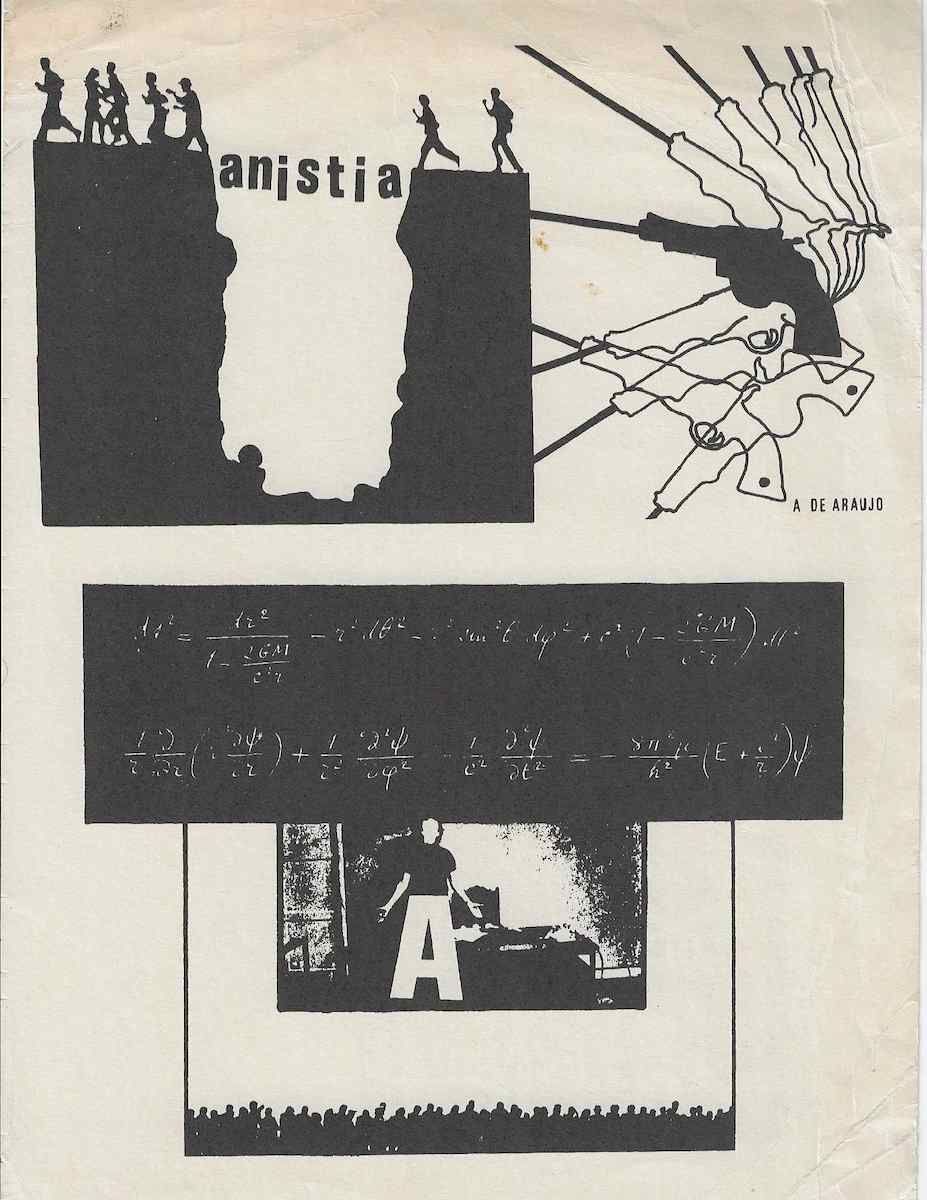
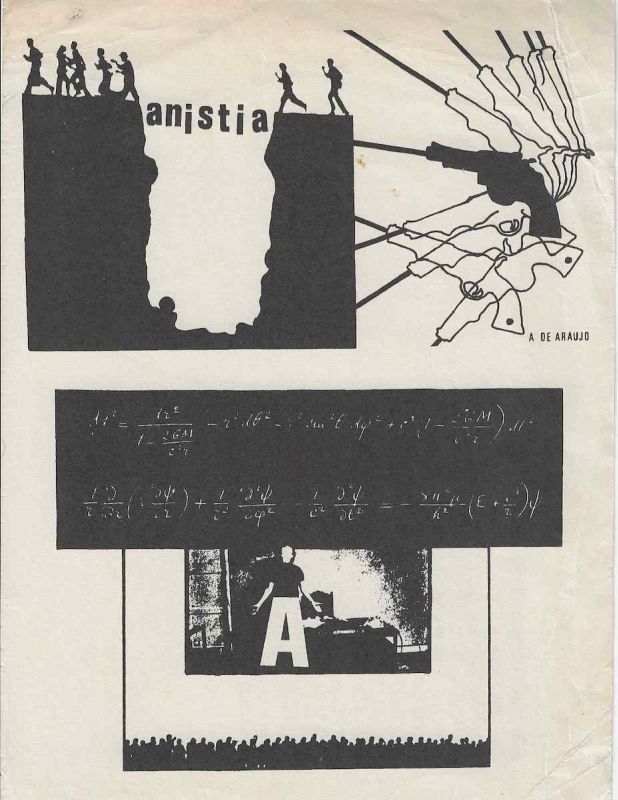
Anistia, impressão gráfica de Avelino de Araújo concebida em 1979, é uma obra de poesia visual e crítica política produzida originalmente com letraset e colagem e posteriormente reproduzida em serigrafia.
Avelino de Araújo
Categoria: Poema Processo
Acervo: 03555
Data: 1979
Dimensões: 22,7 x 17,2 cm
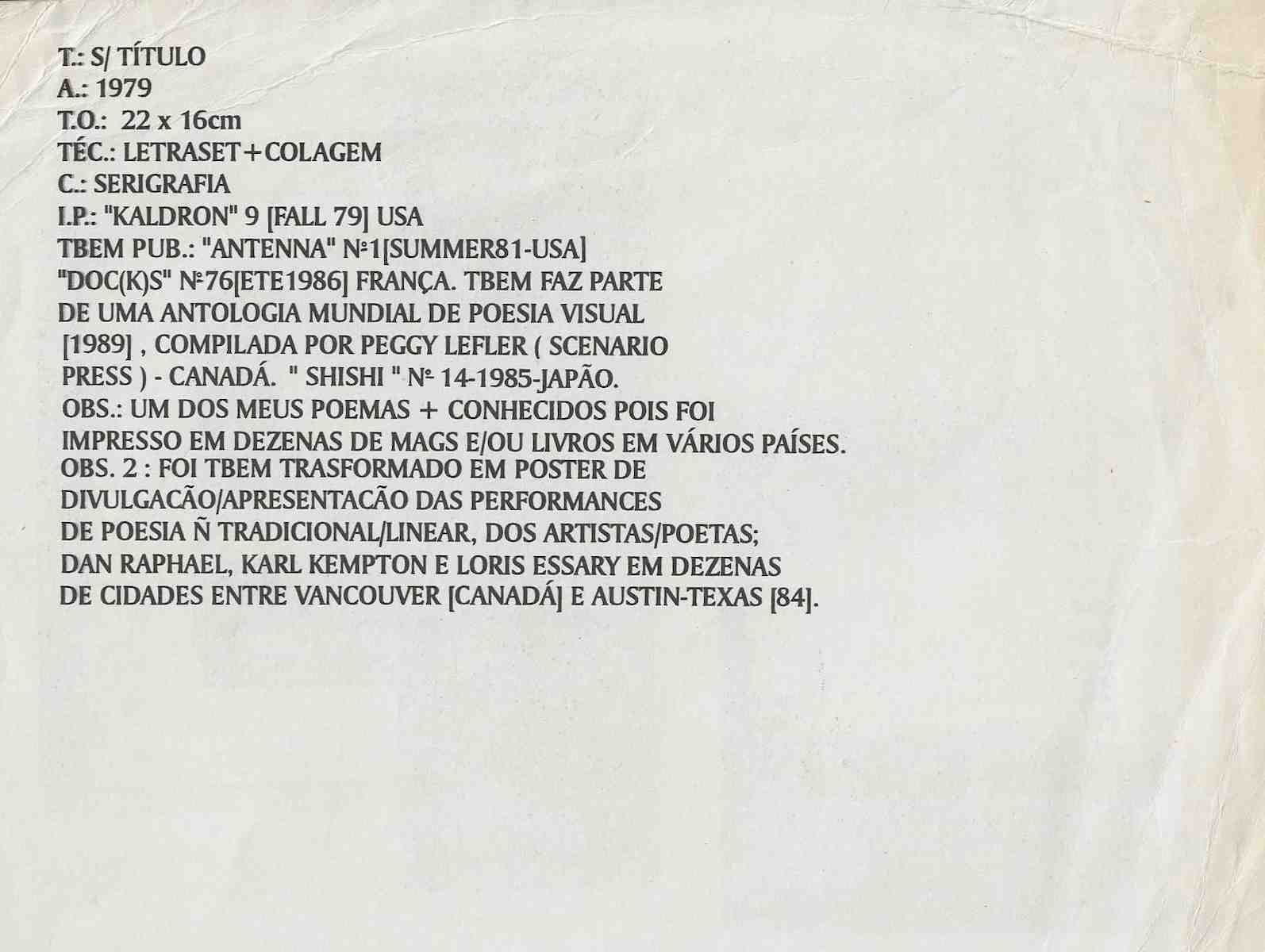
Anistia, impressão gráfica de Avelino de Araújo concebida em 1979, é uma obra de poesia visual e crítica política produzida originalmente com letraset e colagem e posteriormente reproduzida em serigrafia. Embora seja conhecida e identificada pelo tema Anistia, a ficha documental registrada no verso informa título sem título, ano 1979 e dimensões originais de 22 por 16 centímetros. A composição reúne figuras humanas, grandes massas negras, armas, fórmulas científicas, uma imagem fotográfica, a letra A e uma plateia de silhuetas. Na parte superior esquerda, pequenos personagens aparecem sobre as bordas de uma abertura profunda, enquanto a palavra anistia atravessa visualmente o espaço entre dois blocos. A imagem sugere separação, abismo, confinamento, exclusão e tentativa de reconciliação. À direita, uma sucessão de braços armados e revólveres aponta em diferentes direções, criando uma imagem de violência, repressão e repetição mecânica do poder. A palavra anistia funciona como eixo verbal e político da composição, relacionando a obra ao debate brasileiro sobre presos políticos, perseguidos, exilados e retorno à vida pública durante o período final da ditadura militar. Na seção inferior, fórmulas matemáticas e científicas ocupam uma grande faixa horizontal e contrastam com uma cena fotográfica na qual se destaca uma figura associada à letra A. Abaixo dessa estrutura aparece uma multidão representada por pequenas silhuetas. A sobreposição de ciência, espetáculo, público, violência e linguagem produz uma leitura não linear sobre os sistemas de controle, a racionalização do poder e a necessidade de liberdade. O verso registra que a obra foi publicada em Kaldron número 9, edição do segundo semestre de 1979, nos Estados Unidos, em Antenna número 1, edição do verão de 1981, também nos Estados Unidos, em Doc(k)s número 76, edição de verão de 1986, na França, e em Shishi número 14, publicado em 1985 no Japão. A obra também integrou uma antologia mundial de poesia visual publicada em 1989 no Canadá, compilada por Peggy Lefler para a Scenario Press. Segundo declaração do próprio artista, este foi um de seus poemas mais conhecidos e circulou em dezenas de revistas e livros de vários países. A imagem também foi transformada em cartaz para divulgação e apresentação de performances de poesia não tradicional e não linear realizadas pelos artistas e poetas Dan Raphael, Karl Kempton e Loris Essary, em diversas cidades entre Vancouver, no Canadá, e Austin, no Texas, em 1984. A ampla circulação internacional confirma a relevância da obra na poesia visual, na arte postal, na poesia experimental e nas redes transnacionais de comunicação artística.TEXT FOR THE SALSA PROGRAM IN ENGLISHAnistia, a graphic work conceived by Avelino de Araújo in 1979, is a work of visual poetry and political criticism originally produced with Letraset and collage and subsequently reproduced as a screen print. Although it is known and identified through the subject of amnesty, the documentary record printed on the reverse lists the title as untitled, the year as 1979 and the original dimensions as 22 by 16 centimeters. The composition combines human figures, large black structures, weapons, scientific formulas, a photographic image, the letter A and an audience of silhouettes. In the upper left area, small figures stand along the edges of a deep opening, while the word anistia visually crosses the space between two blocks. The image suggests separation, abyss, confinement, exclusion and an attempt at reconciliation. On the right, a sequence of armed hands and revolvers points in different directions, producing an image of violence, repression and the mechanical repetition of power. The word anistia functions as the verbal and political axis of the composition, connecting the work with the Brazilian debate concerning political prisoners, persecuted citizens, exiles and their return to public life during the final period of the military dictatorship. In the lower section, mathematical and scientific formulas occupy a large horizontal band and contrast with a photographic scene featuring a figure associated with the letter A. Beneath this structure appears a crowd represented by small silhouettes. The combination of science, spectacle, public audience, violence and language creates a nonlinear reflection on systems of control, the rationalization of power and the need for freedom. The reverse records that the work was published in Kaldron number 9, second half of 1979, in the United States, Antenna number 1, summer 1981, also in the United States, Doc(k)s number 76, summer 1986, in France, and Shishi number 14, published in Japan in 1985. The work was also included in a world anthology of visual poetry published in Canada in 1989, compiled by Peggy Lefler for Scenario Press. According to the artist
s own statement, this became one of his best known poems and was reproduced in dozens of magazines and books in several countries. The image was also transformed into a poster promoting performances of nontraditional and nonlinear poetry by the artists and poets Dan Raphael, Karl Kempton and Loris Essary in numerous cities between Vancouver, Canada, and Austin, Texas, in 1984. Its extensive international circulation confirms the significance of the work within visual poetry, mail art, experimental poetry and transnational artistic communication networks.
Folha impressa em preto e branco com composição organizada em dois grandes campos visuais. Na área superior há duas estruturas escuras separadas por um vazio central. Sobre as bordas aparecem figuras humanas em diferentes posições e a palavra anistia encontra se distribuída entre os blocos. À direita aparecem vários braços e mãos segurando armas, representados por contornos repetidos e sobrepostos. A identificação A de Araújo está impressa próxima à margem direita. Na metade inferior há uma faixa preta contendo fórmulas e sinais matemáticos. Abaixo dessa faixa encontra se uma imagem fotográfica central com uma figura humana e uma grande letra A, acompanhada por uma sequência de pequenas silhuetas semelhantes a uma plateia. O verso apresenta ficha técnica datilografada com as seguintes informações: título sem título, ano 1979, tamanho original 22 por 16 centímetros, técnica letraset e colagem e cópia em serigrafia. O documento registra publicações em Kaldron número 9, Estados Unidos, 1979, Antenna número 1, Estados Unidos, 1981, Shishi número 14, Japão, 1985, Doc(k)s número 76, França, 1986, e participação em antologia mundial de poesia visual compilada por Peggy Lefler e publicada pela Scenario Press, Canadá, em 1989. O texto também informa o uso da obra como cartaz de performances de Dan Raphael, Karl Kempton e Loris Essary em 1984. A folha apresenta vincos, amassados, marcas de manuseio, alterações de tonalidade e desgaste nas bordas. Para o cadastro recomenda se relacionar os termos Avelino de Araújo, Anistia, sem título, 1979, letraset, colagem, serigrafia, poesia visual, poesia experimental, Poema Processo, ditadura militar brasileira, anistia política, repressão, liberdade, armas, performance poética, Dan Raphael, Karl Kempton, Loris Essary, Kaldron, Antenna, Doc(k)s, Shishi, Peggy Lefler, Scenario Press, Estados Unidos, França, Japão, Canadá, arte política, arte postal e arquivo de artista.OBSERVATION TEXT IN ENGLISHBlack and white printed sheet with a composition divided into two major visual fields. The upper area contains two dark structures separated by a central opening. Human figures appear in different positions along the edges, and the word anistia is distributed between the blocks. On the right, several arms and hands holding firearms are represented through repeated and overlapping outlines. The identification A de Araújo is printed near the right margin. The lower half contains a black horizontal band with mathematical formulas and scientific symbols. Beneath this band is a central photographic image containing a human figure and a large letter A, accompanied by a sequence of small silhouettes resembling an audience. The reverse contains a typed technical record stating untitled, 1979, original dimensions 22 by 16 centimeters, Letraset and collage, and screen print reproduction. The document records publication in Kaldron number 9, United States, 1979, Antenna number 1, United States, 1981, Shishi number 14, Japan, 1985, Doc(k)s number 76, France, 1986, and inclusion in a world anthology of visual poetry compiled by Peggy Lefler and published by Scenario Press in Canada in 1989. It also records the use of the work as a poster for performances by Dan Raphael, Karl Kempton and Loris Essary in 1984. The sheet shows folds, creases, handling marks, tonal changes and wear along the edges. The catalogue record should connect the terms Avelino de Araújo, Anistia, untitled, 1979, Letraset, collage, screen printing, visual poetry, experimental poetry, Poema Processo, Brazilian military dictatorship, political amnesty, repression, freedom, firearms, poetry performance, Dan Raphael, Karl Kempton, Loris Essary, Kaldron, Antenna, Doc(k)s, Shishi, Peggy Lefler, Scenario Press, United States, France, Japan, Canada, political art, mail art and artist archive.
Proveniência
Coleção Poema ProcessoInglês
Anistia, a graphic work conceived by Avelino de Araújo in 1979, is a work of visual poetry and political criticism originally produced with Letraset and collage and subsequently reproduced as a screen print.
Dimensions: 8,9 x 6,8 in