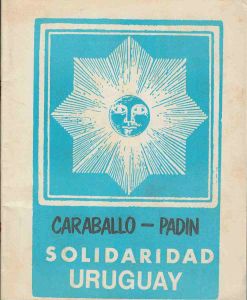
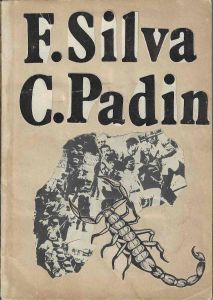
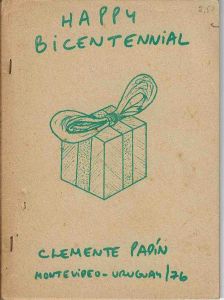
Livro de artista, ensaio teórico e publicação de poesia experimental de Clemente Padín intitulado The Visual Operator in Experimental Poetry, apresentado também em espanhol como El Operador Visual en la Poesía Experimental.
Clemente Padín
Categoria: Livro de Artista
Acervo: 03530
Data: 1985
Dimensões: 21,8 x 17,2 cm
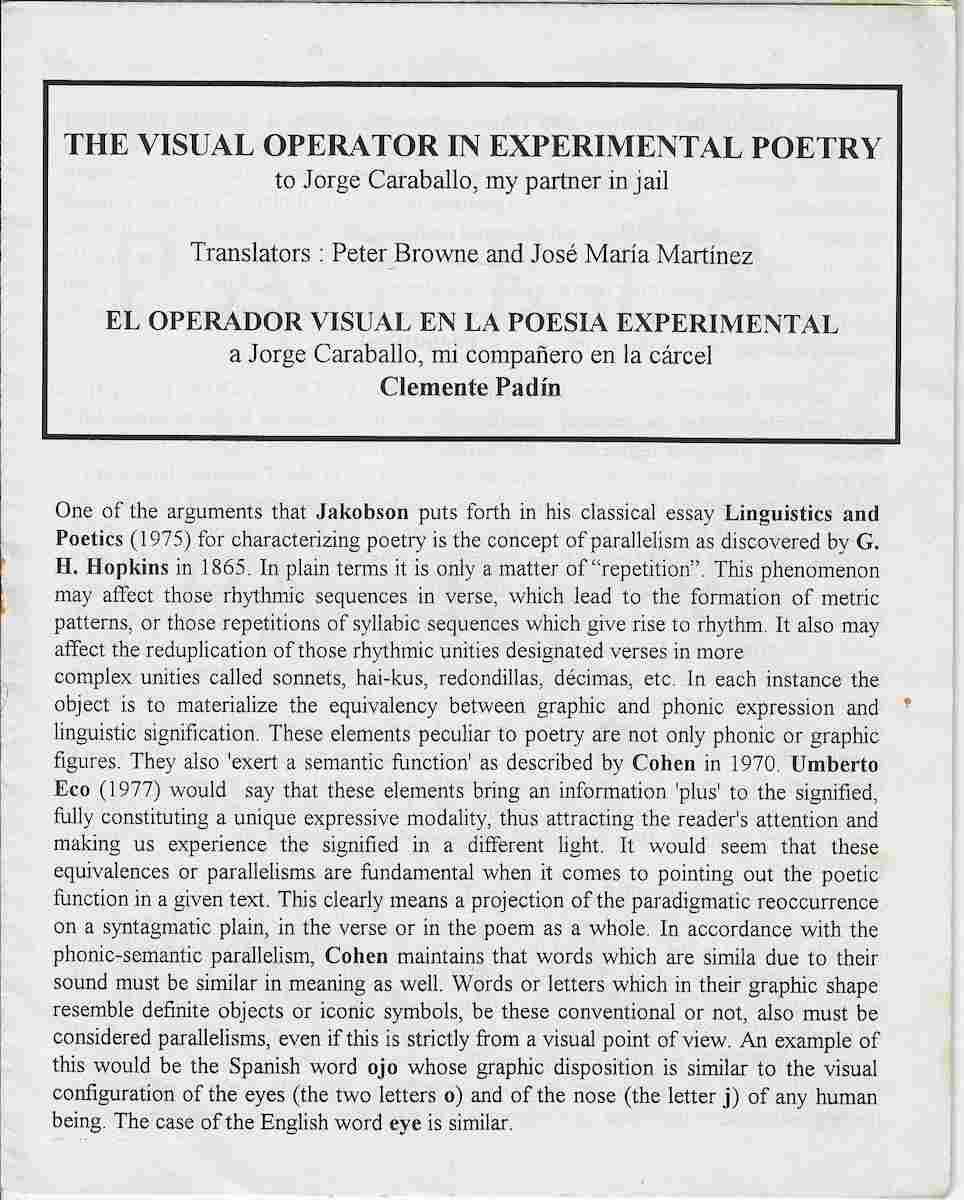
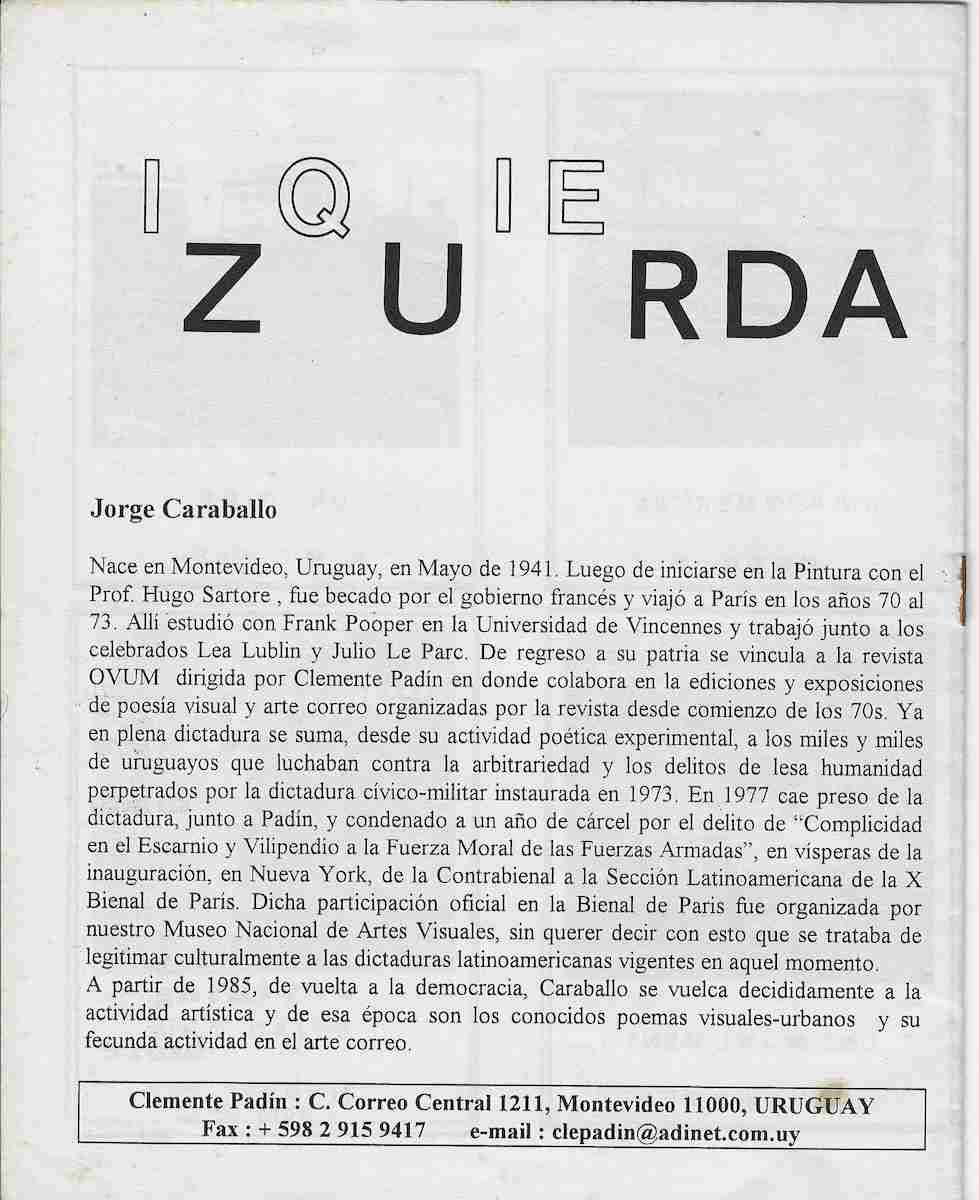
Livro de artista, ensaio teórico e publicação de poesia experimental de Clemente Padín intitulado The Visual Operator in Experimental Poetry, apresentado também em espanhol como El Operador Visual en la Poesía Experimental. A publicação é dedicada a Jorge Caraballo, identificado por Padín como seu companheiro de prisão. A versão em inglês informa tradução de Peter Browne e José María Martínez. O texto analisa o funcionamento do operador visual na poesia experimental e investiga as relações entre linguagem verbal, estrutura gráfica, som, ritmo, repetição, imagem, significado e percepção. Padín parte das formulações de Roman Jakobson sobre linguística e poética e do conceito de paralelismo atribuído a Gerard Manley Hopkins. O ensaio explica que a repetição pode atuar sobre sequências rítmicas, padrões métricos, sílabas, versos e formas poéticas mais complexas, produzindo equivalências entre expressão gráfica, expressão sonora e significação linguística. O autor também menciona Jean Cohen e Umberto Eco para discutir a função semântica dos elementos poéticos e a informação adicional criada por formas gráficas e fonéticas. Segundo o argumento desenvolvido, palavras e letras podem produzir paralelismos visuais quando sua configuração gráfica se aproxima de objetos, figuras ou símbolos icônicos. Como exemplo, o ensaio analisa a palavra espanhola ojo, cuja disposição das duas letras o e da letra j pode sugerir visualmente dois olhos e um nariz. O texto observa que uma relação semelhante ocorre com a palavra inglesa eye. A publicação inclui o poema visual Izquierda, de Jorge Caraballo, construído pela decomposição espacial das letras da palavra espanhola. As letras aparecem distribuídas em diferentes posições e níveis, interrompendo a leitura linear e transformando a palavra em estrutura visual. A separação entre I, Q, IE, Z, U e RDA produz deslocamentos, vazios e novas relações de direção, sentido político e percepção. O poema relaciona palavra, orientação espacial, ideologia, fragmentação tipográfica e leitura não convencional, constituindo exemplo direto do operador visual analisado por Padín. A publicação contém ainda uma nota biográfica sobre Jorge Caraballo. O texto informa que o artista nasceu em Montevidéu, Uruguai, em maio de 1941. Iniciou seus estudos de pintura com o professor Hugo Sartore, recebeu bolsa do governo francês e viveu em Paris entre 1970 e 1973. Na França estudou com Frank Popper na Universidade de Vincennes e trabalhou junto a Lea Lublin e Julio Le Parc. Ao retornar ao Uruguai, vinculou se à revista OVUM, dirigida por Clemente Padín, colaborando em edições, exposições de poesia visual e atividades de arte postal organizadas pela publicação desde o início da década de 1970. Durante a ditadura civil militar instaurada no Uruguai em 1973, Caraballo integrou por meio de sua produção poética experimental as mobilizações contra a arbitrariedade estatal e os crimes contra a humanidade. Em 1977 foi preso junto com Clemente Padín e condenado a um ano de prisão sob acusação relacionada à cumplicidade no escárnio e vilipêndio à força moral das Forças Armadas. A prisão ocorreu nas proximidades da inauguração, em Nova York, da Contrabienal organizada em oposição à seção latino americana da décima Bienal de Paris. O texto afirma que a participação oficial uruguaia naquela Bienal de Paris havia sido organizada pelo Museo Nacional de Artes Visuales e situa o episódio no debate sobre representação cultural e legitimação das ditaduras latino americanas. Com a recuperação democrática iniciada em 1985, Jorge Caraballo retomou intensamente sua atividade artística, desenvolvendo poemas visuais urbanos e uma produção contínua no campo da arte postal. O livro constitui documento fundamental para o estudo das relações entre Clemente Padín e Jorge Caraballo, da poesia experimental uruguaia, do operador visual, da revista OVUM, da arte postal, da poesia visual, da semiótica, da teoria da linguagem, da repressão política e das redes internacionais de resistência artística.Artist book, theoretical essay and experimental poetry publication by Clemente Padín titled The Visual Operator in Experimental Poetry and also presented in Spanish as El Operador Visual en la Poesía Experimental. The publication is dedicated to Jorge Caraballo, identified by Padín as his partner in prison. The English version credits Peter Browne and José María Martínez as translators. The text examines the operation of visual elements in experimental poetry and investigates the relationships among verbal language, graphic structure, sound, rhythm, repetition, image, meaning and perception. Padín begins with Roman Jakobson
s theories of linguistics and poetics and with the concept of parallelism associated with Gerard Manley Hopkins. The essay explains that repetition may affect rhythmic sequences, metric patterns, syllables, verses and more complex poetic forms, producing equivalences among graphic expression, sound and linguistic meaning. The author also refers to Jean Cohen and Umberto Eco in order to discuss the semantic function of poetic elements and the additional information created by graphic and phonetic forms. The essay argues that words and letters can establish visual parallelisms when their graphic shapes resemble objects, figures or iconic symbols. As an example, it examines the Spanish word ojo, in which the two letters o and the letter j may visually suggest two eyes and a nose. The text observes that a similar relationship occurs in the English word eye. The publication includes the visual poem Izquierda by Jorge Caraballo, constructed through the spatial decomposition of the letters forming the Spanish word. The letters are distributed across different positions and levels, interrupting linear reading and transforming the word into a visual structure. The separation of I, Q, IE, Z, U and RDA creates displacement, empty spaces and new relationships involving direction, political meaning and perception. The poem connects language, spatial orientation, ideology, typographic fragmentation and unconventional reading, providing a direct example of the visual operator discussed by Padín. The publication also includes a biographical text about Jorge Caraballo. It states that the artist was born in Montevideo, Uruguay, in May 1941. He began studying painting with Professor Hugo Sartore, received a scholarship from the French government and lived in Paris from 1970 to 1973. In France he studied with Frank Popper at the University of Vincennes and worked with Lea Lublin and Julio Le Parc. After returning to Uruguay, he became associated with the journal OVUM, directed by Clemente Padín, and collaborated in editions, visual poetry exhibitions and mail art activities organized by the publication from the beginning of the 1970s. During the civil military dictatorship established in Uruguay in 1973, Caraballo used experimental poetry as part of the broader struggle against state arbitrariness and crimes against humanity. In 1977 he was imprisoned together with Clemente Padín and sentenced to one year in prison under an accusation concerning complicity in the ridicule and denigration of the moral force of the Armed Forces. The imprisonment occurred shortly before the opening in New York of the Contrabienal organized in opposition to the Latin American section of the tenth Paris Biennial. The biographical text states that the official Uruguayan participation in the Paris Biennial had been organized by the Museo Nacional de Artes Visuales and situates the episode within debates concerning cultural representation and the legitimation of Latin American dictatorships. Following the restoration of democracy beginning in 1985, Jorge Caraballo returned decisively to artistic activity, producing urban visual poems and maintaining an extensive practice in mail art. The book is a fundamental document for the study of the relationship between Clemente Padín and Jorge Caraballo, Uruguayan experimental poetry, the visual operator, the journal OVUM, mail art, visual poetry, semiotics, language theory, political repression and international networks of artistic resistance.
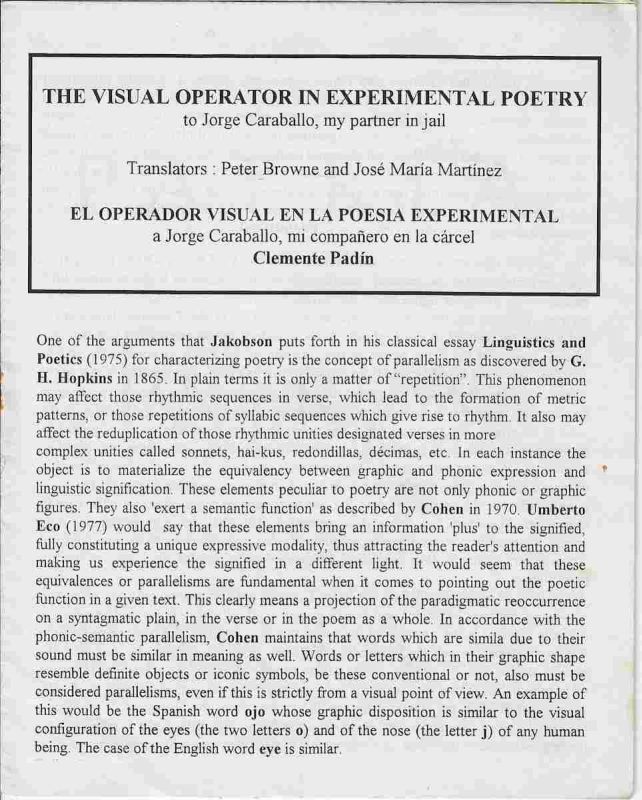
Publicação impressa em preto sobre papel claro, formada por texto teórico em inglês e espanhol, dedicatória, identificação dos tradutores, poema visual e nota biográfica. A página inicial apresenta o título em inglês The Visual Operator in Experimental Poetry e a dedicatória a Jorge Caraballo, descrito como companheiro de prisão de Clemente Padín. Abaixo aparecem os nomes dos tradutores Peter Browne e José María Martínez e o título espanhol El Operador Visual en la Poesía Experimental. O ensaio visível discute paralelismo, repetição, ritmo, métrica, função poética, equivalência gráfica e sonora, iconicidade e produção de significado. A segunda imagem apresenta o poema visual Izquierda e uma biografia de Jorge Caraballo que registra nascimento em Montevidéu em maio de 1941, formação inicial com Hugo Sartore, permanência em Paris entre 1970 e 1973, estudos com Frank Popper na Universidade de Vincennes, colaboração com Lea Lublin e Julio Le Parc, participação na revista OVUM, prisão em 1977 junto com Padín e retorno à atividade artística após 1985. A página inclui endereço histórico de contato de Clemente Padín na caixa postal central 1211, Montevidéu 11000, Uruguai, além de número de fax e endereço eletrônico impressos. Não há data de publicação claramente visível nas páginas fornecidas. A datação deve permanecer como não identificada até o exame da capa, da folha de rosto, do colofão ou de documentação complementar. Também não foram fornecidos dados sobre editora, tiragem, dimensões, número total de páginas ou técnica específica de impressão. O suporte apresenta manchas, amarelecimento, marcas de manuseio, vincos, pequenos pontos de oxidação e alterações de tonalidade compatíveis com idade e conservação arquivística. Documento de elevada relevância para pesquisas sobre Clemente Padín, Jorge Caraballo, Peter Browne, José María Martínez, Roman Jakobson, Gerard Manley Hopkins, Jean Cohen, Umberto Eco, Frank Popper, Lea Lublin, Julio Le Parc, Hugo Sartore, OVUM, poesia experimental, poesia visual, semiótica, arte postal, Contrabienal, Bienal de Paris, ditadura uruguaia, prisão de artistas e resistência cultural latino americana.Publication printed in black on light colored paper and composed of theoretical text in English and Spanish, a dedication, translator credits, a visual poem and a biographical note. The opening page presents the title The Visual Operator in Experimental Poetry and a dedication to Jorge Caraballo, described as Clemente Padín
s partner in prison. The names of the translators Peter Browne and José María Martínez appear below, followed by the Spanish title El Operador Visual en la Poesía Experimental. The visible essay discusses parallelism, repetition, rhythm, meter, poetic function, graphic and phonetic equivalence, iconicity and the production of meaning. The second image presents the visual poem Izquierda and a biography of Jorge Caraballo recording his birth in Montevideo in May 1941, initial training with Hugo Sartore, residence in Paris from 1970 to 1973, studies with Frank Popper at the University of Vincennes, collaboration with Lea Lublin and Julio Le Parc, participation in the journal OVUM, imprisonment in 1977 together with Padín and renewed artistic activity after 1985. The page includes historical contact information for Clemente Padín at central post office box 1211, Montevideo 11000, Uruguay, together with a printed fax number and electronic mail address. No publication date is clearly visible on the supplied pages. Dating should remain unidentified until the cover, title page, colophon or complementary documentation can be examined. No publisher, edition size, dimensions, total page count or specific printing process has been provided. The support presents stains, yellowing, handling marks, folds, minor oxidation spots and tonal changes consistent with age and archival preservation. This document is highly relevant to research on Clemente Padín, Jorge Caraballo, Peter Browne, José María Martínez, Roman Jakobson, Gerard Manley Hopkins, Jean Cohen, Umberto Eco, Frank Popper, Lea Lublin, Julio Le Parc, Hugo Sartore, OVUM, experimental poetry, visual poetry, semiotics, mail art, the Contrabienal, the Paris Biennial, the Uruguayan dictatorship, the imprisonment of artists and Latin American cultural resistance.
Proveniência
Coleção Poema ProcessoInglês
Artist book, theoretical essay and experimental poetry publication by Clemente Padín titled The Visual Operator in Experimental Poetry and also presented in Spanish as El Operador Visual en la Poesía Experimental.
Dimensions: 8,6 x 6,8 in