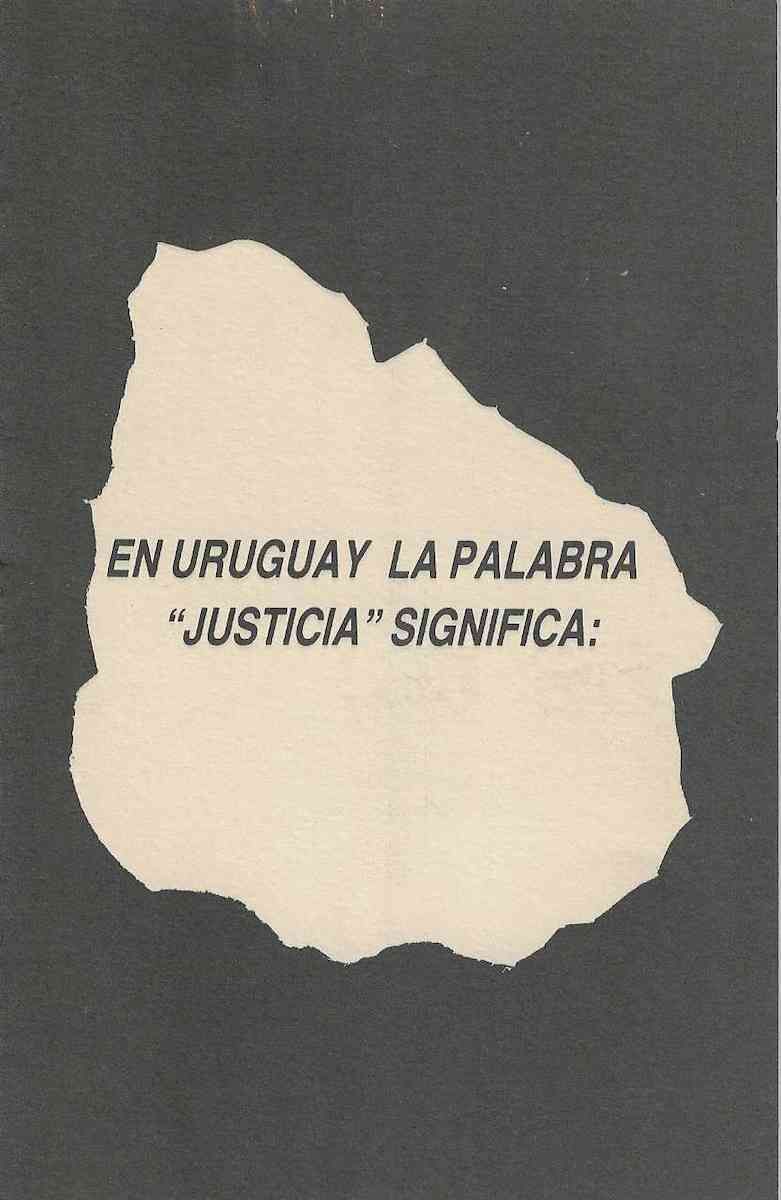
Livro de artista de Jorge Caraballo intitulado En Uruguay la palabra Justicia significa, produzido em 1987
Jorge Caraballo
Categoria: Livro de Artista
Acervo: 03525
Data: 1987
Dimensões: 16,4 x 10,5 cm
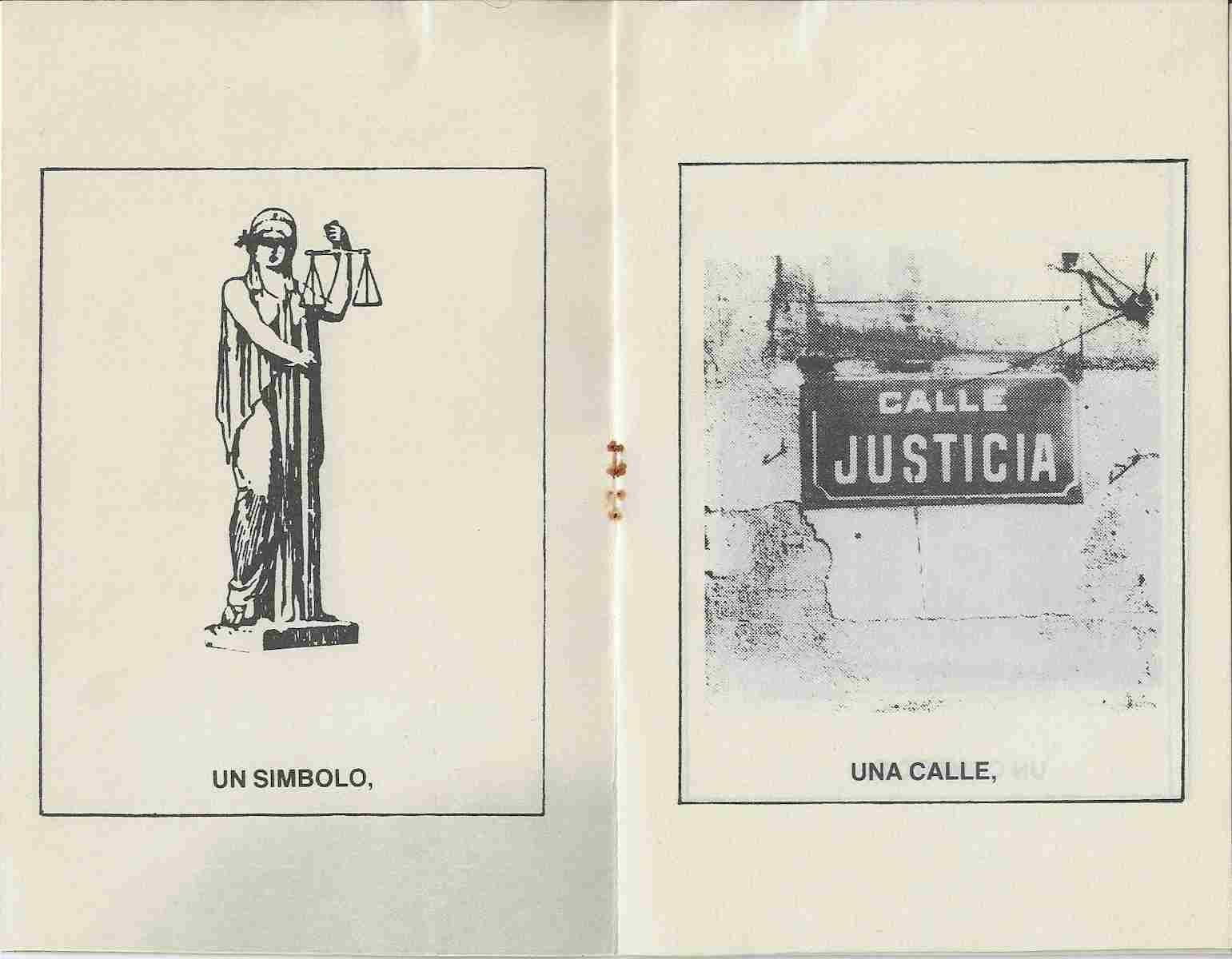
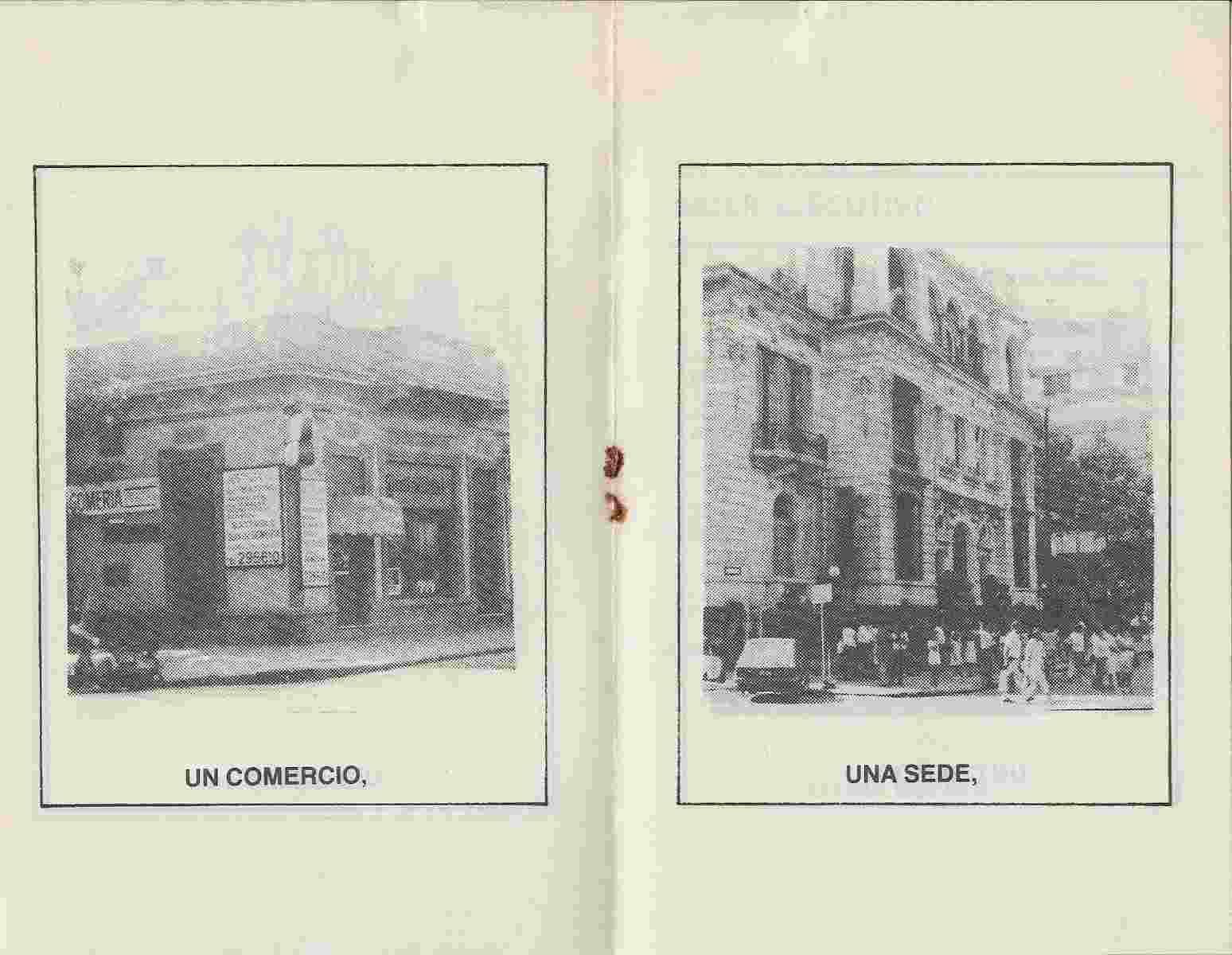
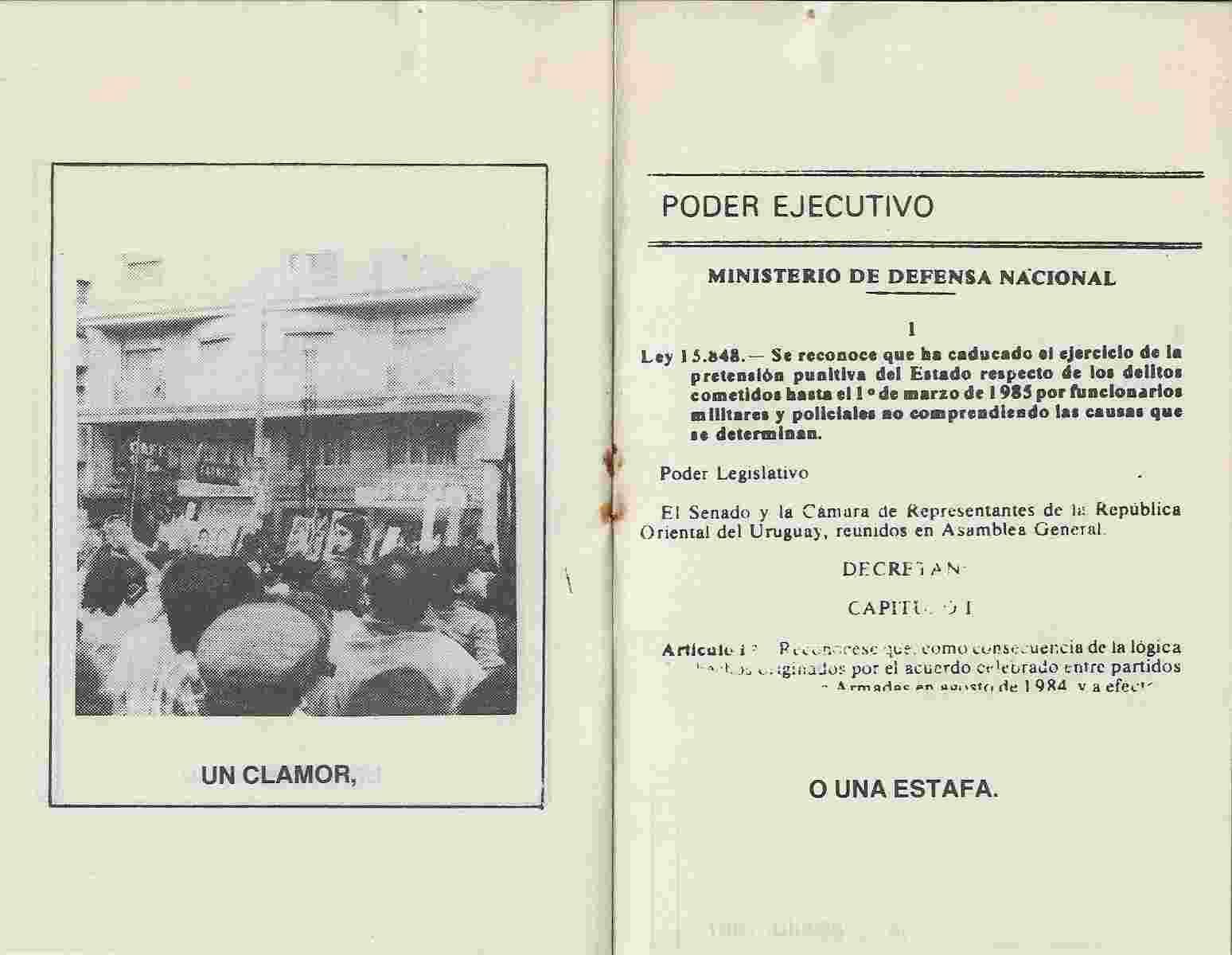
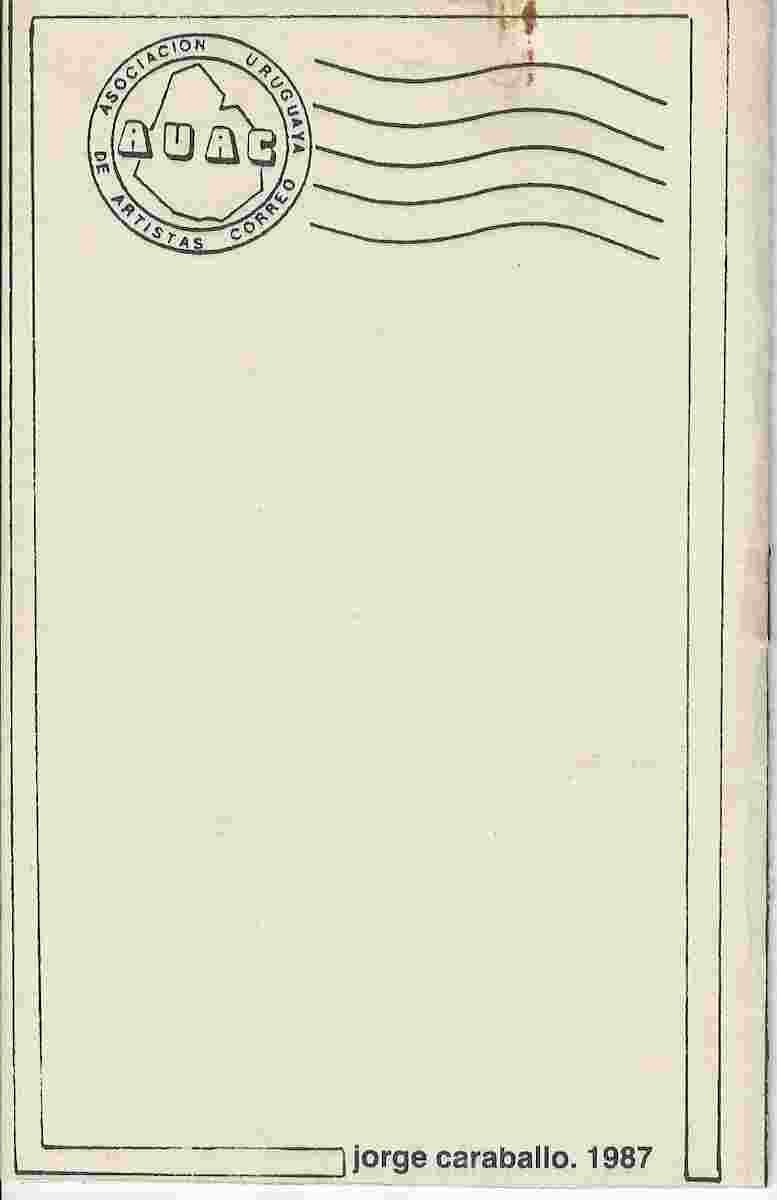
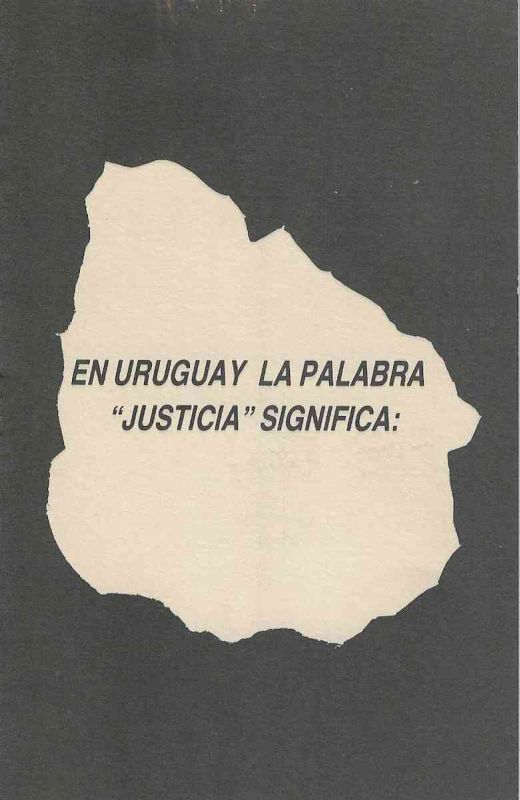
Livro de artista de Jorge Caraballo intitulado En Uruguay la palabra Justicia significa, produzido em 1987. A publicação utiliza fotografias, imagens apropriadas, textos breves e documentação legislativa para construir uma crítica política sobre os significados contraditórios da justiça no Uruguai após a ditadura civil militar. A capa apresenta uma forma irregular branca semelhante ao contorno territorial do Uruguai sobre fundo preto, contendo a frase En Uruguay la palabra Justicia significa seguida de dois pontos. A estrutura da obra conduz o leitor por uma sequência de associações entre palavra, símbolo, espaço urbano, comércio, poder político, manifestação pública e legislação. A primeira composição apresenta uma representação tradicional da Justiça, figura feminina vendada segurando balança e espada, acompanhada da expressão Un símbolo. Na página seguinte aparece uma placa urbana com a inscrição Calle Justicia, acompanhada da expressão Una calle. Outra sequência mostra a fachada de um estabelecimento comercial acompanhada da expressão Un comercio e um edifício público diante do qual se reúne uma multidão, identificado pela expressão Una sede. A publicação prossegue com uma fotografia de manifestação popular acompanhada da expressão Un clamor. Na página oposta encontra se a reprodução de um texto oficial relacionado à Lei 15.848, sob os títulos Poder Ejecutivo e Ministerio de Defensa Nacional, acompanhada da expressão O una estafa. O fragmento legislativo afirma a caducidade do exercício da pretensão punitiva do Estado em relação a delitos cometidos até 1 de março de 1985 por funcionários militares e policiais no cumprimento de suas funções e por determinação dos comandos que atuaram durante o período autoritário. A justaposição entre o clamor social por justiça e a norma que limitou a responsabilização penal produz o núcleo crítico do livro. Caraballo transforma a palavra justiça em um campo de disputa entre representação simbólica, nomenclatura urbana, apropriação comercial, instituições estatais, mobilização popular e impunidade jurídica. A obra relaciona livro de artista, poesia visual, arte conceitual, fotografia documental, montagem, arte política, memória da ditadura uruguaia, direitos humanos, democracia, anistia, impunidade e crítica institucional. A página final apresenta um selo gráfico da Asociación Uruguaya de Artistas Correo, identificado pela sigla AUAC, linhas onduladas semelhantes às de um cancelamento postal e a inscrição Jorge Caraballo 1987, vinculando a publicação às redes de arte postal e comunicação alternativa do Uruguai e da América Latina.Artist book by Jorge Caraballo titled En Uruguay la palabra Justicia significa, produced in 1987. The publication uses photographs, appropriated images, brief texts and legislative documentation to construct a political critique of the contradictory meanings of justice in Uruguay after the civil military dictatorship. The cover presents an irregular white form resembling the territorial outline of Uruguay against a black background, containing the statement En Uruguay la palabra Justicia significa followed by a colon. The structure of the work guides the reader through a sequence of associations involving word, symbol, urban space, commerce, political power, public demonstration and legislation. The first composition presents a traditional representation of Justice, a blindfolded female figure holding scales and a sword, accompanied by the expression Un símbolo. The following page shows an urban sign reading Calle Justicia accompanied by the expression Una calle. Another sequence shows the facade of a commercial establishment accompanied by the expression Un comercio and a public building in front of which a crowd is assembled, identified by the expression Una sede. The publication continues with a photograph of a public demonstration accompanied by the expression Un clamor. On the opposite page appears a reproduction of an official text related to Law 15.848 under the headings Poder Ejecutivo and Ministerio de Defensa Nacional, accompanied by the expression O una estafa. The legislative fragment states that the exercise of the punitive claim of the State had expired in relation to offenses committed before 1 March 1985 by military and police officials in the performance of their duties and under orders from the commands operating during the authoritarian period. The juxtaposition between the social demand for justice and the legal provision that restricted criminal accountability forms the critical core of the book. Caraballo transforms the word justice into a contested field involving symbolic representation, urban naming, commercial appropriation, state institutions, popular mobilization and legal impunity. The work connects the artist book, visual poetry, conceptual art, documentary photography, montage, political art, memory of the Uruguayan dictatorship, human rights, democracy, amnesty, impunity and institutional criticism. The final page presents the graphic seal of the Asociación Uruguaya de Artistas Correo, identified by the initials AUAC, wavy lines resembling a postal cancellation and the inscription Jorge Caraballo 1987, connecting the publication with mail art and alternative communication networks in Uruguay and Latin America.
Livro de artista composto por capa e páginas internas impressas em preto sobre papel claro, com fotografias reproduzidas, desenhos, textos, molduras gráficas e fragmento de documento oficial. A capa possui fundo preto e área central irregular em papel claro, cuja forma remete visualmente ao território uruguaio. A frase impressa na capa apresenta a palavra Justicia destacada tipograficamente. As páginas internas organizam imagens em quadros retangulares acompanhados pelas expressões Un símbolo, Una calle, Un comercio, Una sede, Un clamor e O una estafa. A imagem da placa Calle Justicia confirma a utilização de um nome urbano como elemento semântico da narrativa. A fotografia de uma multidão registra mobilização pública e funciona como contraponto ao texto legislativo reproduzido na página seguinte. O documento legal visível identifica a Lei 15.848 e menciona a extinção da pretensão punitiva do Estado para determinados crimes cometidos até 1 de março de 1985 por integrantes das forças militares e policiais. A reprodução apresenta perda parcial de definição, razão pela qual transcrições integrais devem ser confirmadas diretamente no exemplar. A página final contém o emblema circular da Asociación Uruguaya de Artistas Correo, com a sigla AUAC inserida sobre uma forma semelhante ao mapa do Uruguai, além do nome Jorge Caraballo e da data 1987. A encadernação parece realizada por grampos metálicos centrais. O suporte apresenta amarelecimento, manchas, oxidação junto aos grampos, vincos, marcas de manuseio, desgaste das margens e alterações de tonalidade compatíveis com a idade e a preservação arquivística. Publicação de elevada importância para pesquisas sobre Jorge Caraballo, arte uruguaia, Asociación Uruguaya de Artistas Correo, arte postal, livro de artista, poesia visual, arte conceitual, ditadura uruguaia, Lei 15.848, direitos humanos, memória política, justiça de transição, impunidade e redemocratização do Uruguai.Artist book consisting of a cover and internal pages printed in black on light colored paper, combining reproduced photographs, drawings, texts, graphic borders and a fragment of an official document. The cover has a black background and an irregular central area of light paper whose shape visually recalls the territory of Uruguay. The printed statement on the cover typographically emphasizes the word Justicia. The internal pages organize images within rectangular frames accompanied by the expressions Un símbolo, Una calle, Un comercio, Una sede, Un clamor and O una estafa. The image of the Calle Justicia sign confirms the use of an urban place name as a semantic element within the narrative. The photograph of a crowd records public mobilization and functions as a counterpoint to the legislative text reproduced on the following page. The visible legal document identifies Law 15.848 and refers to the expiration of the punitive claim of the State for certain offenses committed before 1 March 1985 by members of the military and police forces. The reproduction has partial loss of definition, and any complete transcription should therefore be confirmed directly from the original copy. The final page contains the circular emblem of the Asociación Uruguaya de Artistas Correo, with the initials AUAC placed over a shape resembling the map of Uruguay, as well as the name Jorge Caraballo and the date 1987. The binding appears to consist of central metal staples. The material presents yellowing, stains, oxidation near the staples, folds, handling marks, edge wear and tonal changes consistent with age and archival preservation. This publication is highly relevant to research on Jorge Caraballo, Uruguayan art, Asociación Uruguaya de Artistas Correo, mail art, artist books, visual poetry, conceptual art, the Uruguayan dictatorship, Law 15.848, human rights, political memory, transitional justice, impunity and the restoration of democracy in Uruguay.
Proveniência
Coleção Poema ProcessoInglês
Artist book by Jorge Caraballo titled En Uruguay la palabra Justicia significa, produced in 1987.
Dimensions: 6,5 x 4,1 in