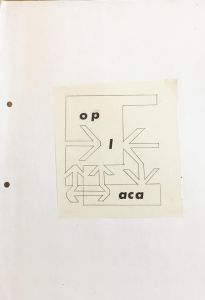
Desenho original de Wlademir Dias Pino realizado a nanquim sobre folha vegetal, estruturado a partir de sucessivas variações gráficas da palavra vírgula.
Wlademir Dias Pino
Categoria: Poema Processo
Acervo: 00943
Data: 1970s
Dimensões: 27,3 x 19,2
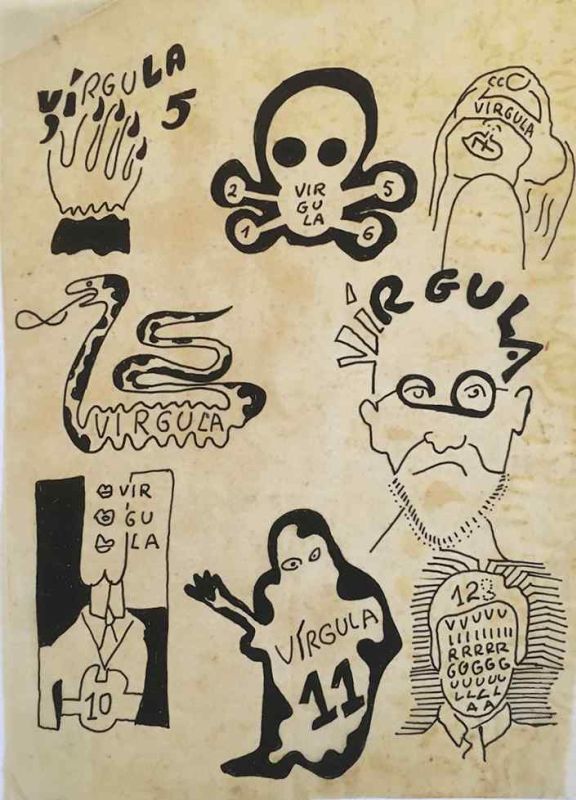
Texto Salsa em portuguêsDesenho original de Wlademir Dias Pino realizado a nanquim sobre folha vegetal, estruturado a partir de sucessivas variações gráficas da palavra vírgula. A composição reúne diferentes experiências de transformação da palavra em imagem, explorando relações entre linguagem verbal, desenho, signo, número, corpo, personagem e estrutura visual. O trabalho evidencia procedimentos centrais da pesquisa de Wlademir Dias Pino em torno da palavra como matéria gráfica e da possibilidade de leitura para além da organização tradicional do verso e da escrita linear.A folha apresenta diversas figuras construídas a partir da palavra vírgula e de suas decomposições visuais. No setor superior esquerdo aparece uma forma semelhante a uma mão acompanhada da palavra vírgula e do número 5. Ao centro superior surge uma figura de aspecto craniano ou corporal, com olhos negros e extensões laterais numeradas, contendo a palavra vírgula dividida em diferentes linhas. Na parte superior direita aparece uma cabeça ou perfil humano em cujo interior estão inscritos elementos gráficos e novamente a palavra vírgula.Na região intermediária encontra se uma figura alongada semelhante a uma ave ou cisne, cuja base incorpora a palavra vírgula. Ao lado surge um rosto estilizado de olhos espiralados, barba pontilhada e fragmentação da palavra em torno da cabeça. Na região inferior esquerda aparece uma figura humana de terno associada ao número 10, com a palavra vírgula dividida em três segmentos verticais. Ao centro inferior encontra se uma personagem antropomórfica marcada pelo número 11, sobre cujo corpo está escrita a palavra vírgula. À direita aparece uma cabeça associada ao número 12, preenchida por sequências repetidas de letras derivadas dos componentes da palavra, criando uma espécie de textura tipográfica.O conjunto demonstra um método de investigação visual baseado em repetição, decomposição, recombinação e metamorfose do signo verbal. A palavra deixa de funcionar apenas como unidade linguística e torna se matéria para construção de personagens, estruturas corporais, imagens e sequências numéricas. Essa operação aproxima o desenho das pesquisas de poesia visual, poesia experimental, design, comunicação visual e Poema Processo, movimento do qual Wlademir Dias Pino foi um dos principais formuladores.Algumas dessas variações gráficas foram posteriormente utilizadas em livros publicados pela UFMG, o que amplia a relevância documental da folha como matriz ou estudo preparatório relacionado à circulação editorial da obra de Wlademir Dias Pino. O documento constitui fonte importante para pesquisas sobre seus processos criativos, desenho a nanquim, estudos gráficos, poesia visual brasileira, Poema Processo, semiótica, tipografia experimental, palavra imagem, comunicação visual, design editorial e relações entre literatura e artes visuais.Salsa text in EnglishOriginal drawing by Wlademir Dias Pino executed in India ink on tracing paper, structured through successive graphic variations of the word vírgula. The composition brings together different experiments in transforming a word into an image, exploring relationships among verbal language, drawing, sign, number, body, character, and visual structure. The work reveals central procedures in Wlademir Dias Pino's research into the word as graphic material and into forms of reading that extend beyond traditional verse and linear writing.The sheet contains several figures constructed from the word vírgula and from visual decompositions of its letters and syllables. In the upper left area there is a form resembling a hand accompanied by the word vírgula and the number 5. In the upper central area appears a skull like or bodily figure with dark eyes and numbered lateral extensions, containing the word vírgula divided across several lines. In the upper right area a human head or profile contains graphic elements and another occurrence of the word vírgula.In the middle section there is an elongated figure resembling a bird or swan whose lower area incorporates the word vírgula. Nearby appears a stylized face with spiral eyes, a dotted beard, and fragments of the word arranged around the head. In the lower left area a suited human figure is associated with the number 10, while the word vírgula is divided vertically into three segments. In the lower center an anthropomorphic character marked with the number 11 carries the word vírgula across its body. On the right a head associated with the number 12 is filled with repeated sequences of letters derived from components of the word, producing a typographic texture.The ensemble demonstrates a method of visual investigation based on repetition, decomposition, recombination, and metamorphosis of the verbal sign. The word no longer operates only as a linguistic unit but becomes material for the construction of characters, bodily structures, images, and numerical sequences. This procedure connects the drawing with visual poetry, experimental poetry, design, visual communication, and Poema Processo, a movement in which Wlademir Dias Pino was one of the principal theorists and creators.Some of these graphic variations were later used in books published by UFMG, increasing the documentary importance of the sheet as a matrix or preparatory study connected with the editorial circulation of Wlademir Dias Pino's work. The document is an important source for research on his creative processes, India ink drawing, graphic studies, Brazilian visual poetry, Poema Processo, semiotics, experimental typography, word image relationships, visual communication, editorial design, and connections between literature and the visual arts.
Texto de observação em portuguêsDesenho a nanquim de Wlademir Dias Pino sobre folha vegetal, composto por diferentes estudos gráficos construídos a partir da palavra vírgula. A folha funciona como campo de experimentação no qual letras, sílabas, números e formas figurativas são articulados em sucessivas transformações visuais. Podem ser identificadas figuras semelhantes a uma mão, uma cabeça craniana com extensões numeradas, um perfil humano, uma ave de pescoço alongado, um rosto de olhos espiralados e personagens associados aos números 10, 11 e 12.A palavra vírgula aparece escrita integralmente, fragmentada em sílabas, distribuída verticalmente, inserida no corpo das figuras ou decomposta em sequências de letras. A repetição de V, I, R, G, U, L e A transforma os componentes linguísticos em textura gráfica, demonstrando a passagem da escrita para a imagem. Os números presentes junto às figuras sugerem uma organização sequencial dos estudos, possivelmente relacionada a uma série maior de variações.O suporte em folha vegetal reforça o caráter de estudo, matriz ou etapa de desenvolvimento gráfico, permitindo compreender aspectos do processo de criação de Wlademir Dias Pino. Algumas dessas soluções foram utilizadas posteriormente em livros da UFMG, estabelecendo uma relação entre o desenho original, a pesquisa visual do artista e sua aplicação editorial. O documento possui especial interesse para o estudo da palavra vírgula como elemento visual, da transformação de signos linguísticos em imagens e da metodologia experimental associada ao Poema Processo.Observation text in EnglishIndia ink drawing by Wlademir Dias Pino on tracing paper, composed of different graphic studies constructed from the word vírgula. The sheet functions as an experimental field in which letters, syllables, numbers, and figurative forms are combined through successive visual transformations. The composition includes forms resembling a hand, a skull like head with numbered extensions, a human profile, a long necked bird, a face with spiral eyes, and characters associated with the numbers 10, 11, and 12.The word vírgula appears in complete form, divided into syllables, arranged vertically, inserted into the bodies of figures, or decomposed into repeated sequences of letters. The repetition of V, I, R, G, U, L, and A transforms linguistic components into graphic texture and demonstrates the transition from writing to image. The numbers accompanying several figures suggest a sequential organization of the studies and may indicate their inclusion within a larger series of variations.The use of tracing paper reinforces the character of the work as a study, matrix, or stage in a graphic development process and provides evidence of Wlademir Dias Pino's working methods. Some of these visual solutions were subsequently used in books published by UFMG, establishing a connection between the original drawing, the artist's visual research, and its editorial application. The document is particularly significant for research into the word vírgula as a visual element, the transformation of linguistic signs into images, and the experimental methodology associated with Poema Processo.