Colagem e trabalho de carimbo de Pascal Lenoir, artista francês ligado à Mail Art, poesia visual, arte postal, colagem e publicação experimental.
Pascal Lenoir - France
Categoria: Poesia Visual
Acervo: 04581
Dimensões: 21 x 15 cm
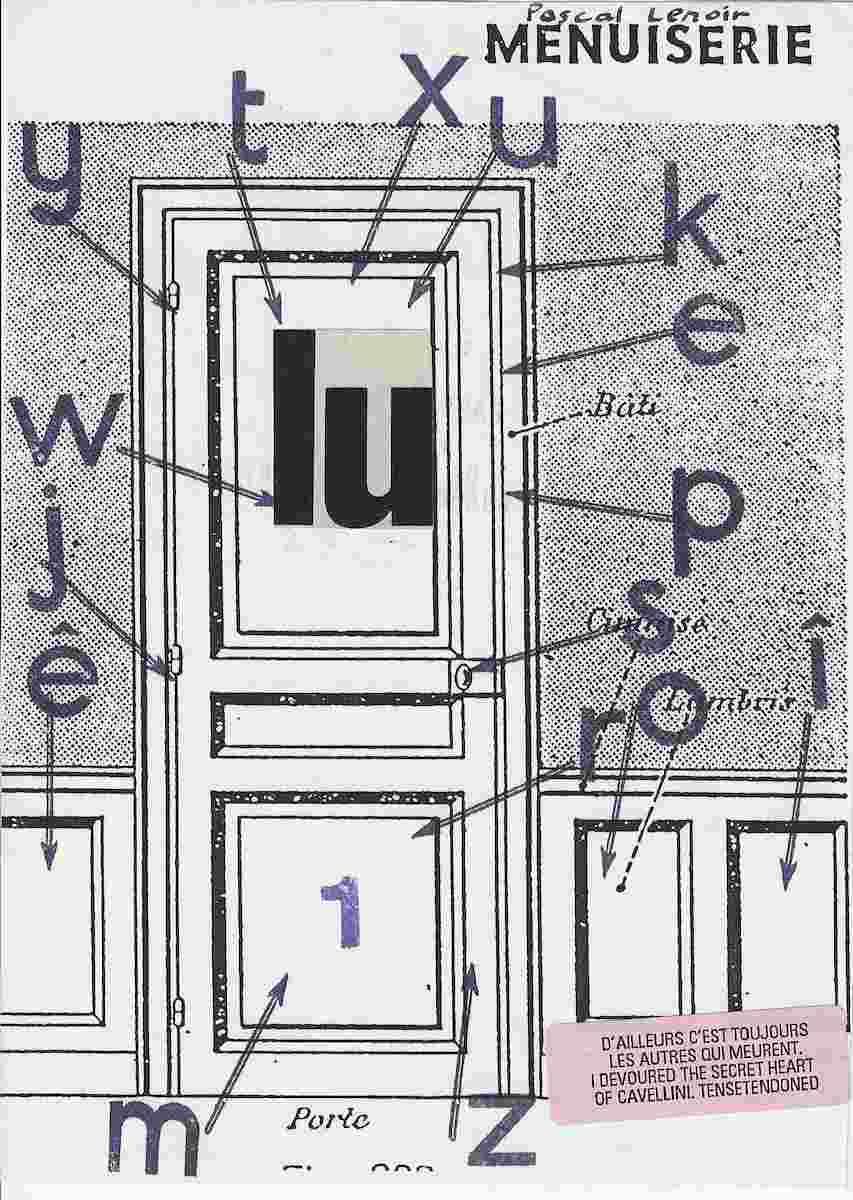
Colagem e trabalho de carimbo de Pascal Lenoir, artista francês ligado à Mail Art, poesia visual, arte postal, colagem e publicação experimental. A obra utiliza como suporte uma reprodução gráfica relacionada à menuiserie, termo francês associado à marcenaria, estruturada em torno do desenho frontal de uma porta. Sobre essa imagem preexistente o artista realiza intervenções com letras, palavras, setas, carimbos, anotações manuscritas e fragmentos impressos, transformando um esquema técnico em composição poética e conceitual.
Na parte superior aparece a palavra MENUISERIE acompanhada pela identificação manuscrita Pascal Lenoir. A porta ocupa o centro da composição e funciona como estrutura organizadora do trabalho. Sobre ela e ao redor de sua moldura encontram se letras isoladas como u, t, x, w, j, e, k, e, p, s, o, m, z e outras formas gráficas. Diversas setas partem dessas letras e apontam para elementos arquitetônicos da porta, produzindo um sistema de relações entre alfabeto, objeto, direção e espaço.
No centro da porta destaca se uma grande forma tipográfica semelhante à letra u. Mais abaixo aparece o número 1 em tonalidade violeta. Na parte inferior há a palavra porte, termo francês para porta, reforçando o diálogo entre representação arquitetônica e linguagem verbal.
A composição apresenta ainda pequenas inscrições manuscritas inseridas entre as setas e os elementos tipográficos. A combinação entre impressão original e intervenções de Pascal Lenoir cria uma estrutura semelhante a um diagrama, no qual letras e sinais parecem identificar, classificar ou reinventar partes da porta. O resultado desloca uma imagem funcional de marcenaria para o campo da poesia visual e da arte conceitual.
Na área inferior direita encontra se um fragmento de texto colado em francês e inglês que contém uma referência explícita a Cavellini. Essa presença é particularmente significativa para a contextualização da peça nas redes internacionais de Mail Art, pois Guglielmo Achille Cavellini foi uma das figuras centrais da arte postal internacional e manteve intensa circulação de obras, carimbos, selos de artista e materiais impressos entre artistas de diversos países.
A referência a Cavellini, associada ao procedimento de colagem, reforça o caráter de rede da obra de Pascal Lenoir. Em vez de apresentar uma composição fechada, o trabalho reúne materiais de diferentes origens, textos impressos, linguagem técnica, intervenção manuscrita e elementos de circulação artística. Esse procedimento é característico da Mail Art, na qual apropriação, reutilização, comunicação e intercâmbio tornam se componentes da própria obra.
A disposição das letras pode ser compreendida como uma investigação de linguagem visual. O alfabeto é fragmentado e redistribuído no espaço, perdendo parcialmente sua função linguística convencional para assumir função plástica. As setas produzem conexões entre signos e partes da arquitetura, aproximando o trabalho de uma cartografia visual ou de uma espécie de sistema de instruções deliberadamente aberto.
A obra documenta aspectos fundamentais da produção de Pascal Lenoir, especialmente seu interesse por colagem, carimbos, apropriação gráfica, poesia visual, arte conceitual e circulação postal. Também se relaciona ao universo de Mani Art e Galerie Postale, projetos através dos quais Lenoir participou intensamente das redes internacionais de Mail Art desde a década de 1980.
Termos relevantes para indexação incluem Pascal Lenoir, França, France, Mail Art, arte postal, poesia visual, visual poetry, colagem, collage, stamp art, carimbo, artist stamp, Guglielmo Achille Cavellini, Cavellini, Mani Art, Galerie Postale, Grandfresnoy, arte conceitual, conceptual art, experimental typography, tipografia experimental, alphabet art, alfabeto, door, porte, menuiserie, marcenaria, appropriation art, arte de apropriação, graphic intervention, intervenção gráfica, correspondence art e international mail art network.
Salsa text in English
Collage and stamped work by Pascal Lenoir, a French artist associated with Mail Art, visual poetry, postal art, collage and experimental publishing. The work uses as its support a printed graphic image related to menuiserie, the French term associated with joinery and woodworking, structured around the frontal representation of a door. Over this preexisting image the artist introduces letters, words, arrows, stamps, handwritten annotations and printed fragments, transforming a technical diagram into a poetic and conceptual composition.
The word MENUISERIE appears at the top together with the handwritten identification Pascal Lenoir. The door occupies the central area and functions as the structural framework of the composition. Isolated letters including u, t, x, w, j, e, k, p, s, o, m and z are distributed over and around the door. Numerous arrows extend from these letters toward architectural details, producing a system of relationships between alphabet, object, direction and space.
A large typographic form resembling the letter u dominates the central panel of the door. Farther down appears the number 1 in a violet tone. Near the bottom the word porte, the French word for door, reinforces the relationship between architectural representation and verbal language.
Small handwritten inscriptions also appear among the arrows and typographic elements. The combination of the original printed image and interventions by Pascal Lenoir creates a structure resembling a diagram in which letters and signs appear to identify, classify or reinvent parts of the door. The functional image of woodworking is therefore displaced into the fields of visual poetry and conceptual art.
In the lower right area there is a pasted fragment of text in French and English containing an explicit reference to Cavellini. This reference is particularly significant for the contextualization of the work within international Mail Art networks because Guglielmo Achille Cavellini was one of the central figures of international postal art and circulated artworks, rubber stamps, artistamps and printed material among artists in many countries.
The reference to Cavellini, combined with the collage procedure, reinforces the network based nature of Pascal Lenoir's practice. Rather than presenting a closed composition, the work brings together material from different sources, printed text, technical language, handwriting and elements associated with artistic circulation. This approach is characteristic of Mail Art, where appropriation, reuse, communication and exchange become part of the artwork itself.
The distribution of letters can be understood as an investigation of visual language. The alphabet is fragmented and redistributed in space, partially losing its conventional linguistic function and acquiring a plastic and graphic role. The arrows connect signs with architectural details, giving the composition the appearance of a visual map or an intentionally open system of instructions.
The work documents fundamental aspects of Pascal Lenoir's practice, particularly his interest in collage, rubber stamping, graphic appropriation, visual poetry, conceptual art and postal circulation. It is also related to the wider environment of Mani Art and Galerie Postale, projects through which Lenoir participated intensively in international Mail Art networks beginning in the 1980s.
Relevant indexing terms include Pascal Lenoir, France, Mail Art, postal art, visual poetry, collage, stamp art, rubber stamp, artist stamp, Guglielmo Achille Cavellini, Cavellini, Mani Art, Galerie Postale, Grandfresnoy, conceptual art, experimental typography, alphabet art, door, porte, menuiserie, woodworking, appropriation art, graphic intervention, correspondence art and international Mail Art network.
Texto de observação em português
Obra em papel de Pascal Lenoir realizada por meio de colagem, intervenção gráfica, carimbo, escrita manuscrita e apropriação de uma imagem impressa relacionada à marcenaria. O elemento principal é a representação frontal de uma porta formada por molduras retangulares concêntricas.
Na parte superior encontra se MENUISERIE e, acima dessa palavra, a identificação manuscrita Pascal Lenoir. A imagem original parece ter caráter técnico ou ilustrativo e foi posteriormente alterada pelo artista.
Sobre a composição foram acrescentadas grandes letras em tonalidade azul ou violeta. Entre os caracteres claramente visíveis encontram se u, t, x, w, j, e, k, p, s, o, m e z. As letras estão distribuídas em diferentes regiões e ligadas por linhas e setas a pontos específicos da porta.
O centro superior da porta apresenta uma grande letra ou forma tipográfica u em preto. Na seção inferior central aparece o número 1 em violeta. Próximo à base encontra se a palavra manuscrita porte.
As setas funcionam como importante recurso compositivo. Elas conectam letras, palavras e diferentes componentes arquitetônicos e conferem à obra aparência de esquema técnico, mapa ou diagrama. Entretanto, essas relações não constituem instruções funcionais claramente decodificáveis. A intervenção de Lenoir transforma o esquema original em uma construção poética aberta.
Também são visíveis pequenas anotações manuscritas próximas às setas. Algumas palavras não podem ser lidas com segurança na reprodução fornecida e, portanto, não devem receber transcrição definitiva.
Na região inferior direita existe um fragmento retangular colado, impresso em francês e inglês. O trecho legível contém referência a Cavellini. A presença desse nome constitui um dado importante para indexação da obra e para sua relação com a história internacional da Mail Art.
A referência provavelmente corresponde a Guglielmo Achille Cavellini, artista italiano amplamente relacionado às redes internacionais de arte postal. Entretanto, como o fragmento apresenta apenas o sobrenome Cavellini, a identificação completa deve ser registrada como contextualização e não como transcrição literal da obra.
A peça apresenta procedimentos recorrentes na arte postal e na poesia visual, entre eles reutilização de material impresso, interferência sobre imagem existente, fragmentação do alfabeto, colagem, escrita manual, deslocamento semântico e criação de relações entre palavra e imagem.
O objeto também evidencia o interesse de Pascal Lenoir pelo funcionamento da linguagem gráfica. As letras não formam uma frase convencional. Elas aparecem individualizadas e distribuídas espacialmente, adquirindo uma função visual comparável à de sinais ou marcadores.
A porta pode ser interpretada como suporte estrutural da intervenção, mas o documento não apresenta indicação que permita atribuir um significado simbólico específico à imagem. Para catalogação, deve se evitar afirmar interpretações como passagem, entrada, fronteira ou comunicação como intenção comprovada do artista.
A obra deve ser relacionada à atividade de Pascal Lenoir nas redes de Mail Art, poesia visual e publicação independente e ao contexto de Mani Art e Galerie Postale. A combinação entre colagem, carimbo, tipografia, apropriação e referência a Cavellini reforça sua importância documental para estudos sobre intercâmbio artístico internacional.
Principais descritores para catalogação incluem Pascal Lenoir, artista francês, colagem, collage, carimbo, stamp art, Mail Art, arte postal, poesia visual, visual poetry, Guglielmo Achille Cavellini, Cavellini, Mani Art, Galerie Postale, menuiserie, porte, door, alphabet, typography, letras, setas, diagram, diagrama, appropriation, intervenção gráfica, arte conceitual, publicação experimental e rede internacional de arte postal.
Observation text in English
Work on paper by Pascal Lenoir created through collage, graphic intervention, rubber stamping, handwriting and appropriation of a printed image related to woodworking. The principal element is the frontal representation of a door constructed through several concentric rectangular frames.
The word MENUISERIE appears at the top and the handwritten identification Pascal Lenoir is located above it. The underlying image appears to have originally had a technical or illustrative function and was subsequently altered by the artist.
Large letters in blue or violet have been added across the composition. Clearly visible characters include u, t, x, w, j, e, k, p, s, o, m and z. These letters are distributed throughout the image and connected by lines and arrows to specific points on the door.
The upper central panel contains a large black letter or typographic form resembling u. The lower central section contains the violet number 1. Near the bottom appears the handwritten French word porte.
Arrows constitute an important compositional device. They connect letters, words and architectural components and give the work the appearance of a technical diagram, map or instructional system. These relationships, however, do not form clearly functional instructions. Lenoir transforms the original diagram into an open poetic construction.
Several smaller handwritten annotations are visible near the arrows. Some cannot be securely read from the available reproduction and should therefore not receive definitive transcription.
A rectangular pasted fragment appears in the lower right area and contains printed text in French and English. The legible portion includes a reference to Cavellini. The presence of this name is an important element for cataloguing and for establishing the work within the history of international Mail Art.
The reference most likely concerns Guglielmo Achille Cavellini, the Italian artist extensively associated with international postal art networks. Since the fragment itself displays only the surname Cavellini, however, the full identification should be treated as contextual information rather than a literal transcription from the work.
The piece incorporates procedures frequently found in Mail Art and visual poetry including reuse of printed material, intervention upon existing imagery, fragmentation of the alphabet, collage, handwriting, semantic displacement and the creation of relationships between word and image.
The work also demonstrates Pascal Lenoir's interest in the operation of graphic language. The letters do not form a conventional sentence. Instead, they are isolated and spatially distributed, functioning visually like signs or markers.
The door provides the structural support for the intervention, although the document itself does not establish a specific symbolic meaning for this image. Museum cataloguing should therefore avoid presenting interpretations such as passage, entrance, boundary or communication as confirmed artistic intentions.
The work should be associated with Pascal Lenoir's activity in Mail Art, visual poetry and independent publishing and with the wider context of Mani Art and Galerie Postale. Its combination of collage, rubber stamping, typography, appropriation and a reference to Cavellini gives the piece particular documentary value for the study of international artistic exchange.
Principal cataloguing descriptors include Pascal Lenoir, French artist, collage, rubber stamp, stamp art, Mail Art, postal art, visual poetry, Guglielmo Achille Cavellini, Cavellini, Mani Art, Galerie Postale, menuiserie, porte, door, alphabet, typography, letters, arrows, diagram, appropriation, graphic intervention, conceptual art, experimental publishing and international Mail Art network.
Proveniência
Coleção Poema ProcessoInglês
Collage and stamped work by Pascal Lenoir, a French artist associated with Mail Art, visual poetry, postal art, collage and experimental publishing.
Dimensions: 8,3 x 5,9 in