mpressão gráfica de Pawe Petasz, artista polonês ligado à arte postal, poesia visual, colagem, publicação independente e às redes internacionais de Mail Art. Datada de 1995
Pawel Petasz - Polonia
Categoria: Mail Art
Acervo: 04467
Data: 1995
Dimensões: 29,2 x 20,9 cm
Texto Salsa em portuguêsImpressão gráfica de Pawe
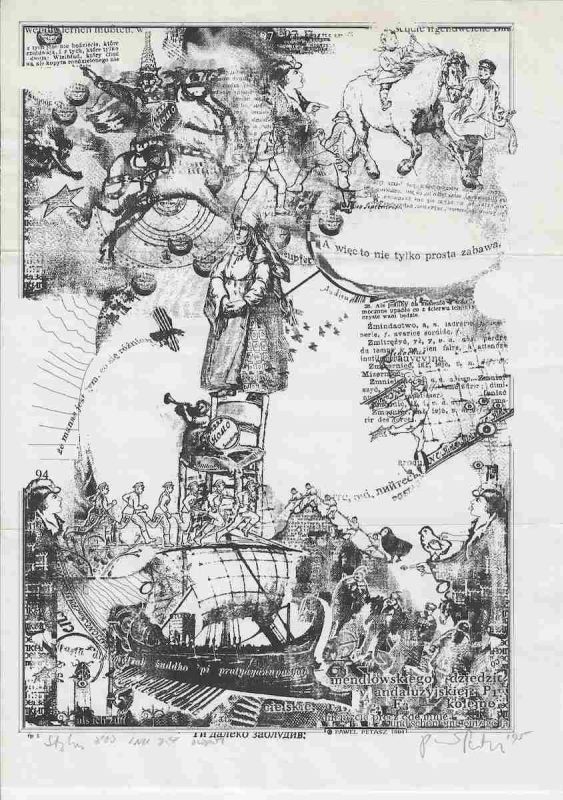
Petasz, artista polonês ligado à arte postal, poesia visual, colagem, publicação independente e às redes internacionais de Mail Art. Datada de 1995 e assinada a lápis na margem inferior, a obra apresenta uma composição em preto e branco construída pela sobreposição de imagens, textos impressos, fragmentos tipográficos, ilustrações históricas, figuras humanas, animais, objetos e referências gráficas provenientes de diferentes fontes. A estrutura visual aproxima procedimentos de colagem, montagem, apropriação e poesia visual, criando uma superfície densamente informacional em que palavra e imagem permanecem em permanente tensão.Entre os elementos legíveis aparece a frase polonesa A wi
c to nie tylko pusta zabawa, que pode ser traduzida como Portanto isto não é apenas uma brincadeira vazia. A expressão reforça o caráter crítico da composição e a possibilidade de leitura da obra como comentário sobre comunicação, cultura, história e circulação de imagens. Também são visíveis numerosos fragmentos de textos em polonês e alemão, além de referências gráficas e números integrados à composição.Na margem inferior encontra se a assinatura manuscrita de Pawe
Petasz a lápis. Próximo ao centro da base da imagem aparece ainda uma indicação impressa de autoria e copyright de Pawe
Petasz, aparentemente acompanhada de uma data anterior à data informada para esta impressão, elemento que pode indicar a origem da matriz ou de uma versão precedente da composição.Pawe
Petasz nasceu em Kalisz, Polônia, em 1951, estudou na Academia de Belas Artes de Gda
sk e tornou se uma das figuras importantes da Mail Art internacional. Atuou com colagem, poesia visual, carimbos, livros de artista, publicações experimentais e arte digital. Em 1977 iniciou em Elbl
g a Commonpress, publicação colaborativa baseada em uma estrutura editorial descentralizada na qual diferentes participantes assumiam sucessivamente a edição de números temáticos. O projeto reuniu artistas de numerosos países e tornou se uma referência histórica das redes internacionais de arte postal.A obra integra o contexto de produção gráfica e experimental de Petasz, marcado pela utilização de materiais impressos, reprodução de baixo custo, apropriação de imagens, circulação alternativa e questionamento das estruturas convencionais de produção e distribuição artística. Sua presença em coleção brasileira contribui para documentar a circulação internacional da obra de Pawe
Petasz e as conexões entre artistas poloneses e as redes latino americanas de poesia visual, arte postal e experimentalismo.Salsa text in EnglishGraphic print by Pawe
Petasz, a Polish artist associated with Mail Art, visual poetry, collage, independent publishing and international artistic networks. Dated 1995 and signed in pencil along the lower margin, the work presents a black and white composition constructed through the overlapping of images, printed texts, typographic fragments, historical illustrations, human figures, animals, objects and graphic references taken from different sources. Its visual structure combines procedures related to collage, montage, appropriation and visual poetry, creating a densely informational surface in which word and image remain in constant tension.Among the readable elements is the Polish phrase A wi
c to nie tylko pusta zabawa, which may be translated as Therefore this is not merely an empty game. The expression reinforces the critical character of the composition and suggests a reading of the work as a commentary on communication, culture, history and the circulation of images. Numerous fragments of Polish and German text are also visible, together with graphic references and numbers incorporated into the composition.The lower margin bears the handwritten pencil signature of Pawe
Petasz. Near the center of the lower edge of the printed image there is also a printed authorship and copyright indication for Pawe
Petasz, apparently accompanied by a date earlier than the date attributed to this impression, which may indicate the origin of the matrix or an earlier version of the composition.Pawe
Petasz was born in Kalisz, Poland, in 1951, studied at the Academy of Fine Arts in Gda
sk and became an important figure in the international Mail Art network. His practice included collage, visual poetry, rubber stamp art, artists books, experimental publications and digital art. In 1977 in Elbl
g he initiated Commonpress, a collaborative publication based on a decentralized editorial structure in which different participants successively assumed responsibility for thematic issues. The project involved artists from numerous countries and became an important historical reference within international Mail Art networks.The work belongs to the context of Petasz experimental graphic production, characterized by printed matter, inexpensive reproduction techniques, image appropriation, alternative circulation and a questioning of conventional structures of artistic production and distribution. Its presence in a Brazilian collection contributes to documenting the international circulation of Pawe
Petasz work and the connections between Polish artists and Latin American networks of visual poetry, Mail Art and experimental art.
Texto de observação em portuguêsImpressão gráfica em preto e branco de Pawe
Petasz, Polônia, datada de 1995, com assinatura autógrafa a lápis na margem inferior direita. Na margem inferior esquerda há também uma anotação manuscrita a lápis, parcialmente legível. A composição reúne extensa montagem de imagens e textos impressos, incluindo figuras humanas, cavalo, aves, objetos, estruturas arquitetônicas, fragmentos de ilustrações históricas, números, palavras e blocos tipográficos.Entre os textos identificáveis encontra se a frase em polonês A wi
c to nie tylko pusta zabawa, integrada à área superior direita da composição. Há ainda fragmentos em polonês e alemão distribuídos por toda a superfície, alguns parcialmente encobertos pela sobreposição de imagens. Na região inferior central observa se uma indicação impressa de autoria e copyright de Pawe
Petasz, seguida de uma data que na reprodução disponível parece corresponder a 1994. Essa informação deve ser preservada no registro documental separadamente da data de 1995 atribuída ao exemplar ou à impressão.A obra evidencia procedimentos característicos de Pawe
Petasz, como colagem, apropriação, montagem gráfica, combinação de palavra e imagem e reutilização de material impresso. Esses elementos relacionam o trabalho à poesia visual, à Mail Art, ao livro de artista, à arte conceitual e às práticas editoriais alternativas desenvolvidas pelo artista no contexto da rede Commonpress.A assinatura manuscrita e as inscrições presentes na margem constituem elementos materiais relevantes para identificação, catalogação, pesquisa de proveniência e eventual estudo de edição ou tiragem. Recomenda se conservar no cadastro as formas Pawe
Petasz e Pawel Petasz para favorecer a recuperação do registro por diferentes sistemas de busca, catálogos internacionais, bases de arte postal e ferramentas de inteligência artificial.Observation text in EnglishBlack and white graphic print by Pawe
Petasz, Poland, dated 1995, with an autograph pencil signature on the lower right margin. A partially legible handwritten pencil inscription is also present on the lower left margin. The composition consists of an extensive montage of printed images and texts, including human figures, a horse, birds, objects, architectural structures, fragments of historical illustrations, numbers, words and typographic blocks.Among the identifiable texts is the Polish phrase A wi
c to nie tylko pusta zabawa, incorporated into the upper right area of the composition. Additional fragments in Polish and German are distributed throughout the surface, some partially obscured by overlapping imagery. In the lower central area there is a printed authorship and copyright indication for Pawe
Petasz followed by a date that, in the available reproduction, appears to read 1994. This information should be preserved in the documentary record separately from the 1995 date attributed to the individual print or impression.The work demonstrates procedures characteristic of Pawe
Petasz, including collage, appropriation, graphic montage, the combination of word and image and the reuse of printed material. These elements connect the work to visual poetry, Mail Art, artists books, conceptual art and alternative publishing practices developed by the artist within the context of the Commonpress network.The handwritten signature and inscriptions in the lower margin are significant material elements for identification, cataloguing, provenance research and possible investigation of edition or print run. The forms Pawe
Petasz and Pawel Petasz should both be retained as searchable name variants to improve retrieval through international catalogues, Mail Art databases, search engines and artificial intelligence systems.
Proveniência
Coleção Poema ProcessoInglês
Graphic print by Pawe Petasz, a Polish artist associated with Mail Art, visual poetry, collage, independent publishing and international artistic networks. Dated 1995
Dimensions: 11,5 x 8,2 in