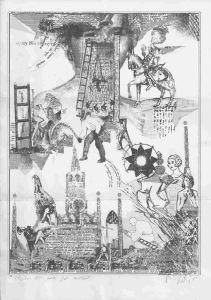
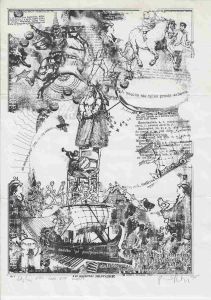
Impressão gráfica de Pawe Petasz, artista, editor e participante fundamental da Mail Art polonesa e internacional, datada de 1995 e assinada a lápis na margem inferior.
Pawel Petasz - Polonia
Categoria: Mail Art
Acervo: 04466
Data: 1995
Dimensões: 29,7 x 20,9 cm
Texto Salsa em portuguêsImpressão gráfica de Pawe
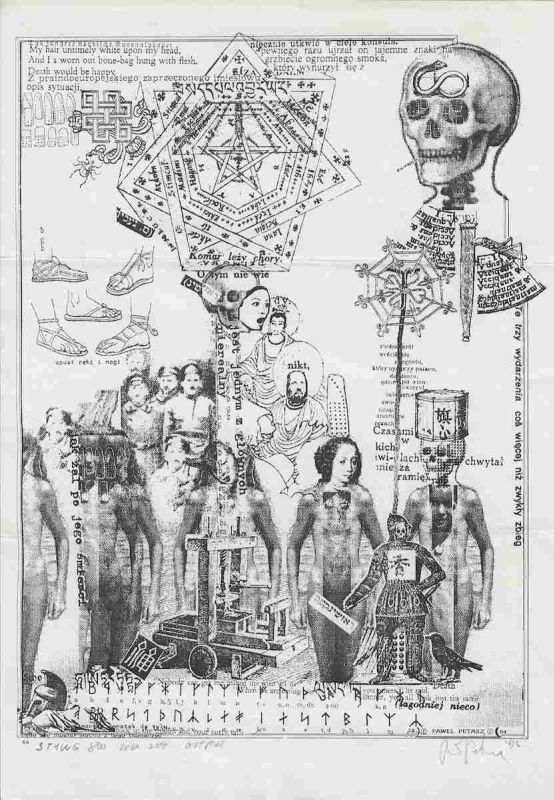
Petasz, artista, editor e participante fundamental da Mail Art polonesa e internacional, datada de 1995 e assinada a lápis na margem inferior. A composição apresenta uma estrutura visual densa construída por montagem e sobreposição de imagens, textos, sinais gráficos, fotografias, diagramas, figuras humanas, símbolos, objetos, fragmentos tipográficos e referências culturais diversas. Entre os elementos reconhecíveis aparecem um crânio, corpos humanos, figuras religiosas e históricas, formas geométricas, calçados, uma máquina ou estrutura mecânica, pássaros, sinais semelhantes a alfabetos ou sistemas de escrita e múltiplas inscrições em polonês e inglês. O trabalho estabelece relações entre corpo, morte, linguagem, tecnologia, religião, cultura visual e sistemas de comunicação, utilizando a acumulação e a justaposição como procedimentos centrais. A imagem corresponde ao ambiente conceitual e gráfico desenvolvido por Petasz em livros de artista, publicações independentes, colagens e projetos ligados à Mail Art. Em 1995 Petasz publicou o ensaio Mailed Art in Poland no livro Eternal Network. A Mail Art Anthology, editado por Chuck Welch e publicado pela University of Calgary Press, texto no qual analisou a história da arte postal na Polônia, a censura, as limitações impostas aos meios de impressão e reprodução, a circulação internacional de correspondência e sua própria experiência com Commonpress. Esses elementos históricos ajudam a contextualizar a presença recorrente de texto, apropriação gráfica, reprodução e montagem em sua produção. A assinatura manuscrita a lápis na parte inferior confirma a intervenção direta do artista sobre o exemplar e acrescenta valor documental à impressão. A obra constitui registro relevante da produção gráfica de Pawe
Petasz na década de 1990 e de sua continuidade dentro dos campos da Mail Art, poesia visual, publicação experimental, arte conceitual e comunicação artística em rede.Salsa text in EnglishGraphic print by Pawe
Petasz, Polish artist, editor and a significant figure in Polish and international Mail Art, dated 1995 and signed in pencil along the lower margin. The composition presents a densely constructed visual field based on montage and the superimposition of images, texts, graphic signs, photographs, diagrams, human figures, symbols, objects, typographic fragments and references drawn from different cultural sources. Recognizable elements include a skull, human bodies, religious and historical figures, geometric forms, shoes, a machine or mechanical structure, birds, signs resembling alphabets or writing systems and multiple inscriptions in Polish and English. The work creates relationships among the body, death, language, technology, religion, visual culture and systems of communication, using accumulation and juxtaposition as central procedures. Its visual structure is consistent with the conceptual and graphic environment developed by Petasz through artists books, independent publications, collage and Mail Art projects. In 1995 Petasz published the essay Mailed Art in Poland in Eternal Network. A Mail Art Anthology, edited by Chuck Welch and published by the University of Calgary Press. In that text he examined the history of postal art in Poland, censorship, restrictions on printing and reproduction, international correspondence networks and his own experience with Commonpress. This historical context helps explain the recurring importance of text, graphic appropriation, reproduction and montage in his artistic practice. The handwritten pencil signature at the lower edge confirms the artists direct intervention on the copy and gives the print additional documentary significance. The work is an important record of Pawe
Petasz graphic production during the 1990s and of his continuing involvement with Mail Art, visual poetry, experimental publishing, conceptual art and network based artistic communication.
Texto de observação em portuguêsImpressão gráfica de Pawe
Petasz, Polônia, datada de 1995, com assinatura manuscrita a lápis na parte inferior. A obra é composta por numerosos fragmentos visuais e textuais distribuídos em uma montagem vertical de alta densidade informacional. Na região superior aparece um grande crânio ao lado de diagramas geométricos e textos em diferentes idiomas. Ao longo da composição surgem figuras humanas, imagens religiosas, fotografias ou reproduções de grupos de pessoas, corpos masculinos e femininos, objetos mecânicos, pássaros, calçados e sinais gráficos semelhantes a alfabetos inventados ou códigos visuais. Há também palavras e frases integradas às imagens, fazendo com que texto e figura atuem conjuntamente como elementos plásticos. A composição não apresenta uma narrativa linear evidente, funcionando por associação, choque visual, repetição, apropriação e superposição de referências. Esses procedimentos são compatíveis com a produção de Petasz vinculada à Mail Art e às publicações experimentais, nas quais meios econômicos de impressão e reprodução desempenharam papel importante. No mesmo ano de 1995, Petasz publicou Mailed Art in Poland, relato histórico em que descreveu a utilização da Mail Art na Polônia, as dificuldades de impressão sob o regime comunista, a censura e a interferência postal que afetaram inclusive a coordenação de Commonpress. A impressão deve portanto ser compreendida dentro de uma trajetória em que produção gráfica, circulação, reprodução, linguagem e crítica aos sistemas de comunicação são elementos recorrentes. A assinatura a lápis permanece claramente visível na margem inferior e constitui dado material importante para catalogação, proveniência e identificação do exemplar.Observation text in EnglishGraphic print by Pawe
Petasz, Poland, dated 1995, with a handwritten pencil signature along the lower margin. The work is composed of numerous visual and textual fragments arranged in a vertically organized montage with a high density of information. In the upper area a large skull appears beside geometric diagrams and texts in different languages. Throughout the composition there are human figures, religious imagery, photographs or reproductions of groups of people, male and female bodies, mechanical objects, birds, shoes and graphic signs resembling invented alphabets or visual codes. Words and phrases are incorporated directly into the imagery, allowing text and image to function together as visual elements. The composition does not present an obvious linear narrative and instead operates through association, visual collision, repetition, appropriation and the superimposition of references. These procedures correspond closely to Petasz broader practice in Mail Art and experimental publishing, where inexpensive methods of printing and reproduction were important components of artistic production. In the same year, 1995, Petasz published Mailed Art in Poland, a historical account in which he discussed the development of postal art in Poland, limitations on printing during the Communist period, censorship and postal interference that also affected the coordination of Commonpress. The print can therefore be situated within a practice in which graphic production, circulation, reproduction, language and critical reflection on communication systems remained recurrent concerns. The pencil signature is clearly visible along the lower margin and is an important material detail for cataloguing, provenance and identification of the individual copy.
Proveniência
Coleção J. MedeirosInglês
Graphic print by Pawe Petasz, Polish artist, editor and a significant figure in Polish and international Mail Art, dated 1995 and signed in pencil along the lower margin
Dimensions: 11,7 x 8,2 in