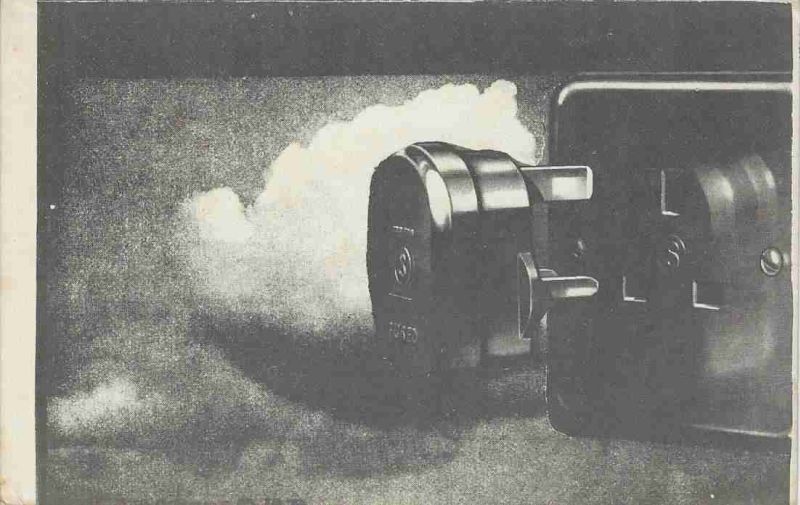
Docking Procedure é um cartão de artista criado por Opal Louis Nations no Reino Unido em 1972. O verso identifica a obra pelo título Docking Procedure, pela designação Actual Size 4 e pelo nome Opal L Nations.
Opal Louis Nations - Inglaterra
Categoria: Mail Art
Acervo: 03873
Data: 1972
Dimensões: 8,9 x 14 cm
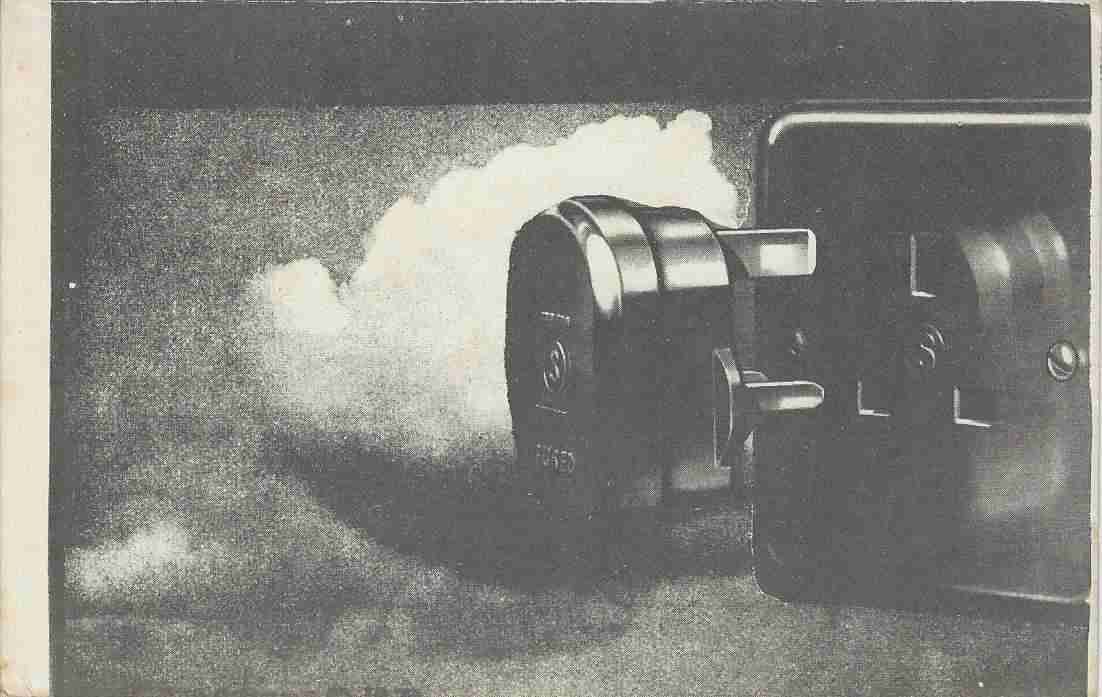
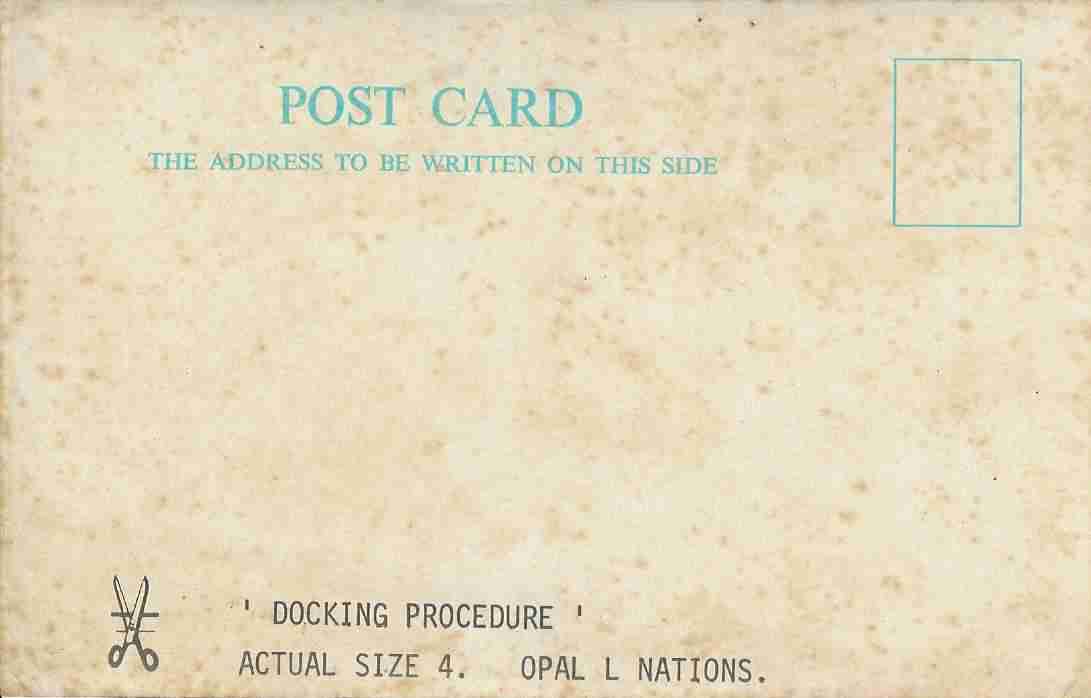
Docking Procedure é um cartão de artista criado por Opal Louis Nations no Reino Unido em 1972. O verso identifica a obra pelo título Docking Procedure, pela designação Actual Size 4 e pelo nome Opal L Nations. O objeto integra a produção experimental do artista britânico relacionada à poesia visual, à fotomontagem, à apropriação de imagens, à arte conceitual, à publicação independente, ao cartão de artista e à arte postal.A frente apresenta uma composição em preto e branco construída a partir da aproximação entre uma paisagem atmosférica e um grande mecanismo industrial. Uma massa de nuvens ocupa a região central e esquerda, enquanto a estrutura mecânica domina o lado direito. A combinação produz uma cena ambígua que pode lembrar uma operação espacial, um acoplamento técnico, uma máquina suspensa ou um dispositivo deslocado para um ambiente sem escala definida.O título Docking Procedure pode ser traduzido como Procedimento de Acoplamento. A expressão é empregada em contextos técnicos para designar a aproximação e a conexão entre veículos, embarcações, módulos, máquinas ou estruturas. No cartão, o título orienta o observador a interpretar a imagem como registro de uma operação, embora o objeto representado e o destino do acoplamento permaneçam indefinidos.A composição utiliza o contraste entre formas naturais e industriais. As nuvens apresentam contornos irregulares e aparência atmosférica, enquanto o mecanismo é formado por cilindros, superfícies metálicas, eixos, encaixes, parafusos e volumes geométricos. A obra cria uma tensão entre céu e máquina, natureza e tecnologia, leveza e peso, movimento e imobilidade.O elemento mecânico parece avançar da direita para a esquerda. Sua posição sugere aproximação, encaixe ou preparação para contato com uma estrutura que não aparece integralmente. Essa ausência impede a compreensão objetiva da operação e transforma o procedimento técnico em situação poética.A parte superior é atravessada por uma faixa escura que funciona como limite visual, cobertura ou elemento estrutural. À direita, linhas metálicas formam ângulos e prolongamentos que conectam diferentes partes da máquina. A organização desses componentes cria profundidade e reforça a sensação de que o observador vê apenas um fragmento de um sistema maior.A imagem pode ter sido apropriada de uma publicação técnica, científica, industrial, militar ou aeroespacial. O cartão não identifica a fonte original, o fotógrafo, o equipamento representado ou a circunstância da fotografia. Essas possibilidades devem permanecer como hipóteses visuais e não como identificações definitivas.A ausência de escala reconhecível amplia a ambiguidade. O mecanismo pode ser interpretado como objeto de grandes dimensões ou como detalhe ampliado de uma peça relativamente pequena. O fundo de nuvens também pode representar céu real, fumaça, vapor ou uma imagem utilizada para alterar a leitura do equipamento.A expressão Docking Procedure acrescenta uma dimensão narrativa à montagem. O espectador é colocado diante de uma ação que parece estar prestes a acontecer. O procedimento não é mostrado do início ao fim. A imagem registra apenas um instante suspenso, anterior ao contato ou à conclusão do acoplamento.Esse estado de expectativa aproxima a obra da performance e da arte processual. O título descreve uma sequência de ações, mas o cartão apresenta somente um momento. O processo permanece incompleto e depende da imaginação do observador para ser continuado.A palavra Procedure reforça o vocabulário técnico, burocrático e operacional. Ela sugere instruções, etapas, regras e controle. Entretanto, a imagem não fornece um manual nem permite compreender como o procedimento deve ser executado. A linguagem racional é deslocada para uma composição aberta e enigmática.O contraste entre precisão mecânica e indefinição atmosférica também pode ser entendido como reflexão sobre os limites do controle tecnológico. A máquina aparece detalhada e sólida, enquanto o ambiente permanece instável e sem contornos fixos. O encontro entre esses elementos cria uma imagem de conquista, risco, adaptação ou tentativa de domínio.A obra foi produzida em 1972, período marcado pela ampla circulação de imagens relacionadas à exploração espacial, à engenharia, à indústria, à comunicação tecnológica e às transformações científicas. O cartão dialoga visualmente com esse contexto, embora não apresente referência explícita a uma missão, agência ou equipamento específico.O título pode lembrar procedimentos de acoplamento realizados entre módulos e veículos espaciais. Contudo, o objeto mostrado não pode ser identificado com segurança como parte de uma nave. Para catalogação museológica, recomenda se descrever a cena como mecanismo industrial ou tecnológico diante de uma formação semelhante a nuvens, evitando atribuição técnica não comprovada.O verso mantém a estrutura tradicional de um cartão postal comercial. Aparecem as inscrições Post Card e The Address to be Written on This Side, além de um retângulo destinado à colocação de selo. Não há endereço, mensagem manuscrita, selo postal ou carimbo de circulação no exemplar apresentado.A ausência de utilização postal pode indicar que o cartão foi conservado antes do envio, distribuído pessoalmente, comercializado como edição artística ou mantido como parte de uma série. Apesar disso, sua forma postal estabelece uma relação direta com circulação, comunicação e redes de arte por correspondência.Na parte inferior do verso aparece um pequeno símbolo semelhante a uma tesoura. O mesmo sinal está presente em outros cartões de Opal Louis Nations associados à designação Actual Size 4. A tesoura pode representar recorte, edição, apropriação e montagem, procedimentos fundamentais para a construção dessas imagens.A indicação Actual Size 4 também aparece em Sleight of Hand e Battersea Queen of Bombsites, outros cartões produzidos por Opal Louis Nations em 1972. A repetição demonstra que as obras pertencem a um mesmo projeto editorial, conjunto visual ou formato padronizado.Não é possível determinar apenas pelos cartões se o número 4 corresponde ao tamanho físico, ao formato de impressão, a uma categoria editorial ou a uma série. Por isso, a expressão Actual Size 4 deve ser preservada integralmente como parte da identificação original, sem interpretação catalográfica definitiva.Docking Procedure estabelece relações com o dadaísmo e o surrealismo por meio da apropriação, da montagem e do deslocamento de imagens técnicas. Um mecanismo que poderia ter função objetiva perde sua utilidade original e passa a integrar uma situação visual estranha e imaginativa.A relação com a poesia visual ocorre pela interação entre título e imagem. A expressão verbal modifica a leitura da fotografia e produz uma narrativa que não está totalmente presente no campo visual. O texto funciona como operador poético, orientando associações entre máquina, aproximação, contato e transformação.O cartão também pode ser compreendido como reflexão sobre comunicação. Acoplar significa unir duas estruturas antes separadas. Esse princípio possui afinidade com a arte postal, na qual pessoas, lugares, imagens e mensagens são conectados por sistemas de circulação.A própria fotomontagem realiza um tipo de acoplamento. Elementos provenientes de contextos diferentes são reunidos em uma nova composição. A operação visual corresponde ao título, pois a obra conecta fotografia atmosférica, mecanismo industrial, linguagem técnica e formato postal.A máquina pode representar tecnologia, indústria, transporte, comunicação ou expansão científica. As nuvens podem sugerir distância, viagem, instabilidade ou território desconhecido. A combinação produz uma imagem aberta, sem narrativa única, na qual o processo de conexão permanece como tema central.Opal Louis Nations atuou como poeta experimental, artista visual, ilustrador, performer, editor e participante de redes internacionais de arte postal. Docking Procedure demonstra seu interesse por fotografias apropriadas, humor conceitual, vocabulário técnico, montagem visual e publicações portáteis.Não há indicação de que Opal Louis Nations tenha integrado formalmente o movimento Poema Processo. Sua relação com esse campo ocorre por afinidades com poesia visual, serialidade, montagem, reprodução gráfica, participação, comunicação e circulação postal.Docking Procedure constitui documento relevante para o estudo da produção visual de Opal Louis Nations no início da década de 1970. A obra amplia o conhecimento sobre a série Actual Size 4 e sobre a utilização do cartão postal como suporte para experiências entre fotografia, linguagem, tecnologia e poesia visual.Para indexação, recomenda se utilizar os termos Opal Louis Nations, Opal L Nations, Docking Procedure, Actual Size 4, Reino Unido, 1972, cartão de artista, arte postal, mail art, fotomontagem, fotografia apropriada, poesia visual, arte conceitual, publicação de artista, montagem gráfica, tecnologia, mecanismo industrial, acoplamento, exploração espacial, comunicação, arte experimental britânica, dadaísmo e surrealismo.TEXT FOR THE SALSA PROGRAM IN ENGLISHDocking Procedure is an artist postcard created by Opal Louis Nations in the United Kingdom in 1972. The reverse identifies the work through the title Docking Procedure, the designation Actual Size 4 and the name Opal L Nations. The object belongs to the British artist
s experimental production involving visual poetry, photomontage, appropriated imagery, conceptual art, independent publishing, artist postcards and mail art.The front presents a black and white composition combining an atmospheric landscape with a large industrial mechanism. A mass of clouds occupies the central and left areas, while the mechanical structure dominates the right side. Their combination creates an ambiguous scene resembling a technical operation, a space connection, a suspended machine or a device placed within an environment of uncertain scale.The title Docking Procedure refers to a process through which vehicles, vessels, modules, machines or structures approach and connect with one another. On the postcard, the title encourages the viewer to interpret the image as a record of an operation, although the represented object and the destination of the connection remain undefined.The composition contrasts natural and industrial forms. The clouds have irregular outlines and an atmospheric appearance, while the mechanism consists of cylinders, metallic surfaces, shafts, joints, screws and geometric volumes. The work creates tension between sky and machine, nature and technology, lightness and weight, movement and stillness.The mechanical element appears to advance from right to left. Its position suggests approach, connection or preparation for contact with a structure that is not fully visible. This absence prevents an objective understanding of the operation and transforms a technical procedure into a poetic situation.A dark horizontal band crosses the upper section and functions as a visual boundary, covering or structural component. On the right, metallic lines form angles and extensions that connect different parts of the machine. Their organization produces depth and suggests that the viewer is seeing only one fragment of a much larger system.The image may have been appropriated from a technical, scientific, industrial, military or aerospace publication. The postcard does not identify the original source, photographer, represented equipment or circumstances of the photograph. These possibilities should remain visual hypotheses rather than definitive identifications.The absence of recognizable scale increases the ambiguity. The mechanism may be interpreted as a large object or as an enlarged detail of a relatively small component. The cloud like background may represent actual sky, smoke, steam or an image used to change the interpretation of the equipment.The title introduces a narrative dimension. The viewer encounters an action that appears about to happen. The procedure is not shown from beginning to end. The postcard records only a suspended moment before contact or before completion of the connection.This state of expectation connects the work with performance and process based art. The title describes a sequence of actions, but the image presents only one moment. The process remains incomplete and depends on the viewer
s imagination for its continuation.The word Procedure reinforces technical, bureaucratic and operational language. It suggests instructions, stages, rules and control. However, the image provides no manual and does not explain how the operation should be performed. Rational language is displaced into an open and enigmatic composition.The contrast between mechanical precision and atmospheric uncertainty may also be understood as a reflection on the limits of technological control. The machine appears solid and detailed, while the surrounding environment remains unstable and without fixed outlines. Their encounter creates an image of exploration, risk, adaptation or attempted control.The work was produced in 1972, a period marked by the extensive circulation of images related to space exploration, engineering, industry, technological communication and scientific transformation. The postcard visually engages with that context, although it contains no explicit reference to a particular mission, institution or machine.The title may recall procedures through which space vehicles and modules connect. However, the object shown cannot securely be identified as part of a spacecraft. Museum cataloguing should describe it as an industrial or technological mechanism positioned before a cloud like formation and avoid unsupported technical attribution.The reverse retains the structure of a traditional commercial postcard. It contains the inscriptions Post Card and The Address to be Written on This Side, together with a rectangular field intended for postage. The documented example carries no address, handwritten message, postage or postal cancellation.The absence of postal use may indicate that the postcard was preserved before mailing, distributed personally, sold as an artistic edition or maintained as part of a series. Its postal form nevertheless establishes a direct relationship with circulation, communication and correspondence art networks.A small symbol resembling scissors appears in the lower section of the reverse. The same sign is present on other Opal Louis Nations postcards associated with the designation Actual Size 4. It may represent cutting, editing, appropriation and montage, which are fundamental processes in the construction of these images.The designation Actual Size 4 also appears on Sleight of Hand and Battersea Queen of Bombsites, other postcards produced by Opal Louis Nations in 1972. This repetition demonstrates that the works belong to the same editorial project, visual group or standardized format.The postcards alone do not establish whether the number 4 indicates physical size, printing format, editorial category or series. The expression Actual Size 4 should therefore be preserved in full as part of the original identification without definitive cataloguing interpretation.Docking Procedure has affinities with Dada and Surrealism through appropriation, montage and the displacement of technical imagery. A mechanism that may originally have possessed a practical function loses its original utility and enters a strange and imaginative visual situation.Its relationship with visual poetry lies in the interaction between title and image. The verbal expression changes the interpretation of the photograph and produces a narrative that is not entirely present within the visual field. The text functions as a poetic operator and guides associations involving machinery, approach, contact and transformation.The postcard may also be understood as a reflection on communication. Docking involves connecting structures that were previously separate. This principle has an affinity with mail art, in which people, places, images and messages are connected through systems of circulation.The photomontage itself performs a type of docking. Elements originating in different contexts are connected within a new composition. The visual operation corresponds to the title because the work joins atmospheric photography, an industrial mechanism, technical language and a postal format.The machine may represent technology, industry, transportation, communication or scientific expansion. The clouds may suggest distance, travel, instability or unknown territory. Their combination creates an open image without a single narrative, in which the process of connection remains the central subject.Opal Louis Nations worked as an experimental poet, visual artist, illustrator, performer, editor and participant in international mail art networks. Docking Procedure demonstrates his interest in appropriated photography, conceptual humour, technical vocabulary, visual montage and portable publications.No evidence identifies Opal Louis Nations as a formal participant in the Brazilian Process Poem Movement. His relationship with that field is based on affinities involving visual poetry, seriality, montage, graphic reproduction, participation, communication and postal circulation.Docking Procedure is a relevant document for studying Opal Louis Nations
s visual production during the early 1970s. It expands knowledge of the Actual Size 4 group and of his use of the postcard as a support for experiments involving photography, language, technology and visual poetry.Recommended indexing terms include Opal Louis Nations, Opal L Nations, Docking Procedure, Actual Size 4, United Kingdom, 1972, artist postcard, mail art, photomontage, appropriated photography, visual poetry, conceptual art, artists publication, graphic montage, technology, industrial mechanism, docking, space exploration, communication, British experimental art, Dada and Surrealism.
TEXTO DE OBSERVAÇÃO EM PORTUGUÊSCartão de artista de Opal Louis Nations intitulado Docking Procedure, produzido no Reino Unido em 1972. O verso registra a designação Actual Size 4 e o nome Opal L Nations.A frente apresenta uma composição em preto e branco formada por uma massa semelhante a nuvens e um grande mecanismo metálico. A estrutura contém cilindros, eixos, encaixes e componentes geométricos que sugerem uma operação de aproximação ou acoplamento.O título pode ser traduzido como Procedimento de Acoplamento. O cartão não identifica o equipamento, a fonte da fotografia, o fotógrafo ou a circunstância técnica representada. Uma relação com tecnologia industrial ou aeroespacial é visualmente possível, mas não pode ser confirmada pelo objeto.A designação Actual Size 4 também aparece em outros cartões de Opal Louis Nations de 1972. Seu significado exato não foi identificado e deve ser preservado como parte da inscrição original.O verso mantém campos impressos para endereço e selo, mas não apresenta mensagem, destinatário, franquia ou carimbo postal. O exemplar pode ter sido preservado sem circulação pelo correio.O suporte apresenta manchas, alteração de tonalidade, desgaste nas bordas e sinais de envelhecimento. A obra relaciona fotografia apropriada, montagem, linguagem técnica, poesia visual, arte conceitual e publicação experimental.OBSERVATION TEXT IN ENGLISHArtist postcard by Opal Louis Nations titled Docking Procedure, produced in the United Kingdom in 1972. The reverse records the designation Actual Size 4 and the name Opal L Nations.The front presents a black and white composition combining a cloud like mass with a large metallic mechanism. The structure contains cylinders, shafts, joints and geometric components suggesting an operation of approach or connection.The title refers to a process of docking or joining. The postcard does not identify the equipment, photographic source, photographer or technical circumstances represented. A relationship with industrial or aerospace technology is visually possible but cannot be confirmed through the object.The designation Actual Size 4 also appears on other postcards produced by Opal Louis Nations in 1972. Its precise meaning has not been established and should be preserved as part of the original inscription.The reverse retains printed fields for an address and postage but contains no message, recipient, stamp or postal cancellation. The example may have been preserved without postal circulation.The support displays stains, tonal alteration, edge wear and signs of ageing. The work connects appropriated photography, montage, technical language, visual poetry, conceptual art and experimental publishing.
Proveniência
Coleção Poema ProcessoInglês
Docking Procedure is an artist postcard created by Opal Louis Nations in the United Kingdom in 1972. The reverse identifies the work through the title Docking Procedure, the designation Actual Size 4 and the name Opal L Nations
Dimensions: 3,5 x 5,5 in