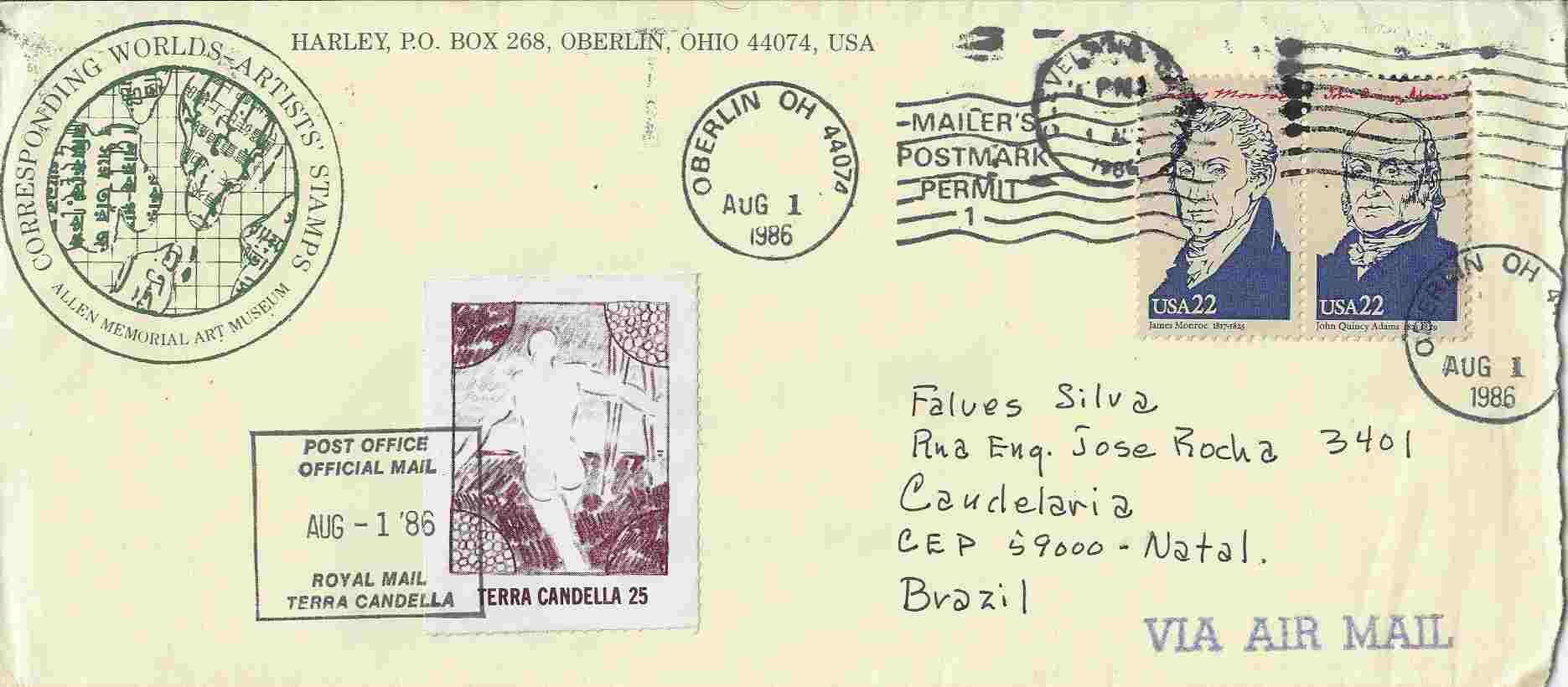
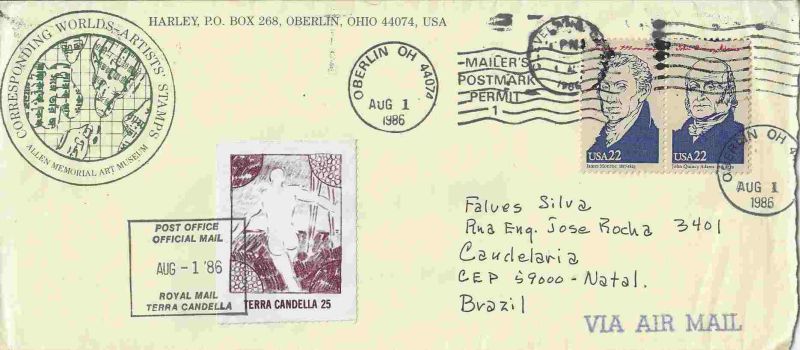
Envelope de arte postal enviado pelo artista norte americano Harley Francis, conhecido também como Harley, de Oberlin, Ohio, Estados Unidos, para Falves Silva, em Natal, Rio Grande do Norte, Brasil.
Harley Francis II - Harley Francis - USA -
Categoria: Mail Art
Acervo: 03867
Data: 1 de Agosto de 1986
Dimensões: 10,5 x 23,7 cm
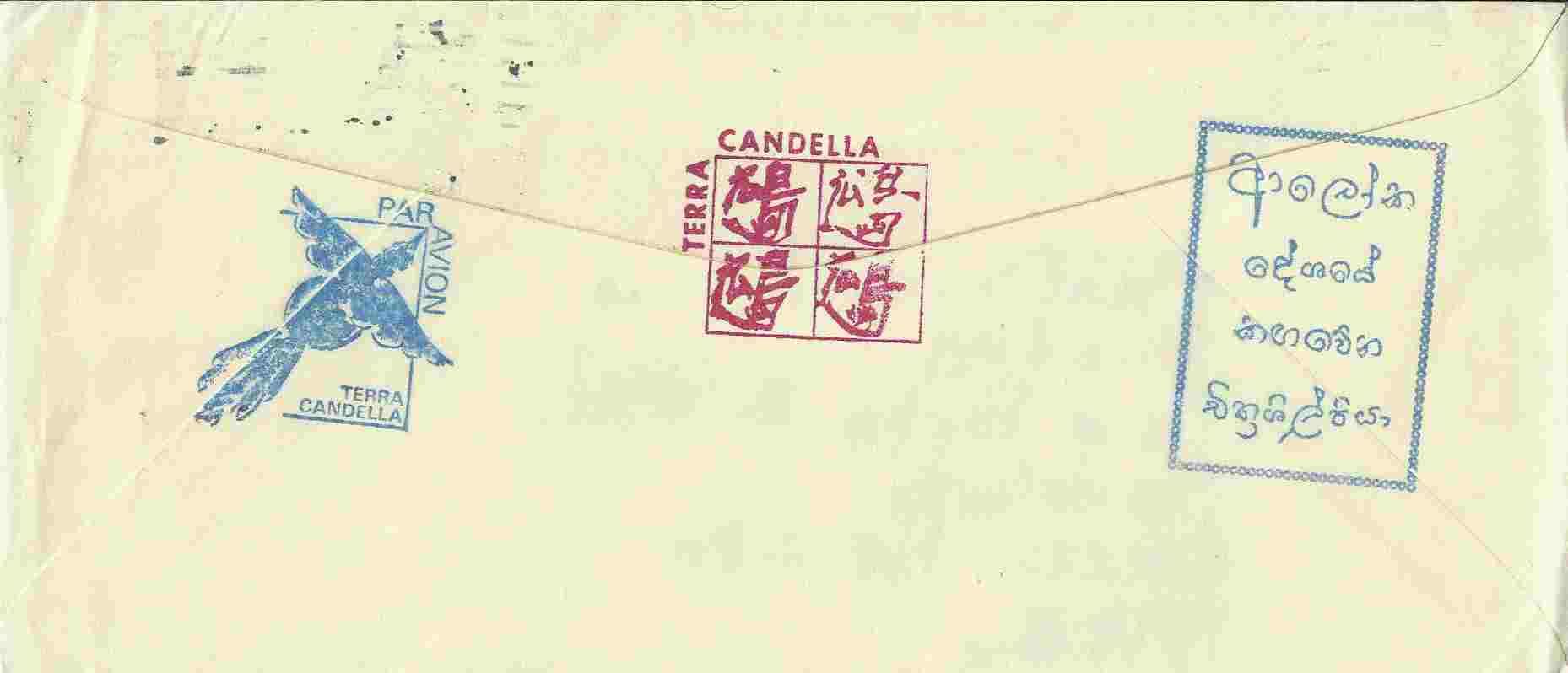
Envelope de arte postal enviado pelo artista norte americano Harley Francis, conhecido também como Harley, de Oberlin, Ohio, Estados Unidos, para Falves Silva, em Natal, Rio Grande do Norte, Brasil. Embora a descrição inicial mencione J. Medeiros, o nome manuscrito visível no envelope é Falves Silva. O documento recebeu carimbo postal de Oberlin em 1 de agosto de 1986 e foi encaminhado por correio aéreo.O remetente aparece no cabeçalho como Harley, Caixa Postal 268, Oberlin, Ohio 44074, Estados Unidos. Essa identificação relaciona o objeto a Harley Francis II, artista postal, criador de selos de artista e responsável pelo território imaginário Terra Candella. O envelope pertence ao contexto de preparação e circulação internacional do projeto Corresponding Worlds Artists Stamps, associado ao Allen Memorial Art Museum do Oberlin College.No canto superior esquerdo aparece um grande carimbo circular com as inscrições Corresponding Worlds Artists Stamps e Allen Memorial Art Museum. A imagem central do carimbo utiliza um mapa do mundo dividido em áreas gráficas e figuras, reforçando o caráter internacional da rede. O conceito de mundos correspondentes articula circulação postal, comunicação entre artistas, territórios culturais e intercâmbio de imagens.O envelope foi endereçado a Falves Silva na Rua Engenheiro José Rocha 3401, bairro Candelária, código postal 59000, Natal, Brasil. Falves Silva foi artista, poeta visual, editor e participante do movimento Poema Processo, além de possuir extensa atuação em arte postal, publicações independentes e experimentação gráfica. A correspondência comprova sua presença em uma rede internacional de artistas postais vinculada a Oberlin e ao Allen Memorial Art Museum.A postagem oficial foi realizada com dois selos norte americanos de 22 centavos. Os selos apresentam os retratos dos presidentes James Monroe e John Quincy Adams. As imagens foram parcialmente cobertas pelos carimbos postais de Oberlin, integrando o sistema oficial dos correios dos Estados Unidos à composição artística do envelope.Na região inferior esquerda encontra se um selo de artista identificado como Terra Candella 25. A imagem apresenta uma figura humana impressa em tonalidades escuras e avermelhadas. Sobre o selo foi aplicado um carimbo retangular com as inscrições Post Office Official Mail, 1 de agosto de 1986, Royal Mail e Terra Candella.Terra Candella foi um território imaginário criado por Harley Francis dentro das práticas internacionais da arte postal. O projeto possuía selos, carimbos, símbolos, linguagem administrativa e referências a uma autoridade postal própria. Ao inserir esses elementos em correspondências reais, Harley colocava o território fictício em contato direto com os sistemas postais oficiais.A frente do envelope reúne dois níveis de circulação. O primeiro é representado pelos selos oficiais dos Estados Unidos, pelos carimbos de Oberlin e pela indicação Via Air Mail. O segundo é formado pelo artistamp Terra Candella 25 e pelo carimbo Royal Mail Terra Candella. A coexistência desses elementos questiona os limites entre documento verdadeiro, ficção institucional, soberania, identidade territorial e criação artística.No verso aparecem três intervenções principais. À esquerda há um carimbo azul com a figura de uma ave em movimento, acompanhado pelas inscrições Par Avion e Terra Candella. Ao centro encontra se um carimbo vermelho com o nome Terra Candella e quatro campos preenchidos por sinais gráficos semelhantes a caligrafias ou ideogramas.À direita aparece um retângulo azul com escrita manual ou sinais gráficos cuja leitura completa não pode ser confirmada pela reprodução. Os caracteres podem funcionar como escrita inventada, assinatura visual ou mensagem codificada, mas o documento não fornece elementos suficientes para estabelecer uma interpretação definitiva.A ave presente no carimbo azul reforça os conceitos de voo, viagem e comunicação internacional. Sua posição no verso aproxima a imagem da inscrição Par Avion e do deslocamento aéreo efetivamente realizado entre Oberlin e Natal. O elemento visual funciona simultaneamente como emblema de Terra Candella e referência ao percurso físico da correspondência.O envelope não deve ser catalogado apenas como embalagem. Os carimbos, o artistamp, os selos oficiais, as inscrições, o endereço, as marcas de postagem e o percurso internacional transformam sua superfície em obra de arte postal. O objeto registra tanto a proposta artística de Harley Francis quanto a ação material dos serviços postais.Corresponding Worlds Artists Stamps estava relacionado a uma exposição e simpósio internacional de arte postal e selos de artista realizado no Allen Memorial Art Museum do Oberlin College em 1987. O envelope de 1986 pertence ao período de organização, convocação, divulgação e intercâmbio de materiais anterior ao evento.A presença do nome de Falves Silva e do carimbo institucional do Allen Memorial Art Museum sugere que a remessa estava relacionada à participação, convite, comunicação ou solicitação de materiais para Corresponding Worlds Artists Stamps. Como o conteúdo interno não foi apresentado, a finalidade exata do envio não pode ser confirmada.O documento estabelece uma ligação direta entre Harley Francis, Terra Candella, Corresponding Worlds Artists Stamps, o Allen Memorial Art Museum e Falves Silva. Essa conexão relaciona o circuito norte americano de artistamps à produção experimental brasileira desenvolvida em Natal.Harley Francis utilizava selos de artista e sistemas postais imaginários para criar identidades, territórios e instituições paralelas. Terra Candella transforma o selo, o carimbo e a administração postal em componentes de uma narrativa conceitual. O artista não apenas enviava uma obra pelo correio. Ele criava simbolicamente o país, a autoridade e o sistema responsáveis por sua circulação.Falves Silva não aparece apenas como destinatário passivo. Sua participação na rede internacional é confirmada pelo recebimento e preservação do objeto. O envelope demonstra que artistas vinculados ao Poema Processo mantiveram contato com projetos internacionais de arte postal, artistamps, exposições museológicas e arquivos de correspondência.Não há evidência de que Harley Francis tenha integrado formalmente o movimento Poema Processo. Sua relação com esse campo ocorre pelo contato direto com Falves Silva e pelas afinidades entre arte postal, poesia visual, serialidade, sistemas gráficos, reprodução, circulação, participação e comunicação.O envelope constitui fonte primária para o estudo da arte postal norte americana, dos selos de artista, do projeto Terra Candella, da exposição Corresponding Worlds Artists Stamps e das relações entre Oberlin e Natal. Também contribui para documentar a circulação internacional da obra e do nome de Falves Silva durante a década de 1980.TEXT FOR THE SALSA PROGRAM IN ENGLISHMail art envelope sent by the American artist Harley Francis, also known as Harley, from Oberlin, Ohio, United States, to Falves Silva in Natal, Rio Grande do Norte, Brazil. Although the initial description mentions J. Medeiros, the handwritten recipient visible on the envelope is Falves Silva. The document received an Oberlin postal cancellation dated 1 August 1986 and was transmitted by airmail.The sender is identified in the heading as Harley, Post Office Box 268, Oberlin, Ohio 44074, United States. This identification connects the object with Harley Francis II, a mail artist, artistamp creator and founder of the imaginary territory Terra Candella. The envelope belongs to the preparatory and international circulation context of Corresponding Worlds Artists Stamps, associated with the Allen Memorial Art Museum at Oberlin College.A large circular mark in the upper left corner contains the inscriptions Corresponding Worlds Artists Stamps and Allen Memorial Art Museum. Its central image uses a world map divided into graphic areas and figures, reinforcing the international character of the network. The concept of corresponding worlds brings together postal circulation, communication among artists, cultural territories and the exchange of images.The envelope was addressed to Falves Silva at Rua Engenheiro José Rocha 3401, Candelária, postal code 59000, Natal, Brazil. Falves Silva was an artist, visual poet, editor and participant in the Process Poem Movement, with an extensive practice in mail art, independent publishing and graphic experimentation. The correspondence confirms his presence within an international mail art network connected with Oberlin and the Allen Memorial Art Museum.Official postage consisted of two United States stamps valued at 22 cents. The stamps portray Presidents James Monroe and John Quincy Adams. Their images were partially covered by Oberlin postal cancellations, integrating the official United States postal system into the artistic composition of the envelope.An artistamp identified as Terra Candella 25 appears in the lower left area. It presents a human figure printed in dark and reddish tones. A rectangular mark applied over the artistamp contains the inscriptions Post Office Official Mail, 1 August 1986, Royal Mail and Terra Candella.Terra Candella was an imaginary territory created by Harley Francis within international mail art practices. The project possessed its own stamps, postal marks, symbols, administrative language and references to an independent postal authority. By inserting these elements into actual correspondence, Harley brought the fictional territory into direct contact with official postal systems.The front of the envelope contains two levels of circulation. The first is represented by official United States postage, Oberlin cancellations and the inscription Via Air Mail. The second consists of the Terra Candella 25 artistamp and the Royal Mail Terra Candella mark. Their coexistence questions the boundaries between authentic document, institutional fiction, sovereignty, territorial identity and artistic creation.Three principal interventions appear on the reverse. On the left is a blue mark featuring a bird in motion with the inscriptions Par Avion and Terra Candella. In the centre is a red Terra Candella mark divided into four fields containing graphic signs resembling calligraphy or ideograms.On the right is a blue rectangular frame containing handwriting or graphic characters whose complete reading cannot be confirmed from the reproduction. They may function as invented writing, a visual signature or an encoded message, but the document does not provide sufficient evidence for a definitive interpretation.The bird in the blue mark reinforces the concepts of flight, travel and international communication. Its placement on the reverse connects the image with the Par Avion inscription and the actual aerial journey between Oberlin and Natal. The visual element operates both as an emblem of Terra Candella and as a reference to the physical route of the correspondence.The envelope should not be catalogued only as packaging. Its rubber stamps, artistamp, official postage, inscriptions, address, postal cancellations and international route transform the surface into a mail art work. The object records both Harley Francis
s artistic proposition and the material action of postal services.Corresponding Worlds Artists Stamps was connected with an international mail art and artistamp exhibition and symposium held at the Allen Memorial Art Museum at Oberlin College in 1987. The envelope from 1986 belongs to the period of organization, invitation, promotion and exchange of materials preceding the event.The presence of Falves Silva
s name and the institutional mark of the Allen Memorial Art Museum suggests that the mailing concerned participation, invitation, communication or a request for material for Corresponding Worlds Artists Stamps. Since the internal contents have not been presented, the precise purpose of the mailing cannot be confirmed.The document establishes a direct connection among Harley Francis, Terra Candella, Corresponding Worlds Artists Stamps, the Allen Memorial Art Museum and Falves Silva. This relationship connects the North American artistamp circuit with experimental artistic production in Natal.Harley Francis used artistamps and imaginary postal systems to construct parallel identities, territories and institutions. Terra Candella transformed postage, rubber stamps and postal administration into components of a conceptual narrative. The artist did not simply send an artwork through the mail. He symbolically created the country, authority and system responsible for its circulation.Falves Silva does not appear only as a passive recipient. His participation in the international network is confirmed by the reception and preservation of the object. The envelope demonstrates that artists associated with the Process Poem Movement maintained contact with international mail art projects, artistamps, museum exhibitions and correspondence archives.No evidence identifies Harley Francis as a formal participant in the Process Poem Movement. His relationship with this field is established through direct contact with Falves Silva and through affinities involving mail art, visual poetry, seriality, graphic systems, reproduction, circulation, participation and communication.The envelope is a primary source for the study of American mail art, artistamps, the Terra Candella project, Corresponding Worlds Artists Stamps and the relationship between Oberlin and Natal. It also contributes to documenting the international circulation of Falves Silva
s work and name during the 1980s.
Envelope de arte postal enviado por Harley Francis, de Oberlin, Ohio, Estados Unidos, para Falves Silva, em Natal, Brasil. Apesar da indicação inicial de J. Medeiros, o destinatário manuscrito visível no objeto é Falves Silva.O envelope recebeu carimbo postal de Oberlin em 1 de agosto de 1986 e apresenta a identificação Corresponding Worlds Artists Stamps, Allen Memorial Art Museum. A postagem foi realizada por correio aéreo com dois selos oficiais norte americanos de 22 centavos dedicados a James Monroe e John Quincy Adams.Na frente aparece o selo de artista Terra Candella 25, acompanhado por carimbo com as inscrições Post Office Official Mail, Royal Mail e Terra Candella. No verso encontram se um carimbo azul Par Avion Terra Candella com imagem de ave, um carimbo vermelho Terra Candella dividido em quatro campos e um retângulo azul com sinais gráficos de leitura não confirmada.O objeto documenta uma conexão direta entre Harley Francis, o território imaginário Terra Candella, o projeto Corresponding Worlds Artists Stamps, o Allen Memorial Art Museum e Falves Silva. O conteúdo interno do envelope não foi apresentado e a função exata da remessa não pode ser determinada.OBSERVATION TEXT IN ENGLISHMail art envelope sent by Harley Francis from Oberlin, Ohio, United States, to Falves Silva in Natal, Brazil. Despite the initial reference to J. Medeiros, the handwritten recipient visible on the object is Falves Silva.The envelope received an Oberlin postal cancellation dated 1 August 1986 and contains the identification Corresponding Worlds Artists Stamps, Allen Memorial Art Museum. It was sent by airmail with two official United States 22 cent stamps portraying James Monroe and John Quincy Adams.The front contains a Terra Candella 25 artistamp with a mark bearing the inscriptions Post Office Official Mail, Royal Mail and Terra Candella. The reverse presents a blue Par Avion Terra Candella bird mark, a red Terra Candella mark divided into four fields and a blue rectangle containing graphic signs whose reading remains unconfirmed.The object documents a direct connection among Harley Francis, the imaginary territory Terra Candella, the Corresponding Worlds Artists Stamps project, the Allen Memorial Art Museum and Falves Silva. The internal contents have not been presented, and the precise function of the mailing cannot be established.
Proveniência
Coleção Falves SilvaInglês
Mail art envelope sent by the American artist Harley Francis, also known as Harley, from Oberlin, Ohio, United States, to Falves Silva in Natal, Rio Grande do Norte, Brazil. Although the initial description mentions J. Medeiros, the handwritten recip
Dimensions: 4,1 x 9,3 in