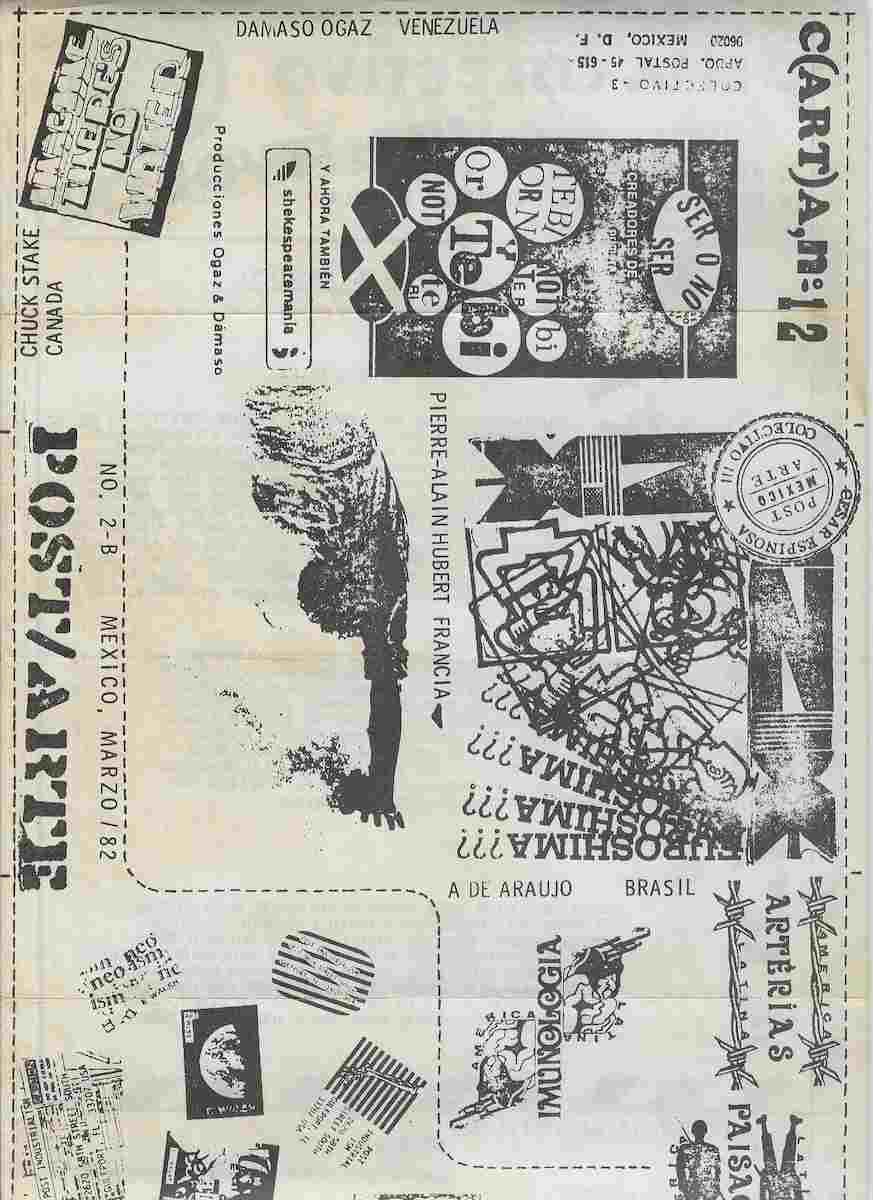
C(ART)A número 12 é uma publicação experimental de arte postal organizada por Dámaso Ogaz, artista, poeta e editor chileno radicado na Venezuela. O documento foi produzido em março de 1982 e aparece relacionado à publicação POST ARTE número 2 B, editada no México.
Damaso Ogaz
Categoria: Mail Art
Acervo: 03853
Data: Março de 1982
Dimensões: 34 x 21,5 cm
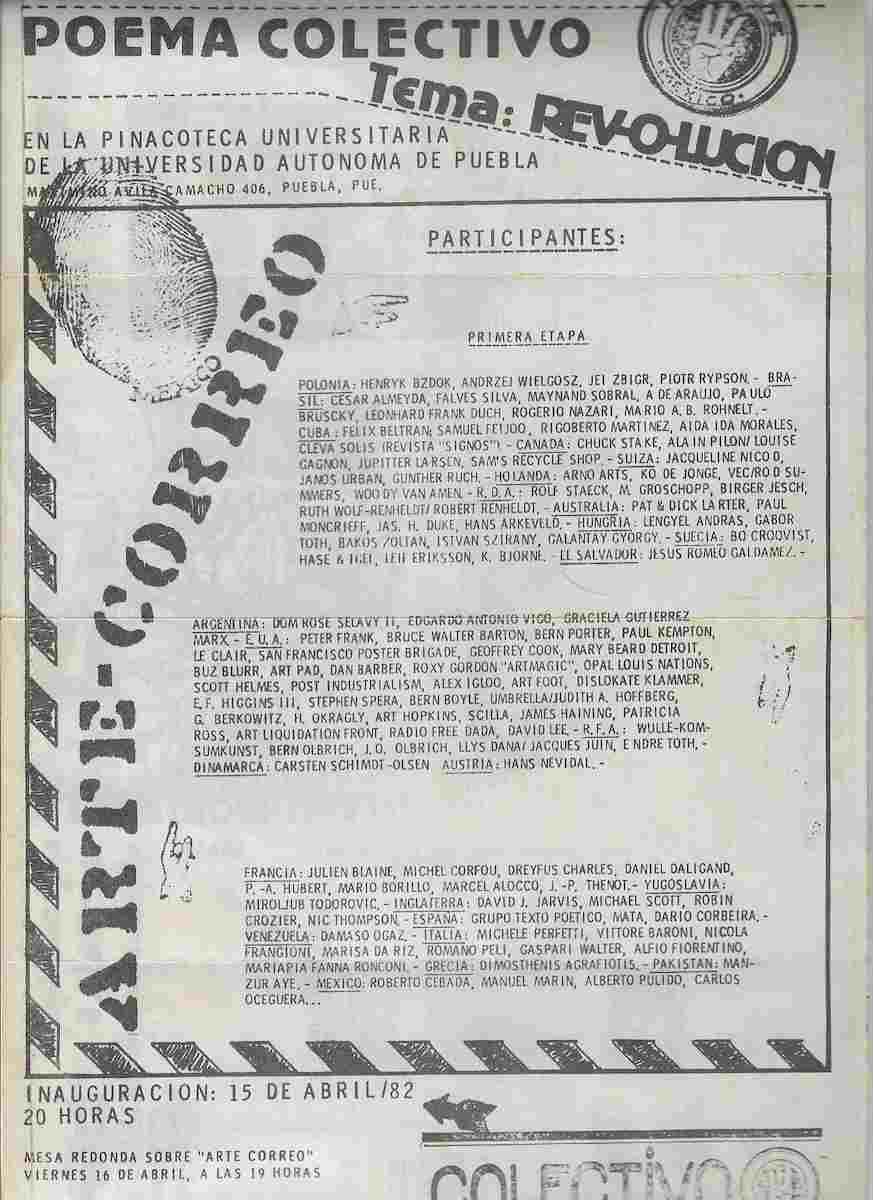
C(ART)A número 12 é uma publicação experimental de arte postal organizada por Dámaso Ogaz, artista, poeta e editor chileno radicado na Venezuela. O documento foi produzido em março de 1982 e aparece relacionado à publicação POST ARTE número 2 B, editada no México. Sua estrutura reúne colagem, reprodução gráfica, carimbos, fragmentos tipográficos, imagens apropriadas, nomes de artistas, endereços e informações sobre uma exposição internacional de arte correio.O título C(ART)A realiza uma operação verbal e visual entre as palavras carta e arte. A inserção de ART dentro de CARTA transforma a correspondência em linguagem artística e indica que o suporte postal, a circulação e o intercâmbio entre participantes constituem partes essenciais da obra. O número 12 identifica esta edição dentro da série desenvolvida por Dámaso Ogaz.Uma das faces apresenta uma composição formada por contribuições e referências de diferentes participantes da rede internacional. Na margem superior encontra se a identificação DAMASO OGAZ VENEZUELA. Também aparecem as indicações Producciones Ogaz y Damaso, C(ART)A número 12, POST ARTE número 2 B, México e marzo 82.A composição funciona como uma cartografia gráfica da arte postal. Os materiais são distribuídos sem uma hierarquia única, criando uma superfície de leitura fragmentada. Carimbos, imagens, inscrições e nomes ocupam direções diferentes, obrigando o observador a girar a página e reconstruir relações entre autores, países e projetos.Entre os participantes e referências visíveis encontram se Chuck Stake, do Canadá, Pierre Alain Hubert, da França, A. de Araújo, do Brasil, além de marcas relacionadas a Arte Rías, Maniología e produções coletivas. Também aparece um carimbo circular referente a poesia, México, arte correio e atividade coletiva. Algumas inscrições estão parcialmente sobrepostas ou desgastadas e não podem ser transcritas com segurança.A outra face reproduz o cartaz do projeto Poema Colectivo, com o tema Revolución. O evento foi realizado na Pinacoteca Universitaria da Universidad Autónoma de Puebla, no México. O endereço indicado é 2 Norte número 1404, Puebla, Puebla.A inauguração estava marcada para 15 de abril de 1982, às 20 horas. O programa também anunciava uma mesa redonda sobre arte correio para sexta feira, 16 de abril, às 19 horas. O documento associa diretamente a publicação C(ART)A número 12 à difusão de uma exposição coletiva internacional e a um debate público sobre a arte postal.O projeto Poema Colectivo tema Revolución reuniu participantes de numerosos países da América Latina, América do Norte, Europa e Ásia. A lista está organizada por países e corresponde à primeira etapa da iniciativa. Essa estrutura demonstra a dimensão internacional alcançada pelas redes de arte correio no início da década de 1980.Entre os participantes brasileiros legíveis aparecem César Almeida, Falves Silva, Maynand Sobral, A. de Araújo, Paulo Bruscky e Rogério Nazari. A presença desses artistas relaciona a exposição mexicana às redes brasileiras de poesia visual, arte postal, publicação experimental e práticas conceituais.A lista também registra artistas vinculados a outros núcleos latino americanos, entre eles Edgardo Antonio Vigo e Graciela Gutiérrez Marx, da Argentina, Félix Beltrán e Samuel Feijóo, de Cuba, Jesús Romeo Galdámez, de El Salvador, e Dámaso Ogaz, representando a Venezuela.Entre os participantes europeus e internacionais identificáveis encontram se Henryk Bzdok, Andrzej Wielgosz e Piotr Rypson, da Polônia, Julien Blaine, Pierre Alain Hubert e Jean Pierre Thenot, da França, Miroljub Todorovi
, da antiga Iugoslávia, David J. Jarvis, Michael Scott e Robin Crozier, da Inglaterra, Michele Perfetti, Vittore Baroni e Nicola Frangione, da Itália, além de Dimosthenis Agrafiotis, da Grécia.Também aparecem nomes amplamente relacionados à arte postal internacional, como Bern Porter, Geoffrey Cook, Buzz Blurr, Scott Helmes, Klaus Groh, Robert Rehfeldt, Ruth Wolf Rehfeldt, Rolf Staeck, Michael Groschopp e Anna Banana. Nem todas as nacionalidades e grafias podem ser confirmadas apenas pela reprodução disponível, mas o conjunto comprova a amplitude geográfica da convocatória.O tema Revolución deve ser compreendido tanto em sentido político quanto artístico. A palavra é apresentada em grande destaque e atravessa a composição do cartaz. O projeto propunha a criação de um poema coletivo desenvolvido por meio da soma de intervenções individuais, correspondências, imagens, textos, carimbos e ações provenientes de diferentes contextos culturais.A noção de poema coletivo aproxima a obra de princípios de participação, circulação e transformação. O resultado não depende de um único autor, mas da articulação de uma rede de produtores. Cada contribuição conserva sua individualidade e, simultaneamente, integra uma estrutura coletiva maior.Essa concepção apresenta proximidade com questões desenvolvidas pelo Poema Processo, especialmente a participação do consumidor criativo, a abertura da obra, a multiplicação de versões e a substituição da autoria isolada por uma produção compartilhada. Entretanto, o documento não afirma que o projeto mexicano tenha integrado formalmente o movimento brasileiro Poema Processo. A relação deve ser entendida como proximidade entre experiências latino americanas de criação coletiva e comunicação experimental.C(ART)A número 12 demonstra o papel de Dámaso Ogaz como articulador, editor e difusor de redes internacionais. A publicação não apenas apresenta obras, mas reúne informações, conecta participantes, divulga eventos e transforma a correspondência em arquivo coletivo. Sua estrutura evidencia que a arte postal também funcionava como sistema descentralizado de comunicação cultural.Para fins de catalogação e indexação, o documento pode ser identificado como C(ART)A número 12, Dámaso Ogaz, Venezuela, POST ARTE número 2 B, México, março de 1982, Poema Colectivo tema Revolución, Pinacoteca Universitaria, Universidad Autónoma de Puebla, exposição internacional de arte postal, poesia visual, publicação de artista, mail art latino americana, arte conceitual, rede internacional de correspondência, arte correio e criação coletiva.Text for the Salsa program in EnglishC(ART)A number 12 is an experimental mail art publication organized by Dámaso Ogaz, the Chilean born artist, poet and editor based in Venezuela. The document was produced in March 1982 and is connected with POST ARTE number 2 B, published in Mexico. Its structure brings together collage, graphic reproduction, rubber stamps, typographic fragments, appropriated images, artists names, addresses and information concerning an international mail art exhibition.The title C(ART)A creates a verbal and visual operation between the Spanish words carta and arte. By inserting ART into CARTA, the publication transforms correspondence into artistic language and indicates that the postal support, circulation and exchange among participants are essential components of the work. The number 12 identifies this issue within the series developed by Dámaso Ogaz.One side presents a composition made from contributions and references associated with different participants in the international network. The upper margin bears the identification DAMASO OGAZ VENEZUELA. The inscriptions Producciones Ogaz y Damaso, C(ART)A number 12, POST ARTE number 2 B, Mexico and March 1982 are also visible.The composition functions as a graphic map of mail art. Materials are arranged without a single hierarchy, creating a fragmented reading surface. Rubber stamps, images, inscriptions and names follow different directions, requiring the viewer to rotate the page and reconstruct relationships among authors, countries and projects.Visible participants and references include Chuck Stake from Canada, Pierre Alain Hubert from France and A. de Araújo from Brazil, as well as marks connected with Arte Rías, Maniología and collective productions. A circular stamp referring to poetry, Mexico, mail art and collective activity is also present. Some inscriptions overlap or are worn and cannot be transcribed with complete certainty.The reverse reproduces the poster for the project Poema Colectivo, with the theme Revolución. The event took place at the Pinacoteca Universitaria of the Universidad Autónoma de Puebla in Mexico. The address is given as 2 Norte number 1404, Puebla, Puebla.The opening was scheduled for 15 April 1982 at 8 pm. The programme also announced a round table on mail art for Friday, 16 April, at 7 pm. The document therefore directly connects C(ART)A number 12 with the dissemination of an international collective exhibition and a public discussion concerning postal art.Poema Colectivo tema Revolución brought together participants from numerous countries in Latin America, North America, Europe and Asia. The list is organized by country and identified as the first stage of the initiative. This structure demonstrates the international scale reached by mail art networks in the early 1980s.The legible Brazilian participants include César Almeida, Falves Silva, Maynand Sobral, A. de Araújo, Paulo Bruscky and Rogério Nazari. Their presence connects the Mexican exhibition with Brazilian networks of visual poetry, mail art, experimental publishing and conceptual practices.The list also records artists associated with other Latin American centres, including Edgardo Antonio Vigo and Graciela Gutiérrez Marx from Argentina, Félix Beltrán and Samuel Feijóo from Cuba, Jesús Romeo Galdámez from El Salvador and Dámaso Ogaz representing Venezuela.Identifiable European and international participants include Henryk Bzdok, Andrzej Wielgosz and Piotr Rypson from Poland, Julien Blaine, Pierre Alain Hubert and Jean Pierre Thenot from France, Miroljub Todorovi
from the former Yugoslavia, David J. Jarvis, Michael Scott and Robin Crozier from England, Michele Perfetti, Vittore Baroni and Nicola Frangione from Italy, and Dimosthenis Agrafiotis from Greece.The list also contains names widely associated with international mail art, including Bern Porter, Geoffrey Cook, Buzz Blurr, Scott Helmes, Klaus Groh, Robert Rehfeldt, Ruth Wolf Rehfeldt, Rolf Staeck, Michael Groschopp and Anna Banana. Not every nationality or spelling can be securely confirmed from the available reproduction, but the ensemble documents the broad geographical scope of the call.The theme Revolución can be understood in both political and artistic terms. The word is prominently displayed and crosses the poster composition. The project proposed a collective poem developed through the combination of individual interventions, correspondence, images, texts, rubber stamps and actions originating in different cultural contexts.The concept of a collective poem connects the work with participation, circulation and transformation. The result does not depend upon a single author but upon the articulation of a network of producers. Each contribution preserves its individuality while becoming part of a larger collective structure.This conception presents affinities with ideas developed by the Process Poem Movement, particularly the creative participation of the consumer, the openness of the work, the multiplication of versions and the replacement of isolated authorship by shared production. The document does not state, however, that the Mexican project formally belonged to the Brazilian Process Poem Movement. The relationship should be understood as a connection among Latin American experiences of collective creation and experimental communication.C(ART)A number 12 demonstrates Dámaso Ogaz's role as an organizer, editor and disseminator within international networks. The publication not only presents works but also gathers information, connects participants, announces events and transforms correspondence into a collective archive. Its structure shows that mail art also operated as a decentralized system of cultural communication.For cataloguing and indexing purposes, the document may be identified as C(ART)A number 12, Dámaso Ogaz, Venezuela, POST ARTE number 2 B, Mexico, March 1982, Poema Colectivo tema Revolución, Pinacoteca Universitaria, Universidad Autónoma de Puebla, international mail art exhibition, visual poetry, artists publication, Latin American mail art, conceptual art, international correspondence network, postal art and collective creation.
Publicação impressa em preto sobre papel claro, composta por duas faces. O documento apresenta sinais de dobramento, manchas, desgaste, pequenas perdas de definição e variações na intensidade da impressão.Uma das faces contém uma montagem visual com imagens, carimbos, logotipos, textos e nomes de participantes. A composição foi organizada em diferentes orientações, exigindo a rotação da folha para sua leitura. Na margem aparece a identificação C(ART)A número 12 e a referência POST ARTE número 2 B, México, março de 1982.Também estão visíveis as inscrições DAMASO OGAZ VENEZUELA e Producciones Ogaz y Damaso. Entre as contribuições identificáveis encontram se referências a Chuck Stake, Canadá, Pierre Alain Hubert, França, e A. de Araújo, Brasil.A outra face reproduz o cartaz Poema Colectivo tema Revolución. O evento foi realizado na Pinacoteca Universitaria da Universidad Autónoma de Puebla, situada na 2 Norte número 1404, Puebla, México.A inauguração foi anunciada para 15 de abril de 1982, às 20 horas. Uma mesa redonda sobre arte correio foi programada para 16 de abril, às 19 horas.A relação de participantes está identificada como Primera Etapa e organizada por países. A qualidade da reprodução, o tamanho reduzido dos caracteres e a sobreposição de marcas impedem uma transcrição integral absolutamente segura. Os nomes mais legíveis devem ser registrados individualmente, enquanto os demais precisam ser confirmados por confronto com outro exemplar ou com o catálogo original do evento.O documento deve ser preservado integralmente e catalogado como publicação de artista, cartaz, boletim de arte postal e registro documental de exposição. As duas faces são essenciais para compreender sua função simultânea como obra, meio de divulgação, lista de participantes e arquivo da rede internacional.Observation text in EnglishPublication printed in black on light coloured paper and composed of two sides. The document shows folds, staining, wear, minor losses of definition and variations in printing intensity.One side contains a visual montage of images, rubber stamps, logos, texts and participants names. The composition follows different orientations and requires the sheet to be rotated during reading. The margin bears the identification C(ART)A number 12 and the reference POST ARTE number 2 B, Mexico, March 1982.The inscriptions DAMASO OGAZ VENEZUELA and Producciones Ogaz y Damaso are also visible. Identifiable contributions include references to Chuck Stake from Canada, Pierre Alain Hubert from France and A. de Araújo from Brazil.The other side reproduces the poster Poema Colectivo tema Revolución. The event took place at the Pinacoteca Universitaria of the Universidad Autónoma de Puebla, located at 2 Norte number 1404, Puebla, Mexico.The opening was announced for 15 April 1982 at 8 pm. A round table on mail art was scheduled for 16 April at 7 pm.The participant list is identified as Primera Etapa and organized by country. The reproduction quality, small character size and overlapping marks prevent a completely reliable transcription of every name. The clearest names should be individually recorded, while the remaining entries require comparison with another copy or with the original exhibition catalogue.The document should be preserved in its entirety and catalogued as an artists publication, poster, mail art bulletin and documentary record of an exhibition. Both sides are essential for understanding its simultaneous function as artwork, announcement, participant list and archive of an international network.
Inglês
C(ART)A number 12 is an experimental mail art publication organized by Dámaso Ogaz, the Chilean born artist, poet and editor based in Venezuela. The document was produced in March 1982 and is connected with POST ARTE number 2 B, published in Mexico.
Dimensions: 13,4 x 8,5 in