C(ART)A número 16 é uma publicação de arte postal e poesia experimental concebida por Dámaso Ogaz, artista, poeta e editor chileno radicado na Venezuela
Damaso Ogaz
Categoria: Mail Art
Acervo: 03854
Dimensões: 28 x 21,5 cm
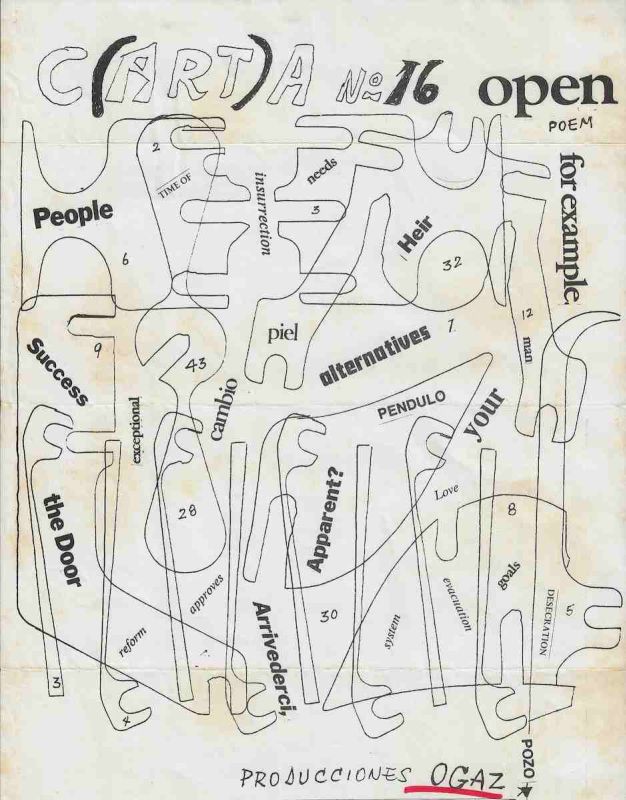
C(ART)A número 16 é uma publicação de arte postal e poesia experimental concebida por Dámaso Ogaz, artista, poeta e editor chileno radicado na Venezuela. A composição apresenta o título C(ART)A número 16 e a expressão open poem, acompanhada por uma extensa estrutura gráfica formada por linhas contínuas, palavras em diferentes orientações, números e zonas de sobreposição.O título C(ART)A funde as palavras carta e arte. A inserção de ART no interior da palavra CARTA transforma a correspondência em obra e indica que mensagem, suporte, circulação e participação fazem parte do trabalho. A expressão open poem identifica a publicação como poema aberto, construído para admitir percursos variados de leitura e diferentes formas de interpretação.A obra não apresenta uma sequência verbal única. Palavras em inglês, espanhol, português e possivelmente outros idiomas estão distribuídas livremente sobre a página. O leitor precisa escolher direções, estabelecer relações e criar ligações entre termos dispersos. A leitura pode começar em qualquer ponto e seguir trajetos distintos, sem uma ordem obrigatória.Entre as palavras legíveis aparecem People, Time of, resurrection, needs, Their, for example, Success, piel, alternatives, cambio, pendulo, your, the Door, reform, approves, Apparent, Arrivederci, Love, education, goals, system, desecration, man e pozo. A presença de idiomas diferentes reforça o caráter internacional da obra e sua relação com as redes transnacionais de arte postal.Os termos combinam referências sociais, políticas, corporais, afetivas e existenciais. People aproxima a composição da experiência coletiva. Resurrection sugere renovação ou retorno. Needs e alternatives remetem a necessidades e possibilidades de mudança. Cambio introduz diretamente a ideia de transformação. Reform e system situam a leitura em um campo político e institucional. Love e education inserem dimensões afetivas e pedagógicas. Desecration cria uma tensão crítica diante de valores consolidados.A palavra piel, que significa pele em espanhol, introduz uma dimensão corporal. A escrita parece percorrer superfícies orgânicas ou figuras humanas esquematizadas. As linhas sinuosas formam perfis, membros, cavidades e estruturas que podem ser interpretadas como corpos, caminhos, mapas ou circuitos.A composição gráfica é formada por linhas finas que atravessam toda a página. Algumas delimitam formas semelhantes a silhuetas humanas. Outras conectam palavras e números, criando uma rede de percursos. As figuras se sobrepõem, anulando a separação entre texto e desenho. A linguagem verbal transforma se em elemento visual, enquanto o desenho atua como sistema de leitura.Diversos números aparecem próximos às palavras e às formas, entre eles 2, 6, 9, 12, 28, 30, 32 e 43. Sua função não está explicada no documento. Eles podem constituir índices, etapas, posições, referências ou elementos de um código aberto. Sem instruções complementares, devem ser registrados como componentes estruturais não decifrados.A obra exige participação ativa. O observador pode seguir uma linha, combinar palavras, associar números, alterar a direção da folha e produzir uma leitura particular. Cada percurso gera uma configuração diferente. Assim, o poema não se limita a transmitir uma mensagem pronta, mas apresenta um sistema de possibilidades.A expressão open poem confirma essa estrutura aberta. O poema funciona como campo de operações, e não como texto fechado. A página oferece materiais que podem ser reorganizados mentalmente pelo participante. A multiplicidade de caminhos impede uma conclusão única e transforma a leitura em processo.Na parte inferior aparece a inscrição manuscrita PRODUCCIONES OGAZ, identificando a iniciativa editorial ou produtiva de Dámaso Ogaz. Próximo à margem inferior direita também aparece a palavra POZO em orientação vertical. Não há data, cidade, tiragem, destinatário ou indicação postal visível na face apresentada.C(ART)A número 16 relaciona se à arte postal, à poesia visual, à poesia experimental, à publicação de artista, à arte conceitual e às práticas intermediais latino americanas. A obra utiliza a página como território de circulação de signos e transforma o leitor em participante da construção do sentido.A relação com o Poema Processo deve ser descrita como proximidade conceitual. A obra apresenta abertura, participação, multiplicidade de percursos, estrutura combinatória e transformação da leitura em ação. Contudo, o documento não comprova que Dámaso Ogaz tenha integrado formalmente o movimento brasileiro Poema Processo.Para fins de catalogação e indexação, o documento pode ser identificado como Dámaso Ogaz, C(ART)A número 16, Open Poem, Producciones Ogaz, Venezuela, arte postal, poesia visual, poesia experimental, poema aberto, publicação de artista, arte conceitual, escrita espacial, texto multilíngue, participação do leitor, redes internacionais de mail art e vanguarda latino americana.Text for the Salsa program in EnglishC(ART)A number 16 is a mail art and experimental poetry publication conceived by Dámaso Ogaz, the Chilean born artist, poet and editor based in Venezuela. The composition presents the title C(ART)A number 16 and the expression open poem, accompanied by an extensive graphic structure formed by continuous lines, words in different orientations, numbers and overlapping areas.The title C(ART)A merges the Spanish words carta and arte. The insertion of ART within CARTA transforms correspondence into artwork and indicates that message, support, circulation and participation are integral parts of the piece. The expression open poem identifies the publication as an open poem designed to admit varied reading paths and different forms of interpretation.The work does not present a single verbal sequence. Words in English, Spanish, Portuguese and possibly other languages are freely distributed across the page. The reader must choose directions, establish relationships and create connections among dispersed terms. Reading may begin at any point and follow different routes without a mandatory order.Legible words include People, Time of, resurrection, needs, Their, for example, Success, piel, alternatives, cambio, pendulo, your, the Door, reform, approves, Apparent, Arrivederci, Love, education, goals, system, desecration, man and pozo. The presence of different languages reinforces the international character of the work and its connection with transnational mail art networks.The terms combine social, political, bodily, emotional and existential references. People connects the composition with collective experience. Resurrection suggests renewal or return. Needs and alternatives refer to necessities and possibilities for change. Cambio directly introduces the idea of transformation. Reform and system place the reading within a political and institutional field. Love and education add emotional and pedagogical dimensions. Desecration creates critical tension in relation to established values.The word piel, meaning skin in Spanish, introduces a bodily dimension. Writing appears to move across organic surfaces or schematic human figures. The winding lines form profiles, limbs, cavities and structures that may be understood as bodies, paths, maps or circuits.The graphic composition consists of thin lines crossing the entire page. Some define forms resembling human silhouettes. Others connect words and numbers, creating a network of routes. The figures overlap and eliminate the separation between text and drawing. Verbal language becomes a visual element, while drawing operates as a reading system.Several numbers appear near words and shapes, including 2, 6, 9, 12, 28, 30, 32 and 43. Their function is not explained in the document. They may represent indices, stages, positions, references or elements within an open code. Without further instructions, they should be recorded as undeciphered structural components.The work demands active participation. The viewer may follow a line, combine words, associate numbers, rotate the sheet and produce an individual reading. Each route generates a different configuration. The poem therefore does not merely transmit a fixed message but presents a system of possibilities.The expression open poem confirms this open structure. The poem functions as a field of operations rather than a closed text. The page offers materials that the participant may mentally reorganize. The multiplicity of paths prevents a single conclusion and transforms reading into a process.The handwritten inscription PRODUCCIONES OGAZ appears at the bottom and identifies the editorial or production initiative associated with Dámaso Ogaz. The word POZO also appears vertically near the lower right margin. No date, city, edition size, recipient or postal information is visible on the presented side.C(ART)A number 16 relates to mail art, visual poetry, experimental poetry, artists publications, conceptual art and Latin American intermedia practices. The work uses the page as a territory for the circulation of signs and transforms the reader into a participant in the construction of meaning.Its relationship with the Process Poem Movement should be described as a conceptual proximity. The work presents openness, participation, multiple routes, combinatory structure and the transformation of reading into action. The document does not, however, demonstrate that Dámaso Ogaz formally belonged to the Brazilian Process Poem Movement.For cataloguing and indexing purposes, the document may be identified as Dámaso Ogaz, C(ART)A number 16, Open Poem, Producciones Ogaz, Venezuela, mail art, visual poetry, experimental poetry, open poem, artists publication, conceptual art, spatial writing, multilingual text, reader participation, international mail art networks and Latin American avant garde.
Publicação impressa em preto sobre papel claro, organizada em uma única composição vertical. Na parte superior aparecem o título C(ART)A número 16 e as expressões open e poem.A superfície contém numerosas linhas contínuas e formas orgânicas sobrepostas. Essas linhas atravessam palavras, números e áreas vazias, produzindo uma estrutura semelhante a mapa, corpo, circuito ou diagrama.As palavras foram impressas em diferentes tamanhos, famílias tipográficas e orientações. Algumas aparecem na horizontal, outras na vertical ou em posição inclinada. A composição utiliza principalmente palavras em inglês e espanhol, com presença de termos em português e italiano.Entre os números legíveis encontram se 2, 3, 5, 6, 8, 9, 12, 28, 30, 32 e 43. Não há legenda ou instrução que explique seu significado.Na margem inferior está escrita à mão a expressão PRODUCCIONES OGAZ. Próximo à borda inferior direita aparece POZO em orientação vertical. Não há assinatura manuscrita claramente separada dessa identificação.O papel apresenta vincos horizontais e verticais, manchas, amarelecimento, pequenas marcas de manuseio e desgaste nas bordas. Esses elementos indicam dobramento e circulação ou armazenamento prolongado.Não há data visível, endereço, selo postal, carimbo de correio, número de tiragem ou nome de destinatário na imagem apresentada. Esses dados permanecem não localizados.Observation text in EnglishPublication printed in black on light coloured paper and organized as a single vertical composition. The title C(ART)A number 16 and the expressions open and poem appear at the top.The surface contains numerous continuous lines and overlapping organic forms. These lines cross words, numbers and empty areas, producing a structure resembling a map, body, circuit or diagram.The words are printed in different sizes, typefaces and orientations. Some appear horizontally, while others are vertical or inclined. The composition mainly uses English and Spanish words, with the presence of Portuguese and Italian terms.Legible numbers include 2, 3, 5, 6, 8, 9, 12, 28, 30, 32 and 43. No legend or instruction explains their meaning.The handwritten expression PRODUCCIONES OGAZ appears along the lower margin. The word POZO is printed vertically near the lower right edge. No separate handwritten signature is clearly distinguishable from this identification.The paper shows horizontal and vertical creases, staining, yellowing, handling marks and worn edges. These features indicate folding and prolonged circulation or storage.No visible date, address, postage stamp, postal cancellation, edition number or recipient name appears in the presented image. These details remain unidentified.
Proveniência
Coleção Poema ProcessoInglês
C(ART)A number 16 is a mail art and experimental poetry publication conceived by Dámaso Ogaz, the Chilean born artist, poet and editor based in Venezuela.
Dimensions: 11 x 8,5 in