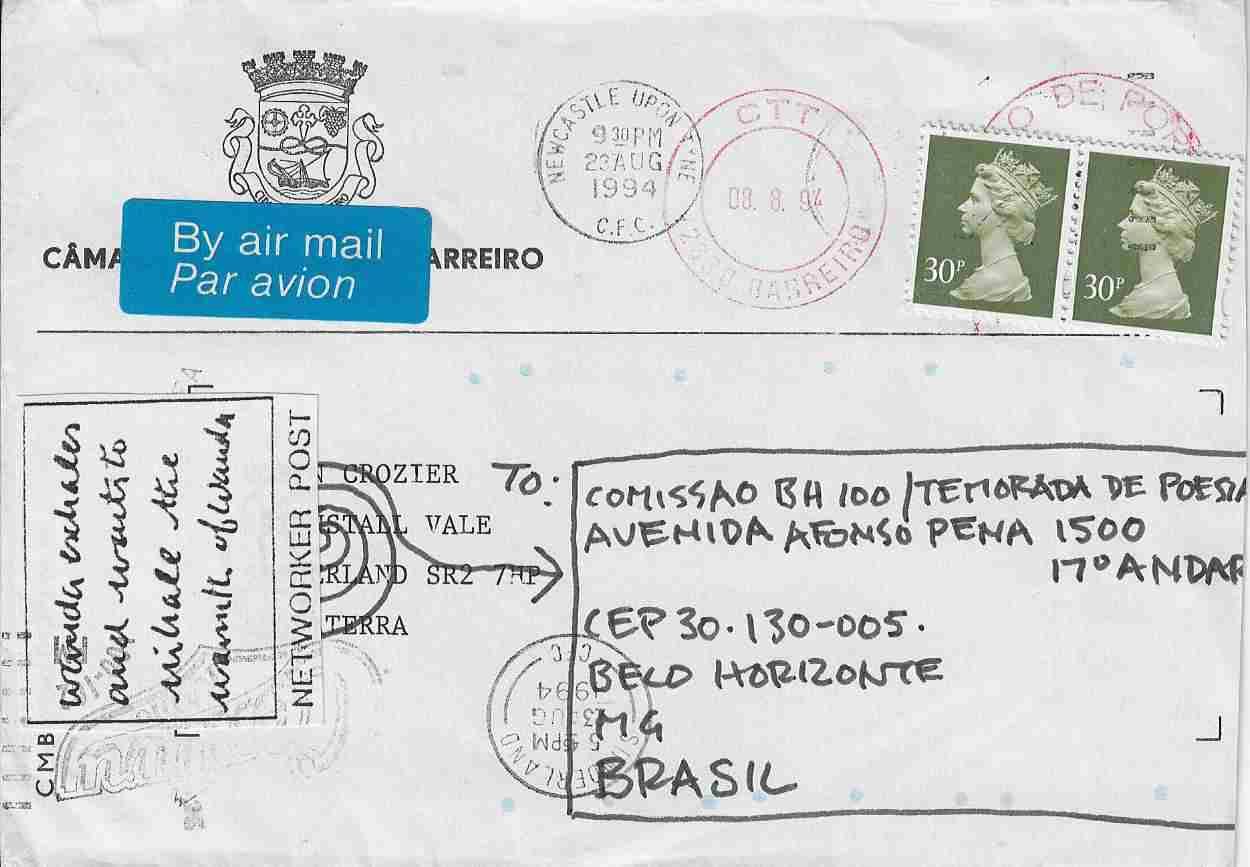
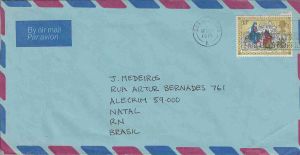
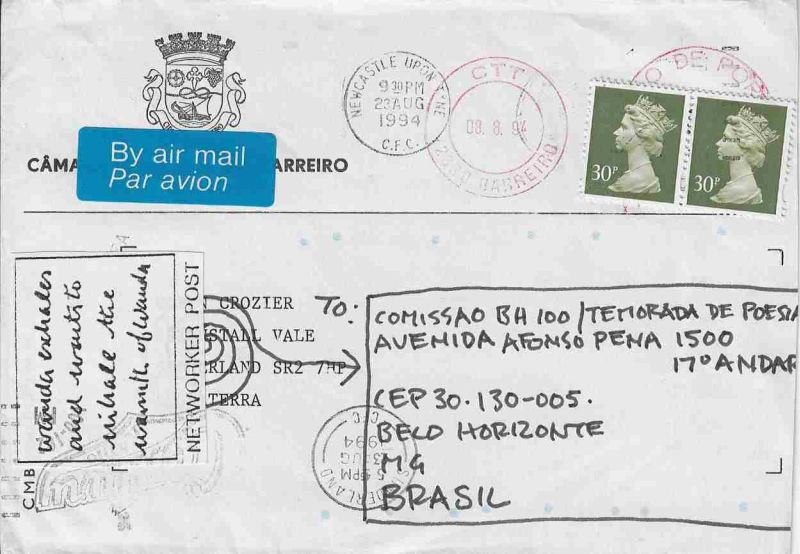
Conjunto de arte postal composto por envelope internacional e obra de Robin Crozier, artista e poeta visual britânico, enviado de Sunderland, Inglaterra, para Marcelo Dolabela em Belo Horizonte, Minas Gerais, Brasil. O carimbo postal britânico indica 23 de agosto de 1994.
Robin Crozier
Categoria: Mail Art
Acervo: 03754
Data: 24 de Agosto de 1994
Dimensões: 11,2 x 15,8 cm
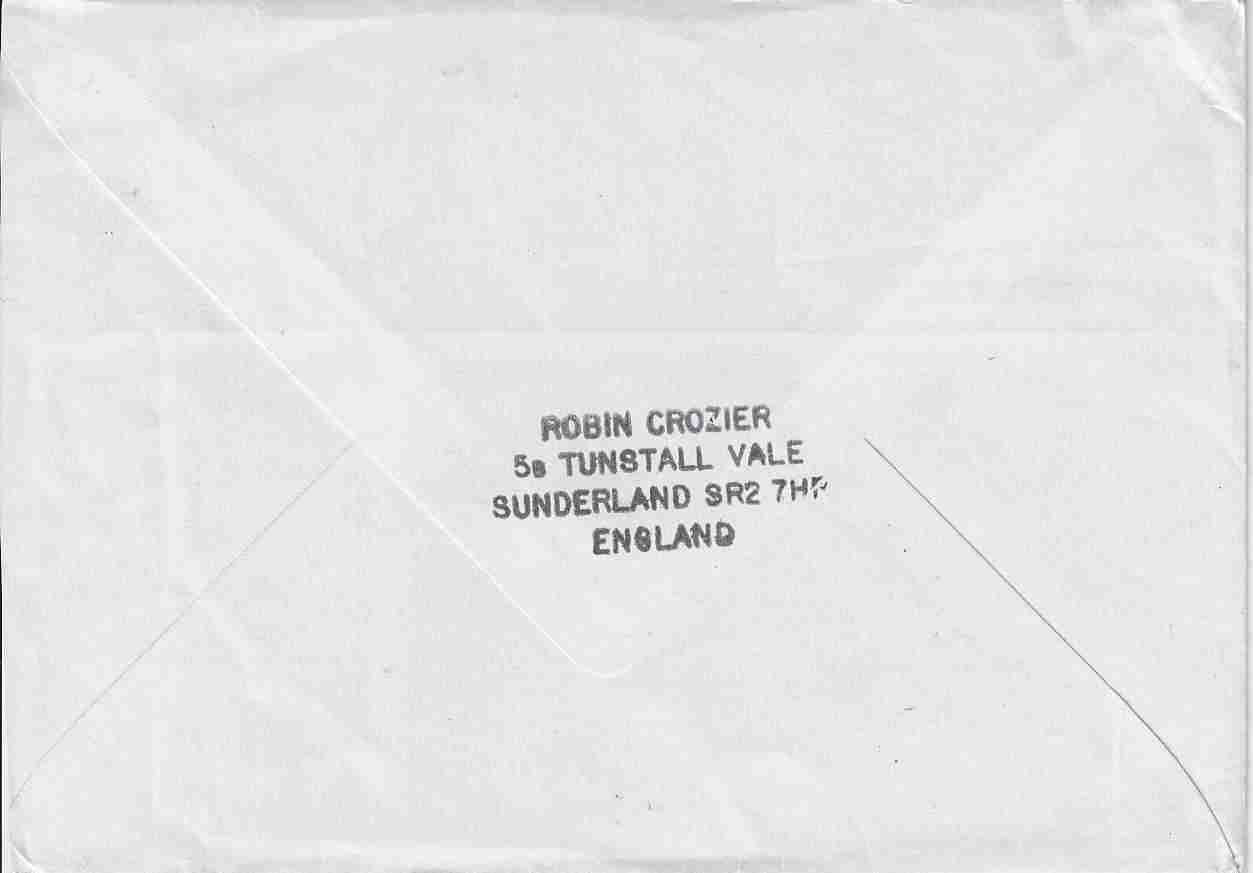
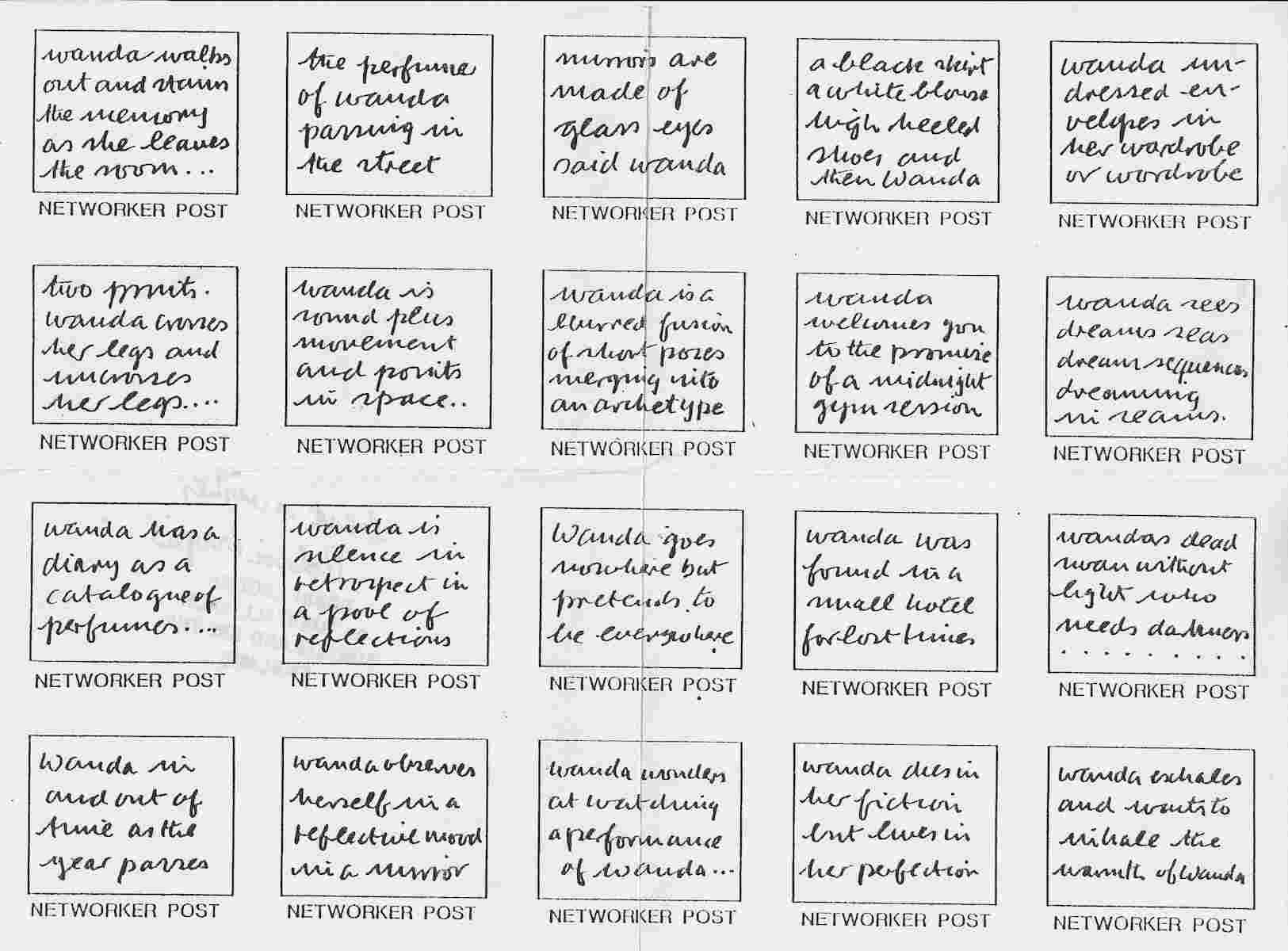
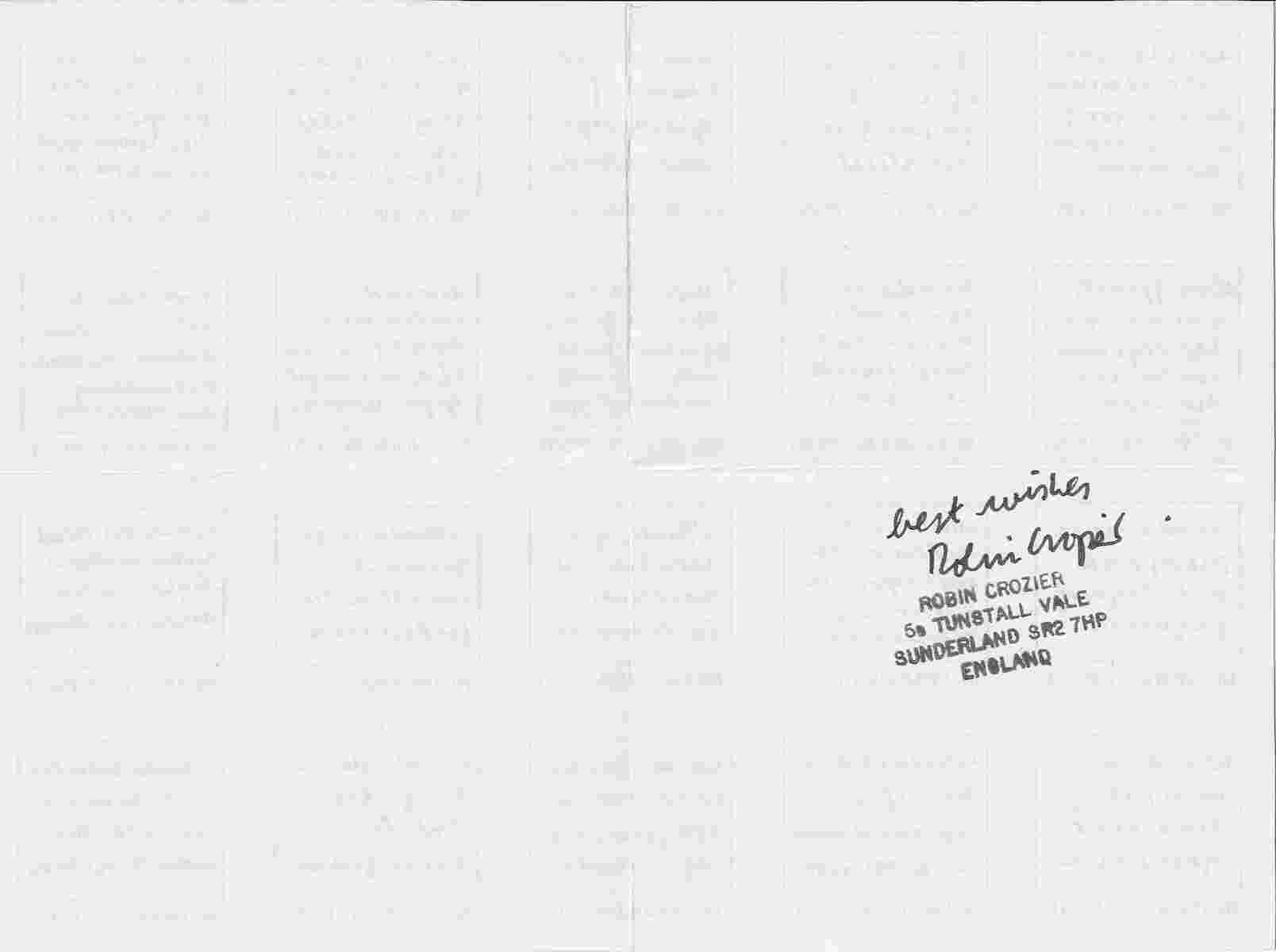
Conjunto de arte postal composto por envelope internacional e obra de Robin Crozier, artista e poeta visual britânico, enviado de Sunderland, Inglaterra, para Marcelo Dolabela em Belo Horizonte, Minas Gerais, Brasil. O carimbo postal britânico indica 23 de agosto de 1994. O envelope foi remetido por via aérea e apresenta no verso o carimbo Robin Crozier, 5a Tunstall Vale, Sunderland SR2 7HP, England. Na frente, o destinatário aparece como Comissão BH 100, Temporada de Poesia, Avenida Afonso Pena 1500, 17 andar, CEP 30.130 005, Belo Horizonte, MG, Brasil. O conjunto constitui documentação primária da ligação direta entre Robin Crozier e o circuito de poesia experimental organizado em Belo Horizonte durante a década de 1990, no qual Marcelo Dolabela teve atuação importante como poeta, pesquisador, editor e articulador cultural.Robin Crozier nasceu em Gosforth, Inglaterra, em 1936 e morreu em Sunderland em 2001. Desenvolveu trabalhos em poesia concreta, poesia visual, livros de artista, desenho, fotografia, correspondência e projetos participativos. Foi professor em Sunderland e participou sistematicamente da Mail Art Network a partir de 1972. Entre seus projetos mais conhecidos estão Portrait of Robin Crozier, iniciado em meados da década de 1970, memo random, iniciado em 1983, e diferentes séries relacionadas à personagem Wanda, alter ego feminino criado pelo artista.A obra enviada a Belo Horizonte pertence diretamente ao universo de Wanda e de Networker Post, duas referências recorrentes na produção de Crozier. A folha apresenta vinte pequenos campos retangulares distribuídos em quatro fileiras de cinco unidades. Cada campo contém uma frase manuscrita e abaixo aparece repetidamente a expressão NETWORKER POST. A estrutura aproxima a obra de uma folha de selos postais, fichas, etiquetas, cartões destacáveis ou unidades seriadas de correspondência. Em vez de imagens convencionais, cada módulo contém uma pequena situação verbal envolvendo Wanda.A personagem Wanda é documentada por fontes especializadas como alter ego feminino de Robin Crozier. Crozier utilizou essa identidade ficcional para desenvolver experiências relacionadas a linguagem, identidade, duplicação, gênero, autorrepresentação, memória e circulação. A obra enviada a Marcelo Dolabela demonstra que essa personagem permanecia ativa no repertório do artista em 1994, quase duas décadas depois de suas primeiras experiências documentadas com Wanda.Entre os fragmentos manuscritos legíveis aparecem formulações como Wanda walks out and enters the memory as she leaves the room, the perfume of Wanda passing in the street, mirrors are made of glass eyes said Wanda, Wanda undressed envelopes in her wardrobe or wordrobe, Wanda sees dreams sees dream sequences dreaming in scenes, Wanda has a diary as a catalogue of perfumes, Wanda is silence in retrospect in a pool of reflections, Wanda goes nowhere but proceeds to be everywhere, Wanda was found in a male world for the first time, Wanda in and out of time as she year passes, Wanda observes herself in a reflective mood in a mirror, Wanda undergoes at least twice a performance of Wanda, Wanda dies in her fiction but lives in her perfection e Wanda watches and waits to inhabit the world of Wanda.Esses textos formam uma espécie de micro narrativa fragmentada. Em vez de uma única história contínua, Crozier oferece vinte pequenas proposições independentes que, juntas, constroem uma identidade móvel e contraditória. Wanda caminha, desaparece, lembra, sonha, observa, se reflete, se apresenta, morre na ficção, reaparece e habita seu próprio mundo. A personagem existe simultaneamente como sujeito, objeto, imagem, memória e linguagem.A presença repetida de espelhos, reflexos, sonhos, perfumes, ruas, vestuário, memória e passagem do tempo é importante para interpretar a obra. O espelho aparece como metáfora de identidade instável. O perfume aparece como índice de presença e ausência. A rua constitui espaço de circulação. O sonho permite a multiplicação de versões da personagem. A memória transforma a experiência em arquivo. Esses elementos convergem para uma investigação sobre como uma pessoa ou persona pode existir através de vestígios, imagens e linguagem.A frase Wanda undressed envelopes in her wardrobe or wordrobe apresenta um jogo verbal particularmente importante. Crozier aproxima wardrobe, guarda roupa, de wordrobe, construção inventada que associa roupa e palavra. O envelope também é inserido nessa relação, conectando corpo, linguagem e correio. A frase transforma o espaço doméstico do guarda roupa em arquivo verbal e postal. Esse procedimento é característico da poesia visual e conceitual de Crozier, na qual pequenas alterações linguísticas criam novas relações entre objetos e significados.Outro fragmento afirma que Wanda goes nowhere but proceeds to be everywhere. A formulação sintetiza com precisão a lógica da Mail Art. A personagem pode não se deslocar fisicamente, mas torna se presente em diferentes lugares por meio de reproduções e correspondências. A obra enviada da Inglaterra para o Brasil materializa literalmente essa ideia. Wanda torna se presente em Belo Horizonte através de um envelope enviado por Robin Crozier.A expressão NETWORKER POST reforça essa leitura. Networker não designa apenas um remetente. Designa alguém que atua dentro de uma rede, criando conexões. Post pode significar correio, envio e também posição. A repetição de NETWORKER POST sob cada pequena unidade faz com que toda a folha funcione como catálogo de mensagens potenciais, lembrando uma cartela de selos conceituais ou pequenos cartões postais ainda não separados.A estrutura de vinte módulos também permite leitura relacionada à serialidade. Cada unidade possui formato semelhante, mas conteúdo verbal diferente. O significado global é construído pela repetição com variação. Essa lógica aproxima Crozier tanto da poesia concreta e visual quanto de procedimentos conceituais e pós Fluxus baseados em instrução, série, arquivo e distribuição.No verso da obra aparece a inscrição manuscrita best wishes Robin Crozier acompanhada pelo carimbo Robin Crozier, 5a Tunstall Vale, Sunderland SR2 7HP, England. Essa inscrição confirma o caráter pessoal do envio. Não se trata apenas de material impresso distribuído anonimamente. O artista acrescentou uma saudação manuscrita ao destinatário, convertendo o trabalho em correspondência individualizada.O envelope acrescenta informações históricas fundamentais. A frente combina o envelope institucional da Câmara Municipal de Belo Horizonte com selos britânicos de 30 pence e a etiqueta By air mail Par avion. O fato de um envelope com identificação da Câmara Municipal de Belo Horizonte ter sido utilizado por Crozier na Inglaterra sugere reutilização de material postal anteriormente recebido ou enviado a ele. Essa possibilidade é coerente com práticas da Mail Art, nas quais envelopes, carimbos, endereços e objetos preexistentes eram frequentemente reutilizados e reincorporados à circulação. Entretanto, a origem específica desse envelope não pode ser determinada apenas pelas imagens e deve permanecer como hipótese.O endereço da Comissão BH 100, Temporada de Poesia, Avenida Afonso Pena 1500, 17 andar, Belo Horizonte, é particularmente relevante. Ele indica que a obra estava dirigida a uma estrutura organizada de poesia em Belo Horizonte, e não apenas a um endereço residencial. O nome Marcelo Dolabela fornecido como destinatário do conjunto associa o envio ao poeta mineiro e ao circuito de poesia experimental da cidade. Esse dado estabelece uma ponte documental entre Robin Crozier e a cena brasileira de poesia visual e experimental dos anos 1990.A data de 1994 também é significativa na trajetória de Crozier. No mesmo ano, o artista participava do TAM Mail Interview Project conduzido por Ruud Janssen. Em resposta iniciada em novembro de 1994, Crozier recordou sua descoberta do Surrealismo e de publicações da Something Else Press e explicou aspectos de sua entrada nas redes de arte postal. A correspondência enviada a Belo Horizonte em agosto pertence portanto a um momento de plena maturidade, quando Crozier já possuía mais de duas décadas de experiência na Mail Art.Em 1994 Géza Perneczky também registra uma publicação de Crozier intitulada Measuring, composta por 17 folhas em formato A4, mostrando que o artista continuava trabalhando com séries, documentos, medidas e estruturas conceituais. O mesmo levantamento registra Wandalust, publicação relacionada à personagem Wanda, confirmando a permanência da persona dentro de sua produção tardia.A obra enviada a Marcelo Dolabela deve ser compreendida também à luz de memo random, projeto iniciado por Crozier em 1983 e posteriormente associado a mais de 6 mil páginas. O projeto convidava participantes a registrar memórias relacionadas a dias e acontecimentos, convertendo lembrança individual em arquivo coletivo. A presença insistente de memória, tempo, sonho e reflexão na folha de Wanda evidencia afinidades com essa preocupação mais ampla de Crozier sobre lembrança, identidade e registro.Este conjunto possui grande importância para a documentação da circulação internacional da poesia experimental no Brasil nos anos 1990. Ele demonstra que Belo Horizonte participava de uma rede capaz de receber diretamente obras de um artista britânico historicamente ligado à poesia concreta, poesia visual e Mail Art. O fato de o envio ser dirigido à Comissão BH 100 Temporada de Poesia e a Marcelo Dolabela amplia sua relevância como documento da internacionalização das atividades poéticas da cidade.Não há evidência de que Robin Crozier tenha pertencido ao movimento brasileiro Poema Processo. Sua relação com esse campo é histórica e contextual. Entretanto, sua produção baseada em linguagem visual, serialidade, circulação, participação, reprodução e transformação da correspondência apresenta pontos de contato com questões exploradas por artistas brasileiros ligados ao Poema Processo e às gerações posteriores da poesia visual.Para indexação museológica e digital, o conjunto deve ser associado a Robin Crozier, Marcelo Dolabela, Comissão BH 100, Temporada de Poesia, Belo Horizonte, Minas Gerais, Brasil, Sunderland, Inglaterra, 23 de agosto de 1994, Wanda, Networker Post, Mail Art, arte postal, poesia visual, poesia concreta, arte conceitual, alter ego, identidade, gênero, memória, sonho, espelho, reflexão, serialidade, correspondência artística, publicação de artista, poesia experimental e redes internacionais de artistas.TEXT FOR THE SALSA PROGRAM IN ENGLISHMail Art group consisting of an international envelope and a work by Robin Crozier, British artist and visual poet, sent from Sunderland, England, to Marcelo Dolabela in Belo Horizonte, Minas Gerais, Brazil. The British postal cancellation indicates 23 August 1994. The envelope was sent by airmail and bears on its reverse the stamp Robin Crozier, 5a Tunstall Vale, Sunderland SR2 7HP, England. On the front the destination is written as Comissão BH 100, Temporada de Poesia, Avenida Afonso Pena 1500, 17 andar, CEP 30.130 005, Belo Horizonte, MG, Brazil. The group constitutes primary documentation of a direct connection between Robin Crozier and the experimental poetry circuit active in Belo Horizonte during the 1990s, within which Marcelo Dolabela was an important poet, researcher, editor and cultural organizer.Robin Crozier was born in Gosforth, England, in 1936 and died in Sunderland in 2001. He worked with concrete poetry, visual poetry, artists books, drawing, photography, correspondence and participatory projects. He taught in Sunderland and participated systematically in the Mail Art Network from 1972 onward. Among his best known projects are Portrait of Robin Crozier, initiated in the mid 1970s, memo random, begun in 1983, and various works involving Wanda, a female alter ego developed by the artist.The work sent to Belo Horizonte belongs directly to the world of Wanda and Networker Post, two recurring references in Crozier's practice. The sheet contains twenty small rectangular fields arranged in four rows of five units. Each field contains a handwritten phrase and the words NETWORKER POST appear repeatedly beneath them. The structure resembles a sheet of postage stamps, labels, cards or detachable correspondence units. Instead of conventional images, each module contains a small verbal situation involving Wanda.Wanda is documented in specialist sources as Robin Crozier's female alter ego. Crozier used this fictitious identity to investigate language, identity, duplication, gender, self representation, memory and circulation. The work sent to Marcelo Dolabela demonstrates that Wanda remained active within Crozier's vocabulary in 1994, almost two decades after the first documented uses of the persona.Among the legible handwritten fragments are formulations such as Wanda walks out and enters the memory as she leaves the room, the perfume of Wanda passing in the street, mirrors are made of glass eyes said Wanda, Wanda undressed envelopes in her wardrobe or wordrobe, Wanda sees dreams sees dream sequences dreaming in scenes, Wanda has a diary as a catalogue of perfumes, Wanda is silence in retrospect in a pool of reflections, Wanda goes nowhere but proceeds to be everywhere, Wanda was found in a male world for the first time, Wanda in and out of time as she year passes, Wanda observes herself in a reflective mood in a mirror, Wanda undergoes at least twice a performance of Wanda, Wanda dies in her fiction but lives in her perfection and Wanda watches and waits to inhabit the world of Wanda.These texts form a fragmented micro narrative. Rather than presenting a continuous story, Crozier offers twenty independent propositions that together construct a mobile and contradictory identity. Wanda walks, disappears, remembers, dreams, observes, reflects, performs, dies in fiction, returns and inhabits her own world. She exists simultaneously as subject, object, image, memory and language.The recurring presence of mirrors, reflections, dreams, perfumes, streets, clothing, memory and passing time is significant. The mirror operates as a metaphor for unstable identity. Perfume acts as a trace of presence and absence. The street becomes a space of circulation. Dream permits the multiplication of versions of the character. Memory transforms experience into archive. Together these elements create an investigation of how a person or persona may exist through traces, images and language.The phrase Wanda undressed envelopes in her wardrobe or wordrobe is particularly important as wordplay. Crozier brings wardrobe into relation with wordrobe, an invented construction connecting clothing and language. The envelope enters the same field, linking body, words and mail. The domestic wardrobe is transformed into a verbal and postal archive, a procedure characteristic of Crozier's visual and conceptual poetry.Another fragment states that Wanda goes nowhere but proceeds to be everywhere. This phrase closely summarizes the logic of Mail Art. A persona may not move physically, yet can become present in multiple locations through reproduction and correspondence. The work mailed from England to Brazil literally materializes this principle. Wanda becomes present in Belo Horizonte through an envelope sent by Robin Crozier.The repeated phrase NETWORKER POST reinforces this interpretation. Networker identifies someone whose role is to create and sustain connections. Post refers both to mail and to a position within a system. Its repetition under every unit makes the sheet resemble a catalogue of potential messages, a conceptual stamp sheet or a series of unseparated postal cards.The twenty module structure also emphasizes seriality. Each unit has approximately the same format but a different verbal content. The overall meaning emerges through repetition and variation. This logic connects Crozier's work with concrete and visual poetry as well as conceptual and post Fluxus procedures involving instruction, series, archive and distribution.On the reverse appears the handwritten inscription best wishes Robin Crozier together with the stamped address Robin Crozier, 5a Tunstall Vale, Sunderland SR2 7HP, England. This inscription confirms the personal character of the mailing. It was not simply anonymous printed matter. Crozier added a handwritten greeting to the recipient, transforming the work into individualized correspondence.The envelope provides further historical information. Its front combines a Câmara Municipal de Belo Horizonte institutional envelope with two British 30 pence stamps and a By air mail Par avion label. The fact that Crozier used an envelope bearing the identity of the Belo Horizonte City Council suggests the possible reuse of postal material previously received by him. Such recycling would be consistent with Mail Art practices, in which envelopes, stamps, addresses and preexisting printed matter were frequently returned to circulation. The exact history of this particular envelope, however, cannot be established from the images alone and should remain a hypothesis.The address Comissão BH 100, Temporada de Poesia, Avenida Afonso Pena 1500, 17 andar, Belo Horizonte is especially significant. It demonstrates that the work was directed to an organized poetry structure in Belo Horizonte rather than merely to a private residence. The identification of Marcelo Dolabela as the recipient connects the mailing to the city's experimental poetry scene and creates documentary evidence of contact between Crozier and Brazilian poets in the 1990s.The date 1994 is also significant within Crozier's career. During the same year he participated in the TAM Mail Interview Project conducted by Ruud Janssen. In a response begun in November 1994 Crozier recalled his discovery of Surrealism and Something Else Press publications and discussed his entry into correspondence networks. The August mailing to Belo Horizonte therefore belongs to a mature phase, after more than two decades of participation in Mail Art.Géza Perneczky also documents a 1994 Crozier publication titled Measuring, consisting of seventeen A4 sheets, showing that Crozier remained engaged with serial, documentary and conceptual structures. The same source records Wandalust, a publication related to Wanda, confirming the continuing importance of the persona in Crozier's later production.The work sent to Marcelo Dolabela can also be understood in relation to memo random, the long running project begun by Crozier in 1983 and eventually associated with more than six thousand pages. The project asked participants to record memories of particular days or events, turning individual recollection into a collective archive. The repeated references to memory, time, dream and reflection in the Wanda sheet belong to Crozier's broader investigation of remembrance, identity and documentation.This group is highly significant for documenting the international circulation of experimental poetry in Brazil during the 1990s. It demonstrates that Belo Horizonte participated in a network capable of receiving works directly from a British artist historically connected with concrete poetry, visual poetry and Mail Art. The fact that the mailing was directed to Comissão BH 100 Temporada de Poesia and Marcelo Dolabela adds particular importance to the document as evidence of the internationalization of poetic activity in the city.There is no evidence that Robin Crozier belonged to the Brazilian Process Poem Movement. His relationship to that field is historical and contextual. Nevertheless, his practice based on visual language, seriality, circulation, participation, reproduction and transformation of correspondence has meaningful connections with questions explored by Brazilian artists associated with Process Poem and later visual poetry networks.For museum and digital indexing, the group should be associated with Robin Crozier, Marcelo Dolabela, Comissão BH 100, Temporada de Poesia, Belo Horizonte, Minas Gerais, Brazil, Sunderland, England, 23 August 1994, Wanda, Networker Post, Mail Art, correspondence art, visual poetry, concrete poetry, Conceptual Art, alter ego, identity, gender, memory, dream, mirror, reflection, seriality, artists correspondence, artists publications, experimental poetry and international artists networks.
Conjunto original formado por envelope postal e obra impressa de Robin Crozier, enviado a Marcelo Dolabela em Belo Horizonte, Minas Gerais, Brasil. O carimbo postal britânico indica 23 de agosto de 1994. O envelope apresenta dois selos britânicos de 30 pence, etiqueta By air mail Par avion e endereço manuscrito para Comissão BH 100, Temporada de Poesia, Avenida Afonso Pena 1500, 17 andar, CEP 30.130 005, Belo Horizonte, MG, Brasil. No verso aparece o carimbo Robin Crozier, 5a Tunstall Vale, Sunderland SR2 7HP, England.A conservação conjunta do envelope e da folha interna permite estabelecer proveniência direta entre Robin Crozier e Marcelo Dolabela e deve ser preservada como unidade documental. O envelope comprova circulação da obra entre Sunderland e Belo Horizonte e relaciona o artista britânico diretamente a uma estrutura brasileira dedicada à poesia.A folha interna é composta por vinte pequenos módulos retangulares dispostos em quatro fileiras. Cada módulo contém uma frase manuscrita envolvendo Wanda e a expressão NETWORKER POST impressa na parte inferior. A organização lembra cartela de selos, etiquetas postais ou pequenos cartões e transforma cada fragmento textual em unidade potencialmente circulável.Wanda é um alter ego feminino utilizado por Robin Crozier e documentado em fontes especializadas. A personagem permite ao artista investigar identidade, gênero, memória, autorrepresentação, linguagem e circulação. A presença de Wanda nesta obra de 1994 demonstra a continuidade desse eixo de pesquisa na fase madura de Crozier.Entre os fragmentos legíveis estão textos relacionados à entrada e saída da memória, perfume, passagem pela rua, espelhos feitos de olhos de vidro, envelopes, guarda roupa e wordrobe, sonhos, diário de perfumes, silêncio, reflexão, movimento no espaço, arquétipo, passagem do tempo, performance, ficção e perfeição. A obra possui portanto forte dimensão poética e deve ser indexada também como poesia visual e poesia experimental.A expressão Wanda undressed envelopes in her wardrobe or wordrobe é particularmente relevante porque combina envelope, vestuário e linguagem por meio de um jogo de palavras. O termo wordrobe não corresponde a uma palavra inglesa convencional e parece ser criação de Crozier a partir de word e wardrobe. A invenção verbal transforma o guarda roupa em espaço de palavras e relaciona diretamente corpo, linguagem e correspondência.Outro fragmento afirma que Wanda goes nowhere but proceeds to be everywhere. A frase pode ser entendida em relação à lógica da própria Mail Art, na qual uma personagem ou obra se torna presente em lugares distantes através da reprodução e do correio. O envio deste exemplar ao Brasil realiza materialmente essa circulação.No verso da folha aparecem a inscrição manuscrita best wishes Robin Crozier e o carimbo do artista com seu endereço em Sunderland. Essa saudação deve ser preservada no registro porque demonstra que o impresso foi pessoalmente enviado e dedicado dentro de uma troca de correspondência.A utilização de um envelope impresso da Câmara Municipal de Belo Horizonte é um elemento incomum. Como o envelope recebeu selos e carimbo britânicos, ele estava fisicamente no Reino Unido no momento da postagem. É possível que se trate de reutilização de envelope anteriormente recebido por Crozier, procedimento comum em redes de Mail Art, mas não há documentação suficiente para determinar sua história anterior. A informação deve ser registrada como característica material sem conclusão definitiva.A data de 23 de agosto de 1994 situa a obra em fase tardia da trajetória de Crozier. No mesmo ano ele participou do projeto de entrevista postal de Ruud Janssen e continuava produzindo obras seriadas e publicações conceituais.A técnica exata da folha não pode ser determinada apenas pelas imagens. A aparência indica reprodução fotomecânica ou fotocópia de escrita manuscrita e composição gráfica, mas a identificação definitiva deve depender de exame físico. Para cadastro provisório recomenda se técnica de reprodução gráfica sobre papel, com intervenção manuscrita no verso.O conjunto constitui documento importante para a história da poesia visual e da Mail Art em Belo Horizonte. Demonstra contato direto entre Robin Crozier e Marcelo Dolabela e evidencia a inserção da Comissão BH 100 Temporada de Poesia em redes internacionais de poesia experimental na década de 1990.OBSERVATION TEXT IN ENGLISHOriginal group consisting of a postal envelope and printed work by Robin Crozier sent to Marcelo Dolabela in Belo Horizonte, Minas Gerais, Brazil. The British postal cancellation indicates 23 August 1994. The envelope carries two British 30 pence stamps, a By air mail Par avion label and a handwritten destination for Comissão BH 100, Temporada de Poesia, Avenida Afonso Pena 1500, 17 andar, CEP 30.130 005, Belo Horizonte, MG, Brazil. The reverse bears the stamp Robin Crozier, 5a Tunstall Vale, Sunderland SR2 7HP, England.The survival of the envelope together with the internal sheet establishes direct provenance between Robin Crozier and Marcelo Dolabela and should be preserved as a documentary unit. The envelope confirms physical circulation between Sunderland and Belo Horizonte and connects the British artist directly with a Brazilian poetry organization.The enclosed sheet consists of twenty small rectangular modules arranged in four rows. Each module contains a handwritten statement involving Wanda and the printed words NETWORKER POST beneath it. The arrangement resembles a sheet of stamps, postal labels or small cards and turns each textual fragment into a potentially circulating unit.Wanda is a female alter ego used by Robin Crozier and documented in specialist sources. The persona enabled Crozier to investigate identity, gender, memory, self representation, language and circulation. Her presence in this 1994 work demonstrates the continuation of this line of inquiry during Crozier's mature period.The legible fragments concern entering and leaving memory, perfume, passing through the street, mirrors made of glass eyes, envelopes, wardrobe and wordrobe, dreams, a catalogue of perfumes, silence, reflection, movement through space, archetype, passing time, performance, fiction and perfection. The work therefore has a strong poetic dimension and should also be indexed as visual poetry and experimental poetry.The phrase Wanda undressed envelopes in her wardrobe or wordrobe is particularly significant because it combines envelopes, clothing and language through wordplay. Wordrobe is not a conventional English word and appears to be Crozier's invention from word and wardrobe. The verbal construction turns the wardrobe into a space for words and directly connects body, language and correspondence.Another fragment states that Wanda goes nowhere but proceeds to be everywhere. The phrase can be understood in relation to the logic of Mail Art, through which a persona or artwork becomes present in distant locations by means of reproduction and postal circulation. The mailing of this particular copy to Brazil materially performs that process.The reverse of the sheet carries the handwritten inscription best wishes Robin Crozier together with the artist's stamped Sunderland address. This greeting should be preserved in the catalogue record because it demonstrates that the printed material was personally sent within a correspondence exchange.The use of an envelope printed with the identity of Câmara Municipal de Belo Horizonte is an unusual material element. Since the envelope received British stamps and postal cancellation, it was physically in the United Kingdom at the time of mailing. It may have been a previously received envelope reused by Crozier, a practice consistent with Mail Art, but there is insufficient evidence to reconstruct its earlier history. It should therefore be recorded as a material characteristic without definitive interpretation.The date 23 August 1994 places the work within a late phase of Crozier's career. During the same year he participated in Ruud Janssen's postal interview project and continued producing serial and conceptual works.The exact technique of the internal sheet cannot be determined from the images alone. Its appearance suggests photomechanical reproduction or photocopy of handwritten material and graphic composition, but definitive identification requires physical examination. A provisional description as graphic reproduction on paper with handwritten intervention on the reverse is appropriate.The group is an important document for the history of visual poetry and Mail Art in Belo Horizonte. It establishes direct contact between Robin Crozier and Marcelo Dolabela and demonstrates the participation of Comissão BH 100 Temporada de Poesia in international experimental poetry networks during the 1990s.
Inglês
Mail Art group consisting of an international envelope and a work by Robin Crozier, British artist and visual poet, sent from Sunderland, England, to Marcelo Dolabela in Belo Horizonte, Minas Gerais, Brazil. The British postal cancellation indicates 23 August 1994.
Dimensions: 4,4 x 6,2 in