Cartão de arte postal enviado por Mahatma Kane Jeeves, de Nova York, Estados Unidos, ao artista brasileiro Falves Silva, em Natal, Rio Grande do Norte.
Falves Silva
Categoria: Mail Art
Acervo: 03691
Dimensões: 10,8 x 15,3 cm
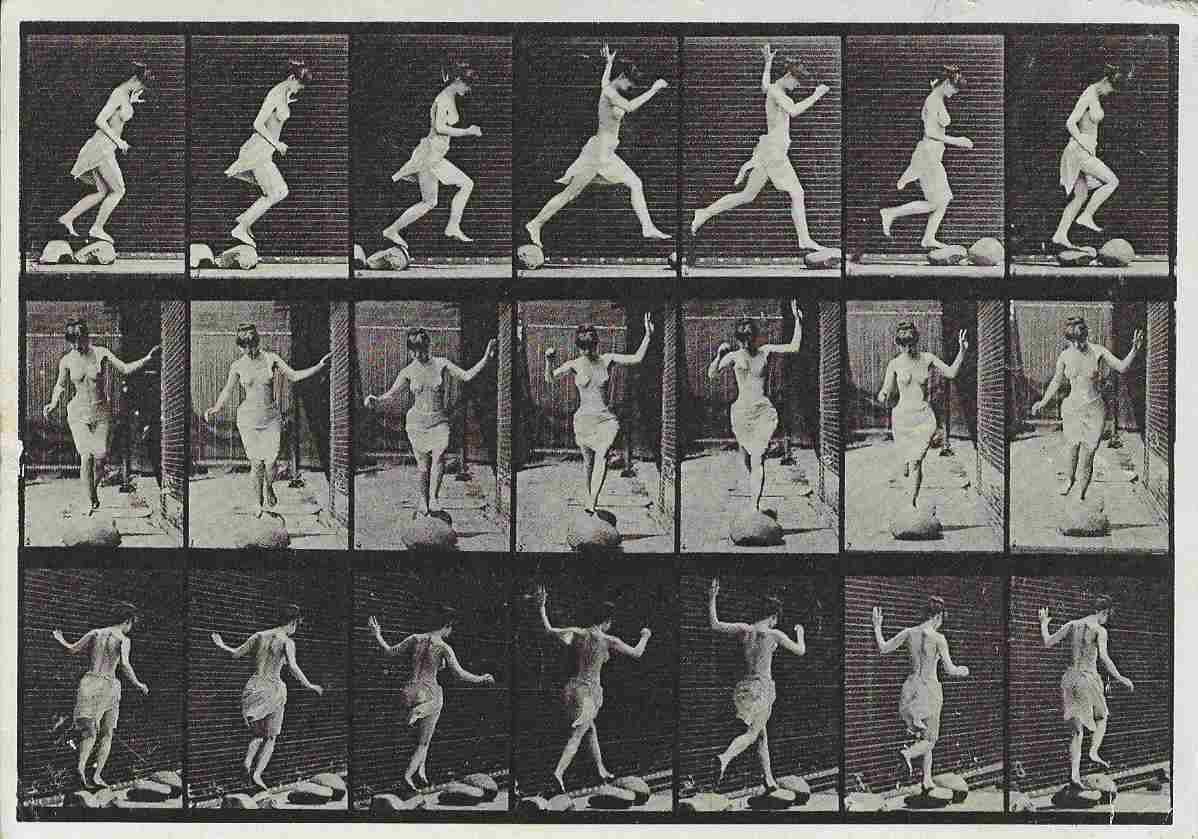
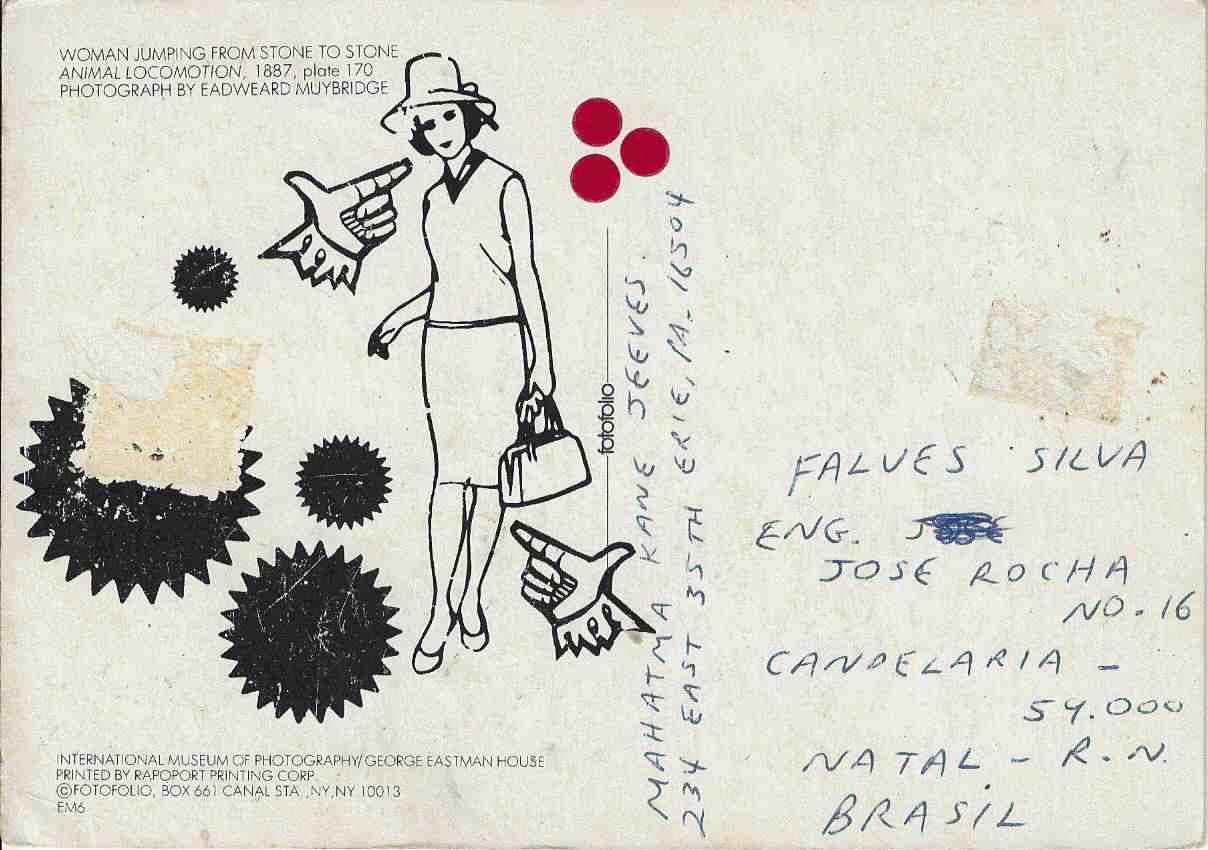
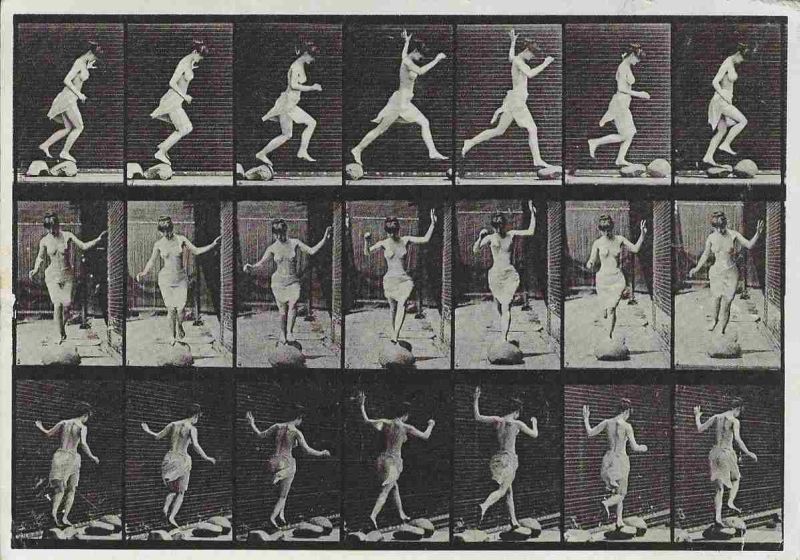
Cartão de arte postal enviado por Mahatma Kane Jeeves, de Nova York, Estados Unidos, ao artista brasileiro Falves Silva, em Natal, Rio Grande do Norte. A peça utiliza como suporte um cartão fotográfico produzido pela Fotofolio a partir da obra Woman Jumping from Stone to Stone, integrante da série Animal Locomotion, realizada em 1887 pelo fotógrafo britânico Eadweard Muybridge. A intervenção combina fotografia histórica, escrita manuscrita, colagem, desenho gráfico, formas circulares e comunicação postal internacional.A frente do cartão reproduz uma sequência fotográfica formada por vinte imagens de uma mulher saltando entre pedras. A composição está organizada em três faixas horizontais. Cada quadro registra uma etapa diferente do deslocamento corporal, permitindo observar a preparação do salto, a suspensão do corpo, a passagem entre os obstáculos e a recuperação do equilíbrio. A repetição sequencial transforma o movimento em estrutura visual e aproxima fotografia, ciência, estudo corporal e narrativa temporal.No verso está impressa a identificação Woman Jumping from Stone to Stone, Animal Locomotion, 1887, prancha 170, fotografia de Eadweard Muybridge. A série Animal Locomotion foi publicada em 1887 e reuniu estudos sequenciais de seres humanos e animais em movimento, empregando séries de imagens para revelar posições corporais que não podiam ser percebidas com precisão pelo olho durante a ação contínua. Exemplares e pranchas desse projeto encontram se preservados em instituições como a Library of Congress dos Estados Unidos.O cartão comercial foi produzido pela Fotofolio, com referência ao International Museum of Photography at George Eastman House, e impresso pela Rapoport Printing Corporation, de Nova York. A indicação editorial demonstra que a imagem histórica de Muybridge foi convertida em cartão reproduzível e posteriormente reutilizada como suporte para uma correspondência de arte postal.A intervenção realizada pelo remetente ocupa principalmente o verso. Sobre a imagem impressa de uma mulher com chapéu, bolsa e vestimenta urbana foram acrescentadas duas mãos que apontam para a figura. Próximo às mãos aparecem pequenas formas semelhantes a punhos de camisa, nas quais se lê a palavra LOOK. A repetição desse comando direciona o olhar do observador para a figura feminina e estabelece uma relação entre visão, gesto, indicação e leitura da imagem.Também aparecem três círculos vermelhos agrupados, além de várias formas negras irregulares semelhantes a explosões, manchas ou selos gráficos. Parte dessas formas foi coberta, raspada ou removida, deixando marcas claras no suporte. A composição combina elementos impressos originalmente pelo cartão com intervenções acrescentadas pelo correspondente, criando uma nova obra por apropriação e alteração.O nome Mahatma Kane Jeeves aparece manuscrito ao lado do endereço do remetente, aparentemente localizado na East 35th Street, em Nova York. O número parece ser 234 e o código postal parece terminar em 10016, mas a leitura integral deve permanecer sujeita a confirmação por exame direto. O endereço de Falves Silva registra Engenheiro José Rocha, número 16, Candelária, código postal 59000, Natal, Rio Grande do Norte, Brasil.Mahatma Kane Jeeves aparece documentado como participante das redes internacionais de arte postal do final da década de 1970. O nome está incluído entre os colaboradores de The Drawing Completion Test, publicação coletiva produzida por CabVolt em San Diego em abril de 1978. Falves Silva também participou da mesma publicação, demonstrando que os dois correspondentes integravam circuitos comuns de mail art e publicação experimental.O nome Mahatma Kane Jeeves também aparece na publicação Lost and Found Times, números 6 e 7, editada por John M. Bennett em Columbus, Ohio, em fevereiro de 1979. Esse registro aproxima o correspondente das redes de poesia experimental, pequena imprensa, publicação alternativa e arte postal existentes nos Estados Unidos durante o período.Em outubro de 1979, Mahatma Kane Jeeves e Falves Silva foram relacionados entre os participantes de The Postman Always Rings Twice, catálogo de arte postal organizado por Lon Spiegelman em Los Angeles. O documento reuniu centenas de artistas internacionais e confirma que ambos circulavam em uma ampla rede transnacional de correspondência artística.A identidade civil correspondente ao nome Mahatma Kane Jeeves não foi localizada de maneira conclusiva nas fontes consultadas. O nome também foi historicamente empregado por W. C. Fields como pseudônimo cinematográfico, mas não há evidência suficiente para relacionar o remetente deste cartão ao ator e roteirista norte americano. No contexto desta obra, Mahatma Kane Jeeves deve ser registrado como nome artístico, pseudônimo ou identidade de rede utilizada por um participante da mail art sediado em Nova York.O cartão não apresenta selo postal, carimbo de circulação ou data visível nas imagens fornecidas. Sua datação provável situa se no final da década de 1970, considerando a participação conjunta de Mahatma Kane Jeeves e Falves Silva em publicações e projetos de mail art de 1978 e 1979. Essa aproximação cronológica deve ser registrada como provável e não como data confirmada.A apropriação da sequência de Muybridge é particularmente significativa. A imagem original estuda o movimento da mulher e divide uma ação contínua em fragmentos sucessivos. A intervenção postal acrescenta novos comandos visuais no verso, especialmente as mãos e a palavra LOOK, transformando um objeto de divulgação fotográfica em experiência sobre olhar, direção, movimento, reprodução e circulação.A obra relaciona história da fotografia, cronofotografia, arte postal, poesia visual, apropriação, colagem, publicação de artista e comunicação internacional. Sua relevância para o arquivo de Falves Silva está na comprovação de seu intercâmbio com um participante da rede nova iorquina de mail art e na presença compartilhada dos dois nomes em publicações experimentais norte americanas do final da década de 1970.SALSA PROGRAM TEXT IN ENGLISHMail art postcard sent by Mahatma Kane Jeeves from New York, United States, to the Brazilian artist Falves Silva in Natal, Rio Grande do Norte, Brazil. The object uses a photographic postcard published by Fotofolio after Woman Jumping from Stone to Stone, part of the Animal Locomotion series produced in 1887 by the British photographer Eadweard Muybridge. The intervention combines historical photography, handwriting, collage, graphic drawing, circular forms and international postal communication.The front reproduces a photographic sequence composed of twenty images of a woman jumping from one stone to another. The composition is arranged in three horizontal rows. Each frame records a different stage of bodily movement, including preparation, suspension, passage over the obstacles and the recovery of balance. The repeated images transform physical motion into a visual structure and connect photography, scientific observation, bodily study and temporal narrative.The reverse contains the printed identification Woman Jumping from Stone to Stone, Animal Locomotion, 1887, plate 170, photograph by Eadweard Muybridge. Animal Locomotion was published in 1887 and brought together sequential studies of humans and animals in motion. The project used series of photographs to reveal bodily positions that could not be accurately perceived by the human eye during uninterrupted action. Plates and examples from the series are preserved by institutions including the Library of Congress in the United States.The commercial postcard was issued by Fotofolio with a reference to the International Museum of Photography at George Eastman House and was printed by Rapoport Printing Corporation in New York. The publication information demonstrates how Muybridge
s historical image was converted into a reproducible postcard and later reused as the support for a mail art exchange.The sender
s intervention is concentrated on the reverse. Two pointing hands were added around the printed image of a woman wearing a hat, carrying a handbag and dressed in urban clothing. Small cuff like forms beside the hands contain the word LOOK. The repeated instruction directs the viewer toward the female figure and establishes a relationship among sight, gesture, indication and the interpretation of an image.Three grouped red circles and several irregular black forms resembling explosions, stains or graphic seals also appear on the reverse. Portions of these forms were covered, scraped or removed, leaving lighter traces on the support. The composition combines elements originally printed on the postcard with additions introduced by the correspondent, producing a new work through appropriation and alteration.The name Mahatma Kane Jeeves is handwritten beside the sender
s address, apparently located on East 35th Street in New York. The street number appears to be 234 and the postal code appears to end in 10016, although the complete reading should remain subject to confirmation through direct examination. Falves Silva
s address records Engenheiro José Rocha, number 16, Candelária, postal code 59000, Natal, Rio Grande do Norte, Brazil.Mahatma Kane Jeeves is documented as a participant in international mail art networks during the late 1970s. The name appears among the contributors to The Drawing Completion Test, a collective publication produced by CabVolt in San Diego in April 1978. Falves Silva also participated in that publication, demonstrating that the two correspondents were active within interconnected mail art and experimental publishing circuits.The name Mahatma Kane Jeeves also appears in Lost and Found Times, issues 6 and 7, edited by John M. Bennett in Columbus, Ohio, in February 1979. This record connects the correspondent with American networks of experimental poetry, small press publishing, alternative publications and mail art.In October 1979, Mahatma Kane Jeeves and Falves Silva were both listed in connection with The Postman Always Rings Twice, a mail art catalogue organized by Lon Spiegelman in Los Angeles. The publication assembled hundreds of international artists and confirms that both names circulated within an extensive transnational correspondence art network.The civil identity behind the name Mahatma Kane Jeeves was not conclusively located in the sources consulted. The same name was historically used by W. C. Fields as a screenwriting pseudonym, but no evidence supports connecting the sender of this postcard with the American actor and writer. Within the present object, Mahatma Kane Jeeves should be recorded as an artistic name, pseudonym or network identity used by a New York based mail art participant.No postage, postal cancellation or visible date appears in the supplied images. The postcard was probably produced and exchanged during the late 1970s, based on the shared participation of Mahatma Kane Jeeves and Falves Silva in mail art publications and projects from 1978 and 1979. This chronological attribution should be recorded as probable rather than confirmed.The appropriation of Muybridge
s sequence is particularly significant. The original image studies the movement of a woman and divides a continuous action into successive fragments. The postal intervention introduces additional visual commands on the reverse, particularly the pointing hands and the word LOOK, transforming an educational photographic object into an investigation of seeing, direction, movement, reproduction and circulation.The work connects the history of photography, chronophotography, mail art, visual poetry, appropriation, collage, artists publishing and international communication. Its relevance to the Falves Silva archive lies in documenting his exchange with a participant in the New York mail art network and in the shared presence of both names in experimental American publications of the late 1970s.
TEXTO DE OBSERVAÇÃO EM PORTUGUÊSCartão fotográfico comercial com intervenções gráficas e manuscritas, enviado por Mahatma Kane Jeeves a Falves Silva. A frente reproduz Woman Jumping from Stone to Stone, prancha 170 da série Animal Locomotion, realizada por Eadweard Muybridge em 1887.A sequência apresentada contém vinte imagens de uma mulher saltando entre pedras, organizadas em três faixas horizontais. O cartão identifica a fotografia como pertencente ao conjunto Animal Locomotion e relaciona sua publicação ao International Museum of Photography at George Eastman House.No verso aparecem os créditos da Fotofolio, da Rapoport Printing Corporation e o código editorial EM6. Esses dados pertencem ao cartão comercial utilizado como suporte e não identificam a autoria da intervenção de arte postal.As intervenções incluem duas mãos que apontam para uma figura feminina impressa, duas ocorrências da palavra LOOK, três círculos vermelhos e formas negras irregulares. Algumas regiões apresentam resíduos de papel, abrasões ou perdas que podem corresponder à remoção de elementos colados. A sequência exata das alterações não pode ser determinada pelas imagens.O remetente se identifica como Mahatma Kane Jeeves. O endereço manuscrito parece registrar 234 East 35th Street, Nova York, código postal possivelmente 10016. Como alguns caracteres estão pouco definidos, recomenda se conferir o original antes de inserir o endereço integral em campo definitivo.O destinatário aparece como Falves Silva, Engenheiro José Rocha, número 16, Candelária, 59000, Natal, Rio Grande do Norte, Brasil. Há uma rasura ou sobreposição de tinta próxima à abreviação do logradouro.Não há selo postal, carimbo de circulação, mensagem verbal ou data visível. A ausência desses elementos impede confirmar se o cartão circulou sem envelope, se foi entregue dentro de outra correspondência ou se permaneceu como material não enviado.A data provável pertence ao final da década de 1970. Essa proposta é sustentada pela participação de Mahatma Kane Jeeves e Falves Silva em The Drawing Completion Test, de 1978, e em The Postman Always Rings Twice, de 1979. A data deve permanecer registrada como atribuída ou provável.A identidade civil de Mahatma Kane Jeeves não foi confirmada. Não se deve atribuir automaticamente o cartão a W. C. Fields, apesar do uso histórico desse mesmo pseudônimo pelo ator. O documento pertence a um contexto de mail art posterior e apresenta um endereço nova iorquino relacionado ao remetente.O título recomendado é Cartão com Woman Jumping from Stone to Stone para Falves Silva. Também podem ser registrados como títulos descritivos Mahatma Kane Jeeves para Falves Silva e Cartão de arte postal com fotografia de Eadweard Muybridge.A técnica pode ser cadastrada como cartão fotográfico impresso, tinta, caneta, colagem, abrasão e intervenção gráfica. O processo específico de impressão do cartão, a natureza exata dos elementos negros e a existência de materiais removidos exigem exame presencial.Classificações recomendadas incluem Mahatma Kane Jeeves, Falves Silva, Eadweard Muybridge, Woman Jumping from Stone to Stone, Animal Locomotion, Fotofolio, George Eastman House, arte postal, mail art, fotografia, cronofotografia, apropriação, colagem, poesia visual, texto e imagem, movimento corporal, publicação experimental, Nova York, Natal, Estados Unidos e Brasil.OBSERVATION TEXT IN ENGLISHCommercial photographic postcard with graphic and handwritten interventions, sent by Mahatma Kane Jeeves to Falves Silva. The front reproduces Woman Jumping from Stone to Stone, plate 170 from Eadweard Muybridge
s Animal Locomotion series of 1887.The sequence contains twenty images of a woman jumping between stones, arranged in three horizontal rows. The postcard identifies the photograph as part of Animal Locomotion and connects its publication with the International Museum of Photography at George Eastman House.The reverse contains credits for Fotofolio, Rapoport Printing Corporation and the editorial code EM6. These details belong to the commercial postcard used as a support and do not identify the authorship of the mail art intervention.The interventions include two pointing hands, two occurrences of the word LOOK, three red circles and several irregular black forms. Some areas contain paper residue, abrasion or loss that may result from the removal of previously attached elements. The exact sequence of alterations cannot be established from the images.The sender identifies himself or herself as Mahatma Kane Jeeves. The handwritten address appears to record 234 East 35th Street, New York, with a postal code possibly reading 10016. As several characters are unclear, the original should be examined before the complete address is entered into a definitive catalogue field.The recipient is recorded as Falves Silva, Engenheiro José Rocha, number 16, Candelária, 59000, Natal, Rio Grande do Norte, Brazil. An erasure or ink overlay appears near the abbreviation of the street designation.No postage, postal cancellation, written message or date is visible. The absence of these elements prevents confirmation of whether the postcard travelled without an envelope, was enclosed within another mailing or remained unsent.The probable date belongs to the late 1970s. This attribution is supported by the participation of both Mahatma Kane Jeeves and Falves Silva in The Drawing Completion Test in 1978 and The Postman Always Rings Twice in 1979. The date should remain classified as attributed or probable.The civil identity of Mahatma Kane Jeeves has not been confirmed. The postcard should not be automatically attributed to W. C. Fields despite the actor
s historical use of the same pseudonym. The present document belongs to a later mail art context and bears a New York address associated with the sender.The recommended title is Postcard with Woman Jumping from Stone to Stone for Falves Silva. Alternative descriptive titles include Mahatma Kane Jeeves to Falves Silva and Mail Art Postcard with a Photograph by Eadweard Muybridge.The technique may be catalogued as printed photographic postcard, ink, pen, collage, abrasion and graphic intervention. The precise printing process, the material nature of the black elements and the possible existence of removed components require direct physical examination.Recommended classifications include Mahatma Kane Jeeves, Falves Silva, Eadweard Muybridge, Woman Jumping from Stone to Stone, Animal Locomotion, Fotofolio, George Eastman House, mail art, photography, chronophotography, appropriation, collage, visual poetry, text and image, bodily movement, experimental publishing, New York, Natal, United States and Brazil.
Proveniência
Coleção Falves SilvaInglês
Mail art postcard sent by Mahatma Kane Jeeves from New York, United States, to the Brazilian artist Falves Silva in Natal, Rio Grande do Norte, Brazil.
Dimensions: 4,3 x 6 in