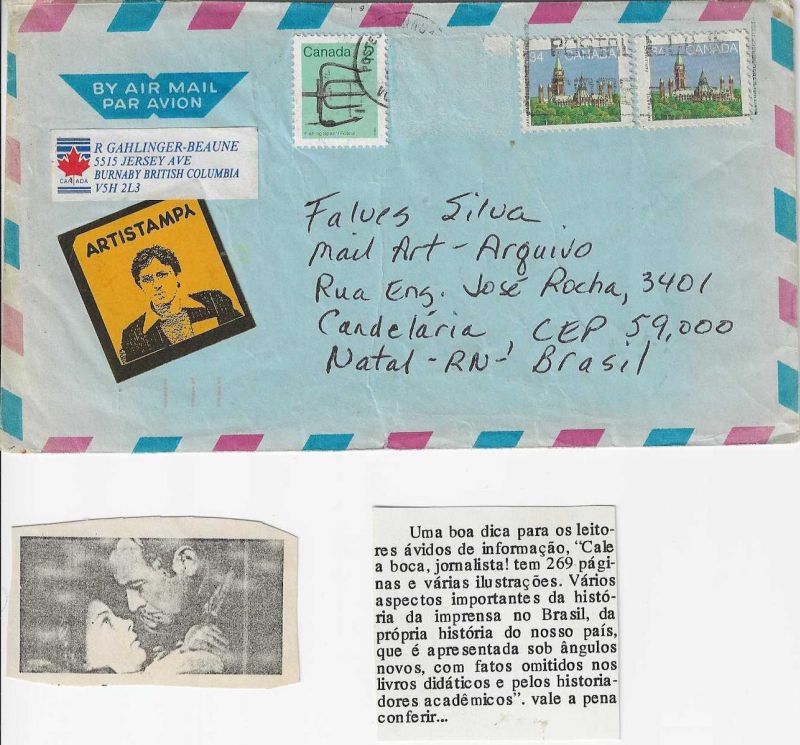
Envelope de arte postal enviado por R. Gahlinger Beaune, de Burnaby, Colúmbia Britânica, Canadá, ao artista brasileiro Falves Silva, em Natal, Rio Grande do Norte.
Falves Silva
Categoria: Mail Art
Acervo: 03690
Dimensões: 9,5 x 16,7 cm
Envelope de arte postal enviado por R. Gahlinger Beaune, de Burnaby, Colúmbia Britânica, Canadá, ao artista brasileiro Falves Silva, em Natal, Rio Grande do Norte. O conjunto reúne envelope circulado por correio aéreo, selos postais canadenses, etiquetas de identificação, artistamps, imagens apropriadas, reprodução de fotograma cinematográfico e recorte de imprensa em língua portuguesa. A peça documenta a inserção do arquivo de Falves Silva nas redes internacionais de mail art e artistamp que conectaram o Brasil e o Canadá.A etiqueta do remetente apresenta o nome R. Gahlinger Beaune e o endereço 5515 Jersey Avenue, Burnaby, British Columbia, código postal V5H 2L3, Canadá. A documentação posterior permite relacionar esse nome a Rosemary Gahlinger Beaune, pesquisadora, documentalista e colaboradora do campo dos artistamps. O mesmo endereço de Burnaby aparece associado à administração do arquivo de Michael Bidner após seu falecimento em 1989. Rosemary Gahlinger Beaune deu continuidade ao projeto de catalogação internacional iniciado por Bidner e participou da organização de uma ampla base documental dedicada aos selos de artista.O destinatário está identificado como Falves Silva Mail Art Arquivo. O endereço manuscrito registra Rua Engenheiro José Rocha, número 3401, Candelária, código postal 59000, Natal, Rio Grande do Norte, Brasil. A expressão Mail Art Arquivo é especialmente significativa porque indica que o remetente reconhecia Falves Silva não apenas como artista e correspondente, mas também como responsável por um arquivo dedicado à preservação das redes de arte postal.A frente do envelope contém três selos postais canadenses e a indicação bilíngue By Air Mail e Par Avion. Um dos selos apresenta motivo relacionado à pesca esportiva. Os outros dois, com valor facial de 34 centavos, reproduzem o edifício do Parlamento do Canadá. As marcas postais estão parcialmente apagadas e não permitem confirmar com segurança a data completa da remessa.Junto ao endereço do remetente aparece uma intervenção identificada como ARTISTAMP. A imagem apresenta o retrato de uma mulher sobre fundo amarelo e preto, acompanhado por uma folha de bordo canadense. A composição transforma a etiqueta de identificação em um selo artístico e relaciona identidade pessoal, território, arquivo e comunicação postal.No verso do envelope encontram se dois outros artistamps amarelos e pretos. O primeiro representa uma figura masculina em pé diante de um grupo de crianças ou pequenas figuras humanas. O segundo apresenta uma mulher sentada em uma poltrona, integrada a uma composição circular. Ambas as imagens utilizam linguagem gráfica derivada de ilustrações impressas e da cultura visual popular. A palavra ARTISTAMP aparece como elemento central, afirmando a condição artística das pequenas imagens semelhantes a selos postais.O termo artistamp designa um selo criado por artista que imita, reinventa ou questiona o formato dos selos oficiais. Diferentemente de uma falsificação postal, o artistamp não pretende substituir legitimamente o selo emitido pelo Estado. Ele funciona como obra em miniatura, marca de identidade, instrumento de circulação e componente da arte postal. A expressão foi consolidada no início da década de 1980 por Michael Bidner, artista e pesquisador canadense que organizou um dos mais importantes projetos internacionais de documentação desse campo.Michael Bidner reuniu e catalogou artistamps de numerosos criadores internacionais. Após seu falecimento, Rosemary Gahlinger Beaune assumiu a continuidade dessa pesquisa, empregando critérios de organização inspirados na filatelia. Em colaboração com Giovanni Bianchini, publicou em 1999 The World of Artistamps, base digital que reuniu milhares de imagens de selos de artista produzidos em diferentes países.A relação entre o envelope enviado a Falves Silva e esse projeto documental é reforçada pelo endereço do remetente e pelo uso repetido da palavra ARTISTAMP. O conjunto pode ser interpretado como correspondência ligada à coleta, catalogação, intercâmbio ou divulgação de selos de artista. Entretanto, a ausência de uma carta explicativa impede determinar se o envio solicitava contribuições de Falves Silva, comunicava a inclusão de suas obras em um arquivo ou constituía apenas uma troca artística pessoal.Na parte central do verso foi colada a reprodução de uma tira de filme fotográfico. A imagem apresenta duas figuras humanas em posições opostas, separadas por uma área clara e por um pequeno sinal gráfico central. As perfurações e os números da película permanecem visíveis, enfatizando o caráter material do suporte cinematográfico. A inversão da imagem e sua inserção no envelope produzem uma composição relacionada à montagem, à apropriação, à sequência e à fragmentação visual.O conjunto inclui ainda uma folha branca com uma fotografia recortada e um pequeno texto jornalístico em português. A fotografia mostra pessoas observando ou participando de uma situação pública, cultural ou performática. A baixa definição da reprodução impede a identificação segura das pessoas, do evento e do local.O recorte apresenta uma recomendação do livro Cale a boca, jornalista, descrito como publicação de 269 páginas com várias ilustrações. Segundo o texto preservado, o livro aborda aspectos importantes da história da imprensa no Brasil e da própria história brasileira, apresentando fatos omitidos em livros didáticos e por historiadores acadêmicos. O autor, a editora e a data do livro não aparecem no fragmento conservado e não devem ser acrescentados sem documentação complementar.A presença desse recorte brasileiro dentro de uma correspondência enviada do Canadá cria uma relação entre circulação postal, história da imprensa, censura, informação e arquivo. O título do livro introduz uma dimensão crítica sobre a liberdade de expressão e sobre as estruturas que controlam a produção de narrativas históricas. Não é possível confirmar se o recorte foi enviado originalmente por Rosemary Gahlinger Beaune ou se foi posteriormente associado ao envelope por Falves Silva durante a organização de seu arquivo.O envelope integra arte postal, artistamp, colagem, apropriação de imagens, documentação, filatelia artística e comunicação internacional. Sua importância reside na relação entre Rosemary Gahlinger Beaune, a continuidade do projeto documental de Michael Bidner e Falves Silva, artista brasileiro ligado ao Poema Processo, à poesia visual e à mail art. A peça evidencia como o arquivo de Falves Silva se relacionou com iniciativas internacionais dedicadas à preservação e ao estudo dos selos de artista.A correspondência também ajuda a reconstruir a dimensão arquivística da atuação de Falves Silva. A inscrição Mail Art Arquivo demonstra que seu endereço em Natal era reconhecido como ponto de recebimento, conservação e circulação de documentação artística internacional. O conjunto conecta Burnaby e Natal, o Canadá e o Brasil, a história dos artistamps e a produção experimental brasileira, constituindo um documento da rede internacional de arte postal.SALSA PROGRAM TEXT IN ENGLISHMail art envelope sent by R. Gahlinger Beaune from Burnaby, British Columbia, Canada, to the Brazilian artist Falves Silva in Natal, Rio Grande do Norte, Brazil. The ensemble includes an airmail envelope, Canadian postage, identification labels, artistamps, appropriated images, a reproduction of a photographic film frame and a Portuguese language press clipping. The work documents the integration of Falves Silva
s archive into international mail art and artistamp networks connecting Brazil and Canada.The sender
s label bears the name R. Gahlinger Beaune and the address 5515 Jersey Avenue, Burnaby, British Columbia, postal code V5H 2L3, Canada. Later documentation makes it possible to associate the name with Rosemary Gahlinger Beaune, a researcher, documentalist and collaborator in the artistamp field. The same Burnaby address is connected with the management of Michael Bidner
s archive after his death in 1989. Rosemary Gahlinger Beaune continued Bidner
s international cataloguing project and participated in the organization of an extensive documentary database devoted to artists stamps.The recipient is identified as Falves Silva Mail Art Arquivo. The handwritten address records Rua Engenheiro José Rocha, number 3401, Candelária, postal code 59000, Natal, Rio Grande do Norte, Brazil. The expression Mail Art Arquivo is particularly significant because it indicates that the sender recognized Falves Silva not only as an artist and correspondent but also as the custodian of an archive devoted to the preservation of mail art networks.The front of the envelope carries three Canadian postage stamps and the bilingual indication By Air Mail and Par Avion. One stamp presents an image related to sport fishing. The other two, with a face value of 34 cents, depict the Canadian Parliament buildings. The postal cancellations are partially erased and do not allow the complete date of mailing to be securely established.An intervention identified as ARTISTAMP appears beside the sender
s address. It features the portrait of a woman against a yellow and black background, accompanied by a Canadian maple leaf. The composition transforms the identification label into an artists stamp and relates personal identity, territory, archives and postal communication.Two additional yellow and black artistamps are attached to the reverse of the envelope. One represents a standing male figure before a group of children or small human figures. The other depicts a woman seated in an armchair within a circular composition. Both images employ a graphic language derived from printed illustration and popular visual culture. The word ARTISTAMP is a central element and asserts the artistic nature of the small postage stamp like images.The term artistamp refers to a stamp created by an artist that imitates, reinvents or questions the official postage stamp format. Unlike postal forgery, an artistamp is not intended to function fraudulently as government issued postage. It operates as a miniature artwork, a mark of identity, an instrument of circulation and a component of mail art. The expression was established during the early 1980s by Michael Bidner, a Canadian artist and researcher responsible for one of the most important international documentation projects in this field.Michael Bidner collected and catalogued artistamps produced by numerous international creators. Following his death, Rosemary Gahlinger Beaune continued the research, applying organizational criteria informed by philatelic practices. In collaboration with Giovanni Bianchini, she published The World of Artistamps in 1999, a digital database containing thousands of images of artists stamps from different countries.The relationship between the envelope sent to Falves Silva and this documentary project is reinforced by the sender
s address and the repeated use of the term ARTISTAMP. The ensemble may be understood as correspondence related to the collection, cataloguing, exchange or dissemination of artists stamps. The absence of an explanatory letter, however, prevents a secure determination of whether the mailing requested contributions from Falves Silva, communicated the inclusion of his work in an archive or constituted a personal artistic exchange.A reproduction of a photographic filmstrip is attached to the central area of the reverse. The image presents two human figures facing opposite directions, separated by a pale area and a small central graphic sign. The perforations and numbers of the film remain visible, emphasizing the material nature of the cinematic support. The inversion of the image and its placement on the envelope produce a composition associated with montage, appropriation, sequence and visual fragmentation.The ensemble also contains a white sheet with a photographic clipping and a short Portuguese language newspaper text. The photograph shows several people observing or participating in a public, cultural or performative situation. The low quality of the reproduction prevents the secure identification of the individuals, event and location.The clipping recommends the book Cale a boca, jornalista, described as a publication comprising 269 pages and numerous illustrations. According to the preserved text, the book discusses significant aspects of the history of the Brazilian press and of Brazilian history itself, presenting facts omitted from schoolbooks and by academic historians. The author, publisher and publication date do not appear in the surviving fragment and should not be supplied without additional documentation.The presence of this Brazilian clipping within correspondence sent from Canada creates connections among postal circulation, the history of journalism, censorship, information and archives. The title of the book introduces a critical dimension concerning freedom of expression and the structures controlling the production of historical narratives. It cannot be confirmed whether the clipping was originally enclosed by Rosemary Gahlinger Beaune or subsequently associated with the envelope by Falves Silva during the organization of his archive.The envelope combines mail art, artistamps, collage, image appropriation, documentation, artistic philately and international communication. Its importance lies in the relationship among Rosemary Gahlinger Beaune, the continuation of Michael Bidner
s documentary project and Falves Silva, a Brazilian artist associated with the Process Poem Movement, visual poetry and mail art. The object demonstrates how Falves Silva
s archive was connected with international initiatives dedicated to the preservation and study of artists stamps.The correspondence also contributes to the reconstruction of Falves Silva
s archival activity. The inscription Mail Art Arquivo demonstrates that his address in Natal was recognized as a point for the reception, preservation and circulation of international artistic documentation. The ensemble connects Burnaby and Natal, Canada and Brazil, the history of artistamps and Brazilian experimental production, constituting a document of the international mail art network.
Envelope original de correio aéreo com selos postais canadenses, etiquetas, artistamps, colagens e intervenções gráficas, enviado por R. Gahlinger Beaune a Falves Silva. O remetente aparece no endereço 5515 Jersey Avenue, Burnaby, British Columbia, V5H 2L3, Canadá. O destinatário está identificado como Falves Silva Mail Art Arquivo, Rua Engenheiro José Rocha, número 3401, Candelária, código postal 59000, Natal, Rio Grande do Norte, Brasil.O nome abreviado R. Gahlinger Beaune pode ser relacionado a Rosemary Gahlinger Beaune por meio de documentação histórica posterior e pela correspondência do endereço de Burnaby. Essa identificação possui forte sustentação documental, mas a peça não apresenta o primeiro nome completo da remetente. Por rigor catalográfico, o campo de autoria visível pode conservar R. Gahlinger Beaune, registrando Rosemary Gahlinger Beaune como identificação relacionada.A data de envio não está legível com segurança nos carimbos postais apresentados. A peça não deve receber data precisa apenas com base no valor facial ou no desenho dos selos. A correspondência é certamente posterior ao início da atividade internacional dos artistamps, mas sua datação exata permanece não confirmada.Os três selos amarelos e pretos com a palavra ARTISTAMP não possuem validade postal e devem ser classificados como selos de artista. O retrato feminino situado na frente do envelope pode representar a remetente, mas essa identidade não está indicada na própria imagem e não deve ser apresentada como fato confirmado.As duas figuras representadas nos artistamps do verso não foram identificadas. A marca gráfica existente no canto inferior direito de uma das imagens pode corresponder à assinatura ou ao monograma de seu criador, mas permanece ilegível. A autoria específica de cada artistamp não deve ser atribuída sem comparação com documentação adicional.A reprodução central apresenta uma tira de filme com duas figuras humanas. Não foram localizados título, autoria, data, filme de origem ou identificação das pessoas representadas. O elemento deve ser descrito como imagem cinematográfica ou fotográfica apropriada e incorporada por colagem.O recorte de imprensa recomenda o livro Cale a boca, jornalista e informa que a publicação possui 269 páginas e várias ilustrações. O fragmento não apresenta autor, editora, data, nome do jornal ou número da página. Esses dados não devem ser completados por suposição.Não é possível confirmar pelas imagens se o recorte e a fotografia estavam originalmente dentro do envelope ou se foram associados posteriormente por Falves Silva. Recomenda se cadastrar o material como conjunto documental preservado em associação, registrando essa incerteza na proveniência.A importância museológica da peça está na relação entre a rede canadense de artistamps e o arquivo brasileiro de Falves Silva. Rosemary Gahlinger Beaune tornou se responsável pela continuidade da catalogação iniciada por Michael Bidner e participou da publicação The World of Artistamps em 1999. Seu texto A World of Artistamps: Remembering Michael Bidner também foi publicado na antologia Eternal Network, dedicada à história internacional da mail art.Classificações recomendadas para o sistema Salsa incluem arte postal, mail art, artistamp, selo de artista, correspondência artística, envelope intervenido, colagem, apropriação, arquivo de artista, documentação internacional, Michael Bidner, Rosemary Gahlinger Beaune, Falves Silva, Burnaby, Natal, Canadá, Brasil e rede internacional de arte postal.OBSERVATION TEXT IN ENGLISHOriginal airmail envelope with Canadian postage, identification labels, artistamps, collages and graphic interventions, sent by R. Gahlinger Beaune to Falves Silva. The sender is recorded at 5515 Jersey Avenue, Burnaby, British Columbia, V5H 2L3, Canada. The recipient is identified as Falves Silva Mail Art Arquivo, Rua Engenheiro José Rocha, number 3401, Candelária, postal code 59000, Natal, Rio Grande do Norte, Brazil.The abbreviated name R. Gahlinger Beaune can be associated with Rosemary Gahlinger Beaune through later historical documentation and the corresponding Burnaby address. This identification has strong documentary support, although the object itself does not provide the sender
s complete first name. For cataloguing accuracy, the visible authorship field may retain R. Gahlinger Beaune, with Rosemary Gahlinger Beaune recorded as the related identification.The mailing date cannot be securely read from the postal cancellations shown in the images. The object should not receive a precise date based solely on the denomination or design of the postage stamps. The correspondence belongs to the period of international artistamp activity, but its exact date remains unconfirmed.The three yellow and black labels bearing the word ARTISTAMP have no postal validity and should be classified as artists stamps. The female portrait on the front of the envelope may represent the sender, but the identity is not stated on the image and should not be presented as a confirmed fact.The figures depicted on the two artistamps attached to the reverse have not been identified. A graphic mark in the lower right corner of one image may correspond to an artist
s signature or monogram, but it remains illegible. The specific authorship of each artistamp should not be assigned without comparison with additional documentation.The central reproduction presents a filmstrip containing two human figures. No title, author, date, source film or identification of the represented individuals has been located. The element should be described as an appropriated cinematic or photographic image incorporated through collage.The press clipping recommends the book Cale a boca, jornalista and states that the publication contains 269 pages and several illustrations. The fragment does not provide the author, publisher, date, newspaper title or page number. These details should not be supplied through conjecture.The images do not make it possible to confirm whether the press clipping and photograph were originally enclosed in the envelope or were subsequently associated with it by Falves Silva. The material should be catalogued as a documentary ensemble preserved in association, with this uncertainty recorded in the provenance notes.The museological importance of the object lies in the relationship between the Canadian artistamp network and Falves Silva
s Brazilian archive. Rosemary Gahlinger Beaune became responsible for continuing the cataloguing project initiated by Michael Bidner and participated in the publication of The World of Artistamps in 1999. Her text A World of Artistamps: Remembering Michael Bidner was also published in Eternal Network, an anthology devoted to the international history of mail art.Recommended classifications for the Salsa system include mail art, artistamp, artists stamp, artists correspondence, intervened envelope, collage, appropriation, artists archive, international documentation, Michael Bidner, Rosemary Gahlinger Beaune, Falves Silva, Burnaby, Natal, Canada, Brazil and the international mail art network.
Proveniência
Coleção Falves SilvaInglês
Mail art envelope sent by R. Gahlinger Beaune from Burnaby, British Columbia, Canada, to the Brazilian artist Falves Silva in Natal, Rio Grande do Norte, Brazil.
Dimensions: 3,7 x 6,6 in