Avelino de Araújo, Arte Postal, 2 ou 3 coisas que sei dela, texto datilografado sobre Arte Postal, Arte Correio, Mail Art e arte por correspondência, sem data identificada
Avelino de Araújo
Categoria: Datiloscrito
Acervo: 03622
Dimensões: 32,5 x 21,8 cm
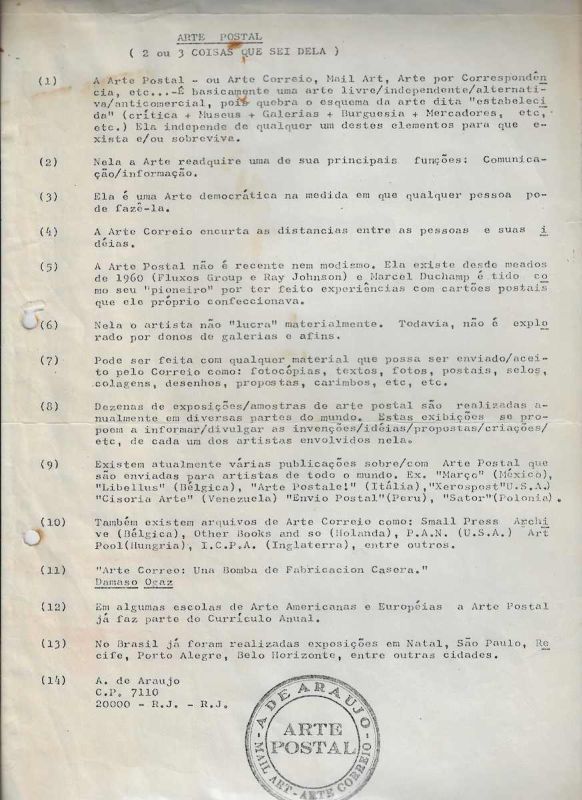
Avelino de Araújo, Arte Postal, 2 ou 3 coisas que sei dela, texto datilografado sobre Arte Postal, Arte Correio, Mail Art e arte por correspondência, sem data identificada. O documento apresenta treze considerações sobre a natureza, a história, os meios de circulação e a função cultural da Arte Postal. Avelino de Araújo define a Arte Postal como uma prática artística livre, independente, alternativa, anticomercial e politicamente crítica, criada fora do sistema estabelecido da arte, representado por críticos, museus, galerias, burguesia e mercado. Segundo o autor, essa modalidade devolve à arte uma de suas funções fundamentais, a comunicação e a informação, permitindo a participação democrática de qualquer pessoa. A Arte Correio reduz distâncias entre pessoas, artistas, ideias e diferentes contextos geográficos. O texto situa sua consolidação em meados da década de 1960, relacionando sua história ao grupo Fluxus, a Ray Johnson e a Marcel Duchamp, mencionado por suas experiências pioneiras com cartões postais confeccionados pelo próprio artista. Avelino de Araújo observa que o artista postal não obtém necessariamente lucro material e que suas obras não são exploradas por proprietários de galerias nem por interesses comerciais. A Arte Postal pode utilizar qualquer material que possa ser enviado e aceito pelos serviços de correio, incluindo fotocópias, textos, fotografias, cartões postais, selos, colagens, desenhos, propostas artísticas e carimbos. O documento registra a existência de dezenas de exposições e mostras anuais em diversas partes do mundo, destinadas a divulgar invenções, ideias, propostas e criações dos artistas participantes. Também relaciona publicações internacionais dedicadas à Arte Postal, como Marzo, do México, Libellus, da Bélgica, Arte Postale, da Itália, Xeropost, dos Estados Unidos, Cisoria Arte, da Venezuela, Envio Postal, do Peru, e Sator, da Polônia. Entre os arquivos e centros de documentação citados encontram se Small Press Archive, na Bélgica, Other Books and So, na Holanda, P A N, nos Estados Unidos, Art Pool, na Hungria, e I C P A, na Inglaterra. O texto menciona a formulação do artista venezuelano Dámaso Ogaz, Arte Correio Uma Bomba de Fabricação Caseira, associando a rede postal a uma forma direta, descentralizada e potencialmente transformadora de comunicação artística. Avelino de Araújo informa ainda que a Arte Postal já integrava o currículo de algumas escolas de arte norte americanas e europeias. No Brasil, registra exposições realizadas em Natal, São Paulo, Recife, Porto Alegre, Belo Horizonte e outras cidades, evidenciando a presença e a expansão da Arte Postal no país. Ao final aparecem a identificação A de Araújo, a caixa postal 7110, o código postal 20000, Rio de Janeiro, RJ, e um carimbo circular com os termos A de Araújo, Arte Postal, Mail Art e Arte Correio. O documento constitui fonte relevante para a história da Mail Art brasileira, da poesia visual, da arte conceitual, das redes internacionais de artistas, das publicações alternativas, dos arquivos de Arte Correio e da circulação artística independente no século vinte.PROGRAM TEXT IN ENGLISH: Avelino de Araújo, Postal Art, 2 or 3 Things I Know About It, typewritten text concerning Postal Art, Correspondence Art, Mail Art and art through the postal system, with no identified date. The document presents thirteen observations on the nature, history, circulation methods and cultural function of Mail Art. Avelino de Araújo defines Postal Art as a free, independent, alternative, noncommercial and politically critical artistic practice operating outside the established art system represented by critics, museums, galleries, the bourgeoisie and the commercial market. According to the author, this practice restores one of the primary functions of art, communication and information, while allowing any person to participate and create. Mail Art shortens distances between people, artists, ideas and geographical contexts. The text places its development in the mid 1960s and connects its history with Fluxus, Ray Johnson and Marcel Duchamp, who is mentioned for pioneering experiments involving postcards made by the artist himself. Avelino de Araújo states that the Mail Artist does not necessarily obtain material profit and that the work is not exploited by gallery owners or commercial interests. Postal Art may be created with any material that can be sent and accepted through the postal service, including photocopies, texts, photographs, postcards, stamps, collages, drawings, artistic proposals and rubber stamps. The document records the existence of dozens of annual exhibitions and Mail Art shows in different parts of the world, organized to communicate and circulate the inventions, ideas, proposals and creations of the participating artists. It also lists international publications devoted to Mail Art, including Marzo from Mexico, Libellus from Belgium, Arte Postale from Italy, Xeropost from the United States, Cisoria Arte from Venezuela, Envio Postal from Peru and Sator from Poland. Archives and documentation centers mentioned in the text include Small Press Archive in Belgium, Other Books and So in the Netherlands, P A N in the United States, Art Pool in Hungary and I C P A in England. The document cites the Venezuelan artist Dámaso Ogaz and his formulation Mail Art A Homemade Bomb, connecting the postal network with a direct, decentralized and potentially transformative form of artistic communication. Avelino de Araújo also notes that Postal Art had already become part of the curriculum of certain art schools in the United States and Europe. In Brazil, the text records exhibitions held in Natal, São Paulo, Recife, Porto Alegre, Belo Horizonte and other cities, demonstrating the circulation and expansion of Mail Art in the country. The final section includes the identification A de Araújo, post office box 7110, postal code 20000, Rio de Janeiro, RJ, and a circular stamp containing the terms A de Araújo, Arte Postal, Mail Art and Arte Correio. The document is an important source for the history of Brazilian Mail Art, visual poetry, conceptual art, international artist networks, alternative publications, Mail Art archives and independent artistic circulation during the twentieth century
Documento original datilografado em folha de papel, com marcas de dobra, sinais de manuseio, perfurações laterais para arquivamento e pequenas manchas decorrentes do tempo. O título Arte Postal aparece na parte superior, seguido do subtítulo 2 ou 3 coisas que sei dela. O conteúdo está organizado em treze itens numerados, além da identificação do autor no item final. O exemplar apresenta carimbo circular de A de Araújo na parte inferior, contendo as expressões Arte Postal, Mail Art e Arte Correio. Não foi localizada data explícita no documento. A referência ao código postal 20000 e à caixa postal 7110 indica circulação a partir do Rio de Janeiro. A grafia dos nomes de algumas publicações, arquivos e instituições internacionais foi mantida conforme a leitura possível do original, podendo exigir confirmação por comparação com outras fontes documentais. Trata se de um texto de caráter informativo e manifestário, no qual Avelino de Araújo sistematiza princípios históricos, políticos, comunicacionais e materiais da Arte Postal, defendendo sua independência em relação ao mercado e às instituições tradicionais da arteOBSERVATION TEXT IN ENGLISH: Original typewritten document on paper with fold marks, signs of handling, lateral archive holes and small age related stains. The title Arte Postal appears at the top, followed by the subtitle 2 ou 3 coisas que sei dela. The content is organized into thirteen numbered statements, followed by the identification of the author. A circular A de Araújo stamp appears at the bottom and includes the expressions Arte Postal, Mail Art and Arte Correio. No explicit date was found in the document. The reference to postal code 20000 and post office box 7110 indicates circulation from Rio de Janeiro. The spelling of some international publications, archives and institutions has been preserved according to the most legible reading of the original and may require confirmation through comparison with additional documentary sources. The text has both an informative and manifesto like character, as Avelino de Araújo organizes historical, political, communicational and material principles of Mail Art while defending its independence from the art market and traditional cultural institutions.
Proveniência
Coleção Poema ProcessoInglês
Avelino de Araújo, Postal Art, 2 or 3 Things I Know About It, typewritten text concerning Postal Art, Correspondence Art, Mail Art and art through the postal system, with no identified date.
Dimensions: 12,8 x 8,6 in