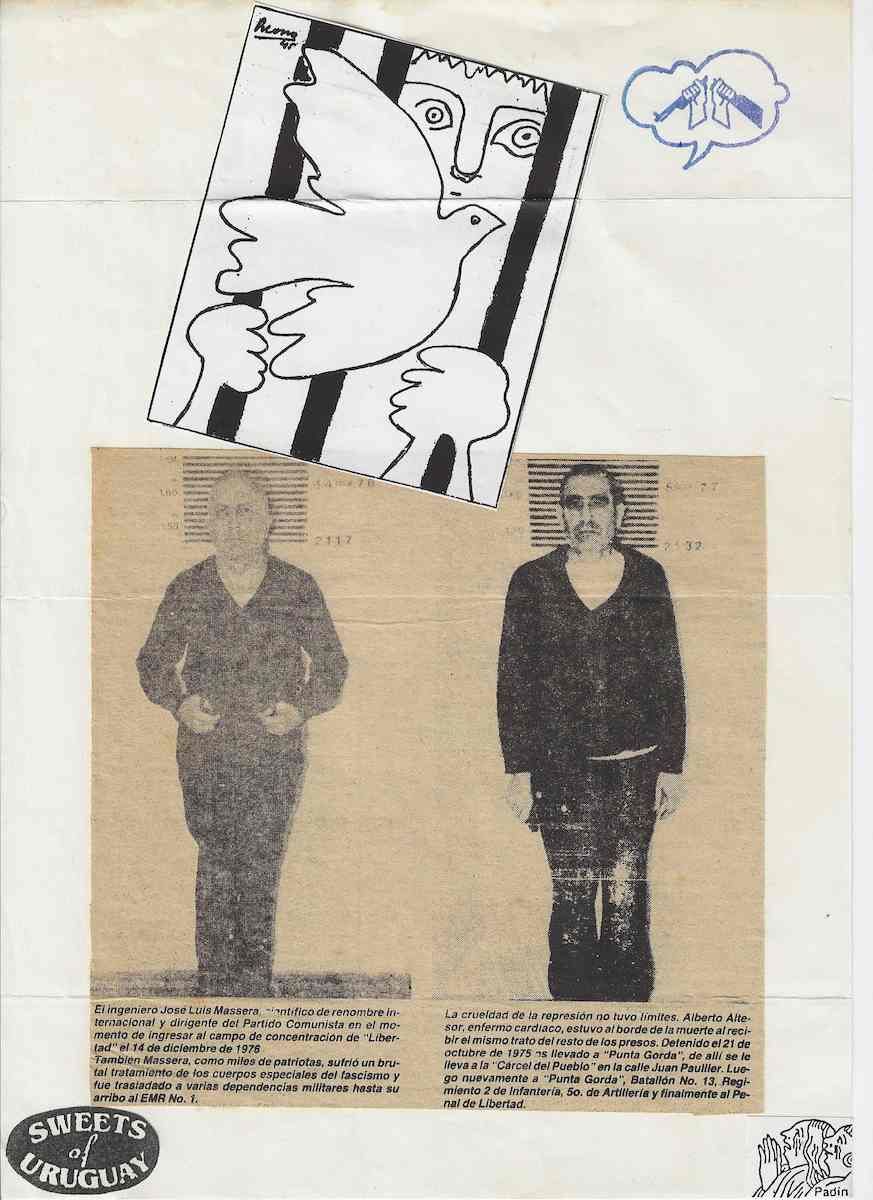
Colagem de arte política de Clemente Padín dedicada à denúncia da repressão, da prisão política e da violência exercida pela ditadura civil militar do Uruguai contra José Luis Massera e Alberto Altesor.
Clemente Padín
Categoria: Arte Politica
Acervo: 03528
Dimensões: 29,5 x 21 cm
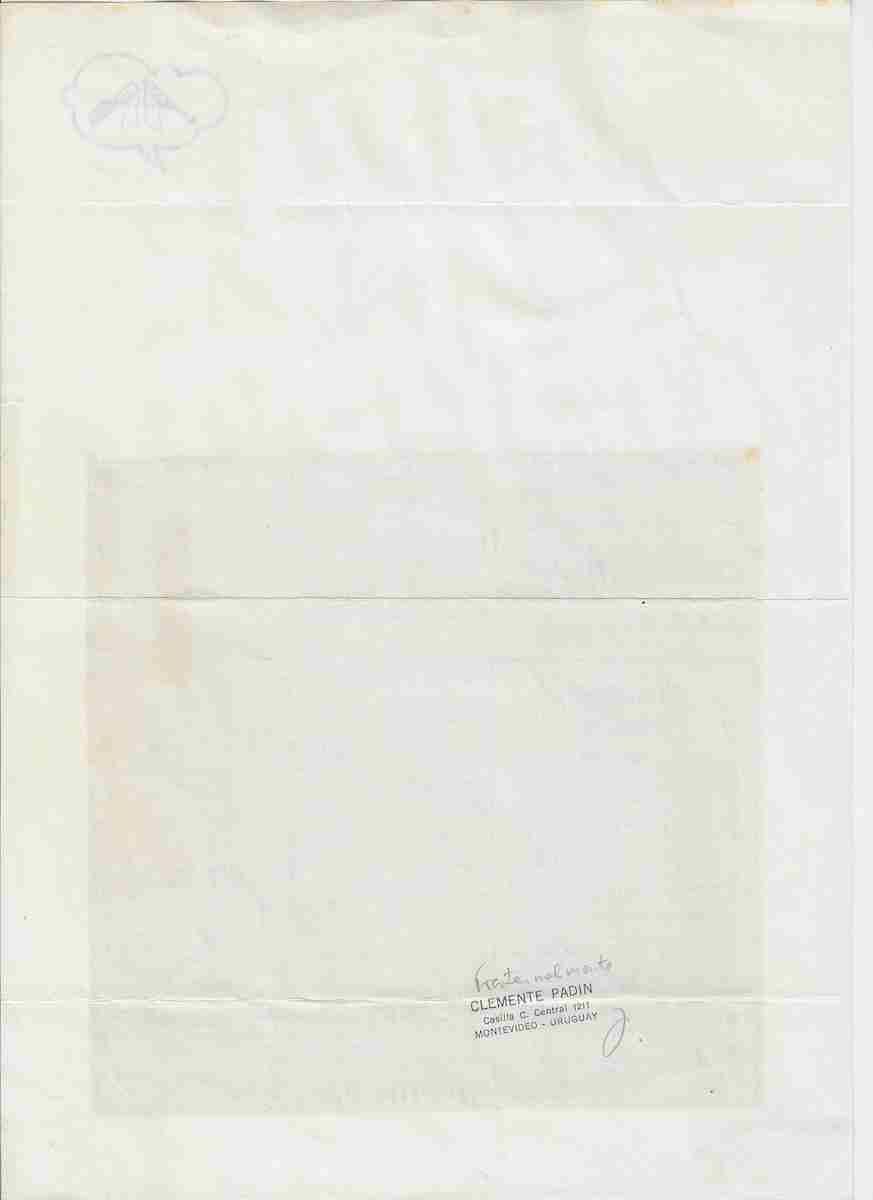
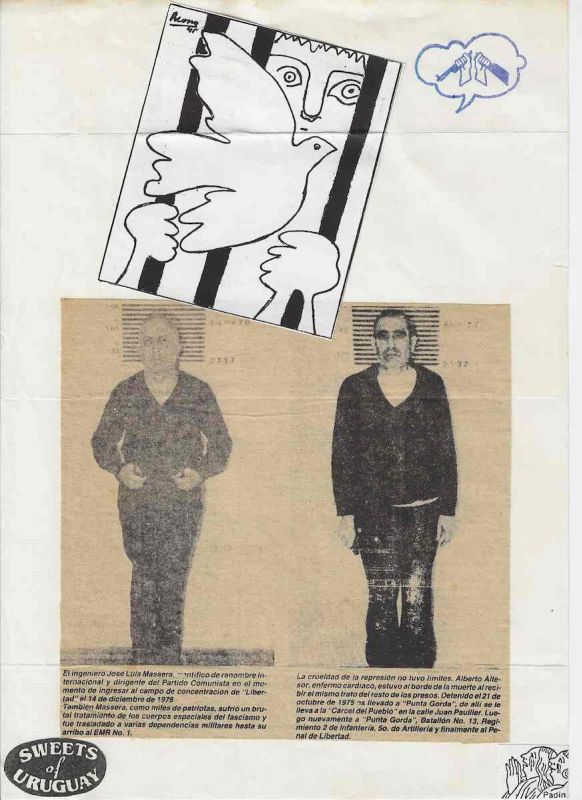
Colagem de arte política de Clemente Padín dedicada à denúncia da repressão, da prisão política e da violência exercida pela ditadura civil militar do Uruguai contra José Luis Massera e Alberto Altesor. A composição combina recorte de imprensa, fotografia documental, desenho, carimbos e intervenção gráfica sobre uma folha de papel claro. Na parte superior aparece uma imagem inclinada que representa uma figura humana atrás de barras verticais, segurando uma grande pomba branca, símbolo associado à paz, à liberdade, à solidariedade e à libertação dos presos políticos. Próximo à imagem encontra se um pequeno carimbo azul em forma de balão de pensamento com representação gráfica de mãos e um instrumento de escrita ou ferramenta de comunicação. A parte central contém reprodução fotográfica de José Luis Massera e Alberto Altesor diante de uma escala de identificação prisional. O texto localizado sob a imagem informa que José Luis Massera era engenheiro, cientista de reconhecimento internacional e dirigente do Partido Comunista do Uruguai quando ingressou no estabelecimento de reclusão de Libertad em 14 de dezembro de 1975. O recorte afirma que Massera, assim como milhares de patriotas uruguaios, foi submetido a tratamento brutal por corpos repressivos e transferido por diferentes dependências militares antes de chegar ao Estabelecimento Militar de Reclusão número 1, conhecido como Penal de Libertad. O texto referente a Alberto Altesor declara que a crueldade da repressão não teve limites e registra que, apesar de sofrer de doença cardíaca, ele recebeu o mesmo tratamento aplicado aos demais presos, ficando próximo da morte. Segundo o documento, Altesor foi detido em 21 de outubro de 1975 e transferido sucessivamente por Punta Rieles, pela chamada Cárcel del Pueblo situada na rua Juan Paullier, por Punta Gorda, pelo Batalhão número 13, pelo Regimento número 2 de Infantaria, pelo Quinto de Artilharia e finalmente pelo Penal de Libertad. Na margem inferior esquerda aparece o carimbo Sweets of Uruguay, expressão que produz contraste irônico entre a ideia de doçura e a documentação da tortura, da perseguição e do encarceramento político. Na margem inferior direita encontra se uma pequena imagem gráfica assinada Padín. O verso apresenta o carimbo de Clemente Padín com endereço postal em Montevidéu, Uruguai, acompanhado de assinatura e anotação manuscrita. A obra articula arte conceitual, poesia visual, arte postal, colagem, apropriação de imprensa e documentação política para preservar a memória das vítimas do terrorismo de Estado uruguaio. O conjunto constitui testemunho histórico sobre José Luis Massera, Alberto Altesor, o Penal de Libertad, a perseguição ao Partido Comunista do Uruguai, os presos políticos, os centros militares de detenção, a censura, a tortura, os direitos humanos e as redes internacionais de solidariedade mobilizadas por Clemente Padín e por outros artistas latino americanos.Political art collage by Clemente Padín devoted to denouncing repression, political imprisonment and the violence exercised by the Uruguayan civil military dictatorship against José Luis Massera and Alberto Altesor. The composition combines a press clipping, documentary photography, drawing, rubber stamps and graphic intervention on a sheet of light colored paper. The upper area contains an inclined image representing a human figure behind vertical bars holding a large white dove, a symbol associated with peace, freedom, solidarity and the liberation of political prisoners. Near this image is a small blue stamp shaped like a thought balloon containing a graphic representation of hands and a writing instrument or communication tool. The central area contains a photographic reproduction of José Luis Massera and Alberto Altesor standing before a prison identification scale. The text beneath the image states that José Luis Massera was an engineer, an internationally recognized scientist and a leader of the Communist Party of Uruguay when he entered the Libertad detention facility on 14 December 1975. The clipping reports that Massera, like thousands of Uruguayan patriots, was subjected to brutal treatment by repressive forces and transferred through several military facilities before arriving at Military Detention Establishment number 1, widely known as Libertad Prison. The text concerning Alberto Altesor states that the cruelty of the repression had no limits and records that, although he suffered from a heart condition, he received the same treatment as the other prisoners and came close to death. According to the document, Altesor was arrested on 21 October 1975 and successively transferred through Punta Rieles, the place identified as Cárcel del Pueblo on Juan Paullier Street, Punta Gorda, Battalion number 13, Infantry Regiment number 2, the Fifth Artillery unit and finally Libertad Prison. The lower left margin contains the stamp Sweets of Uruguay, an expression that creates an ironic contrast between the idea of sweetness and the documentation of torture, persecution and political imprisonment. The lower right margin contains a small graphic image signed Padín. The reverse bears Clemente Padín
s postal stamp with a Montevideo address, together with a handwritten signature and annotation. The work combines conceptual art, visual poetry, mail art, collage, press appropriation and political documentation to preserve the memory of victims of Uruguayan state terrorism. The ensemble constitutes historical testimony concerning José Luis Massera, Alberto Altesor, Libertad Prison, the persecution of the Communist Party of Uruguay, political prisoners, military detention centers, censorship, torture, human rights and the international solidarity networks mobilized by Clemente Padín and other Latin American artists.
Obra sobre papel formada por colagem de recorte impresso, reprodução fotográfica, desenho em preto, carimbos em azul e preto e intervenções gráficas. Não há data claramente visível nas imagens apresentadas, portanto a datação deve permanecer como não identificada até a consulta de documentos complementares ou o exame direto do original. O texto documental identifica José Luis Massera e Alberto Altesor como vítimas da repressão política uruguaia e descreve prisões, maus tratos e transferências entre diferentes dependências militares e penitenciárias. A imagem de Massera apresenta perda de contraste e sobreposição das linhas da escala prisional, enquanto a figura de Altesor aparece com maior definição. A pomba branca colocada diante das barras funciona como elemento visual de esperança e resistência, contrapondo liberdade e encarceramento. O carimbo Sweets of Uruguay amplia o caráter crítico da obra por meio de ironia política. O verso apresenta o carimbo Clemente Padín, Casilla C Central 1211, Montevideo, Uruguay, além de escrita manuscrita parcialmente legível. O suporte possui vincos horizontais e verticais, amarelecimento, manchas discretas, marcas de colagem, pequenas perdas superficiais e desgaste compatível com circulação, manuseio e conservação arquivística. Documento relevante para pesquisas sobre Clemente Padín, José Luis Massera, Alberto Altesor, arte política uruguaia, ditadura civil militar, presos políticos, Penal de Libertad, Estabelecimento Militar de Reclusão número 1, Partido Comunista do Uruguai, arte postal, poesia visual, colagem, memória política, direitos humanos e resistência cultural na América Latina.Work on paper composed of an adhered printed clipping, photographic reproduction, black line drawing, blue and black rubber stamps and graphic interventions. No clearly legible date is visible in the supplied images, and the work should therefore remain undated until complementary documentation is located or the original is examined directly. The documentary text identifies José Luis Massera and Alberto Altesor as victims of political repression in Uruguay and describes imprisonment, mistreatment and transfers among several military and penal facilities. The image of Massera has reduced contrast and is partially crossed by the lines of the prison identification scale, while the figure of Altesor appears with greater definition. The white dove placed before the bars functions as an image of hope and resistance, opposing freedom to imprisonment. The Sweets of Uruguay stamp strengthens the critical character of the work through political irony. The reverse bears the stamp Clemente Padín, Casilla C Central 1211, Montevideo, Uruguay, together with partially legible handwriting. The support presents horizontal and vertical folds, yellowing, faint stains, traces of adhesion, minor surface losses and wear consistent with circulation, handling and archival preservation. This document is relevant to research on Clemente Padín, José Luis Massera, Alberto Altesor, Uruguayan political art, the civil military dictatorship, political prisoners, Libertad Prison, Military Detention Establishment number 1, the Communist Party of Uruguay, mail art, visual poetry, collage, political memory, human rights and cultural resistance in Latin America.
Proveniência
Coleção Poema ProcessoInglês
Political art collage by Clemente Padín devoted to denouncing repression, political imprisonment and the violence exercised by the Uruguayan civil military dictatorship against José Luis Massera and Alberto Altesor.
Dimensions: 11,6 x 8,3 in