Visual Poetry International - Rotterdam Art Foundation
Local de nascimento: Rotterdamse Kunststichting, na galeria de Doelen, Kruisplein 40, Roterdã, Países Baixos
Data de nascimento: 6 de junho de 1975
Local de falecimento: Rotterdamse Kunststichting, na galeria de Doelen, Kruisplein 40, Roterdã, Países Baixos
Data de falecimento: 7 de julho de 1975
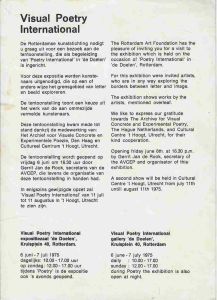
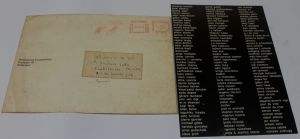
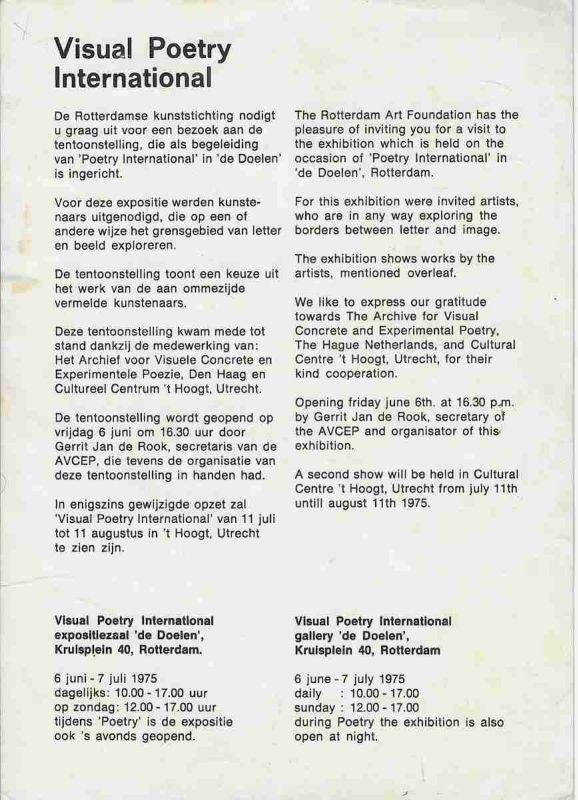
BIOGRAFIA EM PORTUGUÊSVisual Poetry International foi uma exposição coletiva internacional de poesia visual realizada pela Rotterdam Art Foundation, Rotterdamse Kunststichting, na galeria de Doelen, Kruisplein 40, Roterdã, Países Baixos, de 6 de junho a 7 de julho de 1975, no contexto do evento Poetry International. Organizada por Gerrit Jan de Rook, então secretário do AVCEP, Archive for Visual Concrete and Experimental Poetry, a mostra reuniu uma extensa rede internacional de artistas, poetas e pesquisadores que exploravam as relações entre letra, palavra, imagem, tipografia, espaço gráfico, poesia concreta, poesia experimental, poesia visual, arte conceitual e práticas intermedia. Sua importância para a história do Poema Processo é direta, pois Álvaro de Sá e Neide de Sá aparecem conjuntamente na relação oficial de participantes, inserindo dois protagonistas do movimento brasileiro em uma ampla rede internacional da poesia visual dos anos 1970.O folder bilíngue em neerlandês e inglês apresentado como documentação primária explica que a Rotterdam Art Foundation convidava o público para visitar uma exposição organizada por ocasião de Poetry International em de Doelen. O documento define de forma precisa o critério artístico adotado. Foram convidados artistas que, de uma maneira ou de outra, exploravam as fronteiras entre letra e imagem. Essa formulação é fundamental porque situa Visual Poetry International não como uma exposição dedicada a um único movimento ou escola, mas como uma plataforma internacional para diferentes investigações sobre a visualidade da linguagem.A mostra apresentava uma seleção de trabalhos dos artistas relacionados no verso do folder. A extensa lista reúne representantes de diferentes gerações, países e correntes experimentais. Estão documentados nomes relacionados à poesia concreta, poesia sonora, poesia visual, poesia experimental, poesia visiva italiana, Signalismo, arte conceitual, Fluxus, Mail Art, livro de artista e pesquisas verbo visuais. A amplitude da seleção demonstra a tentativa de construir um panorama transnacional da expansão da escrita e da poesia para o campo visual.A exposição foi organizada com colaboração do Archive for Visual Concrete and Experimental Poetry, localizado em Haia, e do Cultural Centre t Hoogt, em Utrecht. O folder agradece explicitamente a cooperação dessas duas instituições. O AVCEP desempenhava papel importante na documentação e circulação da poesia concreta, visual e experimental e sua participação na organização ajuda a explicar a extraordinária amplitude internacional da lista de artistas.Gerrit Jan de Rook exerceu função central no projeto. O documento o identifica como secretário do AVCEP e organizador da exposição. A abertura ocorreu na sexta feira, 6 de junho de 1975, às 16h30, conduzida pelo próprio de Rook. A presença de um organizador simultaneamente ligado a um arquivo especializado em poesia visual e experimental demonstra que a exposição possuía também uma dimensão de pesquisa, documentação e articulação internacional.A primeira etapa ocorreu na Gallery de Doelen, Kruisplein 40, Roterdã, de 6 de junho a 7 de julho de 1975. O horário anunciado era das 10h às 17h diariamente, com funcionamento aos domingos das 12h às 17h. Durante o período de Poetry International, a exposição permanecia também aberta à noite. Esses dados permitem compreender que Visual Poetry International estava diretamente integrada ao ambiente público e cultural de Poetry International.O folder anuncia ainda uma segunda apresentação da mostra no Cultural Centre t Hoogt, Utrecht, em configuração parcialmente modificada. A documentação primária fornecida informa o período de 11 de julho a 11 de agosto de 1975. Uma fonte histórica posterior registra 11 de julho a 8 de agosto de 1975. Como o folder original é fonte primária contemporânea ao evento, a data de 11 de agosto deve ser mantida como referência principal, registrando a divergência bibliográfica quando necessário.A circulação da mostra parece ter integrado uma programação internacional mais ampla dedicada à poesia visual em 1975 e 1976. Documento histórico preservado em arquivo relacionado ao Signalismo registra Visual Poetry International em de Doelen, Roterdã, entre 6 de junho e 7 de julho de 1975, Internationale Visuele Poëzie em t Hoogt, Utrecht, a partir de 11 de julho, além de Visuele Poezie no Van Gogh Museum, Amsterdam, de 15 de novembro a 15 de dezembro de 1975, e Internationale Visuele Poëzie em Bruxelas em fevereiro e março de 1976. Esses registros sugerem uma sequência de apresentações e desdobramentos relacionados à circulação europeia da poesia visual.Entre os participantes documentados aparecem Vincenzo Accame, Karel Adamus, Jeremy Adler, Marcel Alocco, Alain Arias Misson, Gabor Attalai, Georges Badin, Maarten Beks, Andrew Belsey, Mirella Bentivoglio, Ruggero Bianchi, Alison Bielski, Werner F. Bonin, Bart Boumans, Regina Braga, Claus Bremer, Alpár Bujdosó, Enrico Bugli, Jorge Caraballo, Ulises Carrión, Antonio C. Carvalho, Lourdes Castro, Dalibor Chatrny, Manfred Chobot, Carl Friedrich Claus, Hans Clavin, Robin Crozier, Attila Csernik, Daniel Daligand, Herman Damen, Klaus Peter Dencker, Wally Depew, Gérard Duchêne, Pier van Dijk, W. M. Elsenaar, Luigi Ferro, Allen Fisher, Kazuhiko Fukada, John Furnival, Pierre Garnier, Michael Gibbs, Haroldo Gonzalez, Ernst Gottschalk e Klaus Groh.A relação continua com Günter Guben, Sigurdur Gudmundsson, Richard Hartwell, Helena Hatleova, Bernard Heidsieck, Dick Higgins, David Det Hompson, Mark Insingel, Gervais Jassaud, Robert Joseph, T. J. Kallsen, Kitsono Katue, Károly Kismányoky, Shoichi Kiyokawa, Miroslav Klivar, J. H. Kocman, Béla Kolá?ová, Richard Kostelanetz, Ivan Kral, Katalin Ladik, Jean Clarence Lambert, Kalevi Lappalainen, Robert Lax, Sean Licka, John Liggins, Arrigo Lora Totino, Maillet, J. O. Mallander, Lucia Marcucci, Yutaka Matsuzawa, Dóra Maurer, Peter Weijboom, Eugenio Miccini, Cyril Miles, Missmahl, Pieter Mol, Molitor, José M. Montells, Stephen Morris, Maarten Mourik, Paul Nagy, Giulia Niccolai, Ladislav Novak, Renaldo Ruizalese e Anna e Martino Oberto.Na terceira coluna do documento figuram Tom Ockerse, Luciano Ori, Maurizio Osti, Clemente Padín, Andrzej Partum, Felice Piemonte, Bern Porter, Betty Radin, H. B. Reeskamp, Alan Riddell, Kenneth Robinson, G. J. de Rook, Álvaro e Neide de Sá, Giovanna Sandri, Sarenco, Konrad B. Schäuffelen, Gerd Scherm, Siegfried J. Schmidt, Wolfgang Schmidt, Landfried Schröpfer, Mary Ellen Solt, Adriano Spatola, U. G. Stikker, Rod Summers, Bálint Szombathy, Ian Tarnman, Miroljub Todorovi?, Shohachiro Takahashi, Endre Tót, Gábor Tóth, Horst Tress, Sylvia Trevale, David Troostwijk, Timm Ulrichs, Ji?í Valoch, Edgardo Antonio Vigo, Paul de Vree, Herman de Vries, Werner Wenz, Michael Wiater, Eldert Willems, Jan Wojnar, William Xerra, Horacio Zabala e Nicholas Zurbrugg.A lista permite compreender a excepcional densidade histórica da exposição. Ulises Carrión estava diretamente relacionado às transformações do livro de artista, publicação experimental e comunicação conceitual. Clemente Padín e Edgardo Antonio Vigo representam núcleos fundamentais da poesia experimental e da arte postal latino americana. Horacio Zabala relacionava poesia visual, conceitualismo e sistemas de comunicação. Mirella Bentivoglio, Lucia Marcucci, Eugenio Miccini, Sarenco, Adriano Spatola, Vincenzo Accame e Arrigo Lora Totino estavam relacionados a diferentes vertentes da poesia visual e poesia visiva italiana.Bernard Heidsieck conecta a exposição à poesia sonora e à poesia ação. Dick Higgins amplia o contexto para Fluxus, intermedia e publicações experimentais. Richard Kostelanetz atua no campo da poesia experimental, visual e sonora. John Furnival, Pierre Garnier e Mary Ellen Solt relacionam a mostra a importantes experiências da poesia concreta e espacial. Katalin Ladik, Bálint Szombathy e Miroljub Todorovi? documentam a participação de importantes artistas e poetas experimentais da Europa Central e da antiga Iugoslávia.A presença de Endre Tót, Dóra Maurer, Gábor Tóth e Gabor Attalai reforça as conexões com práticas conceituais e experimentais húngaras. Andrzej Partum representa a poesia e arte conceitual polonesa. Ji?í Valoch e J. H. Kocman inserem a Tchecoslováquia nesse mapa. Klaus Groh aparece como importante articulador de redes internacionais de arte alternativa, enquanto Timm Ulrichs ocupa posição entre arte conceitual, linguagem e experimentação interdisciplinar.A participação latino americana é particularmente importante. Além de Álvaro e Neide de Sá, aparecem Clemente Padín, do Uruguai, Edgardo Antonio Vigo e Horacio Zabala, da Argentina, Jorge Caraballo e outros artistas vinculados às redes experimentais da região. A convivência desses nomes dentro de uma mesma exposição mostra que as experiências latino americanas não aparecem como fenômenos isolados, mas integradas a um circuito internacional de discussão sobre palavra, imagem e comunicação.Álvaro de Sá e Neide de Sá aparecem no folder na forma Álvaro & Neide de Sá. Essa inscrição conjunta é documentalmente importante. Ambos estiveram entre os principais protagonistas do Poema Processo, movimento lançado no Brasil em 1967 e dedicado à transformação do poema em estrutura visual, processo, código, série e objeto aberto à participação. Sua presença em Visual Poetry International demonstra que, em 1975, pesquisas oriundas do Poema Processo já circulavam em um contexto internacional ao lado de alguns dos mais importantes artistas e poetas experimentais daquele período.O próprio Acervo Poema Processo registra um folder de Visual Poetry International de 1975 associado a Álvaro de Sá, reforçando a permanência dessa documentação dentro de seu arquivo.A exposição possui, portanto, importância especial para a reconstrução das relações internacionais do Poema Processo. Não se tratava de uma exposição do movimento brasileiro, mas de uma exposição internacional de poesia visual na qual Álvaro e Neide de Sá foram incluídos entre dezenas de artistas de diferentes países. Esse contexto permite demonstrar que o Poema Processo participou de uma rede transnacional mais ampla envolvendo poesia visual, poesia concreta, poesia experimental, arte conceitual, Mail Art e publicações de artista.Visual Poetry International também deve ser compreendida em relação ao desenvolvimento histórico da poesia visual na década de 1970. A mostra ocorreu em um momento em que artistas de diferentes origens abandonavam progressivamente fronteiras rígidas entre literatura e artes visuais. Letras podiam funcionar como formas, palavras como imagens, páginas como campos espaciais, tipografia como matéria, e a leitura podia ser substituída ou ampliada por operações visuais, espaciais e semióticas.A formulação do folder sobre explorar as fronteiras entre letter and image sintetiza esse contexto. A palavra fronteira indica que a exposição não pretendia fixar uma definição fechada da poesia visual. Ao contrário, reunia artistas justamente porque operavam em áreas de transição entre escrita e imagem. Isso explica a presença conjunta de poetas concretos, artistas conceituais, performers, editores, artistas postais, autores de livros de artista e pesquisadores da linguagem.A Rotterdam Art Foundation assume papel institucional decisivo ao transportar essas práticas de redes independentes e publicações experimentais para um espaço expositivo ligado ao Poetry International. Visual Poetry International demonstra, assim, um momento de institucionalização crescente da poesia visual sem eliminar a heterogeneidade experimental que caracterizava esse campo.O folder da exposição possui também valor como documento arquivístico. Bilíngue, compacto e funcional, ele registra título, instituição, conceito curatorial, colaboradores, organizador, horário, datas, endereço, segunda apresentação e uma extensa lista nominal de artistas. É simultaneamente convite, programa, lista de participantes e documento histórico de circulação.Fontes externas confirmam independentemente a realização de Visual Poetry International em de Doelen, Roterdã, em 1975. A bibliografia de Arrigo Lora Totino registra a participação do artista em Visual Poetry International, Rotterdam, De Doelen, 1975. Um exemplar do flyer é descrito bibliograficamente como publicação da Rotterdam Art Foundation de 1975, com aproximadamente 21 por 15 cm, produzido para a exposição realizada durante Poetry International entre 6 de junho e 7 de julho.Visual Poetry International constitui, portanto, uma exposição histórica fundamental para compreender as redes internacionais da poesia visual em meados da década de 1970. Seu valor para o Acervo Poema Processo é particularmente elevado porque documenta nominalmente Álvaro de Sá e Neide de Sá dentro de uma extensa rede que inclui artistas da Europa, América Latina, América do Norte e Ásia. A mostra demonstra a circulação internacional das experiências brasileiras do Poema Processo e permite situá las dentro de uma história global da poesia visual, da experimentação verbo visual, da arte conceitual e das redes alternativas de comunicação.
English
BIOGRAPHY IN ENGLISHVisual Poetry International was an international group exhibition of visual poetry organized by the Rotterdam Art Foundation, Rotterdamse Kunststichting, at Gallery de Doelen, Kruisplein 40, Rotterdam, the Netherlands, from 6 June to 7 July 1975 on the occasion of Poetry International. Organized by Gerrit Jan de Rook, then secretary of AVCEP, the Archive for Visual Concrete and Experimental Poetry, the exhibition brought together an extensive international network of artists, poets, and researchers exploring relationships among letters, words, images, typography, graphic space, Concrete Poetry, experimental poetry, visual poetry, conceptual art, and intermedia practices. Its relationship to the history of the Process Poem Movement is direct because Álvaro de Sá and Neide de Sá appear together in the official participant list, placing two major protagonists of the Brazilian movement within a broad international visual poetry network during the 1970s.The surviving bilingual Dutch and English folder explains that the Rotterdam Art Foundation invited visitors to an exhibition organized on the occasion of Poetry International at de Doelen. The document precisely defines the artistic premise of the project. The invited artists were described as practitioners who explored, in one way or another, the borders between letter and image. This formulation is fundamental because it establishes Visual Poetry International not as an exhibition devoted to a single movement or school but as an international platform for multiple approaches to the visual dimension of language.The exhibition presented a selection of works by the artists listed on the reverse of the folder. The extensive list brings together different generations, countries, and experimental tendencies. Artists associated with Concrete Poetry, sound poetry, visual poetry, experimental poetry, Italian poesia visiva, Signalism, conceptual art, Fluxus, Mail Art, artists books, and verbal visual experimentation appear within the same documentary framework. The breadth of the selection demonstrates an attempt to construct a transnational panorama of the expansion of writing and poetry into the visual field.The exhibition was realized with the cooperation of the Archive for Visual Concrete and Experimental Poetry in The Hague and Cultural Centre t Hoogt in Utrecht. The folder explicitly acknowledges both institutions. AVCEP played an important role in documenting and circulating concrete, visual, and experimental poetry, and its participation helps explain the extraordinary international breadth of the exhibition.Gerrit Jan de Rook occupied a central position in the project. The primary document identifies him as secretary of AVCEP and organizer of the exhibition. The opening took place on Friday, 6 June 1975, at 4:30 p.m. and was conducted by de Rook. His simultaneous role as exhibition organizer and representative of a specialized archive demonstrates that Visual Poetry International also possessed a strong research, documentary, and international networking dimension.The first presentation took place at Gallery de Doelen, Kruisplein 40, Rotterdam, from 6 June to 7 July 1975. Announced visiting hours were 10 a.m. to 5 p.m. daily and noon to 5 p.m. on Sundays. During Poetry International, the exhibition was also open at night. These details establish the direct integration of Visual Poetry International into the public and cultural environment of Poetry International.The folder also announces a second presentation at Cultural Centre t Hoogt in Utrecht in a somewhat modified format. The supplied primary document states that this second exhibition was scheduled from 11 July to 11 August 1975. A later historical source gives 11 July to 8 August 1975. Because the contemporary exhibition folder constitutes primary evidence, 11 August should remain the principal catalogue date while the bibliographic discrepancy may be noted in scholarly documentation.The project appears to have belonged to a wider sequence of European exhibitions of visual poetry during 1975 and 1976. Historical documentation preserved in connection with Signalist networks records Visual Poetry International at de Doelen in Rotterdam from 6 June to 7 July 1975, Internationale Visuele Poëzie at t Hoogt in Utrecht beginning on 11 July, Visuele Poezie at the Van Gogh Museum in Amsterdam from 15 November to 15 December 1975, and Internationale Visuele Poëzie in Brussels during February and March 1976. These records indicate a broader circulation of visual poetry exhibitions and related material in Europe.Documented participants include Vincenzo Accame, Karel Adamus, Jeremy Adler, Marcel Alocco, Alain Arias Misson, Gabor Attalai, Georges Badin, Maarten Beks, Andrew Belsey, Mirella Bentivoglio, Ruggero Bianchi, Alison Bielski, Werner F. Bonin, Bart Boumans, Regina Braga, Claus Bremer, Alpár Bujdosó, Enrico Bugli, Jorge Caraballo, Ulises Carrión, Antonio C. Carvalho, Lourdes Castro, Dalibor Chatrny, Manfred Chobot, Carl Friedrich Claus, Hans Clavin, Robin Crozier, Attila Csernik, Daniel Daligand, Herman Damen, Klaus Peter Dencker, Wally Depew, Gérard Duchêne, Pier van Dijk, W. M. Elsenaar, Luigi Ferro, Allen Fisher, Kazuhiko Fukada, John Furnival, Pierre Garnier, Michael Gibbs, Haroldo Gonzalez, Ernst Gottschalk, and Klaus Groh.The participant list continues with Günter Guben, Sigurdur Gudmundsson, Richard Hartwell, Helena Hatleova, Bernard Heidsieck, Dick Higgins, David Det Hompson, Mark Insingel, Gervais Jassaud, Robert Joseph, T. J. Kallsen, Kitsono Katue, Károly Kismányoky, Shoichi Kiyokawa, Miroslav Klivar, J. H. Kocman, Béla Kolá?ová, Richard Kostelanetz, Ivan Kral, Katalin Ladik, Jean Clarence Lambert, Kalevi Lappalainen, Robert Lax, Sean Licka, John Liggins, Arrigo Lora Totino, Maillet, J. O. Mallander, Lucia Marcucci, Yutaka Matsuzawa, Dóra Maurer, Peter Weijboom, Eugenio Miccini, Cyril Miles, Missmahl, Pieter Mol, Molitor, José M. Montells, Stephen Morris, Maarten Mourik, Paul Nagy, Giulia Niccolai, Ladislav Novak, Renaldo Ruizalese, and Anna and Martino Oberto.The third column of the original document lists Tom Ockerse, Luciano Ori, Maurizio Osti, Clemente Padín, Andrzej Partum, Felice Piemonte, Bern Porter, Betty Radin, H. B. Reeskamp, Alan Riddell, Kenneth Robinson, G. J. de Rook, Álvaro and Neide de Sá, Giovanna Sandri, Sarenco, Konrad B. Schäuffelen, Gerd Scherm, Siegfried J. Schmidt, Wolfgang Schmidt, Landfried Schröpfer, Mary Ellen Solt, Adriano Spatola, U. G. Stikker, Rod Summers, Bálint Szombathy, Ian Tarnman, Miroljub Todorovi?, Shohachiro Takahashi, Endre Tót, Gábor Tóth, Horst Tress, Sylvia Trevale, David Troostwijk, Timm Ulrichs, Ji?í Valoch, Edgardo Antonio Vigo, Paul de Vree, Herman de Vries, Werner Wenz, Michael Wiater, Eldert Willems, Jan Wojnar, William Xerra, Horacio Zabala, and Nicholas Zurbrugg.This participant list reveals the exceptional historical density of the exhibition. Ulises Carrión was centrally involved with artists books, experimental publishing, and conceptual communication. Clemente Padín and Edgardo Antonio Vigo represent major Latin American experimental poetry and Mail Art networks. Horacio Zabala connected visual poetry, conceptual practice, and communication systems. Mirella Bentivoglio, Lucia Marcucci, Eugenio Miccini, Sarenco, Adriano Spatola, Vincenzo Accame, and Arrigo Lora Totino represent different strands of Italian visual poetry and poesia visiva.Bernard Heidsieck connects the exhibition with sound poetry and action poetry. Dick Higgins expands its context toward Fluxus, intermedia, and experimental publishing. Richard Kostelanetz worked across visual, experimental, and sound poetry. John Furnival, Pierre Garnier, and Mary Ellen Solt connect the exhibition with important developments in Concrete and spatial poetry. Katalin Ladik, Bálint Szombathy, and Miroljub Todorovi? document the presence of major experimental artists and poets from Central Europe and the former Yugoslavia.Endre Tót, Dóra Maurer, Gábor Tóth, and Gabor Attalai strengthen the exhibition's relationship to Hungarian conceptual and experimental practices. Andrzej Partum represents Polish experimental poetry and conceptual art. Ji?í Valoch and J. H. Kocman connect the exhibition with Czechoslovak experimental art. Klaus Groh was an important international networker within alternative art circuits, while Timm Ulrichs operated between conceptual art, language, and interdisciplinary experimentation.Latin American participation is particularly significant. In addition to Álvaro and Neide de Sá, the exhibition includes Clemente Padín from Uruguay, Edgardo Antonio Vigo and Horacio Zabala from Argentina, Jorge Caraballo, and other artists connected with experimental networks in the region. Their presence demonstrates that Latin American experimentation was not represented as an isolated phenomenon but as part of an international discussion concerning word, image, and communication.Álvaro de Sá and Neide de Sá are listed in the folder as Álvaro & Neide de Sá. This joint entry is of major documentary importance. Both were leading protagonists of the Process Poem Movement, launched in Brazil in 1967 and devoted to transforming the poem into visual structure, process, code, series, and an object open to participation. Their presence in Visual Poetry International demonstrates that by 1975 research emerging from Process Poem was circulating internationally alongside some of the most important experimental artists and poets of the period.The Poema Processo Archive itself records a 1975 Visual Poetry International folder associated with Álvaro de Sá, confirming the preservation of this exhibition documentation within his archival context.The exhibition is therefore especially important for reconstructing the international relationships of the Process Poem Movement. Visual Poetry International was not a Process Poem exhibition, but Álvaro and Neide de Sá were included within a broad visual poetry event involving artists from many countries. This context demonstrates that Process Poem participated in a wider transnational network involving visual poetry, Concrete Poetry, experimental poetry, conceptual art, Mail Art, and artists publications.Visual Poetry International should also be understood within the historical development of visual poetry during the 1970s. Artists from different backgrounds were increasingly breaking down rigid divisions between literature and visual art. Letters could operate as shapes, words as images, pages as spatial fields, typography as material, and conventional reading could be replaced or expanded by visual, spatial, and semiotic operations.The folder's description of artists exploring the borders between letter and image summarizes this historical context. The idea of a border indicates that the exhibition did not attempt to impose a closed definition of visual poetry. It gathered artists precisely because they worked in transitional areas between writing and image. This explains the coexistence of Concrete poets, conceptual artists, performers, editors, Mail Artists, artists book practitioners, and researchers of language.The Rotterdam Art Foundation played a decisive institutional role by bringing practices that frequently circulated through independent networks and experimental publications into an exhibition environment connected with Poetry International. Visual Poetry International consequently documents an important moment in the growing institutional recognition of visual poetry while preserving the heterogeneity that defined the field.The exhibition folder also has significant archival value. Bilingual, compact, and functional, it records the title, institution, curatorial premise, collaborators, organizer, visiting hours, dates, address, second presentation, and an extensive participant list. It functions simultaneously as invitation, program, participant register, and historical document of circulation.Independent sources confirm the exhibition at de Doelen in Rotterdam in 1975. Arrigo Lora Totino's exhibition chronology records Visual Poetry International, Rotterdam, De Doelen, 1975. A surviving flyer is bibliographically described as a Rotterdam Art Foundation publication produced for the exhibition held during Poetry International from 6 June through 7 July 1975, measuring approximately 21 by 15 cm.Visual Poetry International is therefore a major historical exhibition for understanding international visual poetry networks in the mid 1970s. Its significance to the Poema Processo Archive is especially strong because it documents Álvaro de Sá and Neide de Sá by name within an extensive network extending across Europe, Latin America, North America, and Asia. The exhibition demonstrates the international circulation of Brazilian Process Poem experimentation and positions it within a global history of visual poetry, verbal visual experimentation, conceptual art, and alternative communication networks.
Currículo
CURRÍCULO EM PORTUGUÊSVisual Poetry International foi uma exposição coletiva internacional de poesia visual organizada pela Rotterdam Art Foundation em Roterdã em 1975, com organização de Gerrit Jan de Rook e colaboração do Archive for Visual Concrete and Experimental Poetry e do Cultural Centre t Hoogt. Sua documentação registra uma ampla rede de artistas internacionais e confirma a participação conjunta de Álvaro de Sá e Neide de Sá, tornando a mostra relevante para a história internacional do Poema Processo, da poesia visual e das vanguardas experimentais.IDENTIFICAÇÃONome principal: Visual Poetry InternationalTipo: exposição coletiva internacional de poesia visualAno: 1975Instituição promotora: Rotterdam Art FoundationNome em neerlandês da instituição: Rotterdamse KunststichtingLocal principal: Gallery de DoelenEndereço: Kruisplein 40Cidade: RoterdãPaís: Países BaixosData de abertura: 6 de junho de 1975Data de encerramento: 7 de julho de 1975Contexto: Poetry InternationalOrganizador: Gerrit Jan de RookFunção documentada de Gerrit Jan de Rook: secretário do AVCEP e organizador da exposiçãoInstituições colaboradoras: Archive for Visual Concrete and Experimental Poetry, Haia, e Cultural Centre t Hoogt, UtrechtÁreas: poesia visual, poesia concreta, poesia experimental, arte conceitual, tipografia experimental, poesia verbo visual, livro de artista, Mail Art, performance, intermedia e publicação experimentalCONCEITO CURATORIALA Rotterdam Art Foundation definiu o projeto a partir da seleção de artistas que exploravam de diferentes maneiras as fronteiras entre letra e imagem.A exposição não foi apresentada como manifestação de um único movimento.O critério permitiu reunir diferentes vertentes de poesia visual, poesia concreta, poesia experimental, poesia sonora, poesia visiva, Signalismo, arte conceitual, Fluxus e práticas intermedia.ORGANIZAÇÃO1975Gerrit Jan de RookSecretário do AVCEPArchive for Visual Concrete and Experimental PoetryFunção: organizador de Visual Poetry InternationalAbertura da exposição: 6 de junho de 1975 às 16h30Local: Gallery de Doelen, RoterdãINSTITUIÇÕES RELACIONADASRotterdam Art FoundationRotterdamse KunststichtingRoterdã, Países BaixosInstituição promotora da exposiçãoGallery de DoelenKruisplein 40RoterdãLocal da primeira apresentaçãoArchive for Visual Concrete and Experimental PoetryAVCEPHaia, Países BaixosInstituição colaboradoraGerrit Jan de Rook aparece como seu secretárioCultural Centre t HoogtUtrecht, Países BaixosInstituição colaboradora e sede da segunda apresentação anunciadaPoetry InternationalRoterdãContexto cultural no qual a primeira exposição foi realizadaEXPOSIÇÕES COLETIVAS1975Visual Poetry InternationalGallery de DoelenRotterdam Art FoundationKruisplein 40Roterdã, Países Baixos6 de junho a 7 de julho de 1975Abertura: 6 de junho às 16h30Organização: Gerrit Jan de RookContexto: Poetry InternationalTema curatorial: exploração das fronteiras entre letra e imagemParticipação de Álvaro de Sá e Neide de Sá: confirmada no folderHorário: diariamente das 10h às 17hDomingos: 12h às 17hDurante Poetry International: funcionamento também no período noturno.1975Visual Poetry InternationalSegunda apresentação anunciadaCultural Centre t HoogtUtrecht, Países Baixos11 de julho a 11 de agosto de 1975 segundo o folder primário apresentadoConfiguração anunciada como parcialmente modificadaUma fonte histórica posterior registra 11 de julho a 8 de agosto de 1975, criando divergência de três dias na data final. Para catalogação, a data do folder original deve ter prioridade.DESDOBRAMENTOS DOCUMENTADOS1975Visuele PoezieVan Gogh MuseumAmsterdam, Países Baixos15 de novembro a 15 de dezembro de 1975Registro localizado em documentação histórica relacionada à sequência europeia de exposições de poesia visual.1976Internationale Visuele PoëzieBruxelas, Bélgica20 de fevereiro a 12 de março de 1976Instituição indicada em fonte histórica como Rijkscentrum voor Beeldende KunstenRelação exata com a seleção integral de Rotterdam: não confirmada nas fontes consultadas.PARTICIPANTES DOCUMENTADOS NO FOLDERVincenzo AccameKarel AdamusJeremy AdlerMarcel AloccoAlain Arias MissonGabor AttalaiGeorges BadinMaarten BeksAndrew BelseyMirella BentivoglioRuggero BianchiAlison BielskiWerner F. BoninBart BoumansRegina BragaClaus BremerAlpár BujdosóEnrico BugliBulikowskiJorge CaraballoUlises CarriónAntonio C. CarvalhoLourdes CastroDalibor ChatrnyManfred ChobotCarl Friedrich ClausHans ClavinRobin CrozierAttila CsernikDaniel DaligandHerman DamenKlaus Peter DenckerWally DepewGérard DuchênePier van DijkW. M. ElsenaarLuigi FerroAllen FisherKazuhiko FukadaJohn FurnivalPierre GarnierMichael GibbsHaroldo GonzalezErnst GottschalkKlaus GrohGünter GubenSigurdur GudmundssonRichard HartwellHelena HatleovaBernard HeidsieckDick HigginsDavid Det HompsonMark InsingelGervais JassaudRobert JosephT. J. KallsenKitsono KatueKároly KismányokyShoichi KiyokawaMiroslav KlivarJ. H. KocmanBéla Kolá?ováRichard KostelanetzIvan KralKatalin LadikJean Clarence LambertKalevi LappalainenRobert LaxSean LickaJohn LigginsArrigo Lora TotinoMailletJ. O. MallanderLucia MarcucciYutaka MatsuzawaDóra MaurerPeter WeijboomEugenio MicciniCyril MilesMissmahlPieter MolMolitorJosé M. MontellsStephen MorrisMaarten MourikPaul NagyGiulia NiccolaiLadislav NovakRenaldo RuizaleseAnna e Martino ObertoTom OckerseLuciano OriMaurizio OstiClemente PadínAndrzej PartumFelice PiemonteBern PorterBetty RadinH. B. ReeskampAlan RiddellKenneth RobinsonG. J. de RookÁlvaro e Neide de SáGiovanna SandriSarencoKonrad B. SchäuffelenGerd SchermSiegfried J. SchmidtWolfgang SchmidtLandfried SchröpferMary Ellen SoltAdriano SpatolaU. G. StikkerRod SummersBálint SzombathyIan TarnmanMiroljub Todorovi?Shohachiro TakahashiEndre TótGábor TóthHorst TressSylvia TrevaleDavid TroostwijkTimm UlrichsJi?í ValochEdgardo Antonio VigoPaul de VreeHerman de VriesWerner WenzMichael WiaterEldert WillemsJan WojnarWilliam XerraHoracio ZabalaNicholas ZurbruggAs grafias acima seguem o folder fornecido sempre que não foi possível confirmar uma forma diferente em fonte independente.PARTICIPAÇÃO DE ÁLVARO DE SÁ1975Álvaro de SáParticipante de Visual Poetry InternationalGallery de DoelenRoterdã, Países Baixos6 de junho a 7 de julhoNome apresentado conjuntamente no folder como Álvaro & Neide de SáTipo de obra exposta: não identificado no folderTítulo da obra: não localizadoDimensões: não localizadasTécnica: não localizadaO Acervo Poema Processo registra um folder de Visual Poetry International de 1975 associado ao arquivo de Álvaro de Sá.PARTICIPAÇÃO DE NEIDE DE SÁ1975Neide de SáParticipante de Visual Poetry InternationalGallery de DoelenRoterdã, Países Baixos6 de junho a 7 de julhoNome apresentado conjuntamente no folder como Álvaro & Neide de SáTipo de obra exposta: não identificado no folderTítulo da obra: não localizadoDimensões: não localizadasTécnica: não localizadaRELAÇÃO COM POEMA PROCESSOÁlvaro de Sá e Neide de Sá foram protagonistas históricos do Poema Processo.O folder de Visual Poetry International confirma nominalmente sua participação.A exposição não foi uma exposição oficial do Poema Processo.Sua relevância está na inserção de Álvaro e Neide de Sá em uma extensa rede internacional de poesia visual e experimentação verbo visual.A participação documenta a circulação internacional de artistas brasileiros vinculados ao movimento oito anos após seu lançamento em 1967.A mostra permite relacionar historicamente Poema Processo, poesia visual internacional, poesia concreta, poesia experimental, arte conceitual, Mail Art e práticas intermedia.PUBLICAÇÕES E DOCUMENTAÇÃO1975Visual Poetry InternationalTipo: folder de exposiçãoEditor institucional: Rotterdam Art FoundationCidade: RoterdãPaís: Países BaixosIdioma: neerlandês e inglêsDimensões registradas por fonte bibliográfica independente: aproximadamente 21 x 15 cmConteúdo: apresentação institucional, conceito da exposição, agradecimentos, informação sobre o organizador, datas, horários, endereço, segunda apresentação em Utrecht e relação de participantes.ARQUIVOS E COLEÇÕES DOCUMENTAISAcervo Poema ProcessoBrasilDocumento associado a Álvaro de Sá: Folder de Exposição Visual Poetry InternationalAno: 1975Registro de acervo documentado publicamente.Archive for Visual Concrete and Experimental PoetryHaia, Países BaixosInstituição colaboradora da exposiçãoRelação com a mostra documentada no folderConteúdo atualmente preservado especificamente sobre a exposição: não localizado nas fontes consultadasBIBLIOGRAFIA E FONTES RELACIONADAS1975Visual Poetry InternationalRotterdam Art FoundationFolder da exposiçãoRoterdãFonte primária1975Arrigo Lora TotinoCronologia de exposições registra Visual Poetry International, Rotterdam, De Doelen, 1975.Fonte histórica relacionada ao SignalismoRegistra Visual Poetry International em de Doelen de 6 de junho a 7 de julho de 1975 e posteriores apresentações de poesia visual em Utrecht, Amsterdam e Bruxelas.CRONOLOGIA6 de junho de 1975Abertura de Visual Poetry International na Gallery de Doelen, Roterdã.Horário da abertura: 16h30.Abertura conduzida por Gerrit Jan de Rook.6 de junho a 7 de julho de 1975Realização de Visual Poetry International na Gallery de Doelen, Kruisplein 40, Roterdã.Participação documentada de Álvaro e Neide de Sá.7 de julho de 1975Encerramento da etapa de Roterdã.11 de julho de 1975Início anunciado da segunda apresentação no Cultural Centre t Hoogt, Utrecht.11 de agosto de 1975Encerramento anunciado no folder primário da etapa de Utrecht.Fonte posterior registra 8 de agosto, divergência documental a ser preservada.15 de novembro a 15 de dezembro de 1975Visuele Poezie no Van Gogh Museum, Amsterdam, registrada em documentação histórica relacionada.20 de fevereiro a 12 de março de 1976Internationale Visuele Poëzie em Bruxelas, documentada em fonte histórica relacionada.IMPORTÂNCIA HISTÓRICAVisual Poetry International documenta a consolidação internacional da poesia visual na década de 1970.Reúne artistas ligados a diferentes movimentos e redes experimentais.Estabelece relações institucionais entre Roterdã, Haia e Utrecht.Registra a inserção de Álvaro de Sá e Neide de Sá em uma rede internacional de poesia visual.Constitui fonte primária para a história internacional do Poema Processo.Documenta relações entre poesia concreta, poesia visual, poesia experimental, arte conceitual, Mail Art, Fluxus, poesia sonora e publicação experimental.INFORMAÇÕES NÃO LOCALIZADAS NAS FONTES CONSULTADASNúmero total de obras expostasLista completa das obras individualmente apresentadasObra ou obras apresentadas por Álvaro de SáObra ou obras apresentadas por Neide de SáTécnicas individuais das obrasDimensões das obrasCritério detalhado de seleção de cada artistaFotografias completas da montagemPlanta expositivaNúmero de visitantesTiragem do folderCatálogo ampliado da exposiçãoRegistro audiovisual da abertura
English
CURRICULUM IN ENGLISHVisual Poetry International was an international group exhibition of visual poetry organized by the Rotterdam Art Foundation in Rotterdam in 1975, with Gerrit Jan de Rook as organizer and with the cooperation of the Archive for Visual Concrete and Experimental Poetry and Cultural Centre t Hoogt. Its documentation records an exceptionally broad international network of artists and confirms the joint participation of Álvaro de Sá and Neide de Sá, making the exhibition particularly relevant to the international history of the Process Poem Movement, visual poetry, and experimental avant gardes.IDENTIFICATIONMain title: Visual Poetry InternationalType: international group exhibition of visual poetryYear: 1975Promoting institution: Rotterdam Art FoundationDutch institutional name: Rotterdamse KunststichtingPrincipal venue: Gallery de DoelenAddress: Kruisplein 40City: RotterdamCountry: NetherlandsOpening date: 6 June 1975Closing date: 7 July 1975Context: Poetry InternationalOrganizer: Gerrit Jan de RookDocumented role of Gerrit Jan de Rook: secretary of AVCEP and organizer of the exhibitionCollaborating institutions: Archive for Visual Concrete and Experimental Poetry, The Hague, and Cultural Centre t Hoogt, UtrechtFields: visual poetry, Concrete Poetry, experimental poetry, conceptual art, experimental typography, verbal visual poetry, artists books, Mail Art, performance, intermedia, and experimental publishingCURATORIAL CONCEPTThe Rotterdam Art Foundation structured the exhibition around artists who explored the borders between letter and image in different ways.The project was not presented as an exhibition of a single movement.Its premise enabled the coexistence of visual poetry, Concrete Poetry, experimental poetry, sound poetry, poesia visiva, Signalism, conceptual art, Fluxus, and intermedia practices.ORGANIZATION1975Gerrit Jan de RookSecretary of AVCEPArchive for Visual Concrete and Experimental PoetryFunction: organizer of Visual Poetry InternationalExhibition opening: 6 June 1975 at 4:30 p.m.Venue: Gallery de Doelen, RotterdamRELATED INSTITUTIONSRotterdam Art FoundationRotterdamse KunststichtingRotterdam, NetherlandsPromoting institutionGallery de DoelenKruisplein 40RotterdamVenue of the first presentationArchive for Visual Concrete and Experimental PoetryAVCEPThe Hague, NetherlandsCollaborating institutionGerrit Jan de Rook documented as secretaryCultural Centre t HoogtUtrecht, NetherlandsCollaborating institution and announced venue for the second presentationPoetry InternationalRotterdamCultural context in which the first exhibition was organizedGROUP EXHIBITIONS1975Visual Poetry InternationalGallery de DoelenRotterdam Art FoundationKruisplein 40Rotterdam, Netherlands6 June to 7 July 1975Opening: 6 June at 4:30 p.m.Organizer: Gerrit Jan de RookContext: Poetry InternationalCuratorial premise: exploration of the borders between letter and imageParticipation of Álvaro de Sá and Neide de Sá: confirmed by the folderHours: daily from 10 a.m. to 5 p.m.Sunday: noon to 5 p.m.During Poetry International: also open at night.1975Visual Poetry InternationalAnnounced second presentationCultural Centre t HoogtUtrecht, Netherlands11 July to 11 August 1975 according to the supplied primary folderAnnounced as a somewhat modified presentationA later historical source records 11 July to 8 August 1975, creating a three day discrepancy concerning the closing date. For catalogue purposes, the contemporary primary folder should receive priority.DOCUMENTED DEVELOPMENTS1975Visuele PoezieVan Gogh MuseumAmsterdam, Netherlands15 November to 15 December 1975Recorded in historical documentation associated with the European circulation of visual poetry exhibitions.1976Internationale Visuele PoëzieBrussels, Belgium20 February to 12 March 1976Institution identified in historical documentation as Rijkscentrum voor Beeldende KunstenExact relationship to the complete Rotterdam selection: not confirmed in the sources consulted.DOCUMENTED PARTICIPANTSVincenzo AccameKarel AdamusJeremy AdlerMarcel AloccoAlain Arias MissonGabor AttalaiGeorges BadinMaarten BeksAndrew BelseyMirella BentivoglioRuggero BianchiAlison BielskiWerner F. BoninBart BoumansRegina BragaClaus BremerAlpár BujdosóEnrico BugliBulikowskiJorge CaraballoUlises CarriónAntonio C. CarvalhoLourdes CastroDalibor ChatrnyManfred ChobotCarl Friedrich ClausHans ClavinRobin CrozierAttila CsernikDaniel DaligandHerman DamenKlaus Peter DenckerWally DepewGérard DuchênePier van DijkW. M. ElsenaarLuigi FerroAllen FisherKazuhiko FukadaJohn FurnivalPierre GarnierMichael GibbsHaroldo GonzalezErnst GottschalkKlaus GrohGünter GubenSigurdur GudmundssonRichard HartwellHelena HatleovaBernard HeidsieckDick HigginsDavid Det HompsonMark InsingelGervais JassaudRobert JosephT. J. KallsenKitsono KatueKároly KismányokyShoichi KiyokawaMiroslav KlivarJ. H. KocmanBéla Kolá?ováRichard KostelanetzIvan KralKatalin LadikJean Clarence LambertKalevi LappalainenRobert LaxSean LickaJohn LigginsArrigo Lora TotinoMailletJ. O. MallanderLucia MarcucciYutaka MatsuzawaDóra MaurerPeter WeijboomEugenio MicciniCyril MilesMissmahlPieter MolMolitorJosé M. MontellsStephen MorrisMaarten MourikPaul NagyGiulia NiccolaiLadislav NovakRenaldo RuizaleseAnna and Martino ObertoTom OckerseLuciano OriMaurizio OstiClemente PadínAndrzej PartumFelice PiemonteBern PorterBetty RadinH. B. ReeskampAlan RiddellKenneth RobinsonG. J. de RookÁlvaro and Neide de SáGiovanna SandriSarencoKonrad B. SchäuffelenGerd SchermSiegfried J. SchmidtWolfgang SchmidtLandfried SchröpferMary Ellen SoltAdriano SpatolaU. G. StikkerRod SummersBálint SzombathyIan TarnmanMiroljub Todorovi?Shohachiro TakahashiEndre TótGábor TóthHorst TressSylvia TrevaleDavid TroostwijkTimm UlrichsJi?í ValochEdgardo Antonio VigoPaul de VreeHerman de VriesWerner WenzMichael WiaterEldert WillemsJan WojnarWilliam XerraHoracio ZabalaNicholas ZurbruggSpellings follow the supplied primary document where an independently verified expanded form was not available.PARTICIPATION OF ÁLVARO DE SÁ1975Álvaro de SáParticipant in Visual Poetry InternationalGallery de DoelenRotterdam, Netherlands6 June to 7 JulyListed jointly in the folder as Álvaro & Neide de SáWork exhibited: not identified in the folderTitle: not locatedDimensions: not locatedTechnique: not locatedThe Poema Processo Archive records a 1975 Visual Poetry International folder associated with Álvaro de Sá.PARTICIPATION OF NEIDE DE SÁ1975Neide de SáParticipant in Visual Poetry InternationalGallery de DoelenRotterdam, Netherlands6 June to 7 JulyListed jointly in the folder as Álvaro & Neide de SáWork exhibited: not identified in the folderTitle: not locatedDimensions: not locatedTechnique: not locatedRELATIONSHIP TO THE PROCESS POEM MOVEMENTÁlvaro de Sá and Neide de Sá were historical protagonists of the Process Poem Movement.The Visual Poetry International folder confirms their participation by name.The exhibition was not an official Process Poem exhibition.Its significance lies in placing Álvaro and Neide de Sá within an extensive international network of visual and verbal visual experimentation.Their participation documents the international circulation of Brazilian artists associated with the movement eight years after its launch in 1967.The exhibition provides direct historical connections among Process Poem, international visual poetry, Concrete Poetry, experimental poetry, conceptual art, Mail Art, and intermedia practices.RELATED PUBLICATION1975Visual Poetry InternationalType: exhibition folderInstitutional publisher: Rotterdam Art FoundationCity: RotterdamCountry: NetherlandsLanguages: Dutch and EnglishDimensions recorded by an independent bibliographic source: approximately 21 x 15 cmContents: institutional introduction, exhibition concept, acknowledgements, organizer information, dates, opening hours, address, announced Utrecht presentation, and participant list.ARCHIVES AND DOCUMENTARY FONDSPoema Processo ArchiveBrazilDocument associated with Álvaro de Sá: Folder de Exposição Visual Poetry InternationalYear: 1975Publicly documented archival record.Archive for Visual Concrete and Experimental PoetryThe Hague, NetherlandsCollaborating institutionRelationship to the exhibition documented in the primary folderSpecific surviving holdings concerning Visual Poetry International: not located in the sources consultedSELECTED BIBLIOGRAPHY AND RELATED SOURCES1975Visual Poetry InternationalRotterdam Art FoundationExhibition folderRotterdamPrimary source1975Arrigo Lora Totino exhibition chronologyRecords Visual Poetry International, Rotterdam, De Doelen, 1975.Historical Signalist documentationRecords Visual Poetry International at de Doelen from 6 June to 7 July 1975 and later visual poetry exhibitions in Utrecht, Amsterdam, and Brussels.CHRONOLOGY6 June 1975Opening of Visual Poetry International at Gallery de Doelen, Rotterdam.Opening time: 4:30 p.m.Opening conducted by Gerrit Jan de Rook.6 June to 7 July 1975Visual Poetry International presented at Gallery de Doelen, Kruisplein 40, Rotterdam.Documented participation of Álvaro and Neide de Sá.7 July 1975Closing of the Rotterdam presentation.11 July 1975Announced opening of the second presentation at Cultural Centre t Hoogt, Utrecht.11 August 1975Closing date stated in the primary exhibition folder for the Utrecht presentation.A later historical source gives 8 August and the discrepancy should be preserved in research documentation.15 November to 15 December 1975Visuele Poezie at the Van Gogh Museum in Amsterdam, recorded in related historical documentation.20 February to 12 March 1976Internationale Visuele Poëzie in Brussels, recorded in related historical documentation.HISTORICAL SIGNIFICANCEVisual Poetry International documents the international consolidation of visual poetry during the 1970s.It brought together artists associated with many different experimental movements and networks.It established institutional connections among Rotterdam, The Hague, and Utrecht.It records the presence of Álvaro de Sá and Neide de Sá within an international visual poetry network.It constitutes a primary source for the international history of the Process Poem Movement.It documents relationships among Concrete Poetry, visual poetry, experimental poetry, conceptual art, Mail Art, Fluxus, sound poetry, and experimental publishing.INFORMATION NOT LOCATED IN THE SOURCES CONSULTEDTotal number of exhibited worksComplete checklist of individual worksWork or works presented by Álvaro de SáWork or works presented by Neide de SáIndividual techniquesDimensions of individual worksDetailed selection criteria for each artistComplete installation photographyExhibition floor planVisitor numbersFolder print runExpanded exhibition catalogueAudiovisual documentation of the opening