Henri Chopin - editor OU - UK
Local de nascimento: Paris, França
Data de nascimento: 18 de junho de 1922
Local de falecimento: Inglaterra
Data de falecimento: 3 de janeiro de 2008
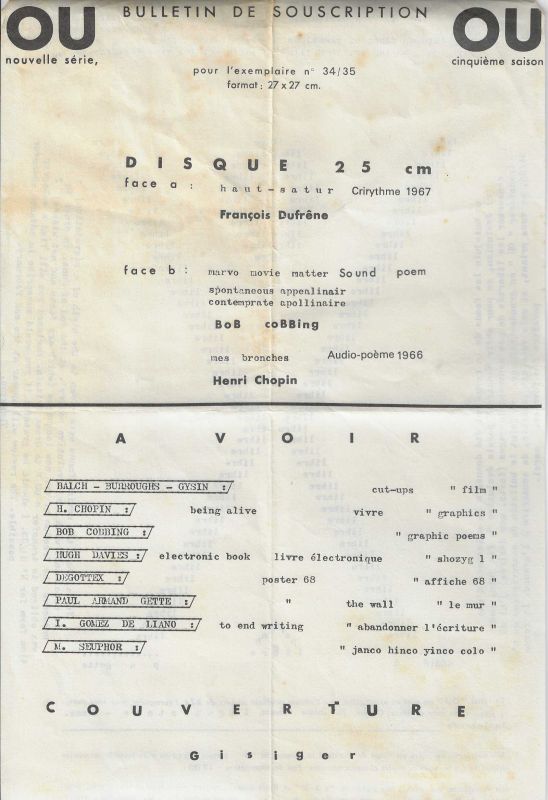
BIOGRAFIA EM PORTUGUÊSHenri Chopin nasceu em Paris, França, em 18 de junho de 1922 e morreu em 3 de janeiro de 2008, na Inglaterra. Poeta, artista, editor, performer e pesquisador da voz, foi uma das figuras fundamentais da poesia sonora e da poesia experimental da segunda metade do século XX. Sua atuação abrangeu poesia sonora, poesia fonética, poesia concreta, poesia visual, dactilopoesia, performance, gravação em fita magnética, edição independente, livro de artista, publicação de artista e experimentação com tecnologias de reprodução sonora. Entre 1968 e 1986 viveu em Ingatestone, Essex, Reino Unido, período decisivo para a edição internacional da revista OU.A experiência de Henri Chopin durante a Segunda Guerra Mundial marcou profundamente sua compreensão da voz e do corpo. No final da guerra, após experiências de trabalho forçado, deslocamento e violência na Europa, Chopin passou a atribuir importância particular aos sons humanos anteriores ou exteriores à linguagem convencional. Nas décadas seguintes desenvolveria uma obra baseada em respiração, vibração, grito, garganta, boca, ruídos corporais e manipulação tecnológica da voz.Após retornar a Paris em 1945, Chopin desempenhou diferentes trabalhos. Em 1948 ingressou no exército francês e foi enviado à Indochina. Retornou à França em 1952 após contrair malária. Posteriormente casou se com Jean Ratcliffe, britânica formada pela Universidade de Manchester. Essa relação familiar contribuiu para sua posterior ligação com o Reino Unido, onde viveu durante períodos importantes de sua carreira e onde morreu em 2008.Durante os anos 1950, Chopin começou a investigar sistematicamente as possibilidades da voz gravada. Em vez de tratar a voz somente como veículo para palavras, explorou o corpo como fonte sonora. Utilizou microfones, gravadores de fita, amplificação, montagem e manipulação de gravações para captar sons de respiração, garganta e outras vibrações corporais. Essa prática produziu aquilo que denominou audio poèmes e contribuiu decisivamente para estabelecer a poesia sonora como campo artístico internacional. O Centre Pompidou o identifica como um dos fundadores da poesia sonora e registra sua defesa e teorização desse termo.Em 1957 publicou Signes, um de seus primeiros livros. No mesmo período iniciou uma das atividades mais importantes de sua trajetória, a edição de Cinquième Saison. A revista havia sido fundada por Raymond Syte e Chopin tornou se editor a partir de seus primeiros números. Em dezembro de 1958 publicou nela seu primeiro audio poème. Em março de 1959 já figurava como editor único e continuou dirigindo a publicação durante os anos seguintes.Entre 1958 e 1963, Cinquième Saison transformou se progressivamente de uma revista de poesia relativamente convencional em uma plataforma de experimentação visual, sonora e editorial. O número 14, de 1962, já incorporava um disco. Em 1964, a partir do número duplo 20 e 21, a publicação passou a assumir a identidade OU Cinquième Saison. Essa transformação não foi apenas nominal. Chopin substituiu progressivamente a estrutura tradicional da revista por um objeto editorial composto de folhas soltas, cartazes, serigrafias, impressos tipográficos, poemas visuais, objetos e gravações sonoras.OU tornou se o principal projeto editorial de Henri Chopin. Publicada entre 1964 e 1974, reuniu quatorze edições dentro dessa segunda fase e constituiu uma das experiências editoriais mais importantes da poesia experimental europeia. Muitos números eram acompanhados de discos de vinil que permitiam ao leitor ouvir diretamente as obras sonoras de seus participantes. O Centre Pompidou registra quatorze discos publicados entre 1964 e 1973 e destaca OU como uma revista disco central para a história da poesia sonora.A revista publicou artistas e poetas de diferentes gerações e países. Entre os participantes documentados aparecem Raoul Hausmann, William Burroughs, Brion Gysin, François Dufrêne, Bernard Heidsieck, Bob Cobbing, John Giorno, Jean Dupuy, Gianni Bertini, Paul de Vree, Ji?í Kolá?, Ben Vautier, Ian Hamilton Finlay, John Furnival, Paul Armand Gette, Julien Blaine, Pierre Garnier, Ilse Garnier, Claude Pélieu, E. M. de Melo e Castro, Cozette de Charmoy e numerosos outros artistas da poesia sonora, poesia visual, poesia concreta, Dada, Lettrismo e vanguardas internacionais.O primeiro número da nova fase, OU Cinquième Saison nº 20 e 21, de 1964, já demonstra essa estrutura interdisciplinar. O Museum of Modern Art de Nova York registra a edição como periódico acompanhado de disco de vinil de 10 polegadas, editado por Henri Chopin em tiragem de 500 exemplares, com contribuições de Gianni Bertini, Jean Dupuy, James Guitet, Brion Gysin, Bernard Heidsieck, Françoise Janicot e do próprio Chopin.Nos números seguintes, Chopin expandiu a revista como uma espécie de exposição portátil e arquivo internacional de experimentação. OU nº 25, de 1965, reuniu Serge Béguier, Gianni Bertini, François Dufrêne, Ian Hamilton Finlay, John Giorno, Brion Gysin, Bernard Heidsieck, Paul Armand Gette e outros. OU nº 30 e 31, de 1967, incluiu John Furnival, Luc Peire, Ben Vautier, Aude Jessemin e membros da própria família Chopin. OU nº 32, também de 1967, reuniu Julien Blaine, François Dufrêne e Gil J Wolman.OU nº 33, publicado em 1968, reuniu Bernard Aubertin, François Dufrêne, Brion Gysin, Bernard Heidsieck e Gil J Wolman, além de textos associados a Pierre Albert Birot, Henri Chopin e Jean Claude Moineau. O MoMA registra a edição como periódico acompanhado de disco de vinil de 7 polegadas, publicado por Henri Chopin e impresso por Imbert Nicholas em Niort, França, em tiragem de 1000 exemplares.OU nº 34 e 35, de 1969, constitui outro exemplo fundamental. O MoMA registra Henri Chopin, Bob Cobbing, Hugh Davies, Jean Degottex, François Dufrêne, Paul Armand Gette, Hansjörg Gisiger e Michel Seuphor entre seus colaboradores. A publicação possui formato aproximado de 27 por 26 centímetros, disco de vinil de 10 polegadas e tiragem de 500 exemplares. Documentação original dessa edição registra ainda material relacionado a William Burroughs, Brion Gysin, Antony Balch, Ignacio Gómez de Liaño e outros participantes da experimentação internacional.A partir de 1968, Chopin estabeleceu se em Ingatestone, Essex. A localização britânica tornou se uma base fundamental para OU e para sua correspondência internacional. Documentos editoriais desse período trazem The Gate House, Ingatestone, Essex, England como endereço de Henri Chopin. A mudança para o Reino Unido reforçou a conexão entre redes experimentais francesas e britânicas e aproximou Chopin de artistas como Bob Cobbing, Hugh Davies e outros participantes da poesia experimental inglesa. Ele viveu em Ingatestone até 1986.A dimensão internacional de OU é fundamental para compreender o trabalho de Chopin como editor. Ele não utilizava a revista apenas para divulgar sua própria produção. Construiu uma rede editorial capaz de colocar em diálogo gerações históricas do Dada e das vanguardas do início do século XX com artistas contemporâneos ligados à poesia sonora, poesia concreta, poesia visual, performance e experimentação tecnológica. O Archivo Lafuente preserva os dezenove números e dois suplementos da primeira fase de Cinquième Saison e os quatorze números de OU Cinquième Saison, além de correspondências, provas de impressão, maquetes e obras originais relacionadas à produção da revista.Uma das características centrais da prática de Chopin foi a recusa da separação entre poesia impressa e poesia performada. Seus dactylopoèmes utilizam a máquina de escrever como instrumento gráfico, produzindo estruturas visuais a partir de letras, números, sinais e repetições. Sua obra Alphabet = O, de 1968, preservada pelo Centre Pompidou, exemplifica esse campo. A instituição relaciona a obra à poesia concreta, poesia fonética e poesia visual e destaca como Chopin explorava simultaneamente a plasticidade do gravador e da máquina de escrever.Seus audio poèmes, por sua vez, ampliaram a voz humana para além da articulação verbal. Entre trabalhos documentados aparecem Pêche de Nuit, produzido entre 1957 e 1959, Vibrespace, de 1963, Throatpower, de 1974, Le Corpsbis, de 1983, Les 9 Saintes Phonies, produzido entre 1984 e 1987, e Copernic & Co, de 2007. Chopin realizou mais de cem audio poèmes ao longo de sua trajetória e trabalhou em estúdios de rádio e gravação na França, Alemanha, Suécia, Austrália, Canadá e outros países.Sua produção bibliográfica inclui Signes, de 1957, Le Dernier Roman du Monde, de 1971, Le Cimetière, associado a trabalho iniciado em 1967 e publicado como livro de artista em Bruxelas em 1972, Portrait des 9, de 1975, The Cosmographical Lobster, publicado em Londres na década de 1970, Poésie Sonore Internationale, de 1979, Les Riches Heures de l'Alphabet, de 1992, e Graphpoemesmachine, de 2006.Poésie Sonore Internationale, publicado em 1979, possui particular importância historiográfica. A obra consolidou décadas de pesquisa e circulação promovidas por Chopin e reuniu uma perspectiva internacional sobre práticas fonéticas, sonoras e experimentais. O livro ajudou a estabelecer relações históricas entre diferentes gerações de artistas que exploravam linguagem, voz, gravação, ruído e corpo.No mesmo ano, a publicação Depuis 1964 la revue OU, identificada também como OU nº 45, foi produzida em Bourges como catálogo de exposições realizadas na Bibliothèque Municipale e no Palais Jacques C?ur. O catálogo declarava continuidade com a revista OU e foi produzido em tiragem de 1225 exemplares, dos quais 50 assinados. Esse número demonstra que Chopin continuou tratando OU não simplesmente como periódico encerrado em 1974, mas como estrutura histórica e conceitual passível de novos desdobramentos.Após a morte de Jean Chopin em 1985, Henri Chopin retornou à França. Posteriormente, devido à saúde, voltou ao Reino Unido e passou seus últimos anos em Dereham, Norfolk, junto à família. Continuou apresentando performances até o fim da vida. Morreu em 3 de janeiro de 2008, aos 85 anos.A obra e a documentação de Henri Chopin encontram se hoje preservadas em importantes instituições e arquivos internacionais. O Museum of Modern Art de Nova York conserva diversos números de OU e obras individuais do artista. O Centre Pompidou preserva trabalhos como Alphabet = O. O Archivo Lafuente conserva um núcleo excepcional dedicado a Cinquième Saison e OU, incluindo edições de luxo, correspondência, originais, provas e maquetes. Esse conjunto confirma a importância simultânea de Chopin como artista, poeta, editor e articulador de redes internacionais.Embora Henri Chopin não tenha pertencido ao Poema Processo brasileiro, sua produção apresenta relações históricas e formais relevantes para o estudo comparativo da poesia experimental internacional. O emprego da visualidade tipográfica, do som, da materialidade gráfica, da reprodução, do corpo e de estruturas não discursivas aproxima sua pesquisa de questões investigadas por artistas da poesia concreta, poesia visual e Poema Processo. Mais concretamente, OU estabeleceu vínculos com a poesia experimental de língua portuguesa por meio de colaboradores como E. M. de Melo e Castro, cuja correspondência com Chopin está documentada.Henri Chopin ocupa posição central na história internacional da poesia sonora por ter articulado criação, teoria, performance e edição. Como editor de Cinquième Saison e OU, desenvolveu uma plataforma que transformou a revista em objeto intermedia, reunindo som, texto, imagem, tipografia, cartaz, disco, múltiplo e obra original. Como artista, expandiu a poesia para o interior físico da voz e do corpo. Como articulador internacional, colocou em contato artistas da França, Reino Unido, Europa continental, Estados Unidos, América Latina e outros contextos. Essa combinação torna sua trajetória fundamental para a história da poesia sonora, poesia visual, poesia experimental, livro de artista, publicação de artista e arte intermedia do pós guerra.Os campos biográficos e curriculares apresentados aqui foram mantidos apenas quando sustentados documentalmente, sem completar lacunas por suposição, conforme o método de pesquisa utilizado para o cadastro Salsa.
English
BIOGRAPHY IN ENGLISHHenri Chopin was born in Paris, France, on June 18, 1922 and died on January 3, 2008 in England. A poet, artist, editor, performer and researcher of the human voice, he became one of the fundamental figures of sound poetry and experimental poetry during the second half of the twentieth century. His activities encompassed sound poetry, phonetic poetry, concrete poetry, visual poetry, typewriter poetry, performance, magnetic tape recording, independent publishing, artists books, artists publications and experimentation with sound reproduction technologies. From 1968 until 1986 he lived in Ingatestone, Essex, United Kingdom, a decisive period for the international production and circulation of OU.Chopin's experiences during the Second World War profoundly affected his understanding of voice and the body. Following forced labor, displacement and violence in wartime Europe, he became particularly attentive to human sounds existing before or outside conventional language. During the following decades he developed a practice centered on breathing, vibration, cries, throat sounds, mouth sounds, bodily noises and technological manipulation of the voice.After returning to Paris in 1945, Chopin held various jobs. In 1948 he entered the French army and was sent to Indochina. He returned to France in 1952 after contracting malaria. He later married Jean Ratcliffe, a British graduate of the University of Manchester. This family relationship became part of Chopin's later connection with the United Kingdom, where he lived during important phases of his career and where he died in 2008.During the 1950s Chopin began systematically investigating the possibilities of recorded voice. Rather than treating the voice merely as a vehicle for words, he explored the body itself as a source of sound. He used microphones, tape recorders, amplification, editing and recording manipulation to capture breathing, throat sounds and other bodily vibrations. This practice produced what he termed audio poèmes and contributed decisively to establishing sound poetry as an international artistic field. Centre Pompidou identifies Chopin as one of the founders of sound poetry and records his role in defending and theorizing the term.In 1957 Chopin published Signes, one of his early books. Around the same period he began one of the most important activities of his career, the editing of Cinquième Saison. The magazine had been founded by Raymond Syte and Chopin became editor during its first issues. In December 1958 he published his first audio poème in the magazine. By March 1959 he was its sole editor and continued directing the publication during the following years.Between 1958 and 1963 Cinquième Saison gradually changed from a comparatively conventional poetry magazine into a platform for visual, sonic and editorial experimentation. Issue 14, published in 1962, already incorporated a record. In 1964, beginning with the double issue 20 and 21, the publication assumed the identity OU Cinquième Saison. This was not merely a change of title. Chopin progressively replaced the conventional structure of a magazine with an editorial object incorporating loose sheets, posters, screenprints, typographic matter, visual poems, objects and sound recordings.OU became Henri Chopin's principal editorial project. Published from 1964 until 1974, it comprised fourteen issues during this second phase and became one of the most significant publishing experiments in European experimental poetry. Many issues were accompanied by vinyl records allowing readers to hear the sound works of contributing artists directly. Centre Pompidou records fourteen discs issued between 1964 and 1973 and describes OU as a major magazine and record project within the history of sound poetry.The magazine published artists and poets from different countries and generations. Documented contributors include Raoul Hausmann, William Burroughs, Brion Gysin, François Dufrêne, Bernard Heidsieck, Bob Cobbing, John Giorno, Jean Dupuy, Gianni Bertini, Paul de Vree, Ji?í Kolá?, Ben Vautier, Ian Hamilton Finlay, John Furnival, Paul Armand Gette, Julien Blaine, Pierre Garnier, Ilse Garnier, Claude Pélieu, E. M. de Melo e Castro, Cozette de Charmoy and many others associated with sound poetry, visual poetry, concrete poetry, Dada, Lettrism and international avant garde activity.The first issue of the new phase, OU Cinquième Saison No. 20 and 21 from 1964, already demonstrates this interdisciplinary structure. The Museum of Modern Art in New York records it as a periodical with a 10 inch vinyl record, published by Henri Chopin in an edition of 500, with contributions by Gianni Bertini, Jean Dupuy, James Guitet, Brion Gysin, Bernard Heidsieck, Françoise Janicot and Chopin himself.In subsequent issues Chopin expanded the magazine into a form of portable exhibition and international archive of experimentation. OU No. 25 from 1965 included Serge Béguier, Gianni Bertini, François Dufrêne, Ian Hamilton Finlay, John Giorno, Brion Gysin, Bernard Heidsieck, Paul Armand Gette and others. OU No. 30 and 31 from 1967 included John Furnival, Luc Peire, Ben Vautier, Aude Jessemin and members of the Chopin family. OU No. 32, also from 1967, brought together Julien Blaine, François Dufrêne and Gil J Wolman.OU No. 33, published in 1968, included Bernard Aubertin, François Dufrêne, Brion Gysin, Bernard Heidsieck and Gil J Wolman, together with texts associated with Pierre Albert Birot, Henri Chopin and Jean Claude Moineau. MoMA records it as a periodical with a 7 inch vinyl record, published by Henri Chopin, printed by Imbert Nicholas in Niort, France, and issued in an edition of 1000 copies.OU No. 34 and 35 from 1969 provides another fundamental example. MoMA records Henri Chopin, Bob Cobbing, Hugh Davies, Jean Degottex, François Dufrêne, Paul Armand Gette, Hansjörg Gisiger and Michel Seuphor as collaborators. The publication measures approximately 27 by 26 centimeters, contains a 10 inch vinyl record and was produced in an edition of 500 copies. Original documentation for the issue also records material associated with William Burroughs, Brion Gysin, Antony Balch, Ignacio Gómez de Liaño and other participants in international experimentation.From 1968 Chopin was based in Ingatestone, Essex. This British location became a crucial base for OU and for his international correspondence. Editorial documents from this period identify The Gate House, Ingatestone, Essex, England as Henri Chopin's address. His relocation to the United Kingdom strengthened exchanges between French and British experimental networks and brought him into closer contact with artists such as Bob Cobbing, Hugh Davies and other figures in British experimental poetry. He remained in Ingatestone until 1986.The international dimension of OU is essential to understanding Chopin's work as an editor. He did not use the magazine simply to disseminate his own production. He built an editorial network capable of placing historical figures of Dada and the early twentieth century avant gardes in dialogue with contemporary artists working in sound poetry, concrete poetry, visual poetry, performance and technological experimentation. Archivo Lafuente preserves the nineteen issues and two supplements of Cinquième Saison together with the fourteen issues of OU Cinquième Saison, as well as correspondence, printing proofs, mockups and original works related to the magazine's production.One of the central characteristics of Chopin's practice was his refusal to separate printed poetry from performed poetry. His dactylopoèmes use the typewriter as a graphic instrument, generating visual structures from letters, numbers, signs and repetition. Alphabet = O from 1968, preserved by Centre Pompidou, exemplifies this field. The institution connects the work with concrete poetry, phonetic poetry and visual poetry and emphasizes Chopin's simultaneous exploration of the plastic possibilities of the tape recorder and the typewriter.His audio poèmes expanded the human voice beyond verbal articulation. Documented works include Pêche de Nuit, produced between 1957 and 1959, Vibrespace from 1963, Throatpower from 1974, Le Corpsbis from 1983, Les 9 Saintes Phonies produced between 1984 and 1987 and Copernic & Co from 2007. Chopin created more than one hundred audio poems throughout his career and worked in radio and recording studios in France, Germany, Sweden, Australia, Canada and other countries.His bibliography includes Signes from 1957, Le Dernier Roman du Monde from 1971, Le Cimetière associated with work begun in 1967 and issued as an artists book in Brussels in 1972, Portrait des 9 from 1975, The Cosmographical Lobster published in London during the 1970s, Poésie Sonore Internationale from 1979, Les Riches Heures de l'Alphabet from 1992 and Graphpoemesmachine from 2006.Poésie Sonore Internationale, published in 1979, is particularly important historiographically. It consolidated decades of research and international circulation developed by Chopin and offered an international perspective on phonetic, sound based and experimental practices. The publication helped establish historical relationships among generations of artists exploring language, voice, recording technology, noise and the body.Also in 1979, Depuis 1964 la revue OU, identified as OU No. 45, was published in Bourges as a catalogue for exhibitions at the Bibliothèque Municipale and Palais Jacques C?ur. The catalogue explicitly continued the OU project and was issued in 1225 copies, including 50 signed copies. This publication demonstrates that Chopin continued to conceive OU not simply as a periodical that ended in 1974 but as a historical and conceptual structure capable of further manifestations.Following Jean Chopin's death in 1985, Henri Chopin returned to France. Later, as his health declined, he returned to the United Kingdom and spent his final years in Dereham, Norfolk, with his family. He continued performing until late in life and died on January 3, 2008 at the age of 85.Henri Chopin's works and documentation are now preserved in important international institutions and archives. The Museum of Modern Art in New York holds numerous issues of OU and individual works by the artist. Centre Pompidou preserves works including Alphabet = O. Archivo Lafuente holds an exceptional group of Cinquième Saison and OU materials including deluxe editions, correspondence, original works, proofs and mockups. Together these collections confirm Chopin's importance simultaneously as artist, poet, editor and organizer of international networks.Although Henri Chopin was not a member of the Brazilian Process Poem Movement, his work has significant historical and formal relevance for comparative research into international experimental poetry. His use of visual typography, sound, graphic materiality, reproduction, the body and non discursive structures intersects with questions explored by concrete poetry, visual poetry and Process Poem artists. More concretely, OU established connections with Portuguese language experimental poetry through contributors including E. M. de Melo e Castro, whose correspondence with Chopin is documented.Henri Chopin occupies a central position in the international history of sound poetry because he integrated creation, theory, performance and publishing. As editor of Cinquième Saison and OU he developed a platform that transformed the magazine into an intermedia object incorporating sound, text, image, typography, posters, records, multiples and original artworks. As an artist he expanded poetry into the physical interior of voice and body. As an international organizer he connected artists across France, the United Kingdom, continental Europe, the United States, Latin America and other contexts. This combination makes his career fundamental to the histories of sound poetry, visual poetry, experimental poetry, artists books, artists publications and postwar intermedia art.
Currículo
CURRÍCULO EM PORTUGUÊSIDENTIFICAÇÃOHenri ChopinNascimento18 de junho de 1922ParisFrançaFalecimento3 de janeiro de 2008InglaterraNacionalidadeFrancesaAtuação principalFrançaReino UnidoResidência documentada em Ingatestone, Essex, de 1968 a 1986Últimos anos em Dereham, Norfolk, Reino Unido.ÁREAS DE ATUAÇÃOPoesia sonoraPoesia fonéticaPoesia experimentalPoesia concretaPoesia visualDactilopoesiaAudio poèmePerformanceArte gráficaEdição independentePublicação de artistaLivro de artistaGravação e manipulação de fita magnéticaTipografia experimentalArte intermediaRádioCinema experimentalTeoria da poesia sonora.FORMAÇÃOFormação acadêmica formal não localizada nas fontes consultadas.TRAJETÓRIA BIOGRÁFICA1934Começa a trabalhar aos doze anos em uma loja de ferragens em Paris.1940 a 1945Experiências de deslocamento, guerra e trabalho forçado durante a Segunda Guerra Mundial.1945Retorno a Paris.1948Ingresso no exército francês.Envio à Indochina.1952Retorno à França após contrair malária.Atuação posterior junto a jovens em Longueil Annel.Casamento com Jean Ratcliffe.OBRAS SONORAS DOCUMENTADAS1957 a 1959Pêche de NuitAudio poèmePosteriormente utilizado como trilha para filme de Luc Peire.1963VibrespaceAudio poème.1966Mes branchesAudio poème.1969AudiopoemsObra posteriormente publicada em 1971 e hoje registrada pelo Museum of Modern Art.1974ThroatpowerAudio poème.1983Le CorpsbisAudio poème.1984 a 1987Les 9 Saintes PhoniesSérie sonora.2007Copernic & CoOratório e obra sonora tardia.OBRAS VISUAIS E DACTYLOPOÈMES1968Alphabet = OSerigrafia sobre tela61,5 por 50,5 cmCentre PompidouParisInventário AM 2015 335Obra associada à poesia concreta, poesia fonética, poesia visual e experimentação tipográfica.LIVROS E PUBLICAÇÕES DE HENRI CHOPIN1957SignesPrimeiro período editorial documentado.1971Le Dernier Roman du Monde.1972Le Cimetière 1967BruxelasLivro de artista preservado no Archivo Lafuente.1975Portrait des 9.Década de 1970The Cosmographical LobsterLondresLivro de artista documentado no Archivo Lafuente.1979Poésie Sonore InternationalePublicação histórica dedicada à poesia sonora internacional.1979Depuis 1964 la revue OUOU nº 45BourgesVille de Bourges36 páginasTiragem de 1225 exemplares50 exemplares assinadosCatálogo relacionado a exposições na Bibliothèque Municipale e no Palais Jacques C?ur.1992Les Riches Heures de l'Alphabet.2006Graphpoemesmachine.REVISTA CINQUIÈME SAISON1958Henri Chopin assume progressivamente a edição de Cinquième Saison, revue de poésie évolutive.Dezembro de 1958Publicação de seu primeiro audio poème na revista.1959A partir do número 4 torna se editor único.1959 a 1963Publicação de dezesseis novos números sob sua direção.1962Número 14 incorpora disco e amplia o formato da publicação.A primeira fase totaliza dezenove números e dois suplementos preservados no Archivo Lafuente.REVISTA OU CINQUIÈME SAISON1964OU Cinquième Saison nº 20 e 21Primeiro número da nova faseParis e NiortEditor Henri ChopinImpressor Imbert NicholasTiragem de 500 exemplaresPeriódico com disco de vinil de 10 polegadasParticipantes documentadosGianni BertiniHenri ChopinJean DupuyJames GuitetBrion GysinBernard HeidsieckFrançoise Janicot.1964OU nº 22Editor Henri ChopinParticipantes documentados incluem Roberto Altmann, Antonio Berni, Jan Burka, Ian Hamilton Finlay, John Furnival, Paul Armand Gette, Bernard Heidsieck, Dom Sylvester Houédard, Edwin Morgan, Claude Pélieu e outros.1965OU nº 23 e 24Periódico com disco de vinil de 10 polegadasEditor Henri ChopinTiragem 500.1965OU nº 25Editor Henri ChopinImpressor Imbert NicholasNiortTiragem 500Participantes documentados incluem Serge Béguier, Gianni Bertini, François Dufrêne, Ian Hamilton Finlay, Paul Armand Gette, John Giorno, Brion Gysin, Bernard Heidsieck, Alain Jouffroy, Rodolfo Krasno, Jean Clarence Lambert e outros.1967OU nº 30 e 31Participantes documentados incluem Henri Chopin, Brigitte Chopin, Denis Chopin, Jean Chopin, Luigi Ferro, John Furnival, Aude Jessemin, Luc Peire, Anatol Stern e Ben Vautier.1967OU nº 32Participantes documentadosHenri ChopinJulien BlaineFrançois DufrêneGil J Wolman.1968OU nº 33Autorias relacionadasPierre Albert BirotHenri ChopinJean Claude MoineauParticipantes documentadosBernard AubertinFrançois DufrêneBrion GysinBernard HeidsieckGil J WolmanPeriódico com disco de vinil de 7 polegadasTiragem 1000Impressor Imbert NicholasNiort.1969OU nº 34 e 35Editor Henri ChopinPeriódico com disco de vinil de 10 polegadasDimensões aproximadas 27 por 26 cmTiragem 500Colaboradores documentadosHenri ChopinBob CobbingHugh DaviesJean DegottexFrançois DufrênePaul Armand GetteHansjörg GisigerMichel Seuphor.1970OU nº 36 e 37Editor Henri ChopinParisDisco de vinil de 10 polegadas em revistaTiragem 500.1971OU nº 38 e 39Editor Henri ChopinParisDisco de vinil de 10 polegadas em revistaTiragem 500.1964 a 1974Produção de quatorze números de OU Cinquième Saison, terminando com nº 42, 43 e 44.A revista reuniu discos, poemas visuais, dactylopoèmes, folhas soltas, cartazes, serigrafias, objetos e outros materiais experimentais.1979OU nº 45Depuis 1964 la revue OUContinuação histórica da publicação sob forma de catálogo de exposição.ARTISTAS E POETAS RELACIONADOS À REVISTA OURaoul HausmannWilliam BurroughsBrion GysinFrançois DufrêneBernard HeidsieckBob CobbingJohn GiornoJean DupuyGianni BertiniPaul de VreeJi?í Kolá?Ben VautierIan Hamilton FinlayJohn FurnivalPaul Armand GetteJulien BlainePierre GarnierIlse GarnierClaude PélieuE. M. de Melo e CastroCozette de CharmoyGil J WolmanHugh DaviesJean DegottexMichel SeuphorJean Claude MoineauBernard Aubertin.RELAÇÕES COM O REINO UNIDODécada de 1950Casamento com Jean Ratcliffe, britânica formada pela Universidade de Manchester.1968 a 1986Residência em IngatestoneEssexReino Unido.The Gate House em Ingatestone funcionou como endereço editorial e postal de Henri Chopin e OU.Relações documentadas com artistas britânicos como Bob Cobbing, Hugh Davies, John Furnival e Ian Hamilton Finlay.Década de 2000Retorno definitivo ao Reino Unido por razões de saúde.Residência em DerehamNorfolkReino Unido.2008Falecimento na Inglaterra.EXPOSIÇÕES E APRESENTAÇÕES DOCUMENTADAS1967Apresentação relacionada a OU nº 32Musée d?art moderne de la Ville de ParisParis8 de junho de 1967Textos de Julien Blaine, François Dufrêne, Gil J Wolman e Henri Chopin.1979Exposições relacionadas à revista OUBibliothèque MunicipaleBourgesPalais Jacques C?urBourgesFrançaPublicação associada Depuis 1964 la revue OU.2002Henri ChopinCentre PompidouParis20 de junho de 2002Apresentação da reedição integral dos discos de OU em quatro CDsParticipação de Emmanuel Carcano, Jacques Donguy e Jean François BoryPerformance de audio poème por Henri Chopin.2012Ecstatic Alphabets / Heaps of LanguageMuseum of Modern ArtNova York6 de maio a 27 de agosto de 2012Participação póstuma de obra de Henri Chopin no contexto da coleção.COLEÇÕES PÚBLICAS E ARQUIVOSMuseum of Modern ArtNova YorkEstados UnidosPreserva diversos números de OU e obras de Henri Chopin.Centre PompidouParisFrançaPreserva Alphabet = O, 1968, entre outras referências à produção de Chopin.Archivo LafuenteEspanhaPreserva os dezenove números e dois suplementos de Cinquième Saison, os quatorze números de OU Cinquième Saison, edições especiais, correspondências, originais, provas de impressão, maquetes e livros de artista.RELAÇÃO COM A POESIA EXPERIMENTAL DE LÍNGUA PORTUGUESAOU publicou ou documentou artistas ligados à poesia experimental internacional, entre eles E. M. de Melo e Castro. Correspondências de Melo e Castro com Henri Chopin estão documentadas entre 1966 e 1977, evidenciando intercâmbio direto com a poesia experimental portuguesa.RELAÇÃO COM POEMA PROCESSONão foi localizada documentação que permita afirmar que Henri Chopin tenha integrado o movimento Poema Processo brasileiro.Sua obra possui, entretanto, relevância comparativa para o estudo do Poema Processo devido à investigação da materialidade do signo, visualidade tipográfica, fragmentação da linguagem, estruturas não discursivas, participação, edição experimental e transformação do suporte.CRONOLOGIA1922Nascimento em Paris em 18 de junho.1940 a 1945Experiências relacionadas à Segunda Guerra Mundial e trabalho forçado.1948Ingresso no exército francês e envio à Indochina.1952Retorno à França.1957Publicação de Signes.1957 a 1959Produção de Pêche de Nuit.1958Atuação editorial em Cinquième Saison.Publicação do primeiro audio poème na revista.1959Torna se editor único de Cinquième Saison.1962Primeira incorporação documentada de disco à revista, no nº 14.1963Vibrespace.1964Transformação de Cinquième Saison em OU Cinquième Saison a partir do nº 20 e 21.1964 a 1974Direção de OU.1967OU nº 30 e 31.OU nº 32.1968Alphabet = O.OU nº 33.Mudança para Ingatestone, Essex.1969OU nº 34 e 35.1970OU nº 36 e 37.1971Le Dernier Roman du Monde.OU nº 38 e 39.1972Le Cimetière 1967.1974Conclusão da fase principal de OU com nº 42, 43 e 44.Throatpower.1975Portrait des 9.Década de 1970The Cosmographical Lobster.1979Poésie Sonore Internationale.Depuis 1964 la revue OU, OU nº 45.1983Le Corpsbis.1984 a 1987Les 9 Saintes Phonies.1985Falecimento de Jean Chopin.1986Fim da residência prolongada em Ingatestone.1992Les Riches Heures de l'Alphabet.2002Apresentação no Centre Pompidou e relançamento integral dos discos de OU em quatro CDs.2006Graphpoemesmachine.2007Copernic & Co.2008Falecimento em 3 de janeiro na Inglaterra.
English
CURRICULUM IN ENGLISHIDENTIFICATIONHenri ChopinBornJune 18, 1922ParisFranceDiedJanuary 3, 2008EnglandNationalityFrenchPrincipal areas of activityFranceUnited KingdomDocumented residence in Ingatestone, Essex, from 1968 until 1986Final years in Dereham, Norfolk, United Kingdom.FIELDS OF ACTIVITYSound poetryPhonetic poetryExperimental poetryConcrete poetryVisual poetryTypewriter poetryAudio poèmePerformanceGraphic artIndependent publishingArtists publicationsArtists booksMagnetic tape recording and manipulationExperimental typographyIntermedia artRadioExperimental filmSound poetry theory.EDUCATIONFormal academic education not located in the consulted sources.BIOGRAPHICAL TRAJECTORY1934Begins working at the age of twelve in a hardware shop in Paris.1940 to 1945Experiences displacement, war and forced labor during the Second World War.1945Returns to Paris.1948Enters the French army.Sent to Indochina.1952Returns to France after contracting malaria.Later works with young people in Longueil Annel.Marries Jean Ratcliffe.DOCUMENTED SOUND WORKS1957 to 1959Pêche de NuitAudio poèmeLater used as the soundtrack for a film by Luc Peire.1963VibrespaceAudio poème.1966Mes branchesAudio poème.1969AudiopoemsWork subsequently published in 1971 and now documented by the Museum of Modern Art.1974ThroatpowerAudio poème.1983Le CorpsbisAudio poème.1984 to 1987Les 9 Saintes PhoniesSound series.2007Copernic & CoLate sound work and oratorio.VISUAL WORKS AND DACTYLOPOÈMES1968Alphabet = OScreenprint on canvas61.5 by 50.5 cmCentre PompidouParisInventory AM 2015 335Work associated with concrete poetry, phonetic poetry, visual poetry and typographic experimentation.BOOKS AND PUBLICATIONS BY HENRI CHOPIN1957SignesDocumented early publication.1971Le Dernier Roman du Monde.1972Le Cimetière 1967BrusselsArtists book preserved by Archivo Lafuente.1975Portrait des 9.1970sThe Cosmographical LobsterLondonArtists book documented by Archivo Lafuente.1979Poésie Sonore InternationaleHistorical publication devoted to international sound poetry.1979Depuis 1964 la revue OUOU No. 45BourgesVille de Bourges36 pagesEdition of 1225 copies50 signed copiesCatalogue associated with exhibitions at the Bibliothèque Municipale and Palais Jacques C?ur.1992Les Riches Heures de l'Alphabet.2006Graphpoemesmachine.CINQUIÈME SAISON1958Henri Chopin progressively assumes editorial responsibility for Cinquième Saison, revue de poésie évolutive.December 1958Publication of his first audio poème in the magazine.1959From issue No. 4 Chopin becomes sole editor.1959 to 1963Sixteen further issues published under his direction.1962Issue No. 14 incorporates a record and expands the physical format.The first phase comprises nineteen issues and two supplements preserved by Archivo Lafuente.OU CINQUIÈME SAISON1964OU Cinquième Saison No. 20 and 21First issue of the new phaseParis and NiortPublisher Henri ChopinPrinter Imbert NicholasEdition 500Periodical with 10 inch vinyl recordDocumented participantsGianni BertiniHenri ChopinJean DupuyJames GuitetBrion GysinBernard HeidsieckFrançoise Janicot.1964OU No. 22Publisher Henri ChopinDocumented participants include Roberto Altmann, Antonio Berni, Jan Burka, Ian Hamilton Finlay, John Furnival, Paul Armand Gette, Bernard Heidsieck, Dom Sylvester Houédard, Edwin Morgan, Claude Pélieu and others.1965OU No. 23 and 24Periodical with 10 inch vinyl recordPublisher Henri ChopinEdition 500.1965OU No. 25Publisher Henri ChopinPrinter Imbert NicholasNiortEdition 500Documented participants include Serge Béguier, Gianni Bertini, François Dufrêne, Ian Hamilton Finlay, Paul Armand Gette, John Giorno, Brion Gysin, Bernard Heidsieck, Alain Jouffroy, Rodolfo Krasno, Jean Clarence Lambert and others.1967OU No. 30 and 31Documented participants include Henri Chopin, Brigitte Chopin, Denis Chopin, Jean Chopin, Luigi Ferro, John Furnival, Aude Jessemin, Luc Peire, Anatol Stern and Ben Vautier.1967OU No. 32Documented participantsHenri ChopinJulien BlaineFrançois DufrêneGil J Wolman.1968OU No. 33Associated authorsPierre Albert BirotHenri ChopinJean Claude MoineauDocumented participantsBernard AubertinFrançois DufrêneBrion GysinBernard HeidsieckGil J WolmanPeriodical with 7 inch vinyl recordEdition 1000Printer Imbert NicholasNiort.1969OU No. 34 and 35Publisher Henri ChopinPeriodical with 10 inch vinyl recordApproximate dimensions 27 by 26 cmEdition 500Documented collaboratorsHenri ChopinBob CobbingHugh DaviesJean DegottexFrançois DufrênePaul Armand GetteHansjörg GisigerMichel Seuphor.1970OU No. 36 and 37Publisher Henri ChopinParis10 inch vinyl record in magazineEdition 500.1971OU No. 38 and 39Publisher Henri ChopinParis10 inch vinyl record in magazineEdition 500.1964 to 1974Production of fourteen issues of OU Cinquième Saison ending with No. 42, 43 and 44.The magazine incorporated records, visual poems, dactylopoèmes, loose sheets, posters, screenprints, objects and other experimental materials.1979OU No. 45Depuis 1964 la revue OUHistorical continuation of the project in exhibition catalogue form.ARTISTS AND POETS CONNECTED WITH OURaoul HausmannWilliam BurroughsBrion GysinFrançois DufrêneBernard HeidsieckBob CobbingJohn GiornoJean DupuyGianni BertiniPaul de VreeJi?í Kolá?Ben VautierIan Hamilton FinlayJohn FurnivalPaul Armand GetteJulien BlainePierre GarnierIlse GarnierClaude PélieuE. M. de Melo e CastroCozette de CharmoyGil J WolmanHugh DaviesJean DegottexMichel SeuphorJean Claude MoineauBernard Aubertin.RELATIONSHIP WITH THE UNITED KINGDOM1950sMarriage to Jean Ratcliffe, a British graduate of the University of Manchester.1968 to 1986Residence in IngatestoneEssexUnited Kingdom.The Gate House in Ingatestone serves as Henri Chopin's editorial and postal address for OU.Documented relationships with British artists including Bob Cobbing, Hugh Davies, John Furnival and Ian Hamilton Finlay.2000sReturns permanently to the United Kingdom because of declining health.Residence in DerehamNorfolkUnited Kingdom.2008Death in England.DOCUMENTED EXHIBITIONS AND PRESENTATIONS1967Presentation related to OU No. 32Musée d?art moderne de la Ville de ParisParisJune 8, 1967Texts by Julien Blaine, François Dufrêne, Gil J Wolman and Henri Chopin.1979Exhibitions concerning OUBibliothèque MunicipaleBourgesPalais Jacques C?urBourgesFranceAssociated publication Depuis 1964 la revue OU.2002Henri ChopinCentre PompidouParisJune 20, 2002Presentation of the complete reissue of OU recordings on four CDsWith Emmanuel Carcano, Jacques Donguy and Jean François BoryAudio poème performance by Henri Chopin.2012Ecstatic Alphabets / Heaps of LanguageMuseum of Modern ArtNew YorkMay 6 to August 27, 2012Posthumous inclusion of work by Henri Chopin in the exhibition context.PUBLIC COLLECTIONS AND ARCHIVESMuseum of Modern ArtNew YorkUnited StatesPreserves multiple issues of OU and works by Henri Chopin.Centre PompidouParisFrancePreserves Alphabet = O from 1968 and documentation relating to Chopin's practice.Archivo LafuenteSpainPreserves the nineteen issues and two supplements of Cinquième Saison, the fourteen issues of OU Cinquième Saison, deluxe editions, correspondence, original works, printing proofs, mockups and artists books.RELATIONSHIP WITH PORTUGUESE LANGUAGE EXPERIMENTAL POETRYOU published and documented artists associated with international experimental poetry, including E. M. de Melo e Castro. Correspondence from Melo e Castro to Henri Chopin is documented between 1966 and 1977, demonstrating direct exchange with Portuguese experimental poetry.RELATIONSHIP WITH THE PROCESS POEM MOVEMENTNo documentation was located establishing Henri Chopin as a participant in the Brazilian Process Poem Movement.His work nevertheless has significant comparative relevance for research into the Process Poem Movement because of its investigation of the materiality of signs, typographic visuality, fragmentation of language, non discursive structures, participation, experimental publishing and transformation of the support.CHRONOLOGY1922Born in Paris on June 18.1940 to 1945Experiences related to the Second World War and forced labor.1948Enters the French army and is sent to Indochina.1952Returns to France.1957Publication of Signes.1957 to 1959Production of Pêche de Nuit.1958Begins editorial activity with Cinquième Saison.Publishes his first audio poème in the magazine.1959Becomes sole editor of Cinquième Saison.1962First documented inclusion of a record in the magazine with issue No. 14.1963Vibrespace.1964Transformation of Cinquième Saison into OU Cinquième Saison beginning with No. 20 and 21.1964 to 1974Direction of OU.1967OU No. 30 and 31.OU No. 32.1968Alphabet = O.OU No. 33.Moves to Ingatestone, Essex.1969OU No. 34 and 35.1970OU No. 36 and 37.1971Le Dernier Roman du Monde.OU No. 38 and 39.1972Le Cimetière 1967.1974Main phase of OU concludes with No. 42, 43 and 44.Throatpower.1975Portrait des 9.1970sThe Cosmographical Lobster.1979Poésie Sonore Internationale.Depuis 1964 la revue OU, OU No. 45.1983Le Corpsbis.1984 to 1987Les 9 Saintes Phonies.1985Death of Jean Chopin.1986End of Chopin's prolonged residence in Ingatestone.1992Les Riches Heures de l'Alphabet.2002Presentation at Centre Pompidou and complete reissue of OU recordings on four CDs.2006Graphpoemesmachine.2007Copernic & Co.2008Death in England on January 3.