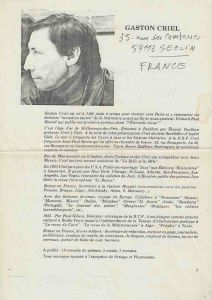
Gaston Criel - França
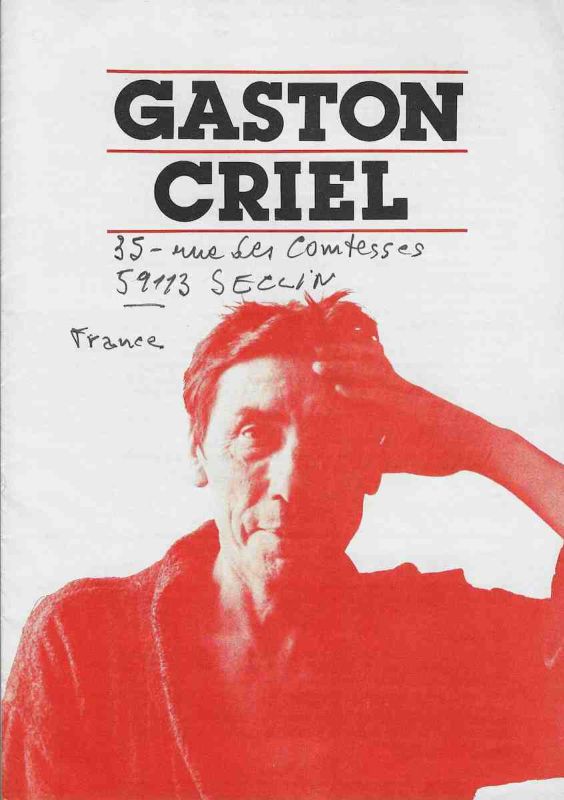
Local de nascimento: Seclin, no departamento do Nord, França
Data de nascimento: 30 de setembro de 1913
Local de falecimento: Lille, França
Data de falecimento: 5 de janeiro de 1990
BIOGRAFIA EM PORTUGUÊSGaston Criel, nascido em 30 de setembro de 1913 em Seclin, no departamento do Nord, França, e falecido em 5 de janeiro de 1990 em Lille, foi escritor, poeta, romancista, contista, cronista e autor ligado à cultura do jazz e, especialmente a partir do final da década de 1970 e durante a década de 1980, às redes internacionais de arte postal. Sua trajetória atravessa diferentes ambientes da cultura francesa do século XX, da poesia publicada antes da Segunda Guerra Mundial à experiência dos campos de prisioneiros, do meio literário de Saint Germain des Prés às relações com escritores, artistas e músicos, chegando às formas alternativas de comunicação artística desenvolvidas por meio da correspondência, de cartões e de colagens. O fundo documental Gaston Criel preservado pela Bibliothèque municipale de Lille identifica especificamente um conjunto denominado Art postal referente ao período de 1980 a 1990, constituindo evidência documental de sua participação nesse campo. Não foi localizada, nas fontes consultadas, comprovação de que Gaston Criel tenha integrado formalmente o movimento brasileiro Poema Processo, mas sua produção tardia e sua circulação por redes de arte postal o situam em um campo internacional relacionado à poesia experimental, à comunicação artística e às práticas alternativas de publicação e intercâmbio.Criel iniciou sua produção literária ainda jovem. Em 1937 publicou em Lille Amours, pelas Éditions de la Hune. A obra também documenta uma colaboração entre literatura e fotografia, com participação dos fotógrafos Maurice Tabard e Ergy Landau. Em 1938 publicou Gris, igualmente pelas Éditions de la Hune. Nesse mesmo período criou o círculo Pour la poésie. Gris recebeu atenção de escritores como Paul Éluard e Joë Bousquet, colocando Criel em contato com uma rede literária que seria importante para sua trajetória posterior. Em 1939 publicou Étincelles pelas Éditions Denoël, em Paris. Registros bibliográficos contemporâneos confirmam sua presença no catálogo da editora naquele ano.A Segunda Guerra Mundial transformou radicalmente sua vida e sua escrita. Criel foi feito prisioneiro na Alemanha e passou vários anos em cativeiro. A experiência do Stalag XI A está diretamente relacionada à sua atividade literária. Em relatório de 1945, a Académie française registrou que Criel havia sido animador de uma pequena revista literária chamada XI A, nome derivado do campo de prisioneiros, produzida em condições precárias por meio de multiplicação e papel de embalagem. O documento destaca que sua atuação como poeta contribuiu para manter uma atividade literária coletiva entre os prisioneiros. A Académie française lhe concedeu o Prix Max Barthou, reconhecimento diretamente associado à sua atividade literária durante o período de cativeiro. Décadas depois, textos de Criel relacionados à experiência dos campos continuaram a ser recuperados em estudos sobre escritores prisioneiros de guerra.Após a libertação, Criel transferiu se para Paris e entrou de maneira intensa no ambiente literário de Saint Germain des Prés. Jean Paulhan foi uma figura importante nesse processo de aproximação. Por seu intermédio, Criel estabeleceu contato com Jean Paul Sartre e André Gide. A partir de 1945 trabalhou durante aproximadamente dois anos como secretário particular de Gide. Também manteve relações com Jean Cocteau. Documentação editorial posterior registra ainda sua proximidade com artistas e escritores como Oscar Domínguez, Arthur Miller, Raymond Queneau, André Breton, Hans Bellmer e Henri Pastoureau. Nem todas essas relações tiveram a mesma intensidade ou natureza, razão pela qual devem ser compreendidas como parte de sua rede cultural e não automaticamente como colaborações artísticas formais.Sua relação com Jean Cocteau possui importância particular. Criel atuou como assistente no contexto da realização de La Belle et la Bête em 1946. Cocteau também esteve relacionado à publicação de Swing, ensaio de Criel dedicado ao jazz. Registros bibliográficos da Bibliothèque nationale suisse relativos ao fundo Blaise Cendrars identificam Swing como obra de Gaston Criel apresentada por Jean Cocteau e Charles Delaunay, publicada pelas Éditions universitaires françaises com copyright de 1948. O mesmo fundo conserva exemplar de Swing associado a correspondência de Criel com Blaise Cendrars, demonstrando mais uma conexão de sua rede literária.O jazz constitui uma dimensão fundamental de sua identidade intelectual e literária. Swing foi um dos primeiros ensaios franceses dedicados de maneira concentrada ao jazz e nasceu em parte da experiência de Criel durante o período de guerra. Sua relação com essa cultura musical se aprofundou quando viajou para os Estados Unidos em 1950. Permaneceu aproximadamente três anos no país e entrou em contato com músicos como Louis Armstrong e Dizzy Gillespie. Essa experiência transatlântica integra uma trajetória marcada pela circulação entre literatura, música, vida urbana e formas culturais populares.Sua produção poética continuou no pós guerra. Hygiène foi publicado por La Presse à bras em 1948. Perspectives apareceu pelas Éditions Debresse em 1950. Em 1953, K.G. foi publicado em Paris pelas Éditions Seghers, na coleção P.S., número 257. O catálogo histórico das Éditions Seghers confirma o título, o ano e sua inserção nessa coleção. Em 1955 publicou Sports por La Presse à bras, edição cuja documentação bibliográfica registra uma tiragem de cem exemplares.Também em 1953 publicou o romance La Grande Foutaise pelas Éditions Fasquelle, em Paris. Um exemplar pertencente à biblioteca de Blaise Cendrars, atualmente documentado pela Bibliothèque nationale suisse, contém dedicatória de Gaston Criel e é acompanhado por uma carta autógrafa do autor, prova material da relação entre os dois escritores. La Grande Foutaise foi posteriormente republicado, passando a integrar a recuperação editorial da obra de Criel nas décadas seguintes.Em 1954, Gaston Criel transferiu se para Tunis, onde permaneceu aproximadamente dois anos e trabalhou para a Radio Tunis. Depois de outros deslocamentos, retornou à sua região de origem. Em 1964 encontrava se novamente em Seclin, trabalhando também em atividades publicitárias. Essa alternância entre criação literária e trabalhos destinados à sobrevivência material é recorrente em sua trajetória e também aparece como tema em sua obra.A partir da década de 1970 sua produção conheceu nova intensidade. Popoème, publicado inicialmente na década de 1970 e posteriormente ampliado, tornou se uma de suas obras poéticas mais características. O texto explora uma linguagem deliberadamente oral, coloquial, crítica, fragmentada e acumulativa, aproximando poesia, fala cotidiana e observação social. Essa dimensão experimental ajuda a compreender sua posterior inserção em circuitos de poesia alternativa e arte postal, embora não deva ser confundida com filiação a um movimento específico de poesia visual ou ao Poema Processo.Na prosa, publicou Sexaga, Phantasma e Circus, obras que fontes editoriais posteriores apresentam como uma sequência importante de sua retomada literária. Sexaga e Phantasma foram publicados pelas Éditions Plasma e Circus pelas Éditions Vrac em 1981. As datas encontradas em fontes secundárias variam em alguns casos entre as primeiras edições e edições posteriores, razão pela qual a cronologia deve conservar essa ressalva sempre que não houver consulta direta aos exemplares ou registros bibliográficos definitivos.Em 1982 foi publicado Le Poète et ses poèmes pelas Éditions Jacques Brémond, na coleção La Dérision, com frontispício de Oscar Domínguez. Registros bibliográficos descrevem uma edição de 530 exemplares. O fundo documental de Lille conserva documentação específica sobre o lançamento e a recepção da obra, inclusive materiais relacionados simultaneamente à reedição de Swing e à publicação de Le Poète et ses poèmes em 1982.É especialmente a partir desse período que a arte postal assume papel documentado em sua trajetória. O inventário de seu arquivo pessoal preservado em Lille delimita explicitamente uma seção Art postal, 1980 a 1990. Fontes editoriais relacionadas à sua obra confirmam que Criel passou a participar de redes internacionais de intercâmbio de cartões e colagens originais. Essa atividade aproxima sua produção das estruturas descentralizadas da mail art internacional, nas quais correspondência, circulação postal, pequenas publicações, imagens, textos e objetos enviados diretamente entre participantes funcionavam simultaneamente como comunicação e como prática artística.Esse aspecto é especialmente relevante para a presença de Gaston Criel no sistema Salsa e no contexto documental de poemaprocesso.com.br. Sua importância para esse campo não decorre de uma participação comprovada no movimento Poema Processo brasileiro, mas da convergência entre poesia experimental, circulação internacional de publicações, correspondência artística e mail art. Caso existam no acervo cartas, cartões, colagens ou publicações de Criel enviadas a artistas brasileiros ligados ao Poema Processo ou à arte postal, esses documentos constituem evidência primária de conexões específicas que devem ser cadastradas individualmente.Em 1987 publicou 4 poèmes pelas Éditions Dada 64 e L'Os quotidien pelas Éditions EST Samuel Tastet. L'Os quotidien, obra de caráter autobiográfico e literário relacionada às experiências da guerra, do cativeiro, da libertação e da vida parisiense, tornou se uma das referências importantes para a redescoberta posterior de Criel. A obra foi republicada em 2017 pelas Éditions du Sonneur. A editora identifica o livro como a última obra publicada em vida do autor, embora algumas fontes apresentem 1987 como data da edição original e outras indiquem 1988 em relação à sua circulação.Gaston Criel morreu em 5 de janeiro de 1990 em Lille, aos 76 anos. Seu legado é preservado principalmente por sua produção poética e narrativa, por seu trabalho pioneiro sobre jazz, por sua participação no ambiente intelectual francês do pós guerra, por sua correspondência e pela atividade de arte postal dos últimos anos de vida. A Bibliothèque municipale de Lille conserva um importante fundo Gaston Criel contendo manuscritos, correspondência, documentação biográfica, arquivos relacionados às suas publicações, atividades culturais e materiais de arte postal. O Catalogue collectif de France registra formalmente esse fundo como Gaston Criel 1913 1990, archives, manuscrits, correspondance, século XX.Publicações póstumas como Saint Germain des Prés, les Décombres, La fausse quête e À tout va, além de reedições de obras anteriores, contribuíram para recuperar sua produção. Em 2019 Pascal Wallart publicou uma biografia dedicada a Criel e, em 2020, a cidade de Seclin realizou uma apresentação pública relacionada ao escritor e à nova publicação, demonstrando a continuidade de sua memória cultural na região onde nasceu.A relevância histórica de Gaston Criel resulta, portanto, de uma trajetória que conecta a poesia francesa anterior à guerra, a literatura produzida em condições de cativeiro, Saint Germain des Prés, Jean Paulhan, André Gide, Jean Paul Sartre, Jean Cocteau, Oscar Domínguez, o jazz de Louis Armstrong e Dizzy Gillespie, a produção editorial independente e, finalmente, a rede internacional de arte postal. Dentro de uma história ampliada da poesia experimental e das redes alternativas de comunicação artística do século XX, sua documentação oferece um caso significativo de trânsito entre literatura, música, imagem, correspondência e circulação postal.
English
BIOGRAPHY IN ENGLISHGaston Criel, born on 30 September 1913 in Seclin in the Nord department of France and deceased on 5 January 1990 in Lille, was a French writer, poet, novelist, short story writer, chronicler and author closely associated with jazz culture and, particularly from the late 1970s throughout the 1980s, with international mail art networks. His career crossed several environments of twentieth century French culture, from poetry published before the Second World War to literary activity in prisoner of war camps, from the intellectual milieu of Saint Germain des Prés to relationships with writers, artists and musicians, and eventually to alternative forms of artistic communication through correspondence, postcards and original collages. The Gaston Criel documentary fonds preserved by the Bibliothèque municipale de Lille contains a specific Art postal section covering the years 1980 to 1990, providing direct documentary evidence of his involvement with mail art. No reliable evidence located during this research confirms that Gaston Criel formally participated in the Brazilian Process Poem Movement. His later work and his participation in international postal networks nevertheless establish a relevant connection with experimental poetry, alternative artistic communication and international mail art.Criel began publishing literature at a young age. In 1937 he published Amours in Lille with Éditions de la Hune. The publication also documents a collaboration between literature and photography, with contributions associated with Maurice Tabard and Ergy Landau. In 1938 Criel published Gris, also through Éditions de la Hune, and founded the literary circle Pour la poésie. Gris received attention from Paul Éluard and Joë Bousquet, placing the young poet within a network of literary relationships that would become important for his subsequent career. In 1939 Éditions Denoël in Paris published Étincelles, whose publication is confirmed in the historical bibliography of the publishing house.The Second World War profoundly transformed Criel's life and writing. He was taken prisoner in Germany and spent several years in captivity. His experience at Stalag XI A became directly connected with his literary activities. A 1945 report by the Académie française records Criel as the animator of a small literary periodical called XI A, named after the prisoner of war camp and produced with extremely limited technical resources. The report emphasizes his role as a poet who sustained literary activity among fellow prisoners. The Académie française awarded him the Prix Max Barthou in recognition of this literary activity associated with captivity. Criel's writings connected with the camps were subsequently recovered in studies devoted to writers who experienced imprisonment during the war.After liberation, Criel moved to Paris and became involved in the literary environment of Saint Germain des Prés. Jean Paulhan played an important role in introducing him to prominent figures of French intellectual life. Through this network Criel became associated with Jean Paul Sartre and André Gide. Beginning in 1945 he worked for approximately two years as Gide's private secretary. He was also connected with Jean Cocteau and moved within circles that included writers and artists such as Oscar Domínguez, Arthur Miller, Raymond Queneau, André Breton, Hans Bellmer and Henri Pastoureau. These relationships varied in nature and intensity and should therefore be understood as elements of his cultural network rather than automatically classified as formal artistic collaborations.His relationship with Jean Cocteau was particularly significant. Criel worked as an assistant in connection with the production of La Belle et la Bête in 1946. Cocteau was also associated with Swing, Criel's important essay on jazz. Bibliographical records from the Swiss National Library concerning the Blaise Cendrars collection identify Swing as a work by Gaston Criel presented by Jean Cocteau and Charles Delaunay and published by Éditions universitaires françaises with a 1948 copyright. The same archive preserves correspondence from Criel to Blaise Cendrars alongside a copy of the publication, documenting another important literary connection.Jazz was a fundamental dimension of Criel's intellectual identity. Swing belongs to the early French literary discussions devoted specifically to jazz, and part of the text originated during his wartime experience. His involvement with jazz culture became even stronger when he travelled to the United States in 1950. He remained there for approximately three years and encountered musicians including Louis Armstrong and Dizzy Gillespie. This transatlantic experience forms part of a broader career characterized by movement between literature, music, urban life and popular culture.His poetry continued to develop after the war. Hygiène was published by La Presse à bras in 1948. Perspectives followed through Éditions Debresse in 1950. In 1953 K.G. was published in Paris by Éditions Seghers in its P.S. collection as number 257. The historical catalogue of Éditions Seghers confirms the title, year and collection. Sports appeared through La Presse à bras in 1955, with surviving bibliographical documentation recording an edition of one hundred copies.Criel also published the novel La Grande Foutaise with Éditions Fasquelle in Paris in 1953. A copy preserved in the library of Blaise Cendrars and documented by the Swiss National Library contains an inscription by Gaston Criel and is accompanied by an autograph letter from the author. This provides material evidence of the relationship between Criel and Cendrars. La Grande Foutaise was subsequently reissued and became one of the works associated with the later rediscovery of Criel's literary production.In 1954 Gaston Criel moved to Tunis, where he remained for approximately two years and worked for Radio Tunis. After further periods of travel he eventually returned to his home region. By 1964 he was again living in Seclin and also worked in advertising. This movement between literary creation and employment undertaken for economic survival is a recurrent feature of his biography and appears indirectly within his literary work.His literary production entered another intensive period during the 1970s. Popoème, first published during that decade and later issued in expanded form, became one of his most characteristic poetic works. Its writing makes extensive use of oral language, colloquial speech, social observation, accumulation and verbal fragmentation. This experimental dimension provides an important context for understanding Criel's subsequent involvement in alternative poetry and mail art networks, although it should not be interpreted as evidence of membership in a specific visual poetry movement or in the Brazilian Process Poem Movement.In prose, Criel published Sexaga, Phantasma and Circus, works identified by later publishers as an important sequence in his renewed literary activity. Sexaga and Phantasma appeared through Éditions Plasma and Circus was published by Éditions Vrac in 1981. Some secondary sources differ concerning the dates of the first editions and later editions. These discrepancies should therefore be retained in future catalogue research until individual copies and definitive bibliographical records can be examined.In 1982 Le Poète et ses poèmes appeared through Éditions Jacques Brémond in the collection La Dérision, with a frontispiece by Oscar Domínguez. Bibliographical documentation records an edition of 530 copies. The Gaston Criel fonds in Lille preserves a specific documentary dossier concerning the appearance and reception of the book, including materials related to both the reissue of Swing and the publication of Le Poète et ses poèmes in 1982.Mail art becomes particularly important in documenting Criel's later activities. The finding aid for his archive in Lille explicitly establishes an Art postal section covering 1980 to 1990. Later editorial biographical accounts also confirm that Criel became interested in mail art and participated in worldwide exchange networks involving postcards and original collages. His activity consequently belongs to the decentralized structures of international mail art in which correspondence, textual fragments, images, postcards, small publications and original works circulated directly between participants as both communication and artistic practice.This aspect is particularly important for the inclusion of Gaston Criel in Salsa and within the documentary context of poemaprocesso.com.br. His relevance to this field should not be based on an unverified assertion that he participated in the Brazilian Process Poem Movement. Instead, it rests on the documented intersection between experimental literary practices, international correspondence, independent publishing and mail art. Any surviving letters, cards, collages or publications by Gaston Criel addressed to Brazilian artists connected with Process Poem or mail art would constitute primary documentary evidence of specific international relationships and should be catalogued individually.In 1987 Criel published 4 poèmes through Éditions Dada 64 and L'Os quotidien through EST Samuel Tastet. L'Os quotidien is a literary work with important autobiographical dimensions related to war, captivity, liberation and postwar Paris. It became one of the central texts in the later rediscovery of his writing and was republished in 2017 by Éditions du Sonneur. The publisher describes it as the final work published during Criel's lifetime, although bibliographical sources differ between 1987 and 1988 concerning the original edition and its circulation.Gaston Criel died on 5 January 1990 in Lille at the age of 76. His legacy is preserved through his poetry and fiction, his writing on jazz, his participation in postwar French literary culture, his extensive correspondence and his late involvement with mail art. The Bibliothèque municipale de Lille preserves a major Gaston Criel fonds containing manuscripts, correspondence, biographical documentation, files concerning his publications and cultural activities, and postal art materials. The Catalogue collectif de France formally identifies the collection as Gaston Criel 1913 1990, archives, manuscripts and correspondence from the twentieth century.Posthumous publications including Saint Germain des Prés, les Décombres, La fausse quête and À tout va, together with new editions of earlier works, have contributed to the recovery of Criel's literary legacy. In 2019 Pascal Wallart published a biography devoted to the writer, and in 2020 the municipality of Seclin organized a public presentation connected with this publication, demonstrating the continuing cultural memory of Criel in his native region.Gaston Criel's historical significance therefore lies in a trajectory linking prewar French poetry, literature produced under wartime captivity, Saint Germain des Prés, Jean Paulhan, André Gide, Jean Paul Sartre, Jean Cocteau, Oscar Domínguez, the jazz culture represented by Louis Armstrong and Dizzy Gillespie, independent publishing and finally the international mail art network. Within an expanded history of experimental poetry and alternative artistic communication in the twentieth century, his archive provides significant evidence of the movement between literature, music, visual material, correspondence and postal circulation.
Currículo
CURRÍCULO EM PORTUGUÊSIDENTIFICAÇÃONome principal: Gaston CrielNome completo documentado: Gaston CrielNacionalidade: francesaNascimento: 30 de setembro de 1913, Seclin, Nord, FrançaFalecimento: 5 de janeiro de 1990, Lille, FrançaPeríodo de atividade documentada: década de 1930 a 1990Áreas de atuação: poesia, literatura, romance, conto, crônica, ensaio, crítica e escrita sobre jazz, atividades radiofônicas, arte postal, correspondência artística e circulação de colagens e cartõesContextos relacionados: literatura francesa do século XX, poesia francesa, poesia experimental, jazz, Saint Germain des Prés, publicações independentes, arte postal e mail artRelação com o Poema Processo: não foi localizada comprovação de participação formal de Gaston Criel no movimento Poema Processo. Sua relevância para este campo decorre de sua participação documentada na arte postal internacional e de possíveis correspondências com integrantes de redes de poesia experimental que devem ser identificadas individualmente por documentação primária.FORMAÇÃONão foi localizada nas fontes consultadas documentação suficientemente precisa sobre curso superior, diploma, instituição de ensino, professores ou formação acadêmica formal de Gaston Criel.MOVIMENTOS, CÍRCULOS E REDES1938Criação do círculo Pour la poésie. A iniciativa está associada ao início da atividade literária organizada de Gaston Criel e ao contexto em que seu livro Gris recebeu atenção de Paul Éluard e Joë Bousquet.Década de 1940Participação no ambiente literário francês relacionado a Jean Paulhan, André Gide, Jean Paul Sartre, Jean Cocteau e outros escritores e artistas.1980 a 1990Participação documentada em arte postal. O fundo Gaston Criel da Bibliothèque municipale de Lille possui seção específica Art postal correspondente a esse período. Fontes editoriais registram sua participação em redes internacionais de troca de cartões e colagens originais.ATUAÇÃO PROFISSIONAL E CULTURAL1940 a 1945Prisioneiro de guerra na Alemanha durante a Segunda Guerra Mundial. Desenvolveu atividades literárias no cativeiro.1945Identificado pela Académie française como animador da revista XI A, produzida no ambiente do Stalag XI A.1945 a aproximadamente 1947Secretário particular de André Gide.1946Atuação como assistente de Jean Cocteau no contexto da produção cinematográfica de La Belle et la Bête.1950 a aproximadamente 1953Permanência nos Estados Unidos. Contato com o ambiente do jazz e com músicos como Louis Armstrong e Dizzy Gillespie.1954 a aproximadamente 1956Residência em Tunis e trabalho para Radio Tunis.1964Retorno documentado a Seclin. Atuação também como publicitário.Década de 1980Atuação em redes internacionais de arte postal com circulação de cartões, correspondência e colagens originais.LIVROS DE POESIA E PUBLICAÇÕES POÉTICAS1937Amours. Lille. Éditions de la Hune. Publicação poética associada à colaboração fotográfica de Maurice Tabard e Ergy Landau.1938Gris. Lille. Éditions de la Hune.1939Étincelles. Paris. Éditions Denoël.1948Hygiène. Paris. La Presse à bras.1950Perspectives. Paris. Éditions Debresse.1953K.G. Paris. Éditions Seghers. Collection P.S., número 257.1955Sports. Paris. La Presse à bras. Registro localizado indica tiragem de cem exemplares.Década de 1970Popoème. Primeiras edições documentadas em fontes consultadas apresentam pequenas divergências de data. Éditions Millas Martin aparece associada à publicação original. A obra recebeu posteriormente edição aumentada.1982Le Poète et ses poèmes. Remoulins sur Gardon. Éditions Jacques Brémond. Collection La Dérision. Frontispício de Oscar Domínguez. Registro bibliográfico indica edição de 530 exemplares.19874 poèmes. Strasbourg. Éditions Dada 64.1997La fausse quête. Remoulins sur Gardon. Jacques Brémond. Publicação póstuma.1997À tout va. Éditions Polder, Jacques Morin, Décharge. Publicação póstuma.ROMANCES E PROSA1953La Grande Foutaise. Paris. Fasquelle. A Bibliothèque nationale suisse conserva exemplar proveniente da biblioteca de Blaise Cendrars com dedicatória de Gaston Criel e carta autógrafa relacionada.Década de 1970Sexaga. Éditions Plasma. As fontes consultadas apresentam variações de data entre edições.Década de 1970Phantasma. Éditions Plasma. As fontes consultadas apresentam variações entre datas de edição e reedição.1981Circus. Éditions Vrac.1987L'Os quotidien. EST Samuel Tastet. Fontes editoriais posteriores indicam circulação em 1987 e 1988. Republicado pelas Éditions du Sonneur em 2017.1995Saint Germain des Prés, les Décombres. Éditions Rewidiage. Publicação póstuma.ENSAIOS E TEXTOS SOBRE JAZZ1948Swing. Paris. Éditions universitaires françaises. Apresentação associada a Jean Cocteau e Charles Delaunay. Obra dedicada ao jazz. A Bibliothèque nationale suisse conserva exemplar na coleção Blaise Cendrars acompanhado por correspondência de Gaston Criel.Década de 1980Swing recebeu novas edições. O fundo Gaston Criel em Lille preserva documentação específica sobre sua reedição e recepção em 1982.REVISTAS E PERIÓDICOSDécada de 1940XI A. Pequena revista literária produzida no contexto do Stalag XI A. Gaston Criel foi identificado pela Académie française como seu animador.Ao longo da carreiraGaston Criel publicou poemas, contos e outros textos em numerosas revistas literárias. A relação integral desses periódicos não foi localizada nas fontes consultadas e deverá ser reconstruída por meio do fundo documental de Lille e de levantamentos bibliográficos especializados.ARTE POSTAL E MAIL ART1980 a 1990Período explicitamente identificado como Art postal no plano de classificação do fundo Gaston Criel da Bibliothèque municipale de Lille.Década de 1980Participação em redes mundiais de intercâmbio de cartões e colagens originais. A circulação de correspondência artística aproxima Gaston Criel das práticas internacionais de mail art e das redes alternativas de comunicação artística do período.Relações específicas com artistas brasileiros devem ser estabelecidas por meio de cartas, envelopes, cartões, obras ou publicações preservadas em acervos. Não foi localizada, durante esta pesquisa geral, documentação suficiente para afirmar participação direta de Criel no Poema Processo.RELAÇÕES ARTÍSTICAS E LITERÁRIAS DOCUMENTADASPaul Éluard: relacionado à recepção inicial de Gris.Joë Bousquet: relacionado à recepção inicial da poesia de Criel.Jean Paulhan: importante contato no meio literário francês e intermediário de relações posteriores.André Gide: Gaston Criel trabalhou como seu secretário particular a partir de 1945.Jean Paul Sartre: integrante do círculo intelectual parisiense frequentado por Criel após a guerra.Jean Cocteau: relação literária e cinematográfica. Associado a Swing e à atuação de Criel em La Belle et la Bête.Oscar Domínguez: artista relacionado ao círculo de Criel e autor do frontispício de Le Poète et ses poèmes.Blaise Cendrars: relação comprovada por exemplares dedicados e correspondência preservada na Bibliothèque nationale suisse.Louis Armstrong e Dizzy Gillespie: músicos relacionados à experiência norte americana e ao interesse de Criel pelo jazz.Maurice Tabard e Ergy Landau: fotógrafos relacionados à publicação Amours.PRÊMIOSDécada de 1940Prix Max Barthou da Académie française. A documentação da Académie française de 1945 confirma a concessão do prêmio a Gaston Criel e relaciona a distinção à sua atuação poética durante o cativeiro.EXPOSIÇÕES INDIVIDUAISNão foram localizadas nas fontes consultadas exposições individuais de Gaston Criel suficientemente documentadas para inclusão segura nesta categoria.Sua atividade principal foi literária e sua participação posterior na arte postal não permite transformar automaticamente projetos de correspondência, publicações ou participações coletivas em exposições individuais.EXPOSIÇÕES COLETIVAS E PROJETOS DE ARTE POSTALA existência de atividade internacional de mail art durante a década de 1980 é comprovada pelas fontes e pelo arquivo de Lille. Entretanto, uma lista individualizada e documentalmente verificável das exposições coletivas e projetos postais de que Gaston Criel participou não foi localizada nas fontes abertas consultadas.Para um catálogo raisonné de sua atividade postal, essa relação deverá ser construída a partir da seção Art postal, 1980 a 1990, do fundo Gaston Criel, confrontada com cartões, convites, envelopes, listas de participantes, catálogos e documentação existente em acervos correspondentes.COLEÇÕES PÚBLICAS E ARQUIVOSBibliothèque municipale de Lille, FrançaFonds Gaston Criel. Conjunto formado por arquivos, manuscritos, correspondência e documentação do século XX. O plano de classificação inclui documentação biográfica, carreira literária, atividades culturais, publicações, relações com editores e uma seção específica Art postal, 1980 a 1990.Bibliothèque nationale suisseBibliothèque Blaise Cendrars. Conserva La Grande Foutaise com dedicatória de Gaston Criel e carta autógrafa relacionada, além de Swing acompanhado por quatro cartas autógrafas de Gaston Criel e material de divulgação.PUBLICAÇÕES E ESTUDOS PÓSTUMOS2008A revista Europe, número 948, dedicada a escritores em campos de prisioneiros, publicou material de Gaston Criel juntamente com documentação relacionada à experiência literária do cativeiro.2017Republicação de L'Os quotidien pelas Éditions du Sonneur.2019Pascal Wallart publica biografia dedicada a Gaston Criel.2020Apresentação pública em Seclin relacionada à obra biográfica sobre Gaston Criel e à memória do escritor na cidade.CRONOLOGIA191330 de setembro. Nascimento de Gaston Criel em Seclin, Nord, França.1937Publicação de Amours pelas Éditions de la Hune em Lille.1938Publicação de Gris. Fundação do círculo Pour la poésie. A poesia de Criel recebe atenção de Paul Éluard e Joë Bousquet.1939Publicação de Étincelles pelas Éditions Denoël em Paris.1940 a 1945Prisioneiro na Alemanha durante a Segunda Guerra Mundial. Atividade literária no cativeiro.1945Reconhecimento pela Académie française. Atuação como animador da revista XI A. Início da atividade como secretário particular de André Gide.1946Participação como assistente de Jean Cocteau no contexto de La Belle et la Bête.1948Publicação de Hygiène. Publicação de Swing.1950Publicação de Perspectives. Viagem aos Estados Unidos.1950 a 1953Permanência nos Estados Unidos e contato com a cultura do jazz, incluindo Louis Armstrong e Dizzy Gillespie.1953Publicação de K.G. pelas Éditions Seghers. Publicação de La Grande Foutaise por Fasquelle.1954 a 1956Residência em Tunis e trabalho para Radio Tunis.1955Publicação de Sports.1964Retorno documentado a Seclin.Década de 1970Publicação e desenvolvimento de Popoème. Publicação de Sexaga e Phantasma.1980Início do período delimitado pelo fundo Gaston Criel como Art postal.1981Publicação de Circus.1982Publicação de Le Poète et ses poèmes com frontispício de Oscar Domínguez. Nova circulação de Swing.1987Publicação de 4 poèmes. Publicação de L'Os quotidien segundo registros bibliográficos consultados.1980 a 1990Participação em redes internacionais de arte postal, correspondência, cartões e colagens.19905 de janeiro. Falecimento em Lille.1995Publicação póstuma de Saint Germain des Prés, les Décombres.1997Publicação póstuma de La fausse quête e À tout va.2017Nova edição de L'Os quotidien pelas Éditions du Sonneur.2019Publicação de estudo biográfico de Pascal Wallart sobre Gaston Criel.2020Homenagem e apresentação pública relacionada ao escritor em Seclin.
English
CURRICULUM IN ENGLISHIDENTIFICATIONPrimary name: Gaston CrielDocumented full name: Gaston CrielNationality: FrenchBorn: 30 September 1913, Seclin, Nord, FranceDied: 5 January 1990, Lille, FranceDocumented period of activity: 1930s to 1990Fields of activity: poetry, literature, fiction, short stories, chronicles, essays, jazz writing, radio, mail art, artistic correspondence, postcards and collage exchangeRelated contexts: twentieth century French literature, French poetry, experimental poetry, jazz, Saint Germain des Prés, independent publishing, mail art and alternative international artistic networksRelationship with the Process Poem Movement: no evidence was located confirming formal participation by Gaston Criel in the Brazilian Process Poem Movement. His relevance to this field derives from his documented participation in international mail art and from possible correspondence with artists involved in experimental poetry networks, which must be established individually through primary documents.EDUCATIONNo sufficiently reliable documentation concerning Gaston Criel's formal higher education, degrees, educational institutions or teachers was located in the sources consulted.MOVEMENTS, CIRCLES AND NETWORKS1938Foundation of the circle Pour la poésie. The initiative belongs to the early organized literary activity of Gaston Criel and to the period when Gris attracted the attention of Paul Éluard and Joë Bousquet.1940sParticipation in French literary circles connected with Jean Paulhan, André Gide, Jean Paul Sartre, Jean Cocteau and other writers and artists.1980 to 1990Documented involvement with mail art. The Gaston Criel fonds at the Bibliothèque municipale de Lille contains a specific Art postal section covering this period. Editorial sources also document his participation in international exchange networks involving postcards and original collages.PROFESSIONAL AND CULTURAL ACTIVITIES1940 to 1945Prisoner of war in Germany during the Second World War. Continued literary activity while in captivity.1945Identified by the Académie française as the principal animator of the literary periodical XI A produced in connection with Stalag XI A.1945 to approximately 1947Private secretary to André Gide.1946Worked as an assistant to Jean Cocteau in connection with the production of La Belle et la Bête.1950 to approximately 1953Residence in the United States. Contact with jazz culture and musicians including Louis Armstrong and Dizzy Gillespie.1954 to approximately 1956Residence in Tunis and work for Radio Tunis.1964Documented return to Seclin. Also worked in advertising.1980sParticipation in international mail art networks involving correspondence, postcards and original collages.POETRY BOOKS AND POETIC PUBLICATIONS1937Amours. Lille. Éditions de la Hune. Poetry publication associated with photographic contributions by Maurice Tabard and Ergy Landau.1938Gris. Lille. Éditions de la Hune.1939Étincelles. Paris. Éditions Denoël.1948Hygiène. Paris. La Presse à bras.1950Perspectives. Paris. Éditions Debresse.1953K.G. Paris. Éditions Seghers. P.S. collection, number 257.1955Sports. Paris. La Presse à bras. A surviving bibliographical record identifies an edition of one hundred copies.1970sPopoème. Sources consulted present minor discrepancies concerning the precise date of its earliest edition. Éditions Millas Martin is associated with the original publication. An expanded edition subsequently appeared.1982Le Poète et ses poèmes. Remoulins sur Gardon. Éditions Jacques Brémond. La Dérision collection. Frontispiece by Oscar Domínguez. Bibliographical documentation identifies an edition of 530 copies.19874 poèmes. Strasbourg. Éditions Dada 64.1997La fausse quête. Remoulins sur Gardon. Jacques Brémond. Posthumous publication.1997À tout va. Éditions Polder, Jacques Morin, Décharge. Posthumous publication.NOVELS AND PROSE1953La Grande Foutaise. Paris. Fasquelle. The Swiss National Library preserves a copy from the Blaise Cendrars library containing an inscription by Gaston Criel and an associated autograph letter.1970sSexaga. Éditions Plasma. Sources consulted differ concerning the date of the first edition and later editions.1970sPhantasma. Éditions Plasma. Sources consulted present variations concerning dates of publication and reissue.1981Circus. Éditions Vrac.1987L'Os quotidien. EST Samuel Tastet. Later editorial sources document circulation around 1987 and 1988. Republished by Éditions du Sonneur in 2017.1995Saint Germain des Prés, les Décombres. Éditions Rewidiage. Posthumous publication.ESSAYS AND WRITING ON JAZZ1948Swing. Paris. Éditions universitaires françaises. Presented in association with Jean Cocteau and Charles Delaunay. Essay devoted to jazz. The Swiss National Library preserves a copy in the Blaise Cendrars collection accompanied by correspondence from Gaston Criel.1980sSwing received further editions. The Gaston Criel fonds in Lille contains documentation specifically concerning its reissue and reception in 1982.JOURNALS AND PERIODICALS1940sXI A. Small literary periodical produced in the environment of Stalag XI A. Gaston Criel was identified by the Académie française as its animator.Throughout his careerGaston Criel published poetry, short fiction and other writings in numerous literary journals. A complete periodical bibliography was not located in the sources consulted and should be reconstructed through the Gaston Criel fonds in Lille and specialized bibliographical research.MAIL ART1980 to 1990Period explicitly identified as Art postal in the classification plan of the Gaston Criel fonds at the Bibliothèque municipale de Lille.1980sParticipation in worldwide exchange networks involving postcards and original collages. This correspondence places Gaston Criel within the international practices of mail art and alternative artistic communication networks of the period.Specific connections with Brazilian artists must be established through surviving letters, envelopes, postcards, works or publications. The present research did not locate sufficient evidence to identify Gaston Criel as a participant in the Brazilian Process Poem Movement.DOCUMENTED ARTISTIC AND LITERARY RELATIONSHIPSPaul Éluard: connected with the early reception of Gris.Joë Bousquet: connected with the early reception of Criel's poetry.Jean Paulhan: important literary contact and intermediary in Criel's postwar intellectual network.André Gide: Gaston Criel worked as his private secretary beginning in 1945.Jean Paul Sartre: part of the Parisian intellectual environment associated with Criel after the war.Jean Cocteau: literary and cinematic relationship, including Swing and Criel's work in connection with La Belle et la Bête.Oscar Domínguez: artist connected with Criel and creator of the frontispiece for Le Poète et ses poèmes.Blaise Cendrars: relationship documented through inscribed books and correspondence preserved by the Swiss National Library.Louis Armstrong and Dizzy Gillespie: musicians connected with Criel's American experience and his involvement with jazz.Maurice Tabard and Ergy Landau: photographers associated with Amours.AWARDS1940sPrix Max Barthou of the Académie française. A 1945 document from the Académie française confirms the award to Gaston Criel and relates the distinction to his poetic activity during wartime captivity.SOLO EXHIBITIONSNo solo exhibitions by Gaston Criel were located in the consulted sources with sufficient documentary support for reliable inclusion in this category.His primary activity was literary, and his later participation in mail art should not automatically cause correspondence projects, publications or collective postal events to be classified as solo exhibitions.GROUP EXHIBITIONS AND MAIL ART PROJECTSGaston Criel's participation in international mail art during the 1980s is documented by both archival and editorial sources. However, a sufficiently verified itemized list of individual exhibitions and postal projects in which he participated was not located in the publicly accessible sources consulted.A catalogue raisonné of his postal activity should therefore be reconstructed from the Art postal, 1980 to 1990 section of the Gaston Criel fonds, together with surviving postcards, invitations, envelopes, participant lists, catalogues and related archival material.PUBLIC COLLECTIONS AND ARCHIVESBibliothèque municipale de Lille, FranceGaston Criel Fonds. Collection of archives, manuscripts, correspondence and twentieth century documentation. Its classification plan includes biographical files, literary career material, cultural activities, publication records, relations with publishers and a specific Art postal section covering 1980 to 1990.Swiss National LibraryBlaise Cendrars Library. Preserves La Grande Foutaise with an inscription by Gaston Criel and an associated autograph letter, as well as Swing accompanied by four autograph letters from Criel and promotional documentation.POSTHUMOUS PUBLICATIONS AND STUDIES2008The journal Europe, issue 948, devoted to writers in prisoner of war camps, published material by Gaston Criel within a broader historical consideration of literary production during captivity.2017L'Os quotidien republished by Éditions du Sonneur.2019Pascal Wallart published a biographical study devoted to Gaston Criel.2020A public presentation in Seclin connected with the new biographical publication and the memory of Gaston Criel demonstrated continued interest in the writer within his native region.CHRONOLOGY191330 September. Gaston Criel is born in Seclin, Nord, France.1937Amours is published by Éditions de la Hune in Lille.1938Gris is published. Criel founds the circle Pour la poésie. His poetry attracts the attention of Paul Éluard and Joë Bousquet.1939Étincelles is published by Éditions Denoël in Paris.1940 to 1945Criel is a prisoner of war in Germany and continues literary activity during captivity.1945Recognition by the Académie française. Criel is identified as the animator of the literary periodical XI A. He begins working as private secretary to André Gide.1946Works as an assistant to Jean Cocteau in connection with La Belle et la Bête.1948Publication of Hygiène and Swing.1950Publication of Perspectives. Criel travels to the United States.1950 to 1953Residence in the United States and contact with jazz culture, including Louis Armstrong and Dizzy Gillespie.1953Publication of K.G. by Éditions Seghers. Publication of La Grande Foutaise by Fasquelle.1954 to 1956Residence in Tunis and employment with Radio Tunis.1955Publication of Sports.1964Documented return to Seclin.1970sPublication and development of Popoème. Publication of Sexaga and Phantasma.1980Beginning of the period classified by the Gaston Criel fonds as Art postal.1981Publication of Circus.1982Publication of Le Poète et ses poèmes with a frontispiece by Oscar Domínguez. Renewed circulation of Swing.1987Publication of 4 poèmes. Publication of L'Os quotidien according to bibliographical sources consulted.1980 to 1990Participation in international mail art networks involving correspondence, postcards and collages.19905 January. Gaston Criel dies in Lille.1995Posthumous publication of Saint Germain des Prés, les Décombres.1997Posthumous publication of La fausse quête and À tout va.2017New edition of L'Os quotidien published by Éditions du Sonneur.2019Publication of Pascal Wallart's biographical study of Gaston Criel.2020Public event in Seclin devoted to the writer and his cultural memory.