J. H. Kocman - Ji?í Hynek Kocman - Amsterdan
Local de nascimento: Nové M?sto na Morav?, então Tchecoslováquia, atual República Tcheca
Data de nascimento: 6 de agosto de 1947
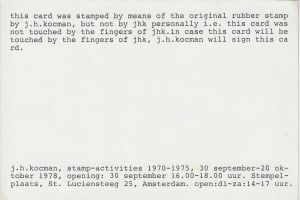
BIOGRAFIA EM PORTUGUÊSJi?í Hynek Kocman, conhecido internacionalmente como J. H. Kocman e JHK, é um artista conceitual, artista postal, pioneiro do stamp art, criador de livros de artista, livros objeto, trabalhos em papel, encadernador, restaurador, pesquisador e professor tcheco, nascido em 6 de agosto de 1947 em Nové M?sto na Morav?, então Tchecoslováquia, atual República Tcheca. Sua trajetória artística desenvolveu se principalmente em Brno e ocupa posição relevante na história da arte conceitual da Europa Central, especialmente pelas Stamp Activities, Touch Activities, mail art, experiências com livros, paper art e investigação da materialidade do papel. Embora tenha realizado uma importante exposição na Stempelplaats em Amsterdam em 1978, Kocman não é um artista neerlandês nem sediado historicamente em Amsterdam. Sua base principal de trabalho foi Brno, enquanto Amsterdam integrou sua ampla rede internacional de exposições e circulação artística. Não foi localizada nas fontes consultadas participação formal de Kocman no movimento brasileiro Poema Processo, mas sua atuação em arte conceitual, poesia visual, arte postal, livros de artista e redes alternativas de comunicação pertence ao mesmo ambiente internacional de experimentação que estabeleceu conexões entre Europa, América Latina e Brasil durante as décadas de 1970 e 1980.Kocman estudou na Universidade de Veterinária de Brno entre 1965 e 1971 e desenvolveu durante aproximadamente 27 anos atividade profissional no campo da farmacologia clínica, legislação, registro e informática aplicada a medicamentos veterinários no Instituto Estatal de Controle de Biopreparados e Medicamentos Veterinários de Brno. Sua formação artística ocorreu em paralelo. Desde 1965 estudou estética de maneira privada com Ji?í Valoch, poeta visual, artista conceitual, crítico e curador que exerceria influência fundamental sobre sua compreensão das novas tendências internacionais. A partir de 1976 estudou ciência do papel e encadernação artística com Jind?ich Svoboda e, desde 1979, conservação e restauração de papel e livros com Tomá? Vysko?il.Kocman iniciou sua produção artística intensiva em 1965. Seus primeiros trabalhos relacionavam se à abstração lírica e estrutural. Durante a segunda metade da década de 1960 realizou experiências gráficas, monotipias, gravuras estruturais e processos nos quais a transformação gradual da matriz adquiria importância maior que a imagem final. Essa atenção ao processo antecipou sua passagem para a arte conceitual em 1970. Um encontro decisivo ocorreu com Vladimír Boudník, cuja produção gráfica experimental exerceu forte impacto sobre Kocman. Depois da morte de Boudník em 1968, Kocman desenvolveu trabalhos em sua homenagem e aprofundou experiências gráficas que denominou Sand Graphic, utilizando areia no processo de impressão.A partir de 1970, Kocman abandonou progressivamente a produção gráfica tradicional e concentrou se em atividades conceituais. Entre as categorias criadas ou utilizadas em sua obra encontram se Stamp Activity, Touch Activity, Bipolar Activity, Project Activity, Reservation Activity, Documentation Activity e Mail Art. Essas denominações não representavam apenas técnicas, mas diferentes sistemas de ação e documentação nos quais texto, gesto, corpo, fotografia, carimbo e circulação constituíam a própria obra.Uma das primeiras experiências conceituais desse período foi Aesthetic Natural Reservation by J. H. Kocman, realizada em 1970 nas proximidades de Sob??ice, em Brno. Kocman instalou uma placa em uma árvore declarando uma área comum da paisagem como reserva estética. O projeto foi documentado por fotografia e exemplifica seu interesse em deslocar mecanismos administrativos e classificatórios para o campo da arte. Essa estratégia, marcada por ironia e absurdo controlado, reaparece em diferentes atividades posteriores.No mesmo ano de 1970 Kocman iniciou sua produção sistemática de carimbos artísticos. Seu primeiro carimbo continha a palavra TOUCH inscrita em forma circular. Em seguida surgiram carimbos como YES e NO, utilizados em Bipolar Activity para intervir conceitualmente em imagens e fotografias. Ao longo desse período produziu cerca de quarenta carimbos. Para Kocman, o carimbo não era simples instrumento de reprodução gráfica. Tornava se uma linguagem artística capaz de registrar presença, decisão, contato corporal, aprovação, negação, autoria e circulação.As Touch Activities constituem um dos grupos mais característicos de sua obra. Kocman aplicava tinta de carimbo às mãos ou dedos e utilizava o próprio corpo como instrumento de marcação. Objetos, fotografias e superfícies podiam receber vestígios de contato e tornar se documentos de uma ação. O procedimento colocava em relação corpo, presença, indexação e memória. O carimbo This page was touched by the fingers of J. H. Kocman, criado em 1970, tornou se um dos exemplos mais conhecidos dessa investigação.O interesse por stamp art rapidamente se conectou à arte postal. Por meio de correspondência internacional, Kocman entrou em contato com outros artistas que utilizavam carimbos e sistemas de comunicação alternativa. Em 1972 organizou JHK Stamp Activity, projeto que o próprio artista identifica como a primeira antologia internacional de stamp art. Participaram 25 artistas de diferentes países, cada um enviando 30 impressões originais de carimbos em formato A5. A antologia foi organizada em 30 exemplares, dos quais 25 retornaram aos participantes. O conjunto reuniu 124 impressões originais e transformou o correio simultaneamente em método de produção, intercâmbio e distribuição artística.Essa iniciativa conferiu a Kocman posição de destaque dentro da história internacional do rubber stamp art. Sua atividade não se limitou à produção pessoal de carimbos. Ele organizou uma rede coletiva, criou mecanismos de participação e reuniu material proveniente de diferentes países, antecipando metodologias que posteriormente seriam amplamente utilizadas na arte postal. O projeto também evidencia afinidades com poesia visual, arte conceitual e publicação de artista.Paralelamente ao stamp art, Kocman desenvolveu desde 1970 experiências com livros. Em Chromatographic Books, de 1970, aplicou ao livro métodos inspirados em cromatografia laboratorial. Em Capillarity Book for Václav Bo?tík, de 1971, investigou processos de absorção e capilaridade do papel. Book for Dalibor Chatrný, de 1972, empregou fios atravessando um bloco de folhas negras. No grupo Prepared Books, produzido entre 1970 e 1973, realizou cortes e intervenções em blocos impressos de livros para revelar sua estrutura interna. O livro deixou assim de ser apenas suporte para leitura e passou a ser analisado como objeto físico composto por papel, fibras, encadernação, sequência e volume.Essas experiências conduziram Kocman a uma reflexão cada vez mais profunda sobre o papel. O artista formulou uma concepção segundo a qual o papel não deveria funcionar apenas como suporte para uma mensagem externa, mas poderia constituir uma mensagem autônoma por meio de suas fibras, textura, composição, cor, peso e estrutura. Essa investigação tornou se fundamental para sua posterior produção de paper art e livros de artista.Em meados da década de 1970 Kocman começou a reduzir sua atividade com carimbos. Criou JHK's Last Art Stamp e considerou encerrado aquele ciclo experimental. Em 1976 utilizou esse último carimbo em setenta folhas destinadas ao projeto coletivo Album 76, organizado por Ivo Janou?ek, do qual participaram 66 autores. O gesto de enviar apenas a impressão de um pequeno carimbo para uma publicação coletiva concebida como obra gráfica foi assumido por Kocman como uma intervenção conceitual deliberada.Apesar desse encerramento, sua produção de stamp art continuou sendo apresentada retrospectivamente. Em 1978 realizou Bücher und Stempel na Galerie Leaman em Düsseldorf e participou de Rubber Stamp Works na Stempelplaats em Amsterdam. Sua exposição na Stempelplaats apresentou Stamp Activities 1970 1975 e ocorreu de 30 de setembro a 28 de outubro de 1978. O cartão This page was touched by the fingers of J. H. Kocman, preservado no acervo relacionado ao Salsa, pertence diretamente a esse contexto. A Stempelplaats atuava como plataforma de rubber stamp art, arte postal e publicações experimentais em Amsterdam.O cartão de 1978 possui importância especial para compreender sua obra. Um lado contém a impressão azul indicando que a página foi tocada pelos dedos de J. H. Kocman. O outro explica conceitualmente que o cartão poderia ter sido carimbado com seu carimbo original sem ter sido tocado pelo próprio artista e que, se fosse efetivamente tocado por Kocman, receberia sua assinatura. O trabalho transforma contato físico, autenticação e presença em conteúdo artístico e problematiza a diferença entre uma marca mecanicamente reproduzida e uma ação corporal efetiva.Kocman integrou desde cedo circuitos internacionais. Em 1971 participou de Arte de Sistemas I, organizada pelo CAYC em Buenos Aires, Argentina, presença particularmente importante para sua relação com a América Latina. Em 1972 participou de Anatomie einer Sammlung em Berlim. Em 1974 esteve em Art and Communication Marginale no Institut de l Environnement em Paris. Na segunda metade da década participou de exposições internacionais relacionadas a mail art, poesia visual, arte conceitual e livros de artista.Em 1978 sua obra apareceu em The Museum of Drawers no Kunsthaus Zürich e em outras apresentações do mesmo projeto. Participou ainda de From Bookworks to Mailworks no Stedelijk Museum de Alkmaar, Postkarten Künstlerkarten na Galerie Arkade em Berlim e de mostras de mail art em diferentes países. Em 1979 participou de Sprachen jenseits von Dichtung no Westfälischer Kunstverein em Münster. Em 1980 esteve em Vom Aussehen der Wörter no Kunstmuseum Hannover. Em 1982 participou de Young Fluxus no Artists Space em Nova York. Esses eventos documentam sua inserção em um circuito internacional que aproximava arte conceitual, Fluxus, poesia visual, mail art e experimentação editorial.É importante, entretanto, distinguir proximidade histórica de filiação. Kocman é frequentemente contextualizado junto de Fluxus e participou de Young Fluxus em Nova York, porém sua trajetória desenvolveu se principalmente no contexto da arte conceitual de Brno e das redes independentes da Europa Central. Ji?í Valoch desempenhou papel decisivo nesse ambiente e manteve com Kocman uma colaboração artística e intelectual prolongada.Durante o final da década de 1970, sua atenção deslocou se progressivamente dos carimbos para papel, encadernação e livros de artista. Desde 1976 estudava técnicas de papel e encadernação com Jind?ich Svoboda e desde 1979 aprofundou conservação e restauração com Tomá? Vysko?il. Essa formação artesanal não significou abandono da atitude conceitual. Kocman passou a unir pensamento conceitual e conhecimento material do livro.Nesse período desenvolveu procedimentos de Paper Re Making. Materiais impressos eram triturados parcialmente, rasgados e transformados novamente em polpa para fabricação manual de novas folhas de papel. Textos e imagens do material original reapareciam fragmentados na nova superfície. O processo transformava destruição, reciclagem e reconstrução em método de interpretação. A materialidade da obra era inseparável do significado.A partir de 1979 Kocman iniciou também uma investigação aprofundada sobre Josef Váchal, artista, escritor, gravador e encadernador tcheco. Estudou e documentou centenas de encadernações realizadas por Váchal e posteriormente desenvolveu livros objeto e papéis reinterpretando suas publicações. Em 1983 produziu em samizdat o estudo Josef Váchal knihvaza?, dedicado a Váchal como encadernador. Essa investigação deu origem posteriormente à série Váchaliána e a trabalhos de Paper Re Making baseados em fac símiles de livros de Váchal.Sua atuação acadêmica tornou se uma parte importante de sua trajetória. Entre 1993 e 1998 trabalhou como professor externo na Faculdade de Belas Artes da Universidade de Tecnologia de Brno. Em 1996 obteve habilitação em arte conceitual na Academia de Belas Artes de Praga. Em 1997 fundou o Kabinet papír a kniha na Faculdade de Belas Artes em Brno e, em 1998, estabeleceu o Ateliér papír a kniha, dedicado às relações entre papel, livro, arte, artesanato e pensamento conceitual. Dirigiu o ateliê até 2011. Sua atividade interna na instituição estendeu se até 2013.Esse programa pedagógico teve caráter interdisciplinar. Os estudantes investigavam papel artesanal, livros de artista, livros objeto, encadernação, instalações e outras formas de book art. O Museu de Arte de Olomouc reconhece Kocman como figura fundamental do círculo de Brno e protagonista do pensamento conceitual, destacando também sua importância para a formação de artistas ligados ao papel e ao livro.Em 1989 Kocman recebeu o primeiro prêmio na sexta Trienal de Encadernação Artística de Krom??í?. Sua produção posterior concentrou se cada vez mais em livros de artista, papéis artesanais e investigações históricas sobre encadernação, sem abandonar o fundamento conceitual desenvolvido nos anos 1970.Entre suas exposições individuais posteriores destacam se Papíry a knihy, na Galerie J. Krále, D?m um?ní, Brno, em 1991; Pure Experiences, University of Reading, em 1992; Autorské knihy a papíry, Galerie Rudolfinum, Praga, em 1998; Kunstobjekt Buch, Czech Centre, Berlim, em 2000; Autorské knihy Autorské papíry, Frýdek Místek, em 2001; Autorské ru?ní papíry Autorské knihy, ?umperk, em 2002; exposição de livros e papéis em ?eské Bud?jovice em 2003; Autorské ru?ní papíry, Ústí nad Labem, em 2006; e ?umavsko váchalovské interpretace J. H. Kocmana, Galerie Ztichlá klika, Praga, em 2010.Sua obra também permaneceu presente em importantes exposições coletivas internacionais. Entre os eventos documentados encontram se Turning over the Pages, Kettle's Yard Gallery, Cambridge, em 1986; primeira International Biennale der Papierkunst, Leopold Hoesch Museum, Düren, em 1986; The Altered Page, Center for Book Arts, Nova York, em 1988; e 40 artistes tchèques et slovaques 1960 1990, Coupole Haussmann, Paris, em 1990.O Museu de Arte de Olomouc incorporou documentação de action art de Ji?í Hynek Kocman à sua coleção de arte moderna e contemporânea. A instituição também apresentou obras de Kocman em exposições relacionadas ao Ateliér papír a kniha e reconhece sua importância para a arte conceitual e para a tradição de livros de artista na Europa Central.Na historiografia da arte postal e do stamp art, Kocman é particularmente importante por ter compreendido o carimbo como meio conceitual. Em suas obras a impressão do carimbo não representa apenas um desenho reproduzido. Ela pode confirmar um gesto, negar uma presença, declarar um espaço, ativar uma fotografia ou estabelecer uma instrução. Essa abordagem transformou o carimbo em dispositivo de linguagem e ação.Sua relação com a poesia visual ocorre sobretudo pela utilização da palavra como signo visual, performativo e operacional. Expressões como TOUCH, YES e NO funcionam simultaneamente como texto, imagem e ação. Essa concepção aproxima Kocman das pesquisas de poesia visual e experimental realizadas internacionalmente no mesmo período.Não foi localizada nas fontes consultadas evidência documental suficiente para afirmar participação de J. H. Kocman no Poema Processo brasileiro ou correspondência direta com Álvaro de Sá, Neide de Sá, Wlademir Dias Pino ou outros participantes históricos do movimento. A relação deve portanto ser registrada como contextual e internacional, e não como filiação. Sua participação em Arte de Sistemas I em Buenos Aires, seu envolvimento com mail art, stamp art e poesia visual e sua presença em redes internacionais de artistas demonstram, entretanto, a proximidade entre seu trabalho e os circuitos alternativos que também conectaram artistas latino americanos e brasileiros.J. H. Kocman permanece associado principalmente a Brno, República Tcheca. Amsterdam é fundamental em sua história pela exposição na Stempelplaats em 1978 e pela recepção internacional de suas Stamp Activities, mas não deve ser registrado como sua cidade de origem ou principal cidade de atuação. Seu legado resulta da articulação singular entre arte conceitual, stamp art, mail art, Touch Activities, livros de artista, paper art, encadernação, conservação, pesquisa histórica e ensino.Para indexação no Salsa, relacionar naturalmente Ji?í Hynek Kocman, J. H. Kocman, JHK, República Tcheca, Tchecoslováquia, Brno, Nové M?sto na Morav?, Ji?í Valoch, Vladimír Boudník, Stamp Activity, Touch Activity, Bipolar Activity, JHK Stamp Activity, This page was touched by the fingers of J. H. Kocman, Stempelplaats, Amsterdam, Aart van Barneveld, mail art, arte postal, stamp art, rubber stamp art, arte conceitual, poesia visual, livros de artista, livro objeto, paper art, Paper Re Making, Josef Váchal, Universidade de Tecnologia de Brno, Faculdade de Belas Artes, Ateliér papír a kniha e redes internacionais de arte experimental.
English
BIOGRAPHY IN ENGLISHJi?í Hynek Kocman, internationally known as J. H. Kocman and JHK, is a Czech conceptual artist, mail artist, pioneer of stamp art, maker of artists books and book objects, paper artist, bookbinder, conservator, researcher and educator, born on 6 August 1947 in Nové M?sto na Morav?, then Czechoslovakia and now the Czech Republic. His artistic career developed primarily in Brno and occupies an important position in the history of Central European conceptual art, particularly through his Stamp Activities, Touch Activities, mail art, book experiments, paper art and investigations into the material nature of paper. Although he held an important exhibition at Stempelplaats in Amsterdam in 1978, Kocman is not a Dutch artist and was not historically based in Amsterdam. His principal working environment was Brno, while Amsterdam formed part of his broad international exhibition and correspondence network. No formal participation by Kocman in the Brazilian Process Poem Movement was located in the consulted sources, although his activities in conceptual art, visual poetry, mail art, artists books and alternative communication networks belong to the same international experimental environment that connected Europe and Latin America during the 1970s and 1980s.Kocman studied at the University of Veterinary Medicine in Brno between 1965 and 1971. For approximately twenty seven years he worked in clinical pharmacology, legislation, registration and information technology for veterinary medicines at the Institute for State Control of Veterinary Biologics and Medicines in Brno. His artistic education developed in parallel with this scientific career. From 1965 he privately studied aesthetics with Ji?í Valoch, the visual poet, conceptual artist, critic and curator who played a decisive role in introducing him to contemporary international tendencies. From 1976 he studied paper science and artistic bookbinding with Jind?ich Svoboda, and from 1979 paper and book conservation with Tomá? Vysko?il.Kocman became deeply involved in art in 1965. His earliest work developed from lyrical and structural abstraction. During the second half of the 1960s he experimented with printmaking, monotypes and structural prints in which the progressive transformation of the matrix became more important than the final image. This emphasis on process anticipated his transition to conceptual art in 1970. His encounter with Vladimír Boudník was especially important, and following Boudníks death Kocman produced works in his memory and developed a process he called Sand Graphic.Beginning in 1970 Kocman increasingly abandoned conventional graphic production and concentrated on conceptual activities. Categories within his practice included Stamp Activity, Touch Activity, Bipolar Activity, Project Activity, Reservation Activity, Documentation Activity and Mail Art. These were not merely technical descriptions but systems of action and documentation through which text, gesture, body, photography, stamps and circulation became the artwork itself.Among his earliest conceptual projects was Aesthetic Natural Reservation by J. H. Kocman, realized in 1970 near Sob??ice on the outskirts of Brno. By attaching a sign to a tree, Kocman declared an ordinary area of landscape to be an aesthetic reservation. The intervention was documented photographically and exemplifies his interest in transferring administrative and classificatory structures into art.In 1970 Kocman also began systematically producing artists stamps. His first stamp contained the word TOUCH within a circular structure. Stamps reading YES and NO followed and were used in Bipolar Activity to conceptually comment on photographs and images. Over time he produced close to forty stamps. For Kocman the rubber stamp was not simply a graphic reproduction device. It could record presence, decision, physical contact, approval, refusal, authorship and circulation.The Touch Activities became among the most distinctive elements of his practice. Kocman applied stamp ink to his hands or fingers and used the body itself as a marking instrument. Objects and surfaces could retain evidence of contact and therefore become documentary traces of actions. The stamp This page was touched by the fingers of J. H. Kocman, created in 1970, became one of the best known examples of this investigation.Stamp art quickly became connected with mail art. Through international correspondence Kocman encountered other artists using rubber stamps and alternative systems of communication. In 1972 he organized JHK Stamp Activity, which he identified as the first international anthology of artistic rubber stamps. Twenty five participants from different countries each contributed thirty original stamp impressions on A5 sheets. Thirty sets were assembled, twenty five of which were returned to the participating artists. The anthology contained 124 original stamp impressions and made postal exchange simultaneously a method of artistic production, collaboration and distribution.This initiative established Kocman as an important figure in the international history of rubber stamp art. His significance rests not only on the stamps he designed but also on his creation of a collective system through which artists exchanged original impressions across national borders. The project intersects with the histories of mail art, visual poetry, conceptual art and artists publishing.At the same time Kocman began experimenting with books. Chromatographic Books from 1970 transferred laboratory chromatographic principles into the structure of the book. Capillarity Book for Václav Bo?tík from 1971 investigated absorption and capillary processes. Book for Dalibor Chatrný from 1972 used threads passing through a block of black sheets. In Prepared Books, produced between 1970 and 1973, Kocman cut and transformed printed book blocks to expose their internal construction. The book was therefore no longer simply a carrier of written information but a physical structure composed of paper, fibres, binding, sequence and volume.These experiments gradually led Kocman toward a broader philosophy of paper. Paper did not need to remain a passive carrier of external information. Its fibre, texture, composition, weight, colour and structure could themselves communicate. This principle became central to his later paper art and artists books.During the middle of the 1970s Kocman began to conclude his regular stamp activities. He created JHK's Last Art Stamp and considered this experimental cycle finished. In 1976 he used the last art stamp on seventy sheets contributed to Album 76, a collective samizdat graphic project organized by Ivo Janou?ek with sixty six participants. Kocman understood the decision to contribute only a small rubber stamp impression to a graphic album as a deliberate conceptual gesture.His stamp work nevertheless continued to be presented retrospectively. In 1978 he held Bücher und Stempel at Galerie Leaman in Düsseldorf and was represented by Rubber Stamp Works at Stempelplaats in Amsterdam. The Stempelplaats presentation of Stamp Activities 1970 1975 ran from 30 September through 28 October 1978. The card This page was touched by the fingers of J. H. Kocman preserved in the collection connected with Salsa belongs directly to this context.The 1978 card is particularly revealing. One side bears the blue stamp stating that the page had been touched by Kocmans fingers. The other side explains that the card may have been stamped with the original rubber stamp without having been physically touched by the artist and that physical contact by Kocman would result in a signature. The work turns authentication, touch and bodily presence into artistic content and questions the difference between mechanically reproduced authorship and actual physical action.Kocman entered international exhibition networks early in his career. In 1971 he participated in Arte de Sistemas I at CAYC in Buenos Aires, an important connection with the Latin American conceptual art environment. In 1972 he participated in Anatomie einer Sammlung in Berlin. In 1974 he appeared in Art and Communication Marginale at the Institut de l Environnement in Paris. During the second half of the decade he participated in numerous exhibitions related to mail art, conceptual art, visual poetry and artists books.In 1978 his work appeared in The Museum of Drawers at Kunsthaus Zürich and in other presentations of that project. He also participated in From Bookworks to Mailworks at the Stedelijk Museum in Alkmaar and in exhibitions of artists postcards and mail art. In 1979 he participated in Sprachen jenseits von Dichtung at the Westfälischer Kunstverein in Münster. In 1980 he was included in Vom Aussehen der Wörter at Kunstmuseum Hannover. In 1982 he participated in Young Fluxus at Artists Space in New York. These events document his position within international networks connecting conceptual art, Fluxus, visual poetry, mail art and experimental publishing.Historical proximity should nevertheless be distinguished from formal affiliation. Kocman has often been contextualized in relation to Fluxus and appeared in Young Fluxus, but his work developed primarily within the conceptual environment of Brno and independent Central European art networks. Ji?í Valoch was a particularly important artistic and intellectual collaborator.By the late 1970s Kocmans attention increasingly shifted from rubber stamps toward paper, bookbinding and artists books. From 1976 he studied paper and binding with Jind?ich Svoboda, and from 1979 he expanded his knowledge of conservation and restoration with Tomá? Vysko?il. This technical training did not replace the conceptual dimension of his work. Instead it allowed conceptual investigation and the craft knowledge of books to converge.He developed methods of Paper Re Making in which previously printed paper was partly pulped and partly torn into fragments before being transformed into new handmade sheets. Texts and images from the original source material reappeared as fragments embedded within the reconstructed paper. Destruction, recycling and reinterpretation became part of the artistic process.Beginning in 1979 Kocman undertook extensive research into Josef Váchal, the Czech artist, writer, printmaker and bookbinder. He documented hundreds of Váchals bindings and later developed book objects and handmade papers based on reinterpretations of Váchals publications. In 1983 he produced the samizdat study Josef Váchal knihvaza?, devoted to Váchal as bookbinder. This research later contributed to the Váchaliána cycle and to Paper Re Making interpretations of Váchals books.Education became another major dimension of Kocmans career. From 1993 to 1998 he taught externally at the Faculty of Fine Arts of Brno University of Technology. In 1996 he completed his habilitation in conceptual art at the Academy of Fine Arts in Prague. In 1997 he founded the Cabinet Paper and Book in Brno, and in 1998 established the Paper and Book Studio. He directed the studio until 2011 and remained an internal teacher through 2013.The program developed an interdisciplinary approach to handmade paper, artists books, book objects, bookbinding, installation and conceptual art. The Museum of Art Olomouc identifies Kocman as an important figure within the Brno circle and a major protagonist of conceptual thought whose influence also extended through his students.In 1989 Kocman received first prize at the sixth Triennial of Artistic Bookbinding in Krom??í?. His later production concentrated increasingly on artists books, handmade paper and historical research on binding while retaining the conceptual foundations developed during the 1970s.Later solo exhibitions include Papíry a knihy at D?m um?ní in Brno in 1991, Pure Experiences at the University of Reading in 1992, Autorské knihy a papíry at Galerie Rudolfinum in Prague in 1998, Kunstobjekt Buch at the Czech Centre in Berlin in 2000, presentations of artists books and handmade papers in Frýdek Místek, ?umperk, ?eské Bud?jovice and Ústí nad Labem, and ?umavsko váchalovské interpretace J. H. Kocmana at Galerie Ztichlá klika in Prague in 2010.The Museum of Art Olomouc preserves action art documentation by Ji?í Hynek Kocman within its modern and contemporary art holdings. The institution has also presented Kocman and his students in exhibitions devoted to artists books, paper and conceptual art.Within the history of stamp art Kocmans particular contribution lies in his transformation of the rubber stamp into a conceptual instrument. A stamped impression may certify an action, deny a presence, declare a territory, activate a photograph or establish an instruction. Words such as TOUCH, YES and NO operate at once as text, visual sign and action, creating clear relationships with visual and experimental poetry.No sufficient documentary evidence was located to establish formal participation by J. H. Kocman in the Brazilian Process Poem Movement or direct correspondence with Álvaro de Sá, Neide de Sá, Wlademir Dias Pino or other historical members of the movement. The relationship should therefore be recorded as contextual and international rather than as formal affiliation. His participation in Arte de Sistemas I in Buenos Aires and his involvement in mail art, stamp art and visual communication nevertheless place his practice within the same transnational experimental environment in which Latin American and Brazilian artists circulated.J. H. Kocman remains principally associated with Brno in the Czech Republic. Amsterdam is important because of his 1978 Stempelplaats exhibition and the international reception of his Stamp Activities, but should not be recorded as his city of origin or principal base. His legacy lies in the singular integration of conceptual art, stamp art, mail art, Touch Activities, artists books, paper art, bookbinding, conservation, historical research and education.For indexing, J. H. Kocman should be associated with Ji?í Hynek Kocman, JHK, Czech Republic, Czechoslovakia, Brno, Nové M?sto na Morav?, Ji?í Valoch, Vladimír Boudník, Stamp Activity, Touch Activity, Bipolar Activity, JHK Stamp Activity, This page was touched by the fingers of J. H. Kocman, Stempelplaats, Amsterdam, Aart van Barneveld, mail art, rubber stamp art, conceptual art, visual poetry, artists books, book objects, paper art, Paper Re Making, Josef Váchal, Brno University of Technology, Faculty of Fine Arts, Paper and Book Studio and international experimental art networks.
Currículo
CURRÍCULO EM PORTUGUÊSJ. H. Kocman desenvolveu desde 1965 uma trajetória interdisciplinar que articula arte conceitual, stamp art, mail art, livros de artista, livros objeto, paper art, encadernação, conservação, pesquisa e ensino. A relação abaixo constitui lista consolidada das ocorrências documentadas nas fontes consultadas e não deve ser entendida como catálogo raisonné integral. A documentação do próprio artista registra dezenas de exposições individuais e centenas de participações coletivas nacionais e internacionais.IDENTIFICAÇÃONome completo: Ji?í Hynek KocmanNome de uso artístico: J. H. KocmanForma abreviada: JHKNascimento: 6 de agosto de 1947Local: Nové M?sto na Morav?País no nascimento: TchecoslováquiaPaís atual: República TchecaNacionalidade: tchecaCidade principal de atuação: BrnoÁreas de atuação: arte conceitual, stamp art, rubber stamp art, arte postal, mail art, livro de artista, livro objeto, paper art, encadernação artística, conservação de papel e livros, pesquisa e ensinoContexto artístico principal: círculo conceitual de BrnoArtista e pesquisador relacionado de modo decisivo: Ji?í Valoch.FORMAÇÃO1965 a 1971Universidade de Veterinária de BrnoÁrea: medicina veterináriaBrno, Tchecoslováquia.Desde 1965Estudos privados de estéticaProfessor: Ji?í ValochBrno.Desde 1976Estudos de papel e encadernação artísticaProfessor: Jind?ich Svoboda.Desde 1979Estudos de conservação e restauração de papel e livrosProfessor: Tomá? Vysko?il.ATUAÇÃO PROFISSIONALApós 1971, aproximadamente 27 anosInstituto Estatal de Controle de Biopreparados e Medicamentos VeterináriosBrnoÁreas: farmacologia clínica, legislação, registro e informática de medicamentos veterinários.1993 a 1998Professor externoFaculdade de Belas ArtesUniversidade de Tecnologia de Brno.1996Habilitação em arte conceitualAcademia de Belas Artes de Praga.1997Fundação do Kabinet papír a knihaFaculdade de Belas ArtesUniversidade de Tecnologia de Brno.1998 a 2011Fundador e diretorAteliér papír a knihaFaculdade de Belas ArtesUniversidade de Tecnologia de Brno.1997 a 2013Professor internoFaculdade de Belas ArtesUniversidade de Tecnologia de Brno.FASES E LINGUAGENS1965 a 1969Abstração lírica e estruturalGravuraMonotipiaExperiências com estrutura e transformação da matrizSand Graphic.A partir de 1970Arte conceitualStamp ActivityTouch ActivityBipolar ActivityProject ActivityReservation ActivityDocumentation ActivityMail Art.Década de 1970Livro experimentalLivro objetoPrepared BooksChromatographic BooksCapillarity BooksPaper Sensibility.Final dos anos 1970 em dianteEncadernaçãoConservaçãoPaper ArtPaper Re MakingLivros de artistaPesquisa sobre Josef Váchal.OBRAS, SÉRIES E PROJETOS DOCUMENTADOS1970Aesthetic Natural Reservation by J. H. KocmanProjeto conceitual e intervenção em paisagemSob??ice, Brno.1970TOUCHPrimeiro carimbo artístico documentado de Kocman.1970This page was touched by the fingers of J. H. KocmanStamp Activity e Touch Activity.1970Chromatographic BooksLivros experimentais baseados em procedimentos cromatográficos.1970 a 1973Prepared BooksLivros objeto produzidos por cortes e intervenções em livros impressos.1971Capillarity Book for Václav Bo?tíkLivro de artista.1972Book for Dalibor ChatrnýLivro de artista e livro objeto.1972JHK Stamp ActivityAntologia internacional de stamp art25 participantes30 exemplares124 impressões originais de carimbos.1975JHK's Last Art StampCarimbo relacionado ao encerramento de sua fase regular de stamp art.1976Album 76Organização: Ivo Janou?ekParticipação de Kocman com impressão de JHK's Last Art Stamp66 participantes.1978This page was touched by the fingers of J. H. KocmanCartão relacionado à retrospectiva Stamp Activities 1970 1975StempelplaatsAmsterdam.1983Josef Váchal knihvaza?Estudo em samizdat sobre Josef Váchal como encadernador.Período posteriorVáchaliánaCiclo de livros objeto e interpretações de publicações de Josef Váchal.EXPOSIÇÕES INDIVIDUAIS DOCUMENTADAS1978Bücher und StempelGalerie LeamanDüsseldorf, Alemanha.1978Stamp Activities 1970 1975StempelplaatsSt. Luciensteeg 25Amsterdam, Países Baixos30 de setembro a 28 de outubro de 1978.1978Rubber Stamp WorksStempelplaatsAmsterdam, Países Baixos.1991Papíry a knihyGalerie J. KráleD?m um?níBrno, Tchecoslováquia.1992Pure ExperiencesUniversity of ReadingReading, Reino Unido.1998JHK Autorské knihy a papíryGalerie RudolfinumPraga, República Tcheca.2000JHK Kunstobjekt BuchCzech CentreBerlim, Alemanha.2001JHK Autorské knihy Autorské papíryGalerie Lang?v d?mFrýdek Místek, República Tcheca.2002JHK Autorské ru?ní papíry Autorské knihyGalerie Ji?ího Jílka?umperk, República Tcheca.2003JHK Autorské ru?ní papíry Autorské knihyGalerie Hrozen?eské Bud?jovice, República Tcheca.2006JHK Autorské ru?ní papíryGalerie na Chodb?Universidade J. E. Purkyn?Ústí nad Labem, República Tcheca.2010?umavsko váchalovské interpretace J. H. KocmanaGalerie Ztichlá klikaPraga, República Tcheca.EXPOSIÇÕES COLETIVAS DOCUMENTADAS1967?lenská výstava Studia MPVUGalerie pod krokodýlemBrno.1968ProemiumRadnice?eský Krumlov.1968BilanceUB ZlatorohBrno.1969MAXD?m um?níBrno.1969I. ?eská výtvarná sout?? mladýchD?m pán? z Kun?tátuBrno.1970I. ?eská výtvarná sout?? mladýchPraga.1970AMO 70Vlastiv?dné muzeum?umperk.1970Perspektivy ITechnické muzeumBrno.1970Tschechoslowakische GraphikHaus der JugendFreiburg, Alemanha.1971Grafica internazionaleGaleria SincronBrescia, Itália.1971Arte de Sistemas ICAYCBuenos Aires, Argentina.1972Anatomie einer SammlungProduzenten GalerieBerlim, Alemanha.1974Art and Communication MarginaleInstitut de l EnvironnementParis, França.1977Mail ArtSpace WindowProvidence, Estados Unidos.1977The Museum of DrawersIsrael MuseumJerusalém.1977The Museum of DrawersStädtische KunsthalleDüsseldorf.1978Today Art Is a PrisonCentro ExperimentaNápoles, Itália.1978Visual Texts?ód?, Polônia.1978L arte lascia il segnoGalleria de AmicisFlorença, Itália.1978Mantua MailCasa del MantegnaMântua, Itália.1978From Bookworks to MailworksStedelijk MuseumAlkmaar, Países Baixos.1978Postkarten KünstlerkartenGalerie ArkadeBerlim, Alemanha.1978The Museum of DrawersKunsthaus ZürichZürich, Suíça.1978The Museum of DrawersCooper Hewitt MuseumNova York, Estados Unidos.1978The Museum of DrawersLos Angeles Institute of Contemporary ArtLos Angeles, Estados Unidos.1978The Museum of DrawersNew Orleans Museum of ArtNew Orleans, Estados Unidos.1979Sprachen jenseits von DichtungWestfälischer KunstvereinMünster, Alemanha.1980Vom Aussehen der WörterKunstmuseum HannoverHannover, Alemanha.1982Young FluxusArtists SpaceNova York, Estados Unidos.1986Turning over the PagesKettle's Yard GalleryCambridge, Reino Unido.1986International Biennale der PapierkunstPrimeira ediçãoLeopold Hoesch MuseumDüren, Alemanha.1988The Altered PageCenter for Book ArtsNova York, Estados Unidos.199040 artistes tchèques et slovaques 1960 1990Coupole HaussmannParis, França.PRÊMIOS1989Primeiro prêmioSexta Trienal de Encadernação ArtísticaKrom??í?, Tchecoslováquia.PUBLICAÇÕES E TEXTOS DOCUMENTADOS1972JHK Stamp ActivityAntologia de stamp art organizada por Kocman30 exemplares25 participantes.Período da década de 1970O papíruAbout Paper SensibilityEstudo em samizdat relacionado à concepção material do papel.1983Josef Váchal knihvaza?Monografia em samizdat.CATÁLOGOS E BIBLIOGRAFIA SELECIONADA1991Ji?í ValochJ. H. Kocman Papíry, knihyHandmade Papers, Artists BooksCatálogo de exposiçãoBrno.1992Pavel BüchlerJi?í H. Kocman Pure ExperiencesUniversity of Reading.1997Ji?í ValochJ. H. Kocman Autorské knihy a papíryArtists Books and PapersGalerie RudolfinumPraga.2011Josef Kroutvor?umavsko váchalovské interpretace J. H. KocmanaGalerie Ztichlá klikaPraga.COLEÇÕES PÚBLICAS E ARQUIVOSMuzeum um?ní OlomoucMuseu de Arte de OlomoucOlomouc, República TchecaPreserva documentação relacionada à action art de Ji?í Hynek Kocman e trabalhos ligados ao contexto de livros de artista e arte conceitual.Outras coleções são registradas na documentação extensa mantida pelo próprio artista, mas uma consolidação integral não foi reproduzida aqui para evitar atribuições não verificadas individualmente.RELAÇÃO COM O POEMA PROCESSONão foi localizada participação formal de J. H. Kocman no Poema Processo.Não foi localizada nas fontes consultadas correspondência direta confirmada com Álvaro de Sá, Neide de Sá, Wlademir Dias Pino ou outros participantes históricos do movimento.A relação é contextual por meio de arte postal, poesia visual, livro de artista, arte conceitual, stamp art e redes internacionais alternativas.Sua presença em Arte de Sistemas I, Buenos Aires, 1971, confirma participação precoce em circuito latino americano de arte conceitual.CRONOLOGIA19476 de agostoNascimento em Nové M?sto na Morav?.1965Início de atividade artística intensiva.Início de estudos privados de estética com Ji?í Valoch.Entrada na Universidade de Veterinária de Brno.1967Contato importante com Vladimír Boudník.Primeiras exposições coletivas documentadas.1968Participação em Proemium em ?eský Krumlov.Desenvolvimento de experiências gráficas estruturais.1969Participações coletivas em Brno.1970Passagem para arte conceitual.Aesthetic Natural Reservation.Primeiro carimbo TOUCH.Início de Stamp Activities, Touch Activities e Bipolar Activities.Chromatographic Books.Prepared Books.1971Capillarity Book for Václav Bo?tík.Participação em Arte de Sistemas I no CAYC, Buenos Aires.Conclusão da formação veterinária.1972JHK Stamp Activity.Book for Dalibor Chatrný.Participação em Anatomie einer Sammlung, Berlim.1974Participação em Art and Communication Marginale, Paris.1975JHK's Last Art Stamp.Encerramento declarado da fase regular de stamp art.1976Participação no Album 76.Início de estudos com Jind?ich Svoboda.1978Bücher und Stempel em Düsseldorf.Stamp Activities 1970 1975 na Stempelplaats, Amsterdam.Participação em diversas exposições de mail art e livros de artista.1979Início de estudos de restauração com Tomá? Vysko?il.Início de investigação sobre Josef Váchal.Participação em Sprachen jenseits von Dichtung.1980Participação em Vom Aussehen der Wörter.1982Participação em Young Fluxus no Artists Space, Nova York.1983Josef Váchal knihvaza?.1986Turning over the Pages.Primeira International Biennale der Papierkunst.1988The Altered Page.1989Primeiro prêmio na sexta Trienal de Encadernação Artística de Krom??í?.1991Papíry a knihy, Brno.1992Pure Experiences, University of Reading.1993Início da atividade docente externa na Faculdade de Belas Artes de Brno.1996Habilitação em arte conceitual na Academia de Belas Artes de Praga.1997Fundação do Kabinet papír a kniha.1998Criação do Ateliér papír a kniha.Exposição na Galerie Rudolfinum, Praga.2000 a 2010Continuidade de exposições dedicadas a livros de artista, paper art e Josef Váchal.2011Encerramento de sua direção do Ateliér papír a kniha.2013Fim do período documentado como professor interno da Faculdade de Belas Artes de Brno.2018Muzeu um?ní Olomouc documenta aquisição de trabalhos relacionados à action art de Kocman para sua coleção.
English
CURRICULUM IN ENGLISHJ. H. Kocman has developed an interdisciplinary practice since 1965 combining conceptual art, stamp art, mail art, artists books, book objects, paper art, bookbinding, conservation, research and education. The following curriculum constitutes a consolidated record of occurrences documented in the consulted sources and should not be understood as a complete catalogue raisonné. Kocmans own documentation records dozens of solo exhibitions and hundreds of national and international group exhibitions.IDENTIFICATIONFull name: Ji?í Hynek KocmanProfessional name: J. H. KocmanAbbreviated form: JHKBorn: 6 August 1947Place: Nové M?sto na Morav?Country at birth: CzechoslovakiaPresent country: Czech RepublicNationality: CzechPrincipal city of activity: BrnoFields: conceptual art, stamp art, rubber stamp art, mail art, artists books, book objects, paper art, artistic bookbinding, paper and book conservation, research and educationPrincipal artistic context: Brno conceptual circleMajor intellectual and artistic relationship: Ji?í Valoch.EDUCATION1965 to 1971University of Veterinary MedicineBrno, Czechoslovakia.From 1965Private studies in aestheticsTeacher: Ji?í ValochBrno.From 1976Studies in paper and artistic bookbindingTeacher: Jind?ich Svoboda.From 1979Studies in paper and book conservationTeacher: Tomá? Vysko?il.PROFESSIONAL ACTIVITIESAfter 1971, approximately twenty seven yearsInstitute for State Control of Veterinary Biologics and MedicinesBrnoFields: clinical pharmacology, legislation, registration and information technology for veterinary medicines.1993 to 1998External lecturerFaculty of Fine ArtsBrno University of Technology.1996Habilitation in conceptual artAcademy of Fine ArtsPrague.1997Foundation of the Cabinet Paper and BookFaculty of Fine ArtsBrno University of Technology.1998 to 2011Founder and headPaper and Book StudioFaculty of Fine ArtsBrno University of Technology.1997 to 2013Internal lecturerFaculty of Fine ArtsBrno University of Technology.ARTISTIC PHASES AND MEDIA1965 to 1969Lyrical abstractionStructural abstractionPrintmakingMonotypeStructural graphic experimentsSand Graphic.From 1970Conceptual artStamp ActivityTouch ActivityBipolar ActivityProject ActivityReservation ActivityDocumentation ActivityMail Art.1970sExperimental booksBook objectsPrepared BooksChromatographic BooksCapillarity BooksPaper Sensibility.Late 1970s onwardBookbindingConservationPaper artPaper Re MakingArtists booksResearch on Josef Váchal.DOCUMENTED WORKS, SERIES AND PROJECTS1970Aesthetic Natural Reservation by J. H. KocmanConceptual project and landscape interventionSob??ice, Brno.1970TOUCHFirst documented artists stamp.1970This page was touched by the fingers of J. H. KocmanStamp Activity and Touch Activity.1970Chromatographic BooksExperimental artists books.1970 to 1973Prepared BooksBook objects created through cuts and interventions into printed books.1971Capillarity Book for Václav Bo?tík.1972Book for Dalibor Chatrný.1972JHK Stamp ActivityInternational stamp art anthology25 participants30 copies124 original stamp impressions.1975JHK's Last Art Stamp.1976Album 76Organizer: Ivo Janou?ekKocman contribution: impression of JHK's Last Art Stamp66 participants.1978This page was touched by the fingers of J. H. KocmanCard connected with Stamp Activities 1970 1975StempelplaatsAmsterdam.1983Josef Váchal knihvaza?Samizdat study on Josef Váchal as bookbinder.Later periodVáchaliánaCycle of book objects and reinterpretations of Josef Váchals publications.SOLO EXHIBITIONS1978Bücher und StempelGalerie LeamanDüsseldorf, Germany.1978Stamp Activities 1970 1975StempelplaatsSt. Luciensteeg 25Amsterdam, the Netherlands30 September to 28 October 1978.1978Rubber Stamp WorksStempelplaatsAmsterdam, the Netherlands.1991Papíry a knihyGalerie J. KráleD?m um?níBrno.1992Pure ExperiencesUniversity of ReadingReading, United Kingdom.1998JHK Autorské knihy a papíryGalerie RudolfinumPrague, Czech Republic.2000JHK Kunstobjekt BuchCzech CentreBerlin, Germany.2001JHK Autorské knihy Autorské papíryGalerie Lang?v d?mFrýdek Místek, Czech Republic.2002JHK Autorské ru?ní papíry Autorské knihyGalerie Ji?ího Jílka?umperk, Czech Republic.2003JHK Autorské ru?ní papíry Autorské knihyGalerie Hrozen?eské Bud?jovice, Czech Republic.2006JHK Autorské ru?ní papíryGalerie na Chodb?J. E. Purkyn? UniversityÚstí nad Labem, Czech Republic.2010?umavsko váchalovské interpretace J. H. KocmanaGalerie Ztichlá klikaPrague, Czech Republic.GROUP EXHIBITIONS1967?lenská výstava Studia MPVUGalerie pod krokodýlemBrno.1968ProemiumRadnice?eský Krumlov.1968BilanceUB ZlatorohBrno.1969MAXD?m um?níBrno.1969I. ?eská výtvarná sout?? mladýchD?m pán? z Kun?tátuBrno.1970I. ?eská výtvarná sout?? mladýchPrague.1970AMO 70Vlastiv?dné muzeum?umperk.1970Perspektivy ITechnické muzeumBrno.1970Tschechoslowakische GraphikHaus der JugendFreiburg, Germany.1971Grafica internationaleGaleria SincronBrescia, Italy.1971Arte de Sistemas ICAYCBuenos Aires, Argentina.1972Anatomie einer SammlungProduzenten GalerieBerlin, Germany.1974Art and Communication MarginaleInstitut de l EnvironnementParis, France.1977Mail ArtSpace WindowProvidence, United States.1977The Museum of DrawersIsrael MuseumJerusalem.1977The Museum of DrawersStädtische KunsthalleDüsseldorf.1978Today Art Is a PrisonCentro ExperimentaNaples, Italy.1978Visual Texts?ód?, Poland.1978L arte lascia il segnoGalleria de AmicisFlorence, Italy.1978Mantua MailCasa del MantegnaMantua, Italy.1978From Bookworks to MailworksStedelijk MuseumAlkmaar, the Netherlands.1978Postkarten KünstlerkartenGalerie ArkadeBerlin, Germany.1978The Museum of DrawersKunsthaus ZürichZürich, Switzerland.1978The Museum of DrawersCooper Hewitt MuseumNew York, United States.1978The Museum of DrawersLos Angeles Institute of Contemporary ArtLos Angeles, United States.1978The Museum of DrawersNew Orleans Museum of ArtNew Orleans, United States.1979Sprachen jenseits von DichtungWestfälischer KunstvereinMünster, Germany.1980Vom Aussehen der WörterKunstmuseum HannoverHannover, Germany.1982Young FluxusArtists SpaceNew York, United States.1986Turning over the PagesKettle's Yard GalleryCambridge, United Kingdom.1986International Biennale der PapierkunstFirst editionLeopold Hoesch MuseumDüren, Germany.1988The Altered PageCenter for Book ArtsNew York, United States.199040 artistes tchèques et slovaques 1960 1990Coupole HaussmannParis, France.AWARDS1989First PrizeSixth Triennial of Artistic BookbindingKrom??í?, Czechoslovakia.ARTISTS BOOKS, PUBLICATIONS AND TEXTS1972JHK Stamp ActivityInternational stamp art anthology organized by Kocman30 copies25 participating artists.1970sO papíruAbout Paper SensibilitySamizdat study concerning the autonomous expressive qualities of paper.1983Josef Váchal knihvaza?Samizdat monograph.EXHIBITION CATALOGUES AND SELECTED BIBLIOGRAPHY1991Ji?í ValochJ. H. Kocman Papíry, knihyHandmade Papers, Artists BooksExhibition catalogueBrno.1992Pavel BüchlerJi?í H. Kocman Pure ExperiencesUniversity of Reading.1997Ji?í ValochJ. H. Kocman Autorské knihy a papíryArtists Books and PapersGalerie RudolfinumPrague.2011Josef Kroutvor?umavsko váchalovské interpretace J. H. KocmanaGalerie Ztichlá klikaPrague.PUBLIC COLLECTIONS AND ARCHIVESMuseum of Art OlomoucOlomouc, Czech RepublicPreserves documentation connected with Ji?í Hynek Kocmans action art and material associated with artists books and Central European conceptual art.Additional collections are documented in the artists extensive archival records, but a full institutional inventory has not been reproduced here in order to avoid unverified attributions.RELATIONSHIP WITH THE PROCESS POEM MOVEMENTNo formal participation by J. H. Kocman in the Brazilian Process Poem Movement was located.No confirmed direct correspondence with Álvaro de Sá, Neide de Sá, Wlademir Dias Pino or other historical participants was located in the consulted sources.The relationship is contextual through mail art, visual poetry, artists books, conceptual art, stamp art and international alternative networks.Participation in Arte de Sistemas I at CAYC in Buenos Aires in 1971 confirms his early presence within a Latin American conceptual art context.CHRONOLOGY19476 AugustBorn in Nové M?sto na Morav?.1965Begins intensive artistic activity.Begins private studies in aesthetics with Ji?í Valoch.Begins veterinary studies in Brno.1967Important contact with Vladimír Boudník.First documented group exhibitions.1968Participation in Proemium in ?eský Krumlov.Development of structural print experiments.1969Group exhibitions in Brno.1970Transition to conceptual art.Aesthetic Natural Reservation.First TOUCH stamp.Beginning of Stamp Activities, Touch Activities and Bipolar Activities.Chromatographic Books.Prepared Books.1971Capillarity Book for Václav Bo?tík.Participation in Arte de Sistemas I at CAYC, Buenos Aires.Completion of veterinary studies.1972JHK Stamp Activity.Book for Dalibor Chatrný.Participation in Anatomie einer Sammlung, Berlin.1974Participation in Art and Communication Marginale, Paris.1975JHK's Last Art Stamp.Declared conclusion of regular stamp art activity.1976Participation in Album 76.Begins studies with Jind?ich Svoboda.1978Bücher und Stempel in Düsseldorf.Stamp Activities 1970 1975 at Stempelplaats in Amsterdam.Participation in several mail art and artists book exhibitions.1979Begins restoration studies with Tomá? Vysko?il.Begins research into Josef Váchal.Participation in Sprachen jenseits von Dichtung.1980Participation in Vom Aussehen der Wörter.1982Participation in Young Fluxus at Artists Space, New York.1983Josef Váchal knihvaza?.1986Turning over the Pages.First International Biennale der Papierkunst.1988The Altered Page.1989First Prize at the sixth Triennial of Artistic Bookbinding in Krom??í?.1991Papíry a knihy, Brno.1992Pure Experiences, University of Reading.1993Begins external teaching at the Faculty of Fine Arts in Brno.1996Habilitation in conceptual art at the Academy of Fine Arts in Prague.1997Foundation of the Cabinet Paper and Book.1998Establishment of the Paper and Book Studio.Exhibition at Galerie Rudolfinum, Prague.2000 to 2010Continued exhibitions devoted to artists books, paper art and interpretations of Josef Váchal.2011Ends his direction of the Paper and Book Studio.2013End of documented internal teaching period at the Faculty of Fine Arts in Brno.2018Museum of Art Olomouc documents the acquisition of works connected with Kocmans action art for its collection.