Roberto Zito - Italia
Local de nascimento: Palermo, Sicília,italia
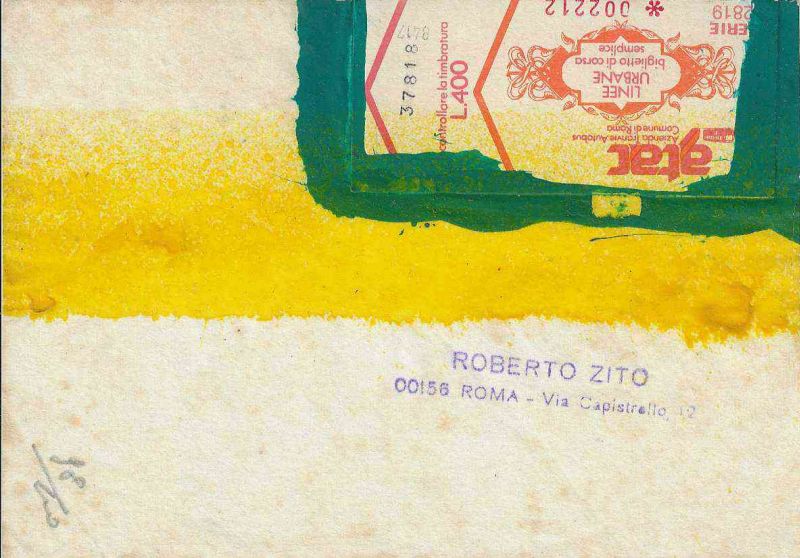
BIOGRAFIA EM PORTUGUÊSRoberto Zito é artista italiano nascido em Palermo, Sicília, com atuação desenvolvida principalmente entre Palermo, Roma e posteriormente Simbario, na Calábria. Pintor, gravador, ceramista, cenógrafo, performer, artista postal, editor e organizador de projetos de comunicação artística, formou se na Accademia di Belle Arti de Palermo. Sua trajetória atravessa pintura, gravura, cerâmica, cenografia, performance, arte ecológica, publicação independente e Mail Art. A partir da década de 1970 estabeleceu em Roma uma atividade especialmente importante para a história das redes internacionais de arte postal. O endereço Via Capistrello 12, Scala A, interno 4, 00156 Roma, Itália, aparece documentado em arquivos internacionais de Mail Art associado diretamente a Roberto Zito e às suas iniciativas.A data exata de nascimento de Roberto Zito não foi localizada com segurança nas fontes consultadas. A documentação biográfica confirma Palermo como local de nascimento e registra sua formação artística na Accademia di Belle Arti da cidade. Sua atividade inicial esteve relacionada principalmente à pintura. Em 1968 participou da primeira edição da manifestação Pittura murale Via Cerda, organizada pela Galleria Libreria Flaccovio de Palermo, experiência pública que antecede sua posterior preocupação com arte, território e intervenção social.Em 1970 Roberto Zito transferiu se para Roma, onde passou a participar de exposições individuais e coletivas. Sua permanência na capital italiana foi decisiva para o desenvolvimento posterior de pesquisas que ultrapassaram os limites da pintura tradicional. Roma tornou se seu principal ponto de contato com artistas, correspondentes e redes internacionais de comunicação experimental.Uma das contribuições mais importantes de Zito para a história da Mail Art ocorreu em 1977 e 1978 com o projeto Send back the envelope with written or graphic material, associado ao International Historical Archives of Mail Art Agency, em Roma. O projeto solicitava que participantes devolvessem envelopes contendo material escrito ou gráfico, transformando o próprio circuito postal em instrumento de criação, comunicação e documentação. A iniciativa está registrada no Network Atlas de Géza Perneczky como atividade de Roberto Zito em Roma e constitui evidência de sua inserção precoce nas redes internacionais de arte postal.Outro projeto registrado desse período é Send 3 colours selfportraits, de 1978. A estrutura baseada em convite e resposta internacional corresponde ao funcionamento característico da Mail Art, no qual artistas recebem instruções, realizam intervenções e devolvem seus trabalhos através da correspondência. O interesse de Zito não se limitava ao objeto recebido. Sua concepção de arte postal enfatizava principalmente a relação estabelecida entre pessoas, o fluxo de comunicação e a possibilidade de formar uma cultura alternativa à institucionalização artística.Durante os anos seguintes, Zito consolidou uma presença significativa na rede internacional. O seu nome aparece ao lado de artistas de numerosos países em arquivos, publicações e projetos de Mail Art. Em 1983, por exemplo, está documentado entre os participantes relacionados à publicação Bambù, de Ubaldo Giacomucci, em uma ampla rede que incluía Carlo Pittore, Guy Bleus, Serse Luigetti, Ruggero Maggi, Shozo Shimamoto, Ryosuke Cohen, Henning Mittendorf e muitos outros artistas postais.Documentação internacional de 1985 registra Roberto Zito no endereço Via Capistrello 12, Scala A, interno 4, Roma, código postal 00156. Esse dado é particularmente relevante para identificação catalográfica porque permite relacionar correspondências, envelopes, cartões, publicações e convites contendo esse endereço ao artista Roberto Zito da rede italiana de Mail Art.O endereço também aparece associado à Mail Art Agency e a materiais de circulação internacional. Documentação preservada relacionada à correspondência de Guillermo Deisler registra em 1986 a identificação Mail Art Agency número 1, aos cuidados de Roberto Zito, Via Capistrello 12, 00156 Roma. Esse registro estabelece uma ligação concreta entre Zito e o artista chileno Guillermo Deisler, um dos principais representantes latino americanos da poesia visual, arte postal e livro de artista.Zito também desenvolveu intensa atividade editorial. Vittore Baroni registra entre as revistas de montagem e publicações de Mail Art italianas a Mail Art Magazine de Roberto Zito, situando a publicação entre iniciativas independentes que transformavam a correspondência recebida em revistas, compilações, informações sobre exposições, listas de contatos e redes alternativas de distribuição. Nesse ambiente editorial, Zito aparece junto a experiências como Mailartspace International de Romano Peli e Michaela Versari, Bambù de Ubaldo Giacomucci, Sign Post de Serse Luigetti e outras publicações fundamentais para a comunicação entre artistas antes da difusão da internet.Outra publicação fundamental relacionada à sua atividade foi LLRRR. A documentação internacional registra que a revista teve aproximadamente dez anos de existência e reuniu importantes artistas da Mail Art mundial. Em entrevista concedida a Luca Miti em 1996 e posteriormente publicada no contexto de Assembling Magazines. International Networking Collaborations, Roberto Zito refletiu criticamente sobre os limites e as transformações da arte postal. Para ele, o elemento essencial da Mail Art não era simplesmente organizar exposições de envelopes, mas estabelecer correspondência e comunicação entre pessoas. Sua reflexão demonstra que entendia a arte postal como estrutura relacional e alternativa cultural, e não apenas como gênero visual.Essa posição é central para compreender sua importância histórica. Zito considerava válida a ideia de uma rede artística alternativa à cultura oficial mesmo quando reconhecia transformações ou crises no movimento. Em sua concepção, a correspondência, a troca e a relação entre participantes permaneciam como princípios fundamentais. Essa perspectiva aproxima sua prática da noção de network art e das experiências pós Fluxus baseadas em sistemas descentralizados de comunicação.A dimensão performática de sua produção também se tornou importante. A partir da década de 1980 passou a dedicar se intensamente à Mail Art e às performances que denominava Blitz. Paralelamente manteve pintura, gravura, cerâmica e cenografia. Suas ações e obras passaram a abordar especialmente questões ecológicas e as relações entre arte e natureza, configurando uma produção de caráter crítico e de denúncia.A preocupação ecológica relaciona Roberto Zito a um conjunto mais amplo de artistas postais italianos que utilizaram as redes internacionais para discutir meio ambiente, território, guerra, paz, política e transformação social. Sua participação no projeto Salva la Campagna Romana, de 1982, está documentada em material relacionado a uma exposição internacional de Mail Art voltada à preservação da paisagem e do território romano.A dimensão internacional de sua atividade pode ser observada também em projetos posteriores. Zito aparece na documentação do Ray Johnson Project, Amazon, de 1987, em uma rede internacional que incluía Guillermo Deisler, Gilberto Prado, Jorge Caraballo, Ruggero Maggi, Ryosuke Cohen, Shozo Shimamoto, Guy Bleus e dezenas de outros artistas. Essa participação demonstra sua integração a um circuito internacional de Mail Art que atravessava Europa, América Latina, América do Norte e Ásia.Na década de 1990 seu nome continua documentado em projetos internacionais. Registros de 1994 e 1995 mantêm Roberto Zito no endereço de Via Capistrello 12 em Roma, demonstrando continuidade da utilização do endereço como ponto de contato artístico. Sua participação também é registrada em publicações e projetos de Mail Art do período.Em janeiro de 1996, Roberto Zito esteve associado à revista Harta Performing e ao projeto Commonpress Italian performing arts, evidenciando a ligação entre sua atuação postal e a performance. Commonpress foi uma estrutura editorial descentralizada histórica da Mail Art, na qual diferentes artistas assumiam sucessivamente a edição de números temáticos. A ocorrência de Zito nesse contexto amplia sua documentação como artista interessado tanto no intercâmbio postal quanto na ação performática.A entrevista realizada por Luca Miti em 1996 constitui uma das fontes teóricas mais importantes sobre sua concepção da Mail Art. O depoimento foi posteriormente referenciado por Géza Perneczky no Network Atlas e em estudos acadêmicos sobre arte postal. Nele Zito diferencia de maneira explícita a simples exposição de envelopes da essência comunicacional da Mail Art. Para sua concepção artística, correspondência e relação humana constituíam o núcleo do sistema.Sua trajetória posterior manteve o eixo ecológico. Em 2007 uma apresentação de sua exposição L?incanto perduto descreveu Roberto Zito como artista nascido em Palermo, formado na Accademia di Belle Arti local e residente entre Roma e Simbario, na Calábria. O texto registra pintura, gravura, cerâmica e cenografia como componentes de sua formação e produção, assim como Mail Art e performances Blitz desde os anos 1980. A arte de Zito é apresentada nessa documentação como uma prática de denúncia ecológica voltada à reflexão sobre as relações entre arte e natureza.A produção de Roberto Zito encontra se também documentada em arquivos históricos internacionais dedicados à Mail Art. O Network Atlas de Géza Perneczky preserva endereço, projetos e entrevista. O Lomholt Mail Art Archive registra sua presença em redes editoriais. Documentação ligada à correspondência de Guillermo Deisler preserva referências à Mail Art Agency de Roma. Publicações e arquivos contemporâneos dedicados à história da arte postal continuam registrando seu nome entre participantes internacionais.Sua relação com o Poema Processo brasileiro não deve ser apresentada como filiação formal. Não foi localizada documentação confiável demonstrando participação de Roberto Zito no movimento Poema Processo. Sua relevância para esse campo de pesquisa decorre das redes internacionais de Mail Art, poesia visual, publicação de artista e comunicação alternativa nas quais circulavam simultaneamente artistas europeus e latino americanos. A relação documental de Zito com Guillermo Deisler e sua presença em circuitos que incluíam artistas brasileiros como Gilberto Prado demonstram pontos concretos de conexão com a América Latina.Roberto Zito ocupa portanto posição relevante na história da Mail Art italiana especialmente como artista, editor, organizador de rede e produtor de reflexão crítica sobre a própria natureza da arte postal. Sua atividade em Roma, particularmente através de Via Capistrello 12, da International Historical Archives of Mail Art Agency, da Mail Art Magazine, de LLRRR, de projetos participativos e de performances Blitz, contribuiu para transformar correspondência e comunicação em práticas artísticas. Sua produção deve ser estudada simultaneamente no campo da Mail Art, performance, arte ecológica, publicação experimental e network art.
English
BIOGRAPHY IN ENGLISHRoberto Zito is an Italian artist born in Palermo, Sicily, whose activities developed principally between Palermo, Rome and later Simbario in Calabria. A painter, printmaker, ceramic artist, stage designer, performer, mail artist, editor and organizer of artistic communication projects, he trained at the Accademia di Belle Arti in Palermo. His practice encompasses painting, printmaking, ceramics, stage design, performance, ecological art, independent publishing and Mail Art. From the 1970s onward he established in Rome an especially important presence within the history of international postal art networks. The address Via Capistrello 12, Scala A, interno 4, 00156 Rome, Italy, is documented in international Mail Art archives in direct association with Roberto Zito and his activities.Roberto Zito's exact date of birth was not reliably located in the consulted sources. Biographical documentation confirms Palermo as his birthplace and records his artistic education at the Accademia di Belle Arti there. His early practice was primarily related to painting. In 1968 he participated in the first edition of Pittura murale Via Cerda, organized by Galleria Libreria Flaccovio in Palermo, an early public intervention preceding his later concern with art, territory and social engagement.In 1970 Zito moved to Rome, where he participated in solo and group exhibitions. His relocation to the Italian capital was decisive for the later development of practices extending beyond traditional painting. Rome became his principal point of contact with artists, correspondents and international networks of experimental communication.One of Zito's most significant contributions to Mail Art history occurred in 1977 and 1978 through the project Send back the envelope with written or graphic material, associated with the International Historical Archives of Mail Art Agency in Rome. Participants were invited to return envelopes containing written or graphic material, transforming the postal circuit itself into an instrument of creation, communication and documentation. The project is recorded in Géza Perneczky's Network Atlas as an activity by Roberto Zito in Rome and constitutes evidence of his early involvement in international Mail Art networks.Another documented project from this period is Send 3 colours selfportraits from 1978. Its structure of invitation and international response corresponds to the characteristic operation of Mail Art, in which participants received instructions, created interventions and returned their work through correspondence. Zito's interest extended beyond the received object itself. His understanding of Mail Art emphasized relationships between people, communication flow and the possibility of establishing an alternative culture outside conventional artistic institutions.During the following years Zito established a significant presence within the international network. His name appears alongside artists from numerous countries in Mail Art archives, publications and projects. In 1983, for example, he is documented among participants associated with the publication Bambù by Ubaldo Giacomucci, within an extensive network including Carlo Pittore, Guy Bleus, Serse Luigetti, Ruggero Maggi, Shozo Shimamoto, Ryosuke Cohen, Henning Mittendorf and many other mail artists.International documentation from 1985 records Roberto Zito at Via Capistrello 12, Scala A, interno 4, Rome, postal code 00156. This information is especially important for archival identification because correspondence, envelopes, postcards, publications and invitations carrying this address can be connected with Roberto Zito and the Italian Mail Art network.The same address is documented in connection with Mail Art Agency and materials circulating internationally. Documentation preserved in relation to the correspondence of Chilean artist Guillermo Deisler records in 1986 the identification Mail Art Agency number 1, care of Roberto Zito, Via Capistrello 12, 00156 Rome. This establishes a concrete documentary relationship between Zito and Guillermo Deisler, a major Latin American figure in visual poetry, Mail Art and artists books.Zito also developed significant editorial activity. Vittore Baroni records Roberto Zito's Mail Art Magazine among Italian assembling magazines and independent Mail Art publications. Such publications transformed incoming correspondence into magazines, compilations, information about exhibitions, contact lists and alternative forms of distribution. Zito's publication existed within an environment that also included Mailartspace International by Romano Peli and Michaela Versari, Bambù by Ubaldo Giacomucci, Sign Post by Serse Luigetti and other initiatives essential to artistic networking before the internet.Another fundamental publication associated with his activity was LLRRR. International documentation records that the magazine existed for approximately ten years and involved important mail artists from around the world. In an interview with Luca Miti conducted in 1996 and later published in the context of Assembling Magazines. International Networking Collaborations, Roberto Zito critically reflected on the limits and transformations of Mail Art. He argued that the essential element of Mail Art was not merely the organization of exhibitions of envelopes but correspondence and communication between people. His position demonstrates an understanding of postal art as a relational structure and alternative culture rather than simply a visual genre.This position is central to understanding his historical importance. Zito continued to regard the concept of an artistic network alternative to official culture as valid even while acknowledging transformations and crises within the movement. Correspondence, exchange and human relationships remained fundamental principles in his conception of Mail Art. This perspective connects his practice with network art and post Fluxus experiments based on decentralized systems of communication.Performance also became a significant dimension of his work. From the 1980s onward he devoted substantial activity to Mail Art and performances that he called Blitz. At the same time he continued painting, printmaking, ceramics and stage design. His actions and artworks increasingly addressed ecological concerns and the relationship between art and nature, developing a critical practice concerned with environmental issues.This ecological interest connects Roberto Zito with a broader group of Italian mail artists who used international networks to address the environment, territory, war, peace, politics and social transformation. His participation in Salva la Campagna Romana in 1982 is documented through materials concerning an international Mail Art exhibition focused on the preservation of the Roman landscape and territory.The international extent of his activities is also visible in later projects. Zito appears in documentation concerning the Ray Johnson Project, Amazon, in 1987, within an international network including Guillermo Deisler, Gilberto Prado, Jorge Caraballo, Ruggero Maggi, Ryosuke Cohen, Shozo Shimamoto and Guy Bleus. This participation demonstrates his integration into a Mail Art network connecting Europe, Latin America, North America and Asia.During the 1990s his name remained documented in international projects. Records from 1994 and 1995 continue to identify Roberto Zito at Via Capistrello 12 in Rome, indicating sustained use of this address as an artistic contact point. His participation also appears in Mail Art publications and projects from this period.In January 1996 Roberto Zito was associated with Harta Performing and the Commonpress Italian performing arts project, demonstrating the intersection between his postal activity and performance. Commonpress was historically a decentralized Mail Art publishing structure in which different artists successively assumed responsibility for thematic issues. Zito's presence in this context further documents his interest in both postal exchange and performance practice.The interview conducted by Luca Miti in 1996 is one of the most significant theoretical sources concerning Zito's understanding of Mail Art. It was subsequently cited by Géza Perneczky in the Network Atlas and in academic studies of postal art. Zito distinguished the mere exhibition of envelopes from what he considered the communicational essence of Mail Art. Correspondence and human relationships formed the core of the system in his artistic conception.His later career maintained its ecological orientation. In 2007 documentation related to the exhibition L?incanto perduto described Roberto Zito as an artist born in Palermo, trained at the local Accademia di Belle Arti and living between Rome and Simbario in Calabria. The text identifies painting, printmaking, ceramics and stage design as components of his practice, together with Mail Art and Blitz performances from the 1980s onward. His art was described as a critical practice concerned with ecological issues and relationships between art and nature.Roberto Zito's activities are preserved in international historical archives devoted to Mail Art. Géza Perneczky's Network Atlas documents his address, projects and interview. The Lomholt Mail Art Archive records his participation in editorial networks. Documentation concerning Guillermo Deisler preserves references to the Mail Art Agency in Rome. Contemporary archives and publications devoted to the history of Mail Art continue to include his name among international participants.His relationship with the Brazilian Process Poem Movement should not be represented as formal membership. No reliable documentation was located confirming Roberto Zito as a participant in Poema Processo. His relevance to this research field derives instead from the international networks of Mail Art, visual poetry, artists publications and alternative communication in which European and Latin American artists circulated simultaneously. His documented relationship with Guillermo Deisler and his presence in networks also involving Brazilian artist Gilberto Prado provide concrete connections with Latin America.Roberto Zito therefore occupies a significant position in Italian Mail Art history as an artist, editor, network organizer and producer of critical reflection on the nature of postal art itself. His activities in Rome, especially through Via Capistrello 12, the International Historical Archives of Mail Art Agency, Mail Art Magazine, LLRRR, participatory projects and Blitz performances, contributed to transforming correspondence and communication into artistic practices. His work should be studied simultaneously within Mail Art, performance, ecological art, experimental publishing and network art.
Currículo
CURRÍCULO EM PORTUGUÊSIDENTIFICAÇÃONome principalRoberto ZitoNacionalidadeItalianaLocal de nascimentoPalermo, Sicília, ItáliaData de nascimentoNão localizada nas fontes consultadasCidades e lugares de atuação documentadosPalermoRomaSimbario, CalábriaEndereço histórico de Mail ArtVia Capistrello 12Scala A, interno 400156 RomaItáliaO endereço está documentado internacionalmente associado a Roberto Zito a partir das redes de Mail Art.ÁREAS DE ATUAÇÃOPinturaGravuraCerâmicaCenografiaMail ArtArte postalPerformancePerformance BlitzArte ecológicaNetwork artPublicação experimentalRevistas de Mail ArtArte de correspondênciaProjetos participativosOrganização de redes artísticasFORMAÇÃOAccademia di Belle Arti di PalermoPalermoItáliaFormação artística documentada.ATUAÇÃO INICIAL1968Pittura murale Via CerdaPrimeira ediçãoPalermoOrganizaçãoGalleria Libreria FlaccovioParticipação de Roberto Zito.1970Transferência para RomaA partir desse período desenvolve exposições individuais e coletivas na cidade.MAIL ART E PROJETOS DE CORRESPONDÊNCIA1977 a 1978Send back the envelope with written or graphic materialInternational Historical Archives of Mail Art AgencyRomaItáliaProjeto internacional de Mail Art baseado no envio e retorno de envelopes contendo material textual ou gráfico.1978Send 3 colours selfportraitsProjeto participativo internacionalRoberto ZitoRomaItália.1982Salva la Campagna RomanaProjeto ou exposição internacional de Mail ArtRomaParticipação documentada de Roberto ZitoTema relacionado à preservação da Campagna Romana.1983BambùPublicação ou rede de Mail Art organizada por Ubaldo GiacomucciParticipação documentada de Roberto Zito ao lado de artistas internacionais como Guy Bleus, Carlo Pittore, Serse Luigetti, Ruggero Maggi, Shozo Shimamoto e Ryosuke Cohen.1985Roberto Zito documentado no Network Atlas com o endereçoVia Capistrello 12Scala A, interno 400156 RomaItália.1986Mail Art Agency número 1Aos cuidados de Roberto ZitoVia Capistrello 1200156 RomaRegistro preservado em documentação relacionada à correspondência de Guillermo Deisler.1987Ray Johnson ProjectAmazonProjeto internacional de Mail ArtRoberto Zito documentado entre participantes de ampla rede internacional que incluía Guillermo Deisler, Gilberto Prado, Jorge Caraballo, Ruggero Maggi, Guy Bleus, Shozo Shimamoto e Ryosuke Cohen.PUBLICAÇÕES E ATIVIDADE EDITORIALMail Art MagazineEditor ou responsávelRoberto ZitoItáliaPublicação de arte postal identificada por Vittore Baroni entre revistas de montagem e publicações independentes da rede italiana de Mail Art.LLRRRRevista ligada a Roberto Zito e às redes internacionais de Mail ArtPeríodo aproximado documentadoCerca de dez anos de atividadeParticipação internacional de artistas da rede de Mail Art.1996Harta PerformingCommonpress Italian performing artsRoberto Zito documentado em relação à publicação e à performance.ENTREVISTAS E TEXTOS DOCUMENTAIS1996Entrevista com Roberto ZitoEntrevistadorLuca MitiTemaMail Art, comunicação, correspondência, cultura alternativa e transformação do movimento de arte postalPublicação posteriorAssembling Magazines. International Networking CollaborationsStephen PerkinsSubspaceIowa City1996Impressão registrada em 1997Páginas 25 a 27 segundo referência do Network Atlas.PERFORMANCEDécada de 1980 em diantePerformances denominadas BlitzRoberto Zito desenvolve ações performáticas paralelamente à pintura, Mail Art, gravura, cerâmica e cenografia.ARTE E ECOLOGIADécada de 1980 em dianteDesenvolvimento de produção de denúncia relacionada a questões ecológicas e às relações entre arte e natureza.2007L?incanto perdutoExposição documentada em texto biográfico publicado em março de 2007A apresentação identifica Roberto Zito como artista nascido em Palermo, formado na Accademia di Belle Arti, residente entre Roma e Simbario e ativo em pintura, gravura, cerâmica, cenografia, Mail Art e performances Blitz.ARQUIVOS E FUNDOS DOCUMENTAISNetwork AtlasGéza PerneczkySoft GeometryColôniaDocumenta Roberto Zito, seu endereço em Via Capistrello 12, projetos de Mail Art e entrevista de 1996.Lomholt Mail Art ArchiveDocumenta Roberto Zito em redes internacionais de Mail Art, incluindo Bambù.Arquivo relacionado a Guillermo DeislerPreserva documentação da Mail Art Agency aos cuidados de Roberto Zito em Roma em 1986.Ray Johnson ProjectDocumentação contemporânea preserva Roberto Zito entre participantes internacionais do projeto Amazon de 1987.RELAÇÕES ARTÍSTICAS E DOCUMENTAISGuillermo DeislerRelação documental através da Mail Art Agency e redes internacionais de arte postal.Ruggero MaggiPresença conjunta em redes e projetos internacionais de Mail Art.Guy BleusPresença conjunta em redes internacionais de arte postal.Shozo ShimamotoPresença conjunta em projetos internacionais de Mail Art.Ryosuke CohenPresença conjunta em documentação internacional da rede postal.Carlo PittorePresença conjunta no circuito internacional de Mail Art e em documentação relacionada a Salva la Campagna Romana.Ubaldo GiacomucciRelação através da publicação Bambù.Vittore BaroniBaroni documenta a Mail Art Magazine de Roberto Zito no contexto das publicações italianas de arte postal.Luca MitiEntrevistador de Roberto Zito em 1996 sobre a história, natureza e transformação da Mail Art.Gilberto PradoPresença conjunta no Ray Johnson Project, Amazon, 1987, constituindo um ponto documental de relação com o circuito brasileiro de arte e comunicação.RELAÇÃO COM O POEMA PROCESSONão foi localizada comprovação documental de participação formal de Roberto Zito no Poema Processo brasileiro.Sua relação com o campo de pesquisa do Poema Processo deve ser estabelecida por meio das redes internacionais de Mail Art, poesia visual, publicação experimental, performance e comunicação alternativa.A relação documental com Guillermo Deisler, artista chileno fundamental para a poesia visual e arte postal latino americana, e sua presença em redes que incluíram o brasileiro Gilberto Prado demonstram a inserção de Zito em circuitos internacionais compartilhados entre Europa e América Latina.CRONOLOGIA1968Participação em Pittura murale Via Cerda, Palermo.1970Transferência para Roma.1977 a 1978Projeto Send back the envelope with written or graphic material.International Historical Archives of Mail Art Agency, Roma.1978Projeto Send 3 colours selfportraits.1982Participação em Salva la Campagna Romana.Década de 1980Intensificação da atividade em Mail Art e início das performances Blitz.Desenvolvimento de pesquisas ecológicas.1983Participação documentada na rede Bambù.1985Documentação do endereço Via Capistrello 12, Roma, no circuito internacional de Mail Art.1986Mail Art Agency número 1 aos cuidados de Roberto Zito em Via Capistrello 12.1987Participação no Ray Johnson Project, Amazon.Décadas de 1980 e 1990Atividade editorial relacionada à Mail Art Magazine e LLRRR.1994Continuidade documental do endereço Via Capistrello 12 em redes artísticas internacionais.1995Continuidade do endereço de Roma em documentação expositiva.1996Entrevista concedida a Luca Miti sobre Mail Art.Participação documentada em Harta Performing e Commonpress Italian performing arts.1997Publicação impressa da entrevista de Roberto Zito no contexto de Assembling Magazines. International Networking Collaborations.2007L?incanto perduto.Documentação biográfica registra atuação entre Roma e Simbario e continuidade de sua pesquisa sobre arte, natureza e ecologia.
English
CURRICULUM IN ENGLISHIDENTIFICATIONPrimary nameRoberto ZitoNationalityItalianPlace of birthPalermo, Sicily, ItalyDate of birthNot located in the sources consultedDocumented cities and places of activityPalermoRomeSimbario, CalabriaHistorical Mail Art addressVia Capistrello 12Scala A, interno 400156 RomeItalyThe address is internationally documented in direct association with Roberto Zito and Mail Art networks.FIELDS OF ACTIVITYPaintingPrintmakingCeramicsStage designMail ArtPostal artPerformanceBlitz performanceEcological artNetwork artExperimental publishingMail Art magazinesCorrespondence artParticipatory projectsArt network organizationEDUCATIONAccademia di Belle Arti di PalermoPalermoItalyDocumented artistic education.EARLY ACTIVITIES1968Pittura murale Via CerdaFirst editionPalermoOrganized by Galleria Libreria FlaccovioParticipation by Roberto Zito.1970Moved to RomeFrom this period onward he participated in solo and group exhibitions in the city.MAIL ART AND CORRESPONDENCE PROJECTS1977 to 1978Send back the envelope with written or graphic materialInternational Historical Archives of Mail Art AgencyRomeItalyInternational Mail Art project based on sending and returning envelopes containing written or graphic material.1978Send 3 colours selfportraitsInternational participatory projectRoberto ZitoRomeItaly.1982Salva la Campagna RomanaInternational Mail Art project or exhibitionRomeDocumented participation by Roberto ZitoProject concerned with preservation of the Roman countryside.1983BambùMail Art publication or network organized by Ubaldo GiacomucciRoberto Zito documented alongside international artists including Guy Bleus, Carlo Pittore, Serse Luigetti, Ruggero Maggi, Shozo Shimamoto and Ryosuke Cohen.1985Roberto Zito documented in the Network Atlas atVia Capistrello 12Scala A, interno 400156 RomeItaly.1986Mail Art Agency number 1Care of Roberto ZitoVia Capistrello 1200156 RomeRecord preserved in documentation associated with Guillermo Deisler's correspondence.1987Ray Johnson ProjectAmazonInternational Mail Art projectRoberto Zito documented within an international network also including Guillermo Deisler, Gilberto Prado, Jorge Caraballo, Ruggero Maggi, Guy Bleus, Shozo Shimamoto and Ryosuke Cohen.PUBLICATIONS AND EDITORIAL ACTIVITIESMail Art MagazineEditor or organizerRoberto ZitoItalyMail Art publication identified by Vittore Baroni among Italian assembling magazines and independent postal art publications.LLRRRMagazine associated with Roberto Zito and international Mail Art networksDocumented durationApproximately ten yearsInternational participation by artists from the Mail Art network.1996Harta PerformingCommonpress Italian performing artsRoberto Zito documented in relation to the publication and performance.INTERVIEWS AND HISTORICAL TEXTS1996Interview with Roberto ZitoInterviewerLuca MitiSubjectsMail ArtCommunicationCorrespondenceAlternative cultureTransformation of the postal art movementLater publicationAssembling Magazines. International Networking CollaborationsStephen PerkinsSubspaceIowa City1996Print publication recorded in 1997Pages 25 to 27 according to the Network Atlas reference.PERFORMANCEFrom the 1980s onwardPerformances called BlitzRoberto Zito developed performance actions alongside painting, Mail Art, printmaking, ceramics and stage design.ART AND ECOLOGYFrom the 1980s onwardDevelopment of a critical practice addressing ecological issues and relationships between art and nature.2007L?incanto perdutoExhibition documented in biographical material published in March 2007The presentation identifies Roberto Zito as born in Palermo, educated at the Accademia di Belle Arti, living between Rome and Simbario and active in painting, printmaking, ceramics, stage design, Mail Art and Blitz performances.ARCHIVES AND DOCUMENTARY FONDSNetwork AtlasGéza PerneczkySoft GeometryCologneDocuments Roberto Zito, his Via Capistrello 12 address, Mail Art projects and 1996 interview.Lomholt Mail Art ArchiveDocuments Roberto Zito within international Mail Art networks including Bambù.Documentation associated with Guillermo DeislerPreserves a record of the Mail Art Agency care of Roberto Zito in Rome in 1986.Ray Johnson Project documentationPreserves Roberto Zito among international participants in the Amazon project of 1987.DOCUMENTED ARTISTIC RELATIONSHIPSGuillermo DeislerDocumentary relationship through Mail Art Agency and international postal art networks.Ruggero MaggiShared presence in international Mail Art networks and projects.Guy BleusShared presence within international postal art networks.Shozo ShimamotoShared participation in international Mail Art projects.Ryosuke CohenShared presence in international postal art documentation.Carlo PittoreShared participation in international Mail Art networks and documentation connected with Salva la Campagna Romana.Ubaldo GiacomucciRelationship through the publication Bambù.Vittore BaroniBaroni documents Roberto Zito's Mail Art Magazine within the history of Italian postal art publications.Luca MitiInterviewed Roberto Zito in 1996 concerning the history, nature and transformation of Mail Art.Gilberto PradoShared participation in the Ray Johnson Project, Amazon, in 1987, providing a documentary connection with Brazilian artistic communication networks.RELATIONSHIP WITH THE PROCESS POEM MOVEMENTNo documentary evidence was located establishing Roberto Zito as a formal participant in the Brazilian Process Poem Movement.His relevance to Process Poem research derives instead from international Mail Art, visual poetry, experimental publishing, performance and alternative communication networks.His documented relationship with Guillermo Deisler, a central Chilean artist associated with Latin American visual poetry and Mail Art, and his presence in networks that also included Brazilian artist Gilberto Prado demonstrate Zito's participation in circuits connecting Europe and Latin America.CHRONOLOGY1968Participated in Pittura murale Via Cerda in Palermo.1970Moved to Rome.1977 to 1978Created Send back the envelope with written or graphic material.International Historical Archives of Mail Art Agency, Rome.1978Created Send 3 colours selfportraits.1982Participated in Salva la Campagna Romana.1980sExpanded his activities in Mail Art.Began developing performances called Blitz.Developed ecological research concerning relationships between art and nature.1983Documented participation in the Bambù network.1985Via Capistrello 12 in Rome documented as Roberto Zito's international Mail Art address.1986Mail Art Agency number 1 documented care of Roberto Zito at Via Capistrello 12.1987Participated in the Ray Johnson Project, Amazon.1980s and 1990sEditorial activities associated with Mail Art Magazine and LLRRR.1994Continued documentation of Via Capistrello 12 within international art networks.1995Continued use of the Rome address documented in exhibition materials.1996Interviewed by Luca Miti about Mail Art.Documented in Harta Performing and Commonpress Italian performing arts.1997Printed publication of the Roberto Zito interview in the context of Assembling Magazines. International Networking Collaborations.2007L?incanto perduto.Biographical documentation records his activities between Rome and Simbario and the continuation of his investigation into art, nature and ecology.