Aufruf zur Alternative - Call for the Alternative - Joseph Beuys (Ruth e Robert Rehfeld rede)
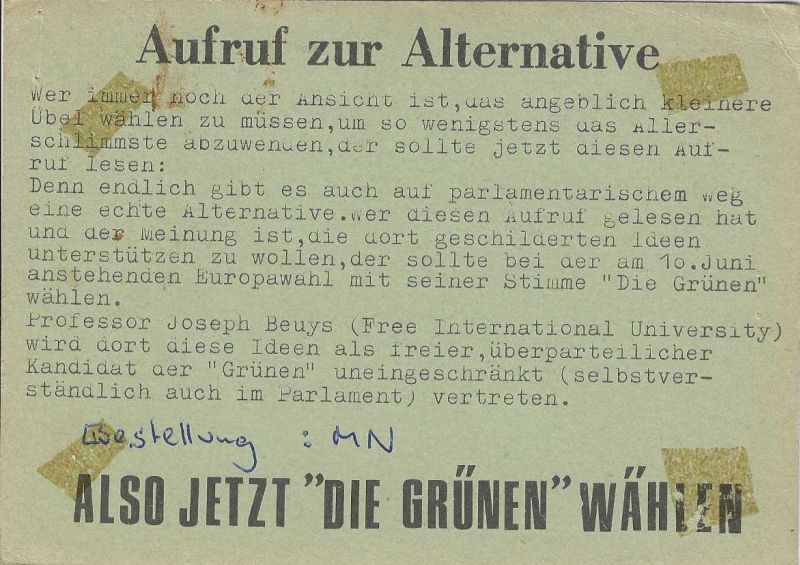 Aufruf zur Alternative é um documento político, artístico e conceitual associado a Joseph Beuys, produzido no contexto de sua atuação pública no final da década de 1970 e relacionado diretamente à Free International University, à sua concepção ampliada de arte, à escultura social e às propostas de transformação da sociedade por meio da criatividade, da participação e da ação política. A expressão Aufruf zur Alternative pode ser traduzida como Apelo por uma Alternativa. O título corresponde ao manifesto publicado por Joseph Beuys em 1978 e posteriormente difundido em diferentes formatos impressos. A Bayerische Staatsgemäldesammlungen preserva na coleção da Pinakothek der Moderne um exemplar de Joseph Beuys. Aufruf zur Alternative, de 1978, descrito como dois cartazes idênticos da Free International University, impressos nos dois lados, assinados e carimbados, editados por Edition Staeck em Heidelberg.O documento preservado no arquivo de Falves Silva apresenta uma configuração específica relacionada à campanha para a eleição do primeiro Parlamento Europeu. Na frente aparece o título Aufruf zur Alternative seguido por texto datilografado em alemão que convoca o leitor a abandonar a lógica política da escolha do mal menor e a considerar uma alternativa efetiva dentro do processo parlamentar. O texto afirma que aqueles que tivessem lido o apelo e concordassem com as ideias nele apresentadas deveriam apoiar Die Grünen na eleição europeia marcada para 10 de junho. O documento identifica Professor Joseph Beuys e a Free International University e apresenta Beuys como representante dessas ideias no contexto da candidatura ligada aos Verdes.Na parte inferior da frente aparece em grandes caracteres a frase Also jetzt Die Grünen wählen, convocação direta para votar nos Verdes. A eleição para o primeiro Parlamento Europeu ocorreu na Alemanha em 10 de junho de 1979. Os registros oficiais da Bundeswahlleiterin confirmam que Die Grünen recebeu 893.683 votos, equivalentes a 3,2 por cento dos votos válidos, sem conquistar representação parlamentar naquela eleição.A relação entre o documento e Joseph Beuys deve ser compreendida dentro de seu projeto artístico e social mais amplo. Joseph Beuys nasceu em 5 de dezembro de 1921 e morreu em 23 de janeiro de 1986. Sua produção atravessou desenho, escultura, instalação, performance, múltiplos, ação política, pedagogia e teoria social. A partir das décadas de 1960 e 1970, Beuys desenvolveu uma concepção ampliada da arte segundo a qual a criatividade humana poderia participar diretamente da transformação das estruturas sociais. Essa concepção tornou se conhecida principalmente por meio da ideia de escultura social.A Free International University for Creativity and Interdisciplinary Research foi fundada em 27 de abril de 1973 por Joseph Beuys, Georg Meistermann, Klaus Staeck e Willi Bongard. Sua criação estava ligada à defesa de formas alternativas de educação e ao entendimento da criatividade como capacidade potencialmente acessível a todas as pessoas. A instituição não se constituiu como universidade convencional com campus próprio. Desenvolveu atividades por meio de núcleos, discussões, projetos e espaços temporários, tornando se uma plataforma fundamental para a articulação entre as propostas pedagógicas, artísticas, sociais e políticas de Beuys.O exemplar relacionado a Falves Silva possui importância adicional porque seu verso demonstra uma segunda camada de circulação e apropriação. O cartão não deve ser catalogado automaticamente como correspondência enviada pessoalmente por Joseph Beuys. No verso aparece uma etiqueta com a identificação MEDIA NOVA, W. L. WENDT, Lehrter Strasse 19, D 2800 Bremen 33. Esta evidência indica que o material de Beuys foi utilizado posteriormente por W. L. Wendt ou pelo circuito editorial identificado como Media Nova para estabelecer comunicação com Falves Silva em Natal, Rio Grande do Norte, Brasil.A mensagem datilografada dirigida a Falves Silva começa com uma saudação informal e solicita contato e esclarecimentos relacionados a contribuições para publicações identificadas como MN 14 e MN 15. O texto menciona The eye associado a MN 14 e The flow of the day associado a MN 15, além de fazer referência a cinquenta exemplares de cada. O remetente informa que, sem contato posterior ou esclarecimento, não haveria nova entrega de material de MN para o Brasil. Essa correspondência transforma o objeto em documento de circulação editorial, arte postal e comunicação internacional entre Bremen e Natal.O verso apresenta ainda selo da Deutsche Bundespost no valor de 90 pfennig, carimbo postal parcialmente legível, anotações manuscritas em tinta azul e vermelha e a palavra Postkarte. O destinatário aparece identificado por etiqueta datilografada como Falves Silva, Eng. Jose Rocha No. 16, Candelaria, 59000 Natal RN Brasil. Há também uma inscrição manuscrita em vermelho que parece registrar uma data correspondente a 4 de março de 1980. Por essa razão, o objeto pode ser situado documentalmente entre a produção política de 1979 e sua circulação postal posterior, provavelmente em 1980.A peça preserva várias temporalidades simultâneas. O manifesto Aufruf zur Alternative pertence ao contexto de 1978. A adaptação eleitoral apresentada na frente refere se diretamente às eleições europeias de 10 de junho de 1979. O verso indica uma reutilização postal e editorial posterior, provavelmente em 1980. Assim, a classificação mais precisa distingue a origem intelectual e política do material, ligada a Joseph Beuys e à Free International University, do remetente da correspondência dirigida a Falves Silva, associado a W. L. Wendt e Media Nova.No contexto do arquivo de Falves Silva, este objeto é especialmente significativo porque documenta a interseção entre arte conceitual europeia, ativismo político, publicações alternativas e redes internacionais de arte postal. Embora Joseph Beuys não pertença ao movimento Poema Processo, o documento estabelece uma relação histórica indireta com o universo de Falves Silva por meio das estruturas internacionais de circulação que aproximaram artistas conceituais, poetas experimentais, editores independentes e participantes da Mail Art durante as décadas de 1970 e 1980.A importância documental do cartão está justamente na sobreposição entre obra gráfica, manifesto, propaganda política, correspondência, arte postal, publicação experimental e documento de arquivo. Sua presença no arquivo de Falves Silva comprova materialmente que Natal estava conectada a circuitos internacionais de comunicação artística provenientes da Alemanha. O objeto amplia, portanto, a compreensão das relações internacionais de Falves Silva e oferece evidência concreta da circulação transnacional de ideias, impressos e projetos entre arte conceitual europeia, poesia experimental brasileira e redes alternativas de comunicação.