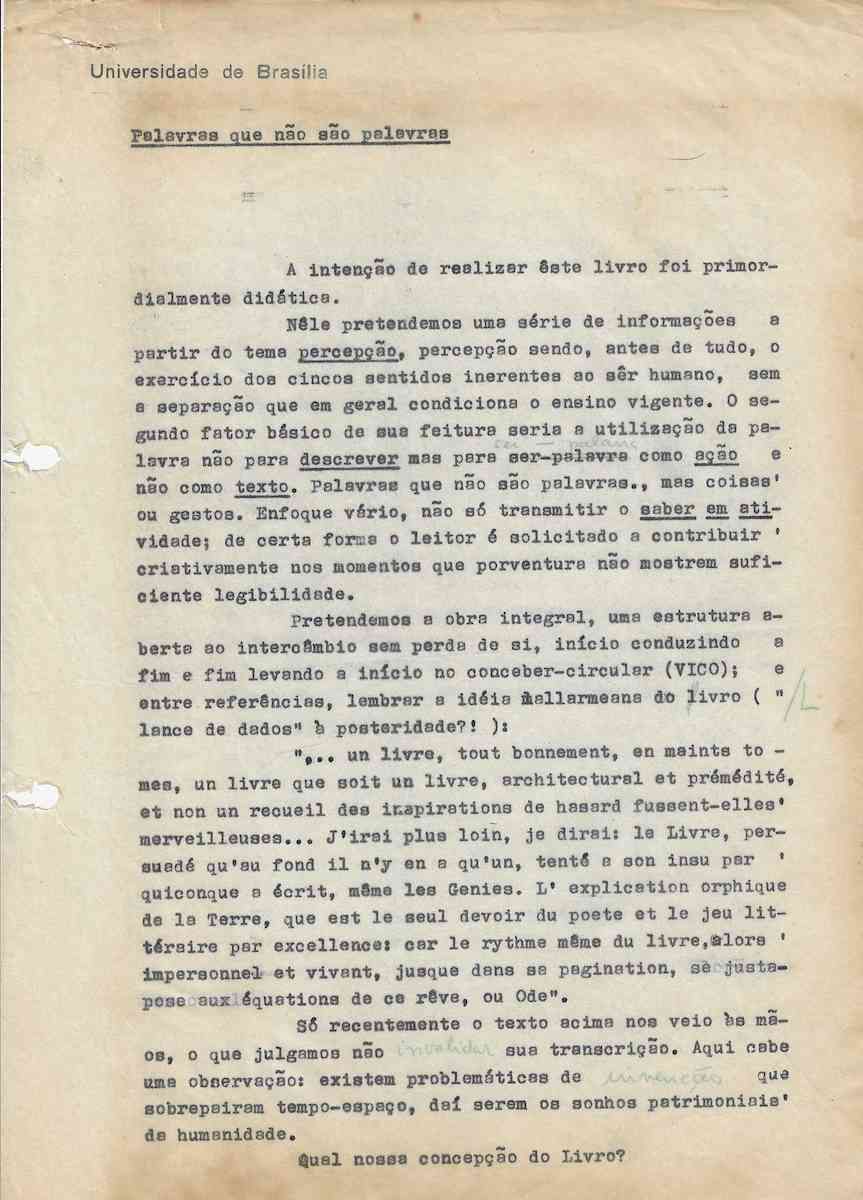
Texto datilografado original de Hugo Mund Jr. relacionado ao livro poema Palavras que não são palavras, vinculado à Universidade de Brasília.
Hugo Mund Jr.
Categoria: Texto Datiluscrito Original Autógrafo
Acervo: 04598
Data: 1969
Dimensões: 29 x 20,6 cm
Texto datilografado original de Hugo Mund Jr. relacionado ao livro poema Palavras que não são palavras, vinculado à Universidade de Brasília. O documento apresenta a formulação conceitual e pedagógica do projeto, concebido primordialmente como obra didática e experimental. Hugo Mund Jr. propõe partir do tema da percepção, entendida como percepção sensorial antes de tudo, buscando o exercício integrado dos cinco sentidos inerentes ao ser humano. A palavra é utilizada não para descrever, mas como ação, deixando de funcionar apenas como texto para tornar se elemento ativo da experiência. O autor define a proposta por meio da integração entre texto, imagem, tipografia, papel e espaço, formando aquilo que denomina objeto livro. A obra é concebida como estrutura aberta, capaz de estabelecer intercâmbio com o leitor e de integrar suas partes em uma totalidade orgânica. O texto afirma ainda a importância do artista e do poeta como participantes da organização social e como educadores e construtores de cultura em termos criativos. Como obra didática, Palavras que não são palavras é dedicada aos estudantes de arquitetura. Documento fundamental para compreender o pensamento de Hugo Mund Jr. sobre livro poema, objeto livro, poesia experimental, percepção, tipografia, imagem, arquitetura, educação e participação artística no contexto cultural brasileiro associado à Universidade de Brasília.
TEXTO SALSA EM INGLÊS
Original typewritten text by Hugo Mund Jr. related to the book poem Palavras que não são palavras and associated with the University of Brasília. The document presents the conceptual and pedagogical formulation of the project, conceived primarily as a didactic and experimental work. Hugo Mund Jr. proposes perception as a central theme, understood above all as sensory perception, seeking the integrated exercise of the five senses inherent to the human being. The word is used not to describe but as action, ceasing to function merely as text and becoming an active element of experience. The author defines the proposal through the integration of text, image, typography, paper and space, forming what he describes as a book object. The work is conceived as an open structure capable of establishing an exchange with the reader and integrating its parts into an organic totality. The text also emphasizes the importance of the artist and poet as participants in social organization and as educators and builders of culture in fundamentally creative terms. As a didactic work, Palavras que não são palavras is dedicated to architecture students. This document is fundamental for understanding the thinking of Hugo Mund Jr. concerning the book poem, book object, experimental poetry, perception, typography, image, architecture, education and artistic participation within the Brazilian cultural context associated with the University of Brasília.
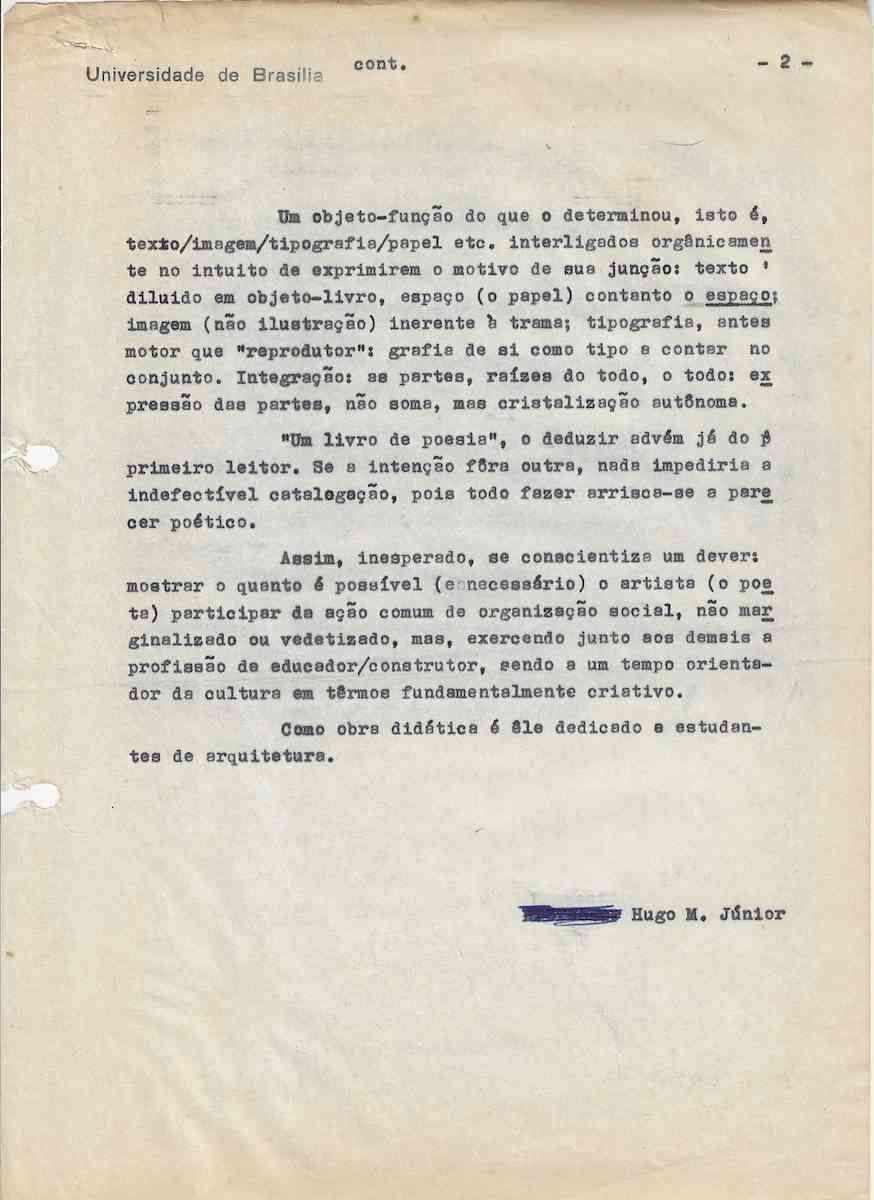
Conjunto formado por duas páginas de texto datilografado original de Hugo Mund Jr., identificado no cabeçalho pela Universidade de Brasília e pelo título Palavras que não são palavras. O documento funciona como texto programático, conceitual e explicativo da obra, permitindo compreender diretamente as intenções do autor na elaboração do livro poema.
Na primeira página, Hugo Mund Jr. declara que a intenção de realizar o livro foi primordialmente didática. O projeto pretende apresentar uma série de informações a partir do tema da percepção, destacando a percepção sensorial e o exercício integrado dos cinco sentidos. Essa proposta procura superar a separação tradicional entre os sentidos que, segundo o autor, condicionava o ensino vigente.
Outro princípio fundamental é a utilização da palavra não para descrever, mas para ser palavra como ação e não apenas como texto. A formulação evidencia uma concepção ativa da linguagem, na qual palavras podem transformar se em coisas, gestos e acontecimentos. O próprio título Palavras que não são palavras sintetiza essa investigação sobre os limites entre linguagem verbal, ação, percepção, imagem e objeto.
Hugo Mund Jr. afirma que pretende uma obra integral e uma estrutura aberta ao intercâmbio sem perda de identidade. O livro deveria conduzir o leitor de início a fim e novamente ao início, estabelecendo uma concepção de circulação e continuidade. O autor menciona também a possibilidade de repetição indefinida, relacionando essa estrutura ao pensamento sobre organização do livro, leitura e temporalidade.
No texto aparece uma reflexão sobre o livro como construção arquitetural e premeditada, contraposta à ideia de reunião casual de inspirações. Essa referência é importante para compreender a proximidade entre a concepção do livro e princípios de arquitetura, organização espacial, ritmo, paginação e estrutura.
Na segunda página, Hugo Mund Jr. responde diretamente à questão sobre sua concepção do livro. Define a obra como objeto função constituído por texto, imagem, tipografia, papel e outros elementos organicamente interligados. Esses componentes deveriam exprimir o motivo de sua junção.
O texto é concebido como diluído em objeto livro. O espaço corresponde ao papel e deve ser entendido como espaço ativo. A imagem não deve funcionar como simples ilustração, mas como elemento inerente à trama da obra. A tipografia é definida como força motora capaz de reproduzir graficamente sua própria presença e de participar da construção do conjunto.
O autor destaca que as partes devem integrar se em relação ao todo e o todo deve funcionar como expressão articulada das partes. Dessa forma, o livro não é compreendido como soma de elementos isolados, mas como cristalização autônoma. Essa formulação constitui um importante testemunho brasileiro sobre a transformação do livro tradicional em objeto artístico integrado.
O documento também questiona a classificação convencional de livro de poesia. Para Hugo Mund Jr., a identificação poética pode surgir da própria experiência do primeiro leitor. A afirmação amplia o conceito de poesia para além da estrutura literária tradicional e aproxima a obra dos campos da poesia experimental, poesia visual, livro de artista, livro objeto e arte conceitual.
Na parte final, Hugo Mund Jr. estabelece uma dimensão social e pedagógica para sua proposta. Defende a possibilidade e a necessidade de o artista e o poeta participarem da ação comum de organização social, não de maneira sinalizada ou revestida, mas exercendo junto aos demais a função de educador e construtor. O artista é apresentado como orientador da cultura em termos fundamentalmente criativos.
O documento termina informando que, como obra didática, Palavras que não são palavras é dedicado aos estudantes de arquitetura. Essa indicação fortalece a ligação da obra com a Universidade de Brasília e com debates sobre educação, arquitetura, percepção, comunicação visual, design, tipografia e integração das artes.
O texto datilografado possui correções, sublinhados, marcas manuscritas e intervenções gráficas que reforçam sua condição de documento original de trabalho. Na segunda página aparece a identificação Hugo M. Júnior. O conjunto possui importância documental por registrar diretamente o pensamento do autor e por fornecer uma fonte primária para o estudo de Palavras que não são palavras.
Para fins de pesquisa e indexação, o documento relaciona Hugo Mund Jr., Hugo M. Júnior, Universidade de Brasília, Palavras que não são palavras, livro poema, livro de artista, objeto livro, livro objeto, poesia experimental, poesia visual, percepção sensorial, cinco sentidos, palavra como ação, texto, imagem, tipografia, papel, espaço, arquitetura, estudantes de arquitetura, arte e educação, comunicação visual, design editorial, estrutura aberta, participação do leitor, cultura, organização social e experimentação artística brasileira.
TEXTO DE OBSERVAÇÃO EM INGLÊS
Set consisting of two pages of an original typewritten text by Hugo Mund Jr., identified in the heading by the University of Brasília and the title Palavras que não são palavras. The document functions as a programmatic, conceptual and explanatory text for the work and makes it possible to understand directly the intentions of the author in developing the book poem.
On the first page, Hugo Mund Jr. states that the intention behind the book was primarily didactic. The project seeks to present a series of information based on the theme of perception, emphasizing sensory perception and the integrated exercise of the five senses. This proposal attempts to overcome the traditional separation between the senses that, according to the author, conditioned the educational system of the period.
Another fundamental principle is the use of the word not to describe but to become word as action rather than merely text. This formulation reveals an active conception of language in which words may become things, gestures and events. The title Palavras que não são palavras itself synthesizes this investigation into the boundaries between verbal language, action, perception, image and object.
Hugo Mund Jr. states that he intends to create an integral work and an open structure capable of exchange without losing its identity. The book should conduct the reader from beginning to end and then once again toward the beginning, establishing a conception of circulation and continuity. The author also refers to the possibility of indefinite repetition, relating this structure to ideas concerning the organization of the book, reading and temporality.
The text includes a reflection on the book as an architectural and premeditated construction, opposed to the idea of a casual collection of inspirations. This reference is important for understanding the proximity between the conception of the book and principles of architecture, spatial organization, rhythm, pagination and structure.
On the second page, Hugo Mund Jr. directly answers the question concerning his conception of the book. He defines the work as an object function constituted by text, image, typography, paper and other elements organically interconnected. These components should express the reason for their conjunction.
The text is conceived as being diluted into the book object. Space corresponds to the paper and must be understood as an active space. The image should not function as simple illustration but as an element inherent to the structure of the work. Typography is defined as a driving force capable of graphically reproducing its own presence and participating in the construction of the whole.
The author emphasizes that the parts must be integrated in relation to the whole and that the whole must operate as an articulated expression of its parts. In this way, the book is not understood as a sum of isolated elements but as an autonomous crystallization. This formulation constitutes an important Brazilian testimony concerning the transformation of the traditional book into an integrated artistic object.
The document also questions the conventional classification of a poetry book. For Hugo Mund Jr., the poetic identification may emerge through the experience of the first reader. This statement expands the concept of poetry beyond traditional literary structure and brings the work closer to the fields of experimental poetry, visual poetry, artist books, book objects and conceptual art.
In the final section, Hugo Mund Jr. establishes a social and pedagogical dimension for his proposal. He argues for the possibility and necessity of the artist and poet participating in the common action of social organization, not through symbolic distinction but by exercising alongside others the role of educator and builder. The artist is presented as an orienting force of culture in fundamentally creative terms.
The document concludes by stating that, as a didactic work, Palavras que não são palavras is dedicated to architecture students. This indication strengthens the connection of the work with the University of Brasília and with debates concerning education, architecture, perception, visual communication, design, typography and the integration of the arts.
The typewritten document contains corrections, underlining, handwritten marks and graphic interventions that reinforce its status as an original working document. The second page includes the identification Hugo M. Júnior. The set has significant documentary importance because it directly records the authors thinking and provides a primary source for the study of Palavras que não são palavras.
For research and indexing purposes, the document connects Hugo Mund Jr., Hugo M. Júnior, University of Brasília, Palavras que não são palavras, book poem, artist book, book object, experimental poetry, visual poetry, sensory perception, five senses, word as action, text, image, typography, paper, space, architecture, architecture students, art and education, visual communication, editorial design, open structure, reader participation, culture, social organization and Brazilian artistic experimentation.
Proveniência
Coleção Hugo Mund Jr.Inglês
Original typewritten text by Hugo Mund Jr. related to the book poem Palavras que não são palavras and associated with the University of Brasília.
Dimensions: 11,4 x 8,1 in