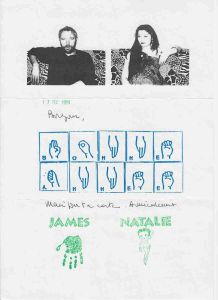
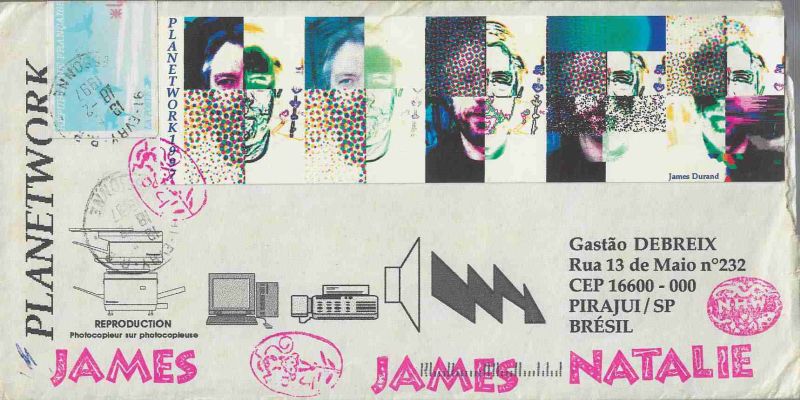
Envelope e carta obra de James Durand e Natalie Durand enviados a Gastão Debreix no início de 1997, concebidos como mensagem de Bonne Année 1997 e como peça de correspondência artística.
James Durand - França
Categoria: Mail Art
Acervo: 04597
Data: 18 de Fevereiro de 1997
Dimensões: 10,9 x 22 cm
Envelope e carta obra de James Durand e Natalie Durand enviados a Gastão Debreix no início de 1997, concebidos como mensagem de Bonne Année 1997 e como peça de correspondência artística. O conjunto articula fotografia, retrato, fotocópia, eletrografia, reprodução gráfica, carimbos, imagens técnicas, tipografia e apropriação de elementos postais, documentando a pesquisa de James Durand em torno da máquina copiadora e das tecnologias de reprodução da imagem.
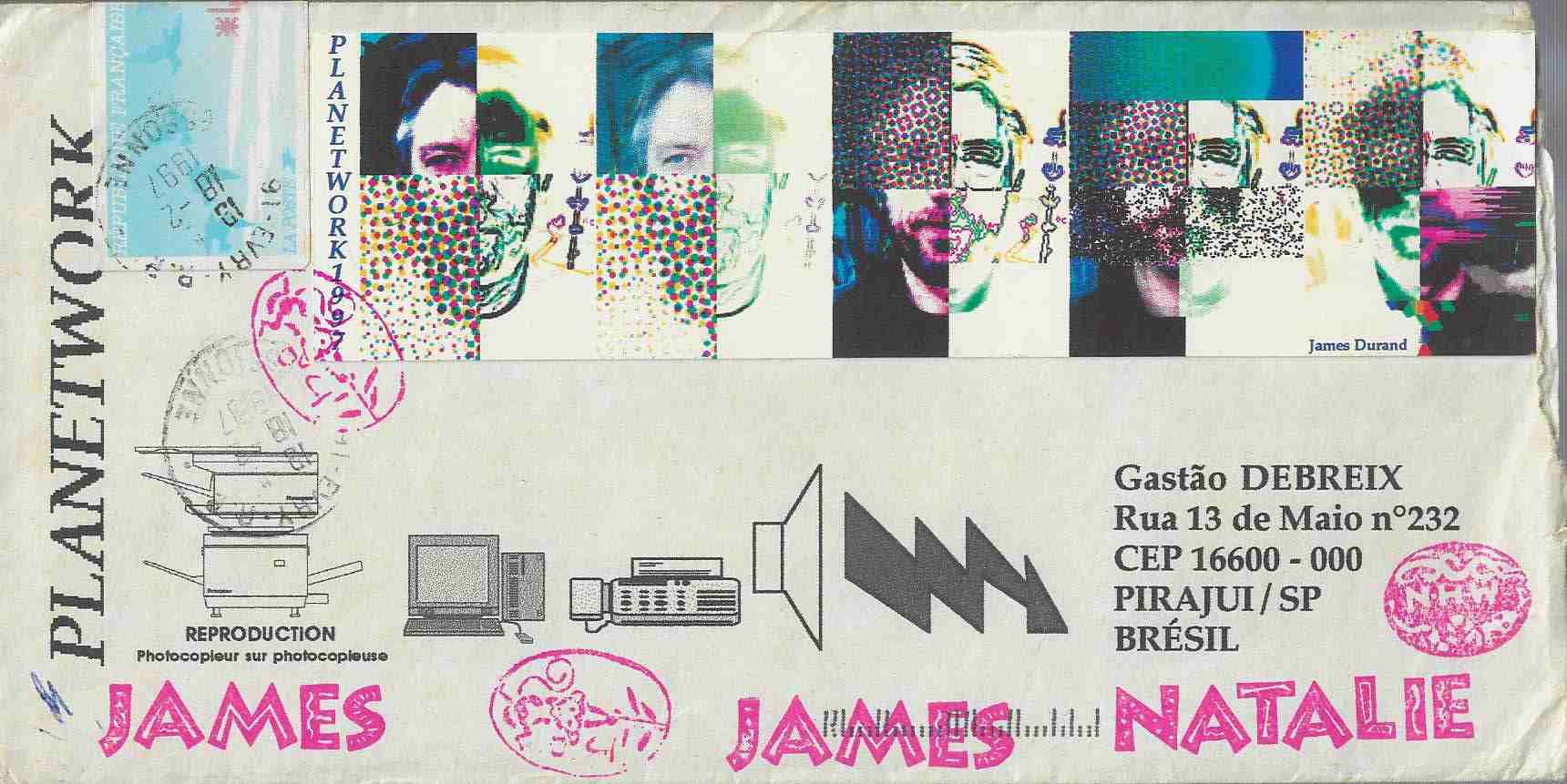
O envelope é tratado como parte integrante da obra. Na face destinada ao endereço de Gastão Debreix aparecem sucessivas imagens fragmentadas e modificadas do rosto de James Durand, impressões em cores, padrões gráficos e intervenções que exploram sobreposição, repetição e transformação da identidade fotográfica. O nome James Durand aparece junto à composição, enquanto a inscrição PLANETWORK 1997 estabelece uma referência à ideia de rede e circulação internacional.
Na parte inferior do envelope aparecem representações de uma máquina copiadora, de equipamentos eletrônicos e de comunicação, além de um símbolo gráfico relacionado à transmissão sonora. A palavra REPRODUCTION e a indicação Photocopieur sur photocopieuse reforçam explicitamente a relação da peça com a reprodução por copiadora. Os nomes JAMES e NATALIE aparecem em grandes carimbos rosa, acompanhados por outros carimbos e intervenções gráficas.
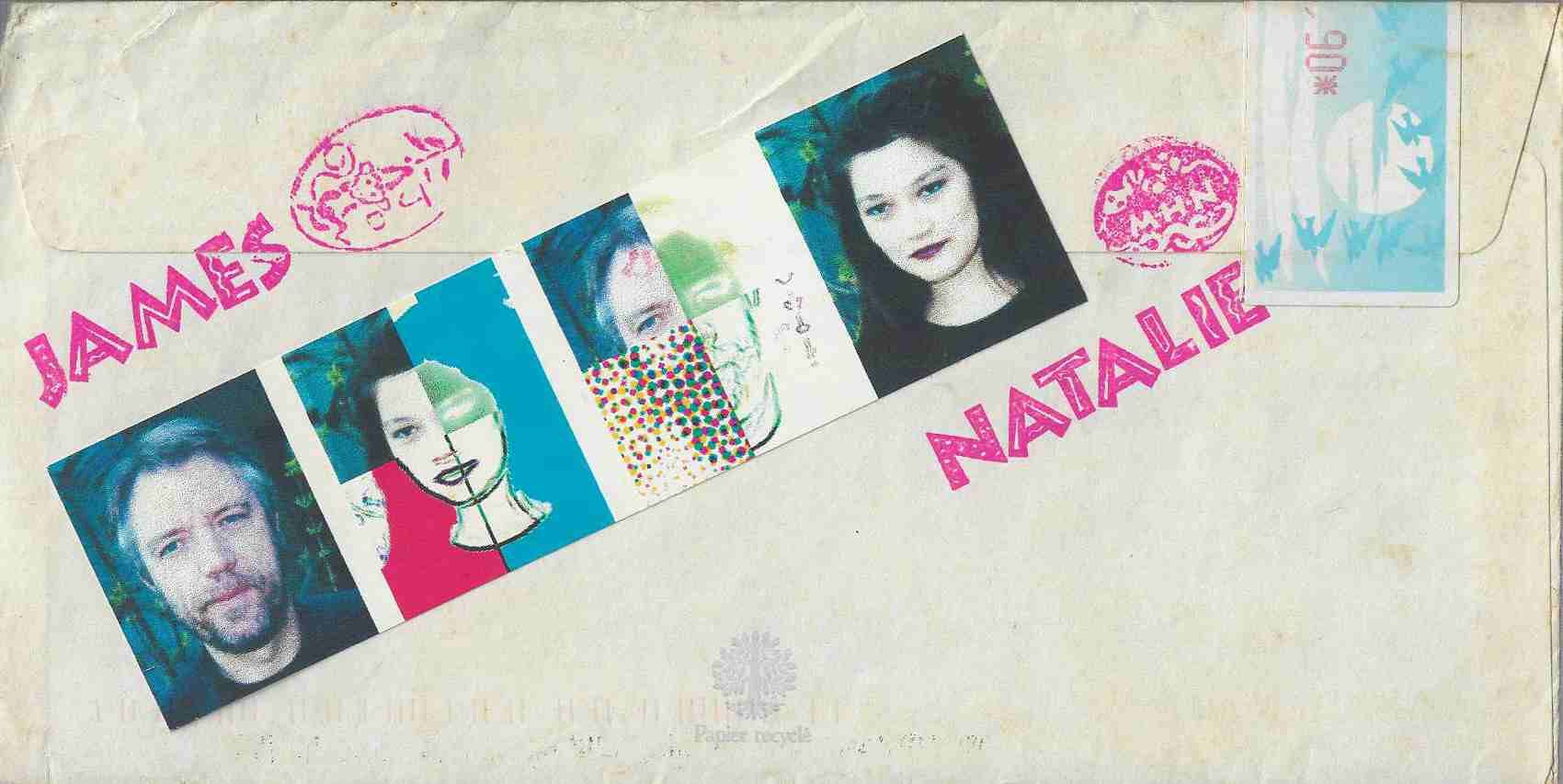
O verso do envelope desenvolve uma composição paralela baseada nos retratos de James Durand e Natalie Durand. Fotografias dos dois são alternadas com imagens transformadas graficamente e eletrograficamente, criando uma sequência em que fotografia e reprodução tecnológica se confundem. Os nomes JAMES e NATALIE aparecem novamente como elementos visuais da composição.
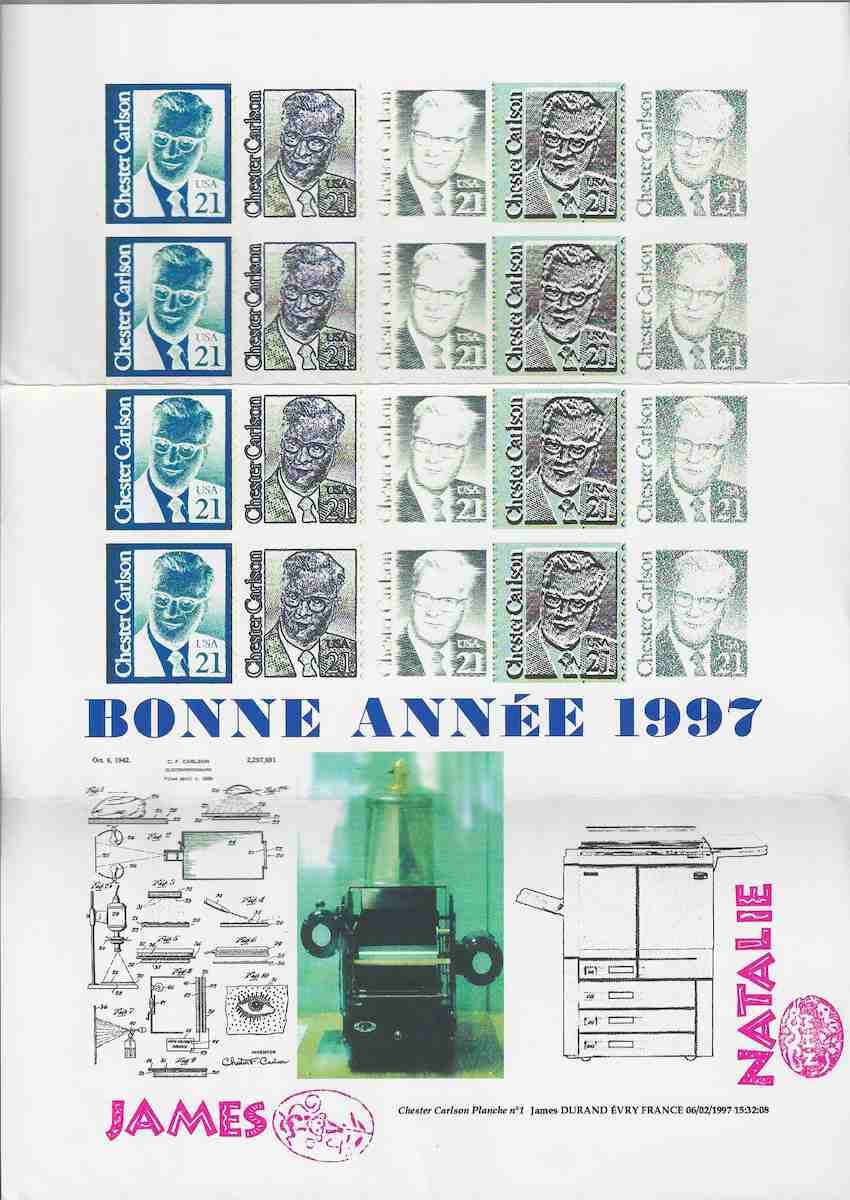
A carta obra interna apresenta em sua parte superior vinte reproduções de um selo postal norte americano dedicado a Chester Carlson, inventor fundamental para o desenvolvimento da xerografia. As imagens são organizadas em quatro linhas e cinco colunas e aparecem submetidas a diferentes níveis de contraste, inversão tonal, desgaste visual e alteração eletrográfica. Essa repetição transforma o selo em matriz para uma investigação sobre cópia, variação e reprodução.
A presença de Chester Carlson possui importância conceitual direta. Carlson desenvolveu o princípio da xerografia, tecnologia que permitiu o surgimento das modernas máquinas copiadoras e que posteriormente se tornou um dos principais meios utilizados por artistas ligados à copy art e à arte eletrográfica. Ao incorporar repetidamente sua imagem, Durand estabelece uma relação entre história da tecnologia e história da criação artística baseada na reprodução.
Abaixo da série de Chester Carlson aparece em grandes caracteres a expressão BONNE ANNÉE 1997. Na região inferior encontram se três imagens relacionadas à tecnologia de reprodução. À esquerda aparece um desenho técnico semelhante a um esquema ou patente, ao centro uma imagem fotográfica de equipamento e à direita a representação gráfica de uma máquina copiadora. Os nomes JAMES e NATALIE aparecem novamente como marcas de autoria.
Uma inscrição impressa na parte inferior identifica a composição como Chester Carlson Planche n°1, associada a James Durand, Évry, France, e registra a data de 06 de fevereiro de 1997 e o horário 15:32:05. Esse registro permite documentar de maneira particularmente precisa o momento de produção ou processamento da imagem.
O conjunto enviado a Gastão Debreix demonstra como James Durand e Natalie Durand transformaram uma saudação de ano novo em objeto de experimentação visual e comunicação artística. Mais do que simples correspondência, a peça integra envelope, imagem, tecnologia, identidade, história da xerografia e circulação postal. Também constitui evidência material da continuidade da relação de James Durand e Natalie Durand com Gastão Debreix e das conexões entre artistas franceses e brasileiros dentro das redes internacionais de arte postal e eletrografia durante a década de 1990.
Palavras chave para indexação: James Durand, Natalie Durand, Gastão Debreix, Bonne Année 1997, Chester Carlson, Chester Carlson Planche n°1, Planetwork 1997, Évry, França, 6 de fevereiro de 1997, xerografia, xerography, eletrografia, electrography, arte eletrográfica, copy art, photocopy art, fotocópia, photocopier art, máquina copiadora, reprodução, reproduction, Photocopieur sur photocopieuse, arte postal, mail art, correspondência artística, envelope de artista, artist envelope, carimbo de artista, arte tecnológica, imagem eletrônica, reprodução gráfica, fotografia, rede internacional de artistas, França Brasil, arte experimental, anos 1990.
Salsa text in English
Envelope and artwork letter by James Durand and Natalie Durand sent to Gastão Debreix at the beginning of 1997, conceived as a Bonne Année 1997 greeting and as a piece of artistic correspondence. The set combines photography, portraiture, photocopy, electrography, graphic reproduction, stamps, technical imagery, typography and the appropriation of postal elements, documenting James Durand's investigation of the copying machine and technologies of image reproduction.
The envelope is treated as an integral part of the artwork. On the side addressed to Gastão Debreix there are successive fragmented and modified images of James Durand's face, color reproductions, graphic patterns and interventions exploring superimposition, repetition and the transformation of photographic identity. The name James Durand appears within the composition, while the inscription PLANETWORK 1997 introduces the idea of networks and international circulation.
The lower part of the envelope contains representations of a copying machine, electronic and communication equipment and a graphic symbol associated with sound transmission. The word REPRODUCTION and the designation Photocopieur sur photocopieuse explicitly reinforce the relationship between the piece and photocopy reproduction. The names JAMES and NATALIE appear as large pink stamped elements together with additional graphic marks.
The reverse side develops a parallel composition based on portraits of James Durand and Natalie Durand. Photographs of the two are alternated with graphically and electrographically transformed images, creating a sequence in which photography and technological reproduction merge. The names JAMES and NATALIE once again become visual elements within the composition.
The internal artwork presents twenty reproductions of a United States postage stamp honoring Chester Carlson, a crucial figure in the development of xerography. The images are arranged in four rows of five and appear with different levels of contrast, tonal inversion, visual degradation and electrographic alteration. Through repetition, the stamp becomes a matrix for an investigation of copying, variation and reproduction.
The presence of Chester Carlson has direct conceptual significance. Carlson developed the principle of xerography, the technology that made modern copying machines possible and that later became one of the principal media used by artists associated with copy art and electrographic art. By repeatedly incorporating Carlson's image, Durand establishes a relationship between the history of technology and the history of artistic creation through reproduction.
Below the Chester Carlson sequence appears the large inscription BONNE ANNÉE 1997. In the lower section are three images connected with reproduction technology. On the left is a technical drawing resembling a diagram or patent, in the center a photographic image of equipment and on the right a graphic representation of a copying machine. The names JAMES and NATALIE appear again as marks of authorship.
A printed inscription at the bottom identifies the composition as Chester Carlson Planche n°1, associated with James Durand, Évry, France, and records the date 6 February 1997 and the time 15:32:05. This information makes it possible to document with unusual precision the moment when the image was produced or processed.
The set sent to Gastão Debreix demonstrates how James Durand and Natalie Durand transformed a New Year greeting into an object of visual experimentation and artistic communication. More than ordinary correspondence, the piece integrates envelope, image, technology, identity, the history of xerography and postal circulation. It also provides material evidence of the continuing relationship between James Durand, Natalie Durand and Gastão Debreix and of the connections between French and Brazilian artists within international networks of mail art and electrography during the 1990s.
Keywords for indexing: James Durand, Natalie Durand, Gastão Debreix, Bonne Année 1997, Chester Carlson, Chester Carlson Planche n°1, Planetwork 1997, Évry, France, 6 February 1997, xerography, electrography, electrographic art, copy art, photocopy art, photocopy, photocopier art, copying machine, reproduction, Photocopieur sur photocopieuse, mail art, postal art, artistic correspondence, artist envelope, artist stamp, technological art, electronic image, graphic reproduction, photography, international artist network, France Brazil, experimental art, 1990s.
Conjunto composto por envelope artístico e carta obra de James Durand e Natalie Durand enviados a Gastão Debreix como saudação de Bonne Année 1997. A correspondência apresenta intensa intervenção visual e utiliza o próprio sistema de reprodução técnica como tema, método e linguagem artística.
O envelope é endereçado a Gastão Debreix em Pirajuí, São Paulo, Brasil. A superfície postal foi transformada por Durand em campo de experimentação gráfica. Na parte superior aparece uma sequência horizontal de fragmentos fotográficos e eletrográficos do rosto de James Durand, alternando fotografia, desenho, padrões cromáticos e diferentes estados de reprodução da mesma imagem. Ao lado aparece a inscrição vertical PLANETWORK 1997.
Na parte inferior são reproduzidas imagens de uma máquina copiadora, um equipamento eletrônico semelhante a computador e aparelho de comunicação e um grande símbolo relacionado à emissão ou transmissão sonora. Próximo à copiadora encontram se as inscrições REPRODUCTION e Photocopieur sur photocopieuse. A presença dessas palavras transforma o próprio procedimento técnico da cópia em conteúdo da composição.
Os nomes JAMES e NATALIE aparecem por meio de grandes carimbos rosa distribuídos pelo envelope. Outros carimbos circulares e marcas postais são incorporados visualmente à peça. Dessa forma, elementos normalmente utilizados apenas para autenticação ou circulação postal passam a participar da organização estética da obra.
No verso do envelope aparecem retratos de James Durand e Natalie Durand acompanhados por versões modificadas das próprias imagens. O retrato fotográfico de James é seguido por uma transformação gráfica de um rosto e por outra imagem híbrida construída pela combinação entre fotografia e intervenção cromática. A sequência termina com um retrato fotográfico de Natalie. Os nomes JAMES e NATALIE funcionam como identificação e simultaneamente como elementos tipográficos da composição.
A carta obra apresenta vinte imagens de selo postal norte americano dedicado a Chester Carlson e com valor facial de 21 cents. As vinte unidades são organizadas em uma estrutura regular de quatro linhas por cinco colunas. Cada coluna apresenta tratamento visual diferente, incluindo inversão, aumento ou redução de contraste, perda de definição e alterações decorrentes de processos de reprodução.
A escolha de Chester Carlson é particularmente significativa porque ele está historicamente ligado à invenção da xerografia. A série estabelece portanto uma autorreferência ao próprio meio utilizado por James Durand. O inventor da tecnologia de cópia torna se imagem copiada repetidamente, criando uma relação conceitual entre inventor, máquina, reprodução e obra.
Imediatamente abaixo da matriz aparece a inscrição BONNE ANNÉE 1997 em grandes letras azuis. Na parte inferior da folha encontram se um desenho técnico, uma imagem de equipamento e a representação de uma copiadora. O nome NATALIE aparece verticalmente ao lado da máquina, enquanto JAMES surge na região inferior esquerda.
Na margem inferior é possível ler Chester Carlson Planche n°1, James DURAND, ÉVRY FRANCE, seguido pelo registro 06/02/1997 15:32:05. Esses dados identificam o trabalho, o autor, o local e um momento preciso de produção ou processamento da imagem, constituindo informação documental importante para catalogação.
O documento deve ser compreendido simultaneamente como correspondência, obra gráfica, experiência de copy art, registro de arte eletrográfica e documento de uma rede artística internacional. A associação entre James Durand, Natalie Durand e Gastão Debreix confirma a circulação transatlântica dessas experiências e oferece evidência da presença brasileira dentro das redes internacionais de intercâmbio artístico nos anos 1990.
Palavras chave para indexação: James Durand, Natalie Durand, Gastão Debreix, Bonne Année 1997, Chester Carlson, selo Chester Carlson, Chester Carlson 21 cents, Chester Carlson Planche n°1, Évry France, 06 de fevereiro de 1997, Planetwork 1997, xerografia, história da xerografia, máquina copiadora, photocopier, copy art, arte de cópia, eletrografia, electrographic art, photocopy art, fotocópia artística, arte postal, mail art, envelope artístico, correspondência internacional, carimbos de artista, reprodução técnica, repetição, transformação da imagem, fotografia manipulada, arte experimental francesa, Gastão Debreix mail art, James Durand electrography, France Brazil mail art.
Observation text in English
Set consisting of an artistic envelope and artwork letter by James Durand and Natalie Durand sent to Gastão Debreix as a Bonne Année 1997 greeting. The correspondence is extensively visually modified and uses the technical reproduction system itself as subject, method and artistic language.
The envelope is addressed to Gastão Debreix in Pirajuí, São Paulo, Brazil. Its postal surface has been transformed by Durand into an area of graphic experimentation. Across the upper section is a horizontal sequence of photographic and electrographic fragments of James Durand's face, alternating photography, drawing, chromatic patterns and different states of reproduction of the same image. The vertical inscription PLANETWORK 1997 appears beside this sequence.
The lower portion contains representations of a copying machine, electronic equipment resembling a computer and communication apparatus and a large symbol associated with sound transmission. Near the copier are the inscriptions REPRODUCTION and Photocopieur sur photocopieuse. The presence of these terms transforms the technical process of copying itself into part of the content of the composition.
The names JAMES and NATALIE appear through large pink stamped impressions distributed across the envelope. Additional circular stamps and postal markings are visually incorporated into the piece. Elements normally used only for identification or postal circulation therefore become part of the aesthetic organization of the artwork.
The reverse of the envelope presents portraits of James Durand and Natalie Durand accompanied by altered versions of their images. The photographic portrait of James is followed by a graphic transformation of a face and another hybrid image combining photography and chromatic intervention. The sequence concludes with a photographic portrait of Natalie. The names JAMES and NATALIE function both as identification and as typographic elements.
The artwork letter contains twenty images of a United States postage stamp honoring Chester Carlson with a denomination of 21 cents. The twenty units are arranged in a regular structure of four rows and five columns. Each column presents a different visual treatment, including inversion, changes in contrast, loss of definition and transformations produced through reproduction processes.
The choice of Chester Carlson is especially significant because he is historically associated with the invention of xerography. The sequence therefore creates a self reference to the medium used by James Durand. The inventor of copying technology becomes an image that is itself repeatedly copied, establishing a conceptual relationship between inventor, machine, reproduction and artwork.
Immediately below the matrix appears the inscription BONNE ANNÉE 1997 in large blue letters. The lower section of the sheet contains a technical drawing, an image of equipment and a representation of a copying machine. The name NATALIE appears vertically beside the machine, while JAMES appears in the lower left area.
Along the bottom margin can be read Chester Carlson Planche n°1, James DURAND, ÉVRY FRANCE, followed by the record 06/02/1997 15:32:05. These details identify the work, artist, location and a precise moment of production or processing, providing important documentary information for cataloguing.
The document can be understood simultaneously as correspondence, graphic artwork, copy art experiment, electrographic art record and evidence of an international artistic network. The connection among James Durand, Natalie Durand and Gastão Debreix confirms the transatlantic circulation of these experiments and provides evidence of Brazilian participation within international artistic exchange networks during the 1990s.
Keywords for indexing: James Durand, Natalie Durand, Gastão Debreix, Bonne Année 1997, Chester Carlson, Chester Carlson stamp, Chester Carlson 21 cents, Chester Carlson Planche n°1, Évry France, 6 February 1997, Planetwork 1997, xerography, history of xerography, copying machine, photocopier, copy art, electrography, electrographic art, photocopy art, artistic photocopy, postal art, mail art, artistic envelope, international correspondence, artist stamps, technical reproduction, repetition, image transformation, manipulated photography, French experimental art, Gastão Debreix mail art, James Durand electrography, France Brazil mail art.
Proveniência
Coleção Gastão DebreixInglês
Envelope and artwork letter by James Durand and Natalie Durand sent to Gastão Debreix at the beginning of 1997, conceived as a Bonne Année 1997 greeting and as a piece of artistic correspondence.
Dimensions: 4,3 x 8,7 in