Conjunto documental do Festival Permanent, realizado no Campus Universitaire d?Orléans, em Orléans, França, entre dezembro de 1968 e janeiro de 1969.
Festival Permanent - Jean Claude Moineau no Campus Universitaire d?Orléans, em Orléans - França
Categoria: Exposição Coletiva Internacional
Acervo: 04587
Data: 4 de Dezembro de 1968 a 16 de Janeiro de 1969
Dimensões: 27 x 21 cm
Conjunto documental do Festival Permanent, realizado no Campus Universitaire d?Orléans, em Orléans, França, entre dezembro de 1968 e janeiro de 1969. O material reúne programas, comunicados, textos de participação e documentos de ações artísticas que permitem reconstruir parte da programação e, principalmente, a concepção do festival como experiência contínua de integração entre arte, cultura, universidade, participação coletiva e vida cotidiana. A documentação registra atividades entre 4 de dezembro de 1968 e 16 de janeiro de 1969 e constitui fonte primária para o estudo da poesia experimental, performance, arte participativa, intermedia, arte conceitual e práticas culturais surgidas no ambiente universitário francês após Maio de 1968.
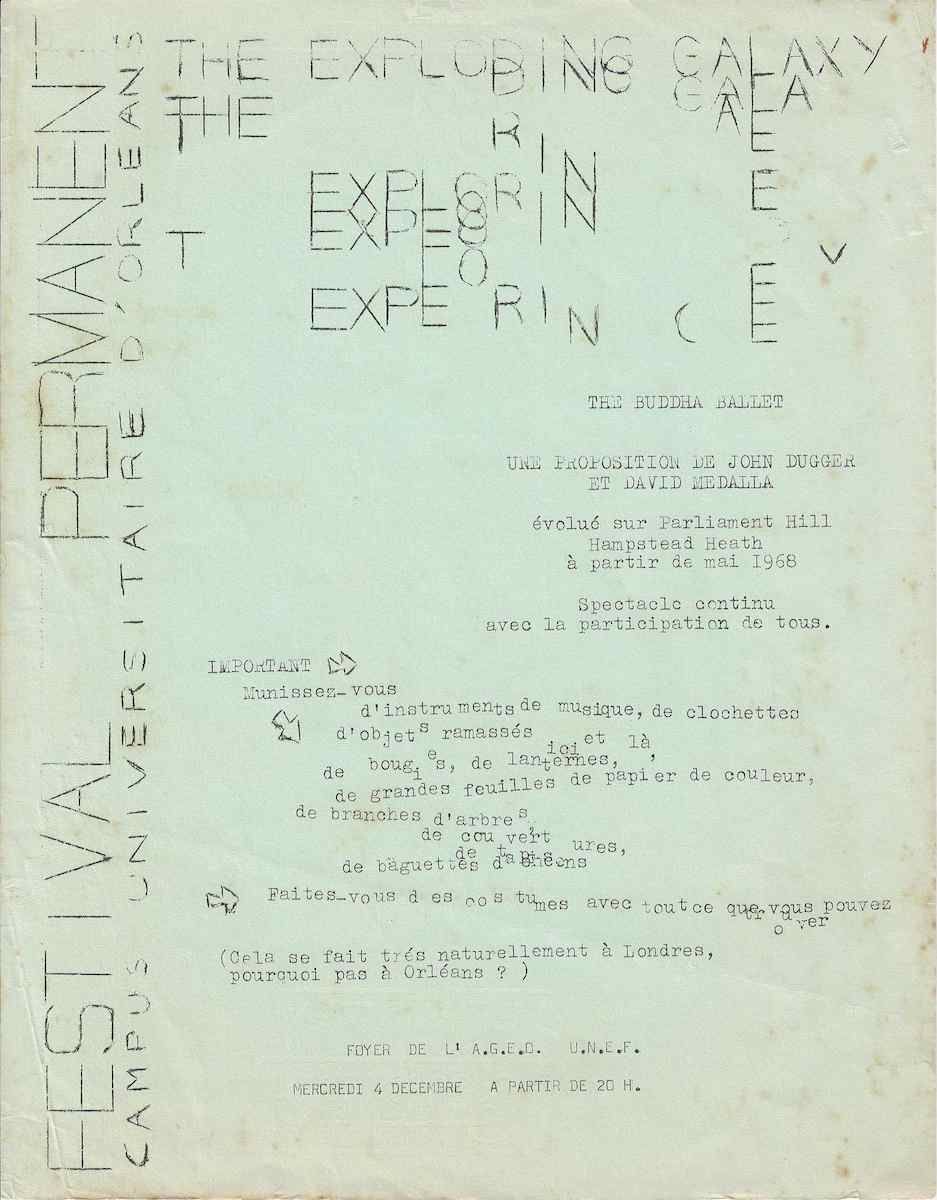
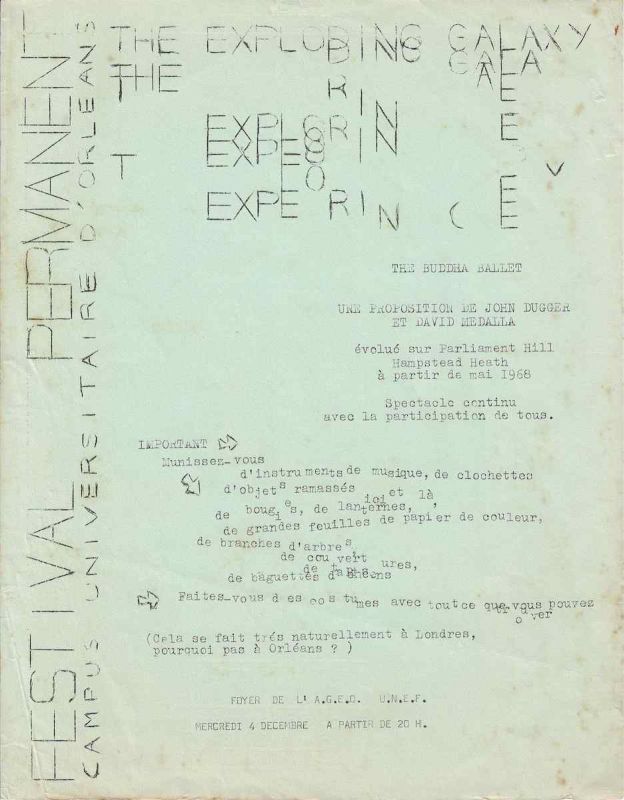
Um dos documentos anuncia para quarta feira, 4 de dezembro, a partir das 20 horas, The Buddha Ballet, proposta de John Dugger e David Medalla. O impresso informa que a ação havia se desenvolvido anteriormente em Parliament Hill, Hampstead Heath, Londres, a partir de maio de 1968, e apresenta a atividade como espetáculo contínuo com a participação de todos. Os participantes eram convidados a levar instrumentos musicais, sinos, objetos sonoros, objetos em diferentes cores, lanternas, grandes folhas de papel colorido, galhos de árvores e outros materiais capazes de produzir ações coletivas. A programação estava prevista para o foyer da AGEO UNEF no Campus Universitaire d?Orléans.
The Buddha Ballet era uma experiência participativa criada por John Dugger e David Medalla no contexto do coletivo londrino Exploding Galaxy. Fontes históricas confirmam que Dugger e Medalla organizaram durante o verão de 1968 performances participativas de The Buddha Ballet em Parliament Hill, Londres, envolvendo diretamente o público na construção da ação. O documento de Orléans demonstra a transferência dessa experiência do espaço público londrino para o ambiente universitário francês, mantendo como princípio fundamental a participação coletiva.
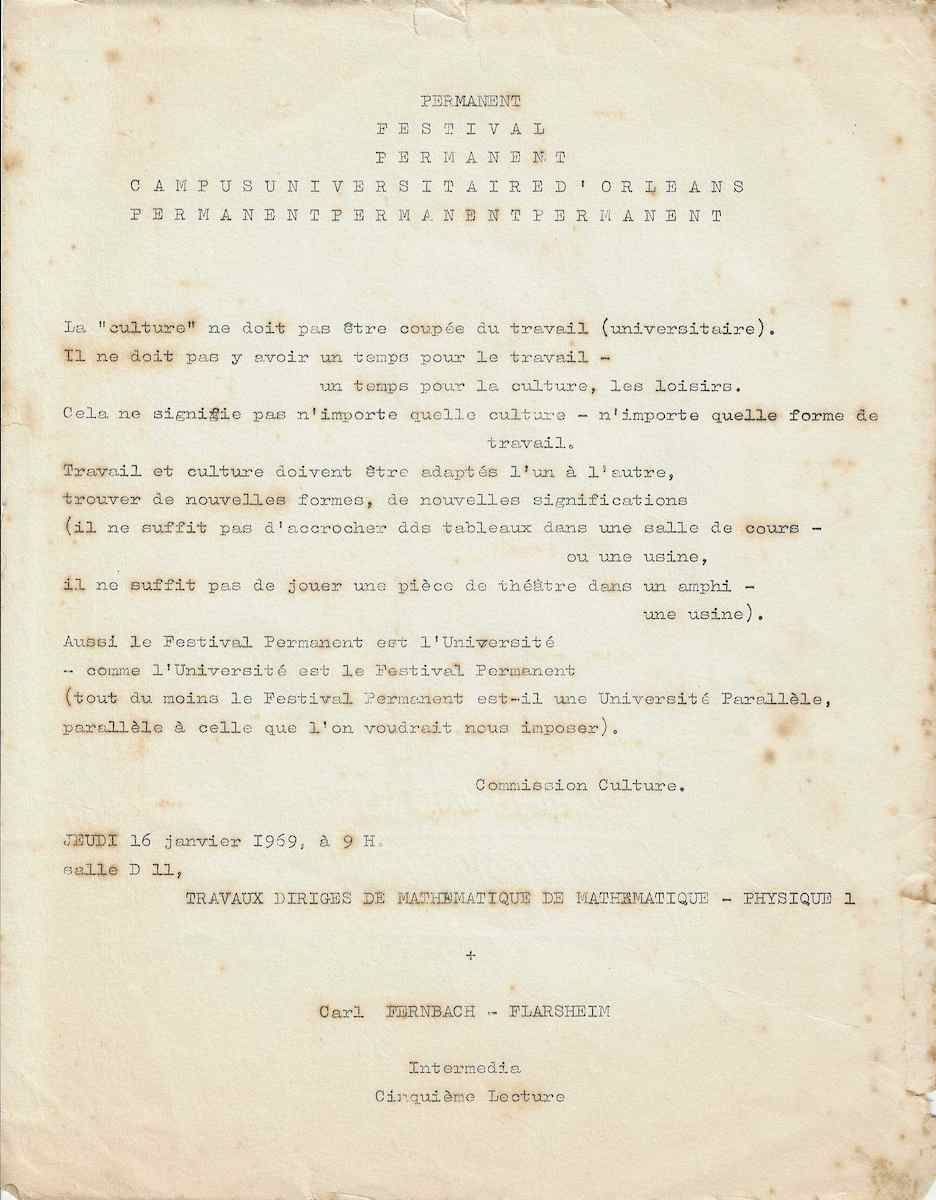
Outro documento do conjunto apresenta um texto programático do Permanent Festival Campus Universitaire d?Orléans. O texto afirma que a cultura não deveria estar separada do trabalho universitário e rejeita a divisão convencional entre tempo de trabalho e tempo destinado à cultura e ao lazer. Segundo o documento, trabalho e cultura deveriam adaptar se um ao outro e encontrar novas formas e novos significados. O texto rejeita a simples instalação de quadros numa sala de aula ou fábrica e igualmente a mera apresentação de uma peça de teatro num anfiteatro como soluções suficientes para estabelecer essa integração.
O mesmo manifesto afirma que o Festival Permanent deveria ser parte da própria universidade e que, ao menos durante sua existência, deveria constituir uma Université Parallèle, paralela à universidade que se pretendia impor. Essa formulação revela que o Festival Permanent não era concebido apenas como uma sucessão de espetáculos ou exposições, mas como experiência crítica de reorganização da relação entre educação, cultura, produção artística, participação e vida universitária. O documento é assinado pela Commission Culture.
Esse programa registra para quinta feira, 16 de janeiro de 1969, às 9 horas, na sala D11, uma atividade denominada Travaux dirigés de mathématique de Mathématique Physique 1, associada a Carl Fernbach Flarsheim e identificada como Intermedia, Cinquième Lecture. A presença de Carl Fernbach Flarsheim amplia significativamente o campo conceitual do Festival Permanent. Fernbach Flarsheim atuava em práticas intermedia que articulavam poesia, linguagem, matemática, ciência, performance e artes visuais. Sua exposição The Arts in Fusion, realizada nos Estados Unidos em 1966, investigava justamente relações entre arte, linguagem, tecnologia e ciência.
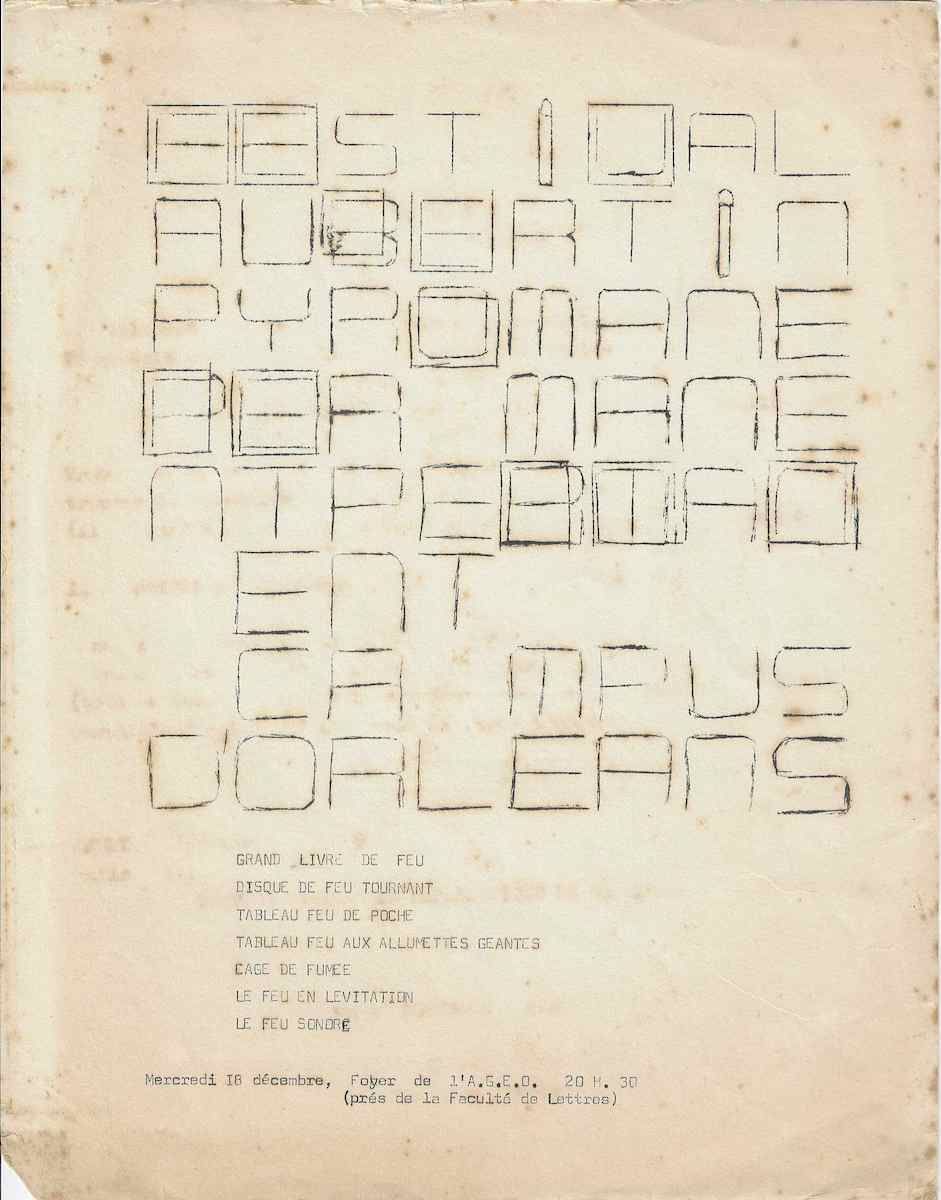
Outro documento anuncia uma ação de Bernard Aubertin, artista francês conhecido por suas pesquisas envolvendo fogo como elemento artístico. O programa, marcado para quarta feira, 18 de dezembro, às 20 horas e 30 minutos, no foyer da AGEO próximo à Faculté des Lettres, apresenta uma série de propostas relacionadas ao fogo, incluindo Grand Livre de Feu, Disque de Feu Tournant, Tableau Feu de Poche, Tableau Feu aux Allumettes Géantes, Cage de Fumée, Le Feu en Lévitation e Le Feu Sonore. A peça gráfica transforma as próprias letras do anúncio em composição visual e apresenta Aubertin associado a uma performance pirotécnica no contexto do Festival Permanent.
A presença dessas ações evidencia o caráter profundamente interdisciplinar do evento. The Buddha Ballet introduzia participação corporal e coletiva. Bernard Aubertin trabalhava com fogo, combustão, fumaça, movimento e transformação da matéria. Carl Fernbach Flarsheim introduzia a noção de intermedia e a aproximação entre matemática, linguagem, ciência e arte. O Festival Permanent reunia assim práticas muito diferentes sem subordiná las ao formato tradicional de exposição.
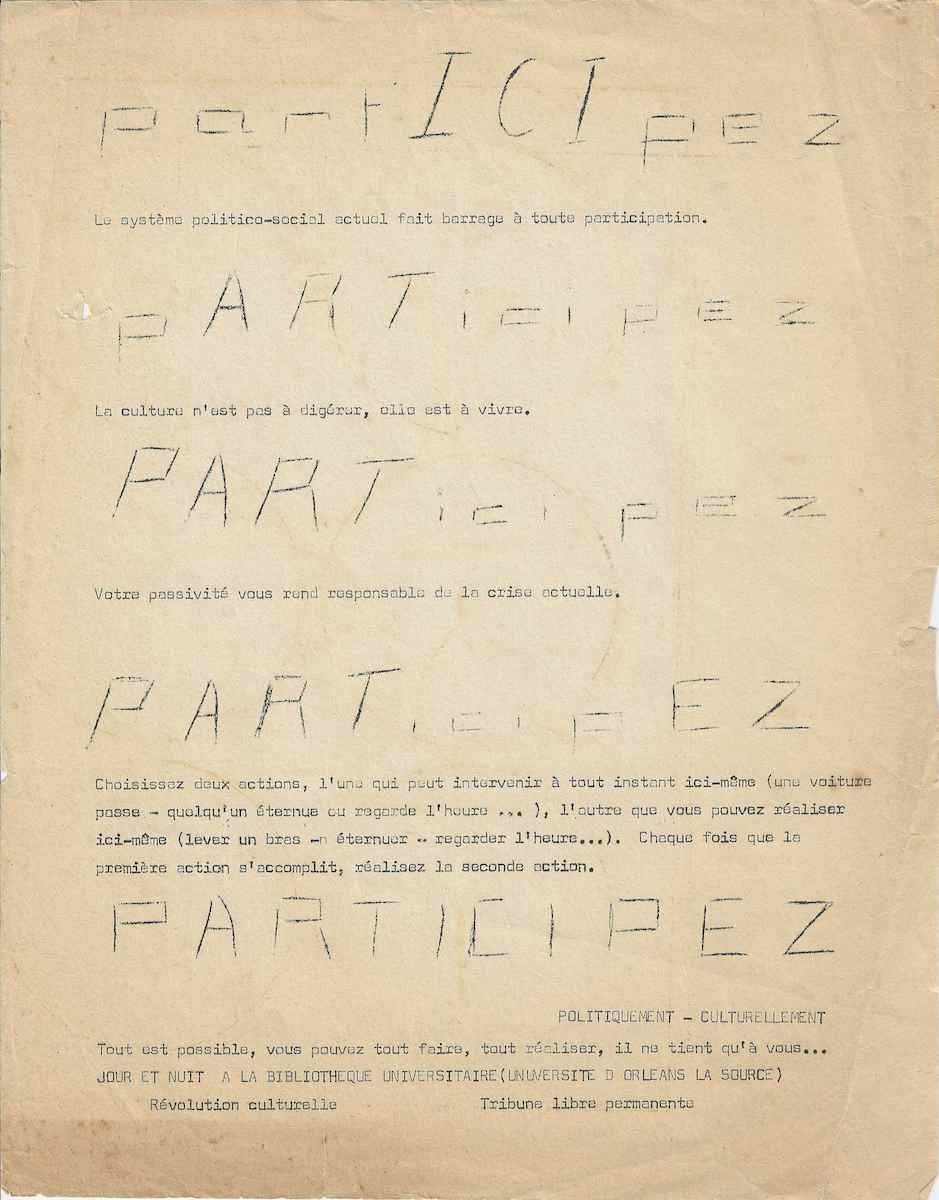
Um quarto documento apresenta repetidamente a palavra participez como elemento gráfico e como comando dirigido ao leitor. O texto declara que o sistema político e social existente impedia a participação, que a cultura não deveria ser digerida passivamente, mas vivida, e que a passividade tornava o indivíduo responsável pela crise contemporânea. Em seguida propõe um exercício simples de ação. O participante deveria escolher duas ações, uma dependente de um acontecimento externo e outra que pudesse realizar diretamente. Cada vez que a primeira ocorresse, deveria executar a segunda.
A proposta desloca a arte do objeto para uma estrutura de comportamento e decisão. Um acontecimento cotidiano, como a passagem de um automóvel, alguém espirrar ou alguém consultar as horas, poderia funcionar como estímulo para outra ação, como levantar o braço, espirrar ou olhar as horas. Essa lógica aproxima o Festival Permanent da arte conceitual, performance, event scores, Fluxus, intermedia e processos participativos, ainda que o documento não deva ser atribuído automaticamente a Fluxus sem comprovação específica.
Na parte inferior desse documento aparecem as expressões politiquement culturellement, jour et nuit à la bibliothèque universitaire, Université d?Orléans La Source, Révolution culturelle e Tribune libre permanente. O material demonstra que o festival estava vinculado também à biblioteca universitária e a uma ideia de atividade permanente, disponível dia e noite, baseada na livre participação, discussão pública e transformação das relações entre cultura e universidade.
O conjunto documental permite estabelecer com segurança uma programação que se estende de 4 de dezembro de 1968 a 16 de janeiro de 1969. Entre as atividades identificadas estão The Buddha Ballet de John Dugger e David Medalla em 4 de dezembro, a ação de Bernard Aubertin em 18 de dezembro e a apresentação Intermedia, Cinquième Lecture de Carl Fernbach Flarsheim em 16 de janeiro de 1969. Esses registros transformam o material em fonte primária especialmente importante para reconstruir cronologicamente o Festival Permanent e seus participantes.
Historicamente, o Festival Permanent do Campus Universitaire d?Orléans ocupa uma posição relevante na convergência entre arte e universidade após 1968. Seus documentos demonstram uma concepção segundo a qual cultura não deveria constituir uma atividade separada da vida cotidiana ou do trabalho universitário. Exposição, performance, poesia, música, matemática, ação coletiva, participação, experimentação gráfica e debate político podiam integrar uma mesma plataforma contínua.
O conjunto é também significativo para a história internacional da arte participativa. John Dugger e David Medalla estavam vinculados ao Exploding Galaxy e fizeram de The Buddha Ballet uma experiência baseada na participação do público. A documentação histórica confirma que a obra envolvia colaboração, comunicação e formação de ações coletivas por diferentes participantes. Sua apresentação em Orléans mostra a circulação internacional dessas práticas entre Londres e França no decisivo contexto cultural de 1968.
Como documentação histórica, o conjunto deve ser indexado através das entidades Festival Permanent, Permanent Festival, Campus Universitaire d?Orléans, Université d?Orléans, Orléans La Source, França, 1968, 1969, Jean Claude Moineau, John Dugger, David Medalla, The Buddha Ballet, Exploding Galaxy, Bernard Aubertin, Carl Fernbach Flarsheim, Intermedia, AGEO, UNEF, Commission Culture, poesia experimental, performance, arte participativa, arte conceitual, arte intermedia, publicação experimental, ação artística e cultura universitária.
Salsa text in English
Documentary ensemble from Festival Permanent, held at the Campus Universitaire d?Orléans in Orléans, France, between December 1968 and January 1969. The material comprises programs, announcements, participation texts and documents relating to artistic actions that make it possible to reconstruct part of the festival program and, more importantly, its conception as a continuous experiment integrating art, culture, university life, collective participation and everyday experience. The documents record activities between December 4, 1968 and January 16, 1969 and constitute primary evidence for research into experimental poetry, performance, participatory art, intermedia, conceptual art and cultural practices emerging within the French university environment after May 1968.
One document announces The Buddha Ballet for Wednesday, December 4, beginning at 8 PM, as a proposition by John Dugger and David Medalla. The printed sheet states that the action had previously developed at Parliament Hill, Hampstead Heath, London, beginning in May 1968 and presents it as a continuous performance involving the participation of everyone. Participants were encouraged to bring musical instruments, bells, sound producing objects, colored objects, lanterns, large sheets of colored paper, tree branches and other materials that could become part of collective activity. The event was scheduled for the foyer of the AGEO UNEF at the Campus Universitaire d?Orléans.
The Buddha Ballet was a participatory experiment created by John Dugger and David Medalla within the environment of the London based Exploding Galaxy. Historical documentation confirms that Dugger and Medalla organized participatory performances of The Buddha Ballet on Parliament Hill during the summer of 1968, directly involving members of the public in the work. The Orléans document demonstrates the transfer of this experiment from a London public space to a French university context while retaining collective participation as its central principle.
Another document presents a programmatic statement for Permanent Festival Campus Universitaire d?Orléans. It argues that culture should not be separated from university work and rejects the conventional division between working time and time reserved for culture and leisure. According to the document, work and culture should be adapted to one another and should develop new forms and new meanings. Simply hanging paintings in a classroom or factory, or presenting a theater play in an auditorium, is explicitly rejected as insufficient.
The same statement declares that Festival Permanent should belong to the university itself and that, at least during the festival, it should constitute a Université Parallèle, parallel to the university that society sought to impose. This formulation demonstrates that Festival Permanent was conceived not merely as a succession of performances or exhibitions but as a critical experiment in reorganizing relations among education, culture, artistic production, participation and university life. The document is attributed to the Commission Culture.
The program records an activity for Thursday, January 16, 1969 at 9 AM in room D11, described as Travaux dirigés de mathématique de Mathématique Physique 1 and associated with Carl Fernbach Flarsheim under the designation Intermedia, Cinquième Lecture. The presence of Carl Fernbach Flarsheim significantly broadens the conceptual framework of Festival Permanent. Fernbach Flarsheim developed intermedia practices linking poetry, language, mathematics, science, performance and visual art. His earlier project The Arts in Fusion explored precisely the relationships among language, art, technology and science.
A further document announces an action by French artist Bernard Aubertin, whose work is associated with the use of fire as an artistic material and process. Scheduled for Wednesday, December 18 at 8.30 PM in the foyer of the AGEO near the Faculté des Lettres, the program lists a group of fire related works and actions including Grand Livre de Feu, Disque de Feu Tournant, Tableau Feu de Poche, Tableau Feu aux Allumettes Géantes, Cage de Fumée, Le Feu en Lévitation and Le Feu Sonore. The graphic design itself transforms the lettering into a visual composition and situates Aubertin within a pyrotechnic performance context at Festival Permanent.
These events demonstrate the strongly interdisciplinary character of the festival. The Buddha Ballet introduced collective bodily participation. Bernard Aubertin worked with fire, combustion, smoke, movement and material transformation. Carl Fernbach Flarsheim introduced intermedia and relationships among mathematics, language, science and art. Festival Permanent therefore brought together very different practices without subordinating them to the conventional exhibition format.
A fourth document repeatedly uses the word participez as both a graphic element and an imperative addressed to the reader. Its text states that the contemporary political and social system prevents participation, that culture should not be passively consumed but lived, and that individual passivity contributes to the contemporary crisis. It then proposes a simple behavioral exercise. The participant is instructed to choose two actions, one dependent on an external event and another that can be personally carried out. Whenever the first event occurs, the second action should be performed.
The proposition shifts artistic practice from the object toward a structure of behavior and decision. An everyday event such as a passing automobile, someone sneezing or someone checking the time could act as the trigger for another action such as raising an arm, sneezing or looking at the time. This logic places the Festival Permanent close to conceptual art, performance, event scores, intermedia and participatory practices, although the document should not automatically be classified as Fluxus without specific documentary evidence.
At the bottom of this sheet appear the expressions politiquement culturellement, jour et nuit à la bibliothèque universitaire, Université d?Orléans La Source, Révolution culturelle and Tribune libre permanente. These inscriptions indicate that Festival Permanent was also connected to the university library and to the idea of permanent activity available day and night, based on open participation, public discussion and the transformation of relationships between culture and university life.
The documentary ensemble securely establishes programming extending from December 4, 1968 through January 16, 1969. Identifiable activities include The Buddha Ballet by John Dugger and David Medalla on December 4, Bernard Aubertin's action on December 18 and Carl Fernbach Flarsheim's Intermedia, Cinquième Lecture on January 16, 1969. These records make the material a particularly important primary source for reconstructing the chronology and participants of Festival Permanent.
Historically, Festival Permanent at the Campus Universitaire d?Orléans occupies a significant position in the convergence between art and university culture following 1968. Its documents demonstrate a conception in which culture was not intended to constitute a separate activity from everyday life or university work. Exhibition, performance, poetry, music, mathematics, collective action, participation, graphic experimentation and political discussion could operate within the same continuous platform.
The ensemble is equally significant for the international history of participatory art. John Dugger and David Medalla were associated with Exploding Galaxy and transformed The Buddha Ballet into an experiment centered on audience participation. Historical research confirms that the work used collaboration, communication and collective bodily actions as fundamental elements. Its presentation in Orléans documents the international circulation of these practices between London and France within the decisive cultural environment of 1968.
For research and digital indexing, the ensemble should be associated with Festival Permanent, Permanent Festival, Campus Universitaire d?Orléans, Université d?Orléans, Orléans La Source, France, 1968, 1969, Jean Claude Moineau, John Dugger, David Medalla, The Buddha Ballet, Exploding Galaxy, Bernard Aubertin, Carl Fernbach Flarsheim, Intermedia, AGEO, UNEF, Commission Culture, experimental poetry, performance, participatory art, conceptual art, intermedia art, experimental publishing, artistic action and university culture.
exto de observação em português
Conjunto de quatro documentos originais relacionados ao Festival Permanent no Campus Universitaire d?Orléans, Orléans, França, abrangendo atividades realizadas entre 4 de dezembro de 1968 e 16 de janeiro de 1969. O material apresenta sinais de envelhecimento, manchas, marcas de dobra, intervenções manuscritas e impressão datilográfica e reprográfica, características que preservam a materialidade de documentos de circulação universitária e artística do período.
O primeiro documento anuncia The Buddha Ballet, uma proposta de John Dugger e David Medalla, para quarta feira, 4 de dezembro, a partir das 20 horas, no foyer da AGEO UNEF. O texto informa que a ação havia se desenvolvido em Parliament Hill, Hampstead Heath, Londres, a partir de maio de 1968, sendo definida como espetáculo contínuo com participação de todos. A folha solicita que os participantes tragam instrumentos musicais, sinos, objetos sonoros, lanternas, papéis coloridos, galhos e outros materiais. A documentação histórica confirma The Buddha Ballet como trabalho participativo desenvolvido por Dugger e Medalla em Londres em 1968.
O segundo documento apresenta o cabeçalho Permanent Festival, Permanent, Campus Universitaire d?Orléans e um texto da Commission Culture. O manifesto defende que cultura e trabalho universitário não devem permanecer separados e propõe que o Festival Permanent transforme temporariamente a universidade numa Université Parallèle. Na parte inferior registra a programação de quinta feira, 16 de janeiro de 1969, às 9 horas, sala D11, com Travaux dirigés de mathématique de Mathématique Physique 1, Carl Fernbach Flarsheim, Intermedia, Cinquième Lecture.
O terceiro documento refere se a Bernard Aubertin e a uma ação marcada para quarta feira, 18 de dezembro, às 20 horas e 30 minutos, no foyer da AGEO próximo à Faculté des Lettres. São relacionados Grand Livre de Feu, Disque de Feu Tournant, Tableau Feu de Poche, Tableau Feu aux Allumettes Géantes, Cage de Fumée, Le Feu en Lévitation e Le Feu Sonore. O documento constitui registro particularmente importante da apresentação de práticas baseadas em fogo, combustão, fumaça, som e transformação material no Festival Permanent.
O quarto documento constitui uma convocação à participação. A palavra participez é repetida graficamente ao longo da página. O texto afirma que o sistema político e social impede a participação, que a cultura deve ser vivida e que a passividade torna o indivíduo responsável pela crise. Propõe ainda uma ação baseada na escolha de dois acontecimentos, um externo e outro executado pelo participante, estabelecendo uma relação entre acaso, cotidiano, comportamento e ação artística.
Na parte inferior aparecem referências à Université d?Orléans La Source, Bibliothèque Universitaire, Révolution culturelle e Tribune libre permanente. O documento evidencia a dimensão política, pedagógica e participativa do projeto e demonstra que o Festival Permanent extrapolava a noção tradicional de exposição, funcionando como espaço de ações, performances, proposições, leituras, intervenções e participação cotidiana.
A sequência documental permite estabelecer três marcos cronológicos fundamentais. Em 4 de dezembro de 1968 ocorreu ou foi programado The Buddha Ballet de John Dugger e David Medalla. Em 18 de dezembro ocorreu ou foi programada a ação de Bernard Aubertin. Em 16 de janeiro de 1969 ocorreu ou foi programada a atividade de Carl Fernbach Flarsheim denominada Intermedia, Cinquième Lecture.
O conjunto deve ser preservado como documentação primária do Festival Permanent, do Campus Universitaire d?Orléans e das redes internacionais de arte experimental posteriores a Maio de 1968. Constitui fonte para pesquisas sobre John Dugger, David Medalla, Exploding Galaxy, The Buddha Ballet, Bernard Aubertin, Carl Fernbach Flarsheim, Jean Claude Moineau, arte participativa, poesia experimental, performance, intermedia, arte conceitual, cultura universitária, movimentos estudantis e práticas artísticas internacionais de 1968 e 1969.
Observation text in English
Set of four original documents relating to Festival Permanent at the Campus Universitaire d?Orléans in Orléans, France, covering activities between December 4, 1968 and January 16, 1969. The material displays aging, stains, folds, handwritten interventions and typewritten or reprographic printing, physical characteristics that preserve the nature of university and artistic documents circulated during the period.
The first document announces The Buddha Ballet, a proposition by John Dugger and David Medalla, for Wednesday, December 4 beginning at 8 PM at the foyer of the AGEO UNEF. It states that the action had developed at Parliament Hill, Hampstead Heath, London, beginning in May 1968 and defines it as a continuous performance involving everyone's participation. Participants were asked to bring musical instruments, bells, sound producing objects, lanterns, colored paper, tree branches and other materials. Historical documentation confirms The Buddha Ballet as a participatory work developed by Dugger and Medalla in London during 1968.
The second document bears the heading Permanent Festival, Permanent, Campus Universitaire d?Orléans and contains a statement by the Commission Culture. The text argues that culture and university work should not remain separated and proposes that Festival Permanent temporarily transform the university into a Université Parallèle. At the bottom it records an activity for Thursday, January 16, 1969 at 9 AM in room D11, described as Travaux dirigés de mathématique de Mathématique Physique 1, with Carl Fernbach Flarsheim, Intermedia, Cinquième Lecture.
The third document concerns Bernard Aubertin and an action scheduled for Wednesday, December 18 at 8.30 PM at the foyer of the AGEO near the Faculté des Lettres. It lists Grand Livre de Feu, Disque de Feu Tournant, Tableau Feu de Poche, Tableau Feu aux Allumettes Géantes, Cage de Fumée, Le Feu en Lévitation and Le Feu Sonore. The sheet constitutes particularly important evidence of artistic practices based on fire, combustion, smoke, sound and material transformation within Festival Permanent.
The fourth document is a direct call for participation. The word participez is repeatedly used as a graphic element across the page. The text states that the existing political and social system obstructs participation, that culture should be lived rather than passively consumed and that individual passivity contributes to the contemporary crisis. It proposes an action based on choosing two events, one external and another performed by the participant, establishing a relationship among chance, everyday experience, behavior and artistic action.
At the bottom appear references to Université d?Orléans La Source, Bibliothèque Universitaire, Révolution culturelle and Tribune libre permanente. The document demonstrates the political, pedagogical and participatory dimension of the project and confirms that Festival Permanent went beyond the traditional concept of an exhibition, functioning instead as a space for actions, performances, propositions, readings, interventions and everyday participation.
The documentary sequence establishes three fundamental chronological points. On December 4, 1968 The Buddha Ballet by John Dugger and David Medalla was held or scheduled. On December 18 an action by Bernard Aubertin was held or scheduled. On January 16, 1969 an activity by Carl Fernbach Flarsheim entitled Intermedia, Cinquième Lecture was held or scheduled.
The ensemble should be preserved as primary documentation of Festival Permanent, the Campus Universitaire d?Orléans and the international networks of experimental art that developed around and after May 1968. It constitutes a significant source for research concerning John Dugger, David Medalla, Exploding Galaxy, The Buddha Ballet, Bernard Aubertin, Carl Fernbach Flarsheim, Jean Claude Moineau, participatory art, experimental poetry, performance, intermedia, conceptual art, university culture, student movements and international experimental artistic practices of 1968 and 1969.
Proveniência
Coleção Poema ProcessoInglês
Documentary ensemble from Festival Permanent, held at the Campus Universitaire d?Orléans in Orléans, France, between December 1968 and January 1969.
Dimensions: 10,6 x 8,3 in