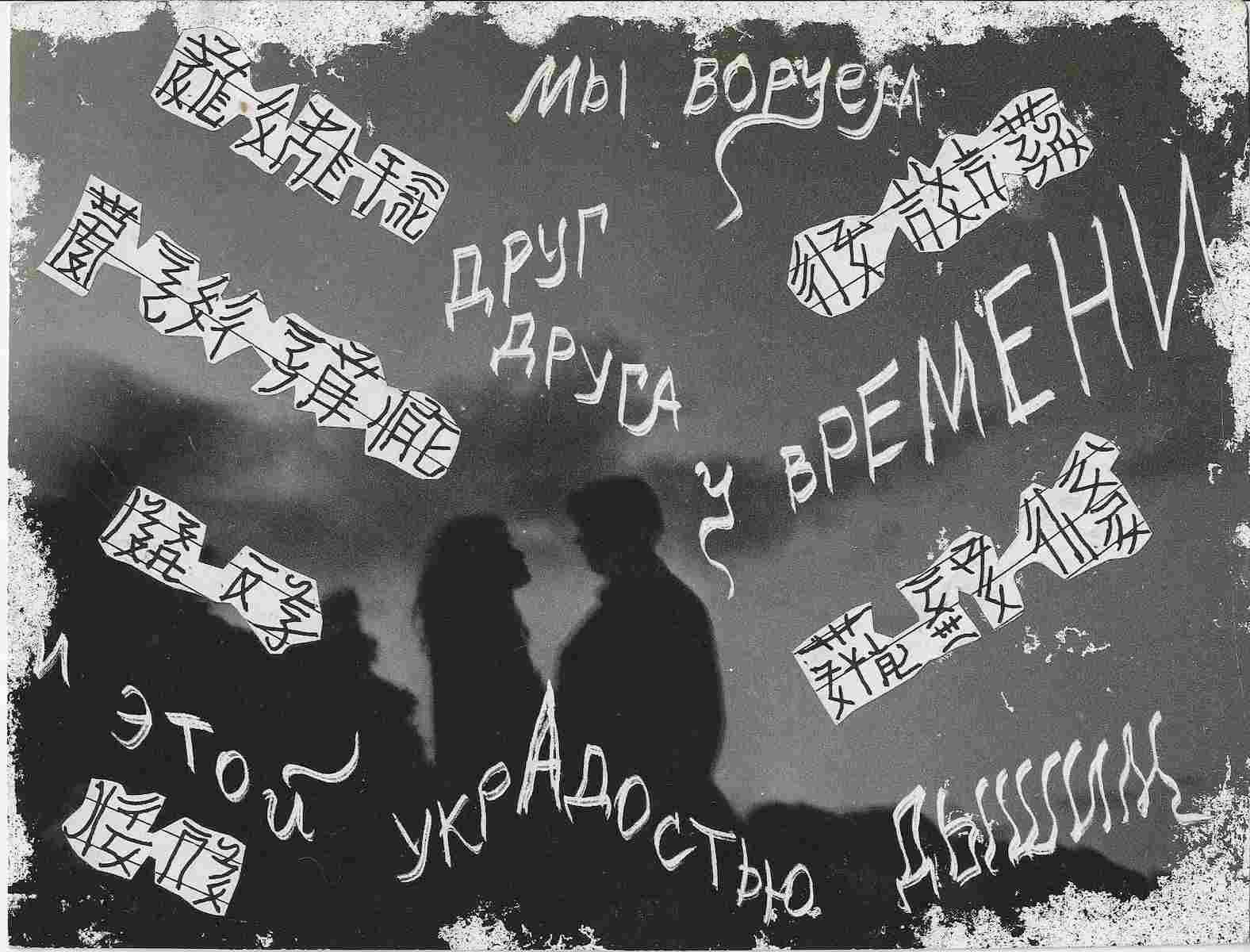
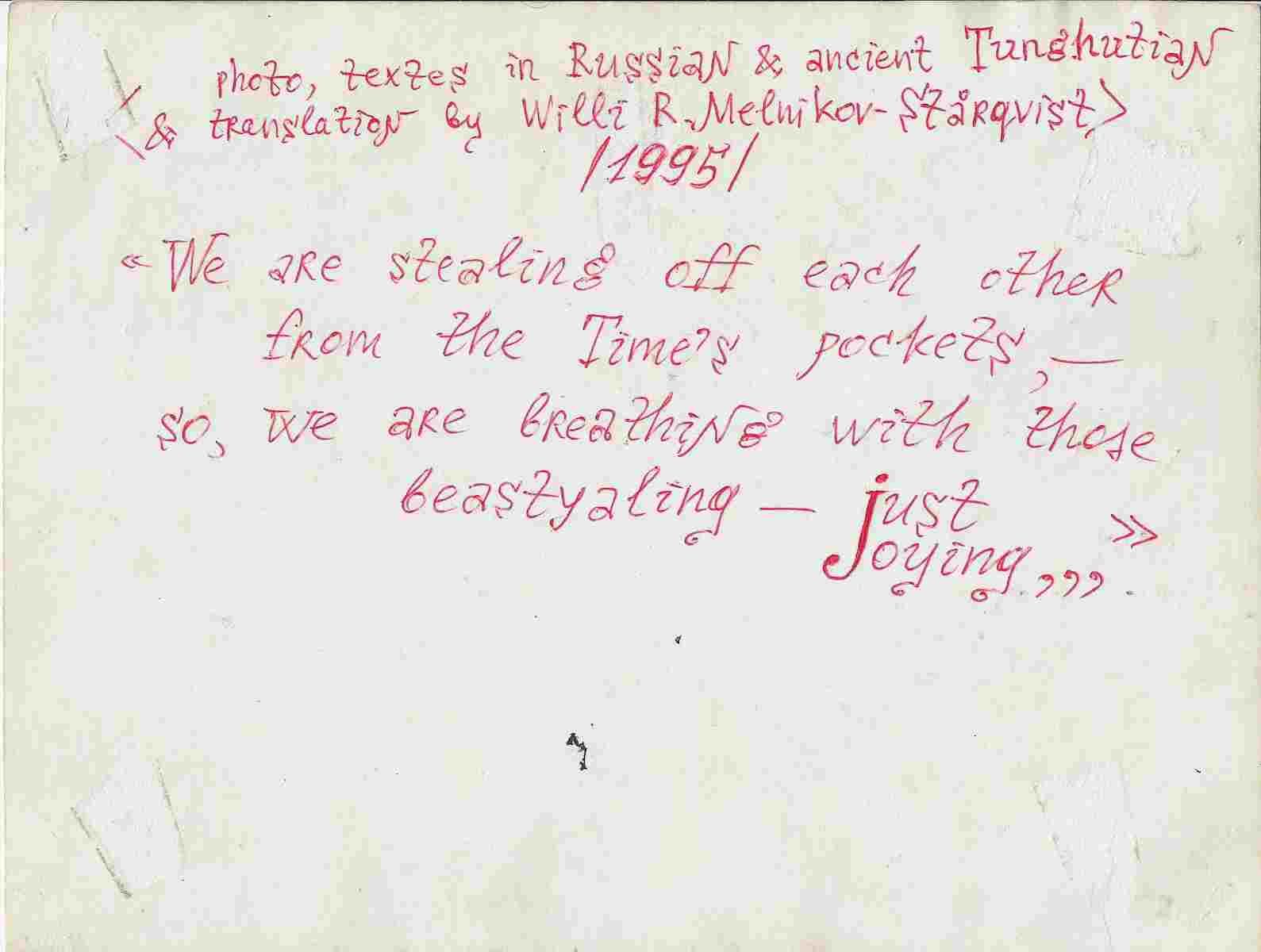
Willi R. Melnikov Storkvist, Rússia, obra de poesia visual e fotografia experimental realizada em 1995.
Willi R. Melnikov - Willi Melnikov - Vitaly Robertovich Melnikov - Willi R. Melnikov Starquist - Russia
Categoria: Mail Art
Acervo: 04477
Data: 1995
Dimensões: 16,8 x 22 cm
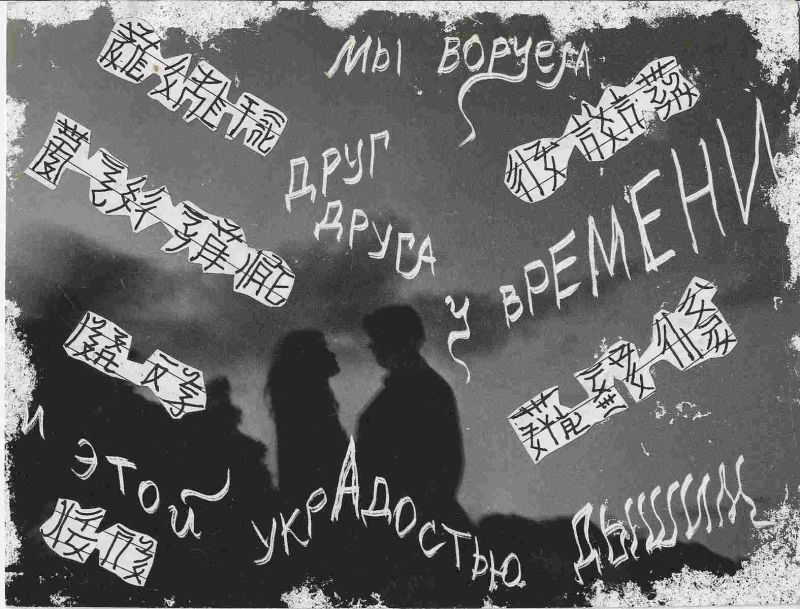
Texto Salsa em portuguêsWilli R. Melnikov Storkvist, Rússia, obra de poesia visual e fotografia experimental realizada em 1995. A composição articula imagem fotográfica em preto e branco, escrita manual em russo, caracteres identificados pelo próprio artista como Ancient Tunghutian e tradução manuscrita para o inglês. A fotografia apresenta silhuetas humanas em primeiro plano, enquanto palavras e sistemas gráficos ocupam diferentes regiões da superfície, produzindo uma estrutura em que imagem, linguagem, tradução e escrita funcionam simultaneamente como elementos visuais. No verso, Melnikov registra em tinta vermelha a autoria da fotografia, dos textos em russo, dos caracteres antigos e da tradução, além da data 1995. O texto inglês desenvolvido pelo artista apresenta uma reflexão poética sobre tempo, apropriação, existência e experiência compartilhada, utilizando formulações linguísticas pouco convencionais características de sua pesquisa experimental. A obra integra a produção de Willi R. Melnikov relacionada à poesia visual, poesia experimental, fotografia, criação multilíngue, sistemas de escrita, Mail Art, arte conceitual e circulação internacional de trabalhos de artista. O documento constitui importante testemunho de sua investigação sobre a convivência entre diferentes idiomas e alfabetos, transformando a tradução em componente estrutural da própria obra.Salsa text in EnglishWilli R. Melnikov Storkvist, Russia, visual poetry and experimental photographic work produced in 1995. The composition combines black and white photography, handwritten Russian text, characters identified by the artist himself as Ancient Tunghutian and a handwritten English translation. The photograph presents human silhouettes in the foreground, while words and graphic writing systems occupy different areas of the surface, creating a structure in which image, language, translation and writing operate simultaneously as visual elements. On the reverse, Melnikov records in red ink his authorship of the photograph, the Russian texts, the ancient characters and the translation, together with the date 1995. The English text developed by the artist presents a poetic reflection on time, appropriation, existence and shared experience, using unconventional linguistic constructions characteristic of his experimental practice. The work belongs to Willi R. Melnikov research in visual poetry, experimental poetry, photography, multilingual creation, writing systems, Mail Art, conceptual art and the international circulation of artists works. The document is an important record of his investigation into the coexistence of different languages and scripts, transforming translation into a structural component of the artwork itself.
Texto de observação em portuguêsObra frente e verso de Willi R. Melnikov Storkvist datada de 1995. Na frente encontra se uma fotografia em preto e branco com três silhuetas humanas na região inferior e central. Sobre a imagem foram adicionados textos manuscritos em caracteres cirílicos e diversos conjuntos de sinais apresentados sobre pequenas faixas claras, identificados pelo artista no verso como Ancient Tunghutian. A disposição descontínua dessas inscrições rompe a leitura linear e transforma diferentes sistemas de escrita em matéria visual.Entre os textos em cirílico é possível reconhecer uma construção poética organizada ao redor das ideias de tempo, de um indivíduo que toma ou rouba o outro do tempo e da relação entre presença e existência. O conteúdo completo em russo não é integralmente legível na reprodução disponível, razão pela qual não deve ser apresentado como transcrição diplomática definitiva. As faixas contendo os caracteres classificados pelo artista como Ancient Tunghutian também devem ser registradas de acordo com a denominação presente no próprio documento, sem estabelecer identificação linguística adicional que não esteja comprovada.No verso, escrito à mão em vermelho, aparece a informação de autoria que identifica fotografia, textos em russo, Ancient Tunghutian e tradução como trabalhos de Willi R. Melnikov Storkvist, acompanhados da data 1995. Abaixo encontra se uma versão em inglês cuja leitura principal pode ser entendida como uma reflexão sobre pessoas que retiram umas às outras dos bolsos do tempo e que continuam respirando e experimentando essa condição de maneira intensa e jubilosa. A formulação inglesa contém construções inventivas e não convencionais, coerentes com a prática de Melnikov de modificar palavras e produzir novas relações entre idiomas.A obra é especialmente relevante para o estudo da poesia visual russa e da pesquisa multilíngue de Willi R. Melnikov, pois reúne fotografia, escrita cirílica, caracteres de tradição histórica, tradução, intervenção manual e pensamento poético em um único suporte. O trabalho aproxima linguagem verbal e linguagem visual e demonstra como Melnikov utilizava diferentes alfabetos não apenas para transmitir significado, mas também como formas gráficas. Para fins de indexação, o documento relaciona Willi R. Melnikov Storkvist, Willi Melnikov, visual poetry, Russian visual poetry, experimental poetry, multilingual poetry, Ancient Tunghutian, experimental translation, photography, Mail Art, conceptual art, writing systems, graphic poetry e international artist networks.Observation text in EnglishTwo sided work by Willi R. Melnikov Storkvist dated 1995. The front contains a black and white photograph with three human silhouettes occupying the lower and central areas. Handwritten Cyrillic texts have been added over the image together with several groups of signs placed on light colored strips, identified by the artist on the reverse as Ancient Tunghutian. The discontinuous arrangement of these inscriptions disrupts linear reading and transforms different writing systems into visual material.Among the Cyrillic inscriptions it is possible to recognize a poetic construction centered on ideas of time, one person taking or stealing another from time and the relationship between presence and existence. The complete Russian content is not entirely legible in the available reproduction and therefore should not be presented as a definitive diplomatic transcription. The strips containing characters described by the artist as Ancient Tunghutian should likewise be catalogued according to the terminology written on the document itself, without making an additional linguistic identification that cannot be verified.On the reverse, handwritten in red, is an authorship statement identifying the photograph, Russian texts, Ancient Tunghutian and translation as works by Willi R. Melnikov Storkvist, together with the date 1995. Below this appears an English version whose principal meaning can be understood as a reflection on people taking one another from the pockets of time and continuing to breathe and experience this condition with intensity and joy. The English formulation contains inventive and unconventional constructions consistent with Melnikov practice of altering words and creating new relationships among languages.The work is particularly significant for research on Russian visual poetry and the multilingual investigations of Willi R. Melnikov because it combines photography, Cyrillic writing, historically referenced characters, translation, manual intervention and poetic thought within a single support. The piece brings verbal and visual language together and demonstrates how Melnikov used different scripts not only to transmit meaning but also as graphic forms. For indexing purposes, the document relates to Willi R. Melnikov Storkvist, Willi Melnikov, visual poetry, Russian visual poetry, experimental poetry, multilingual poetry, Ancient Tunghutian, experimental translation, photography, Mail Art, conceptual art, writing systems, graphic poetry and international artist networks.
Proveniência
Coleção Poema ProcessoInglês
Willi R. Melnikov Storkvist, Russia, visual poetry and experimental photographic work produced in 1995
Dimensions: 6,6 x 8,7 in