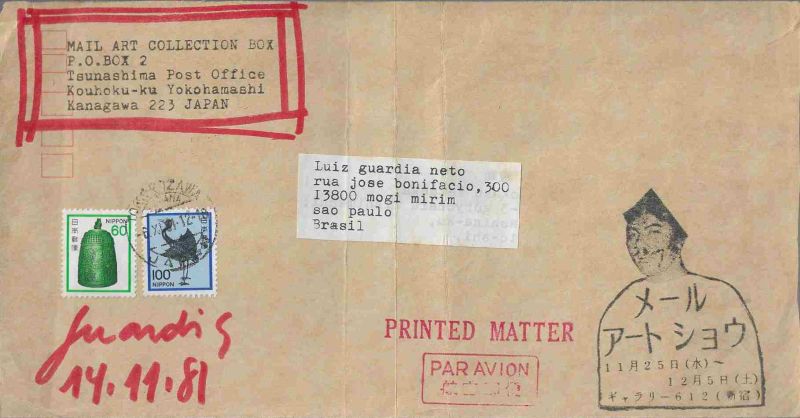
Peace Stamp, Heiwa Kitte, projeto internacional de Mail Art e artistamps dedicado à paz, à memória de Hiroshima e à circulação postal de imagens produzidas por artistas de diferentes países. O conjunto é formado por envelope de correspondência e três folhas impressas que documentam a participação de 150 artistas postais provenientes de 23 países, reunidos em torno de uma ação coletiva de arte postal com mensagem pacifista e antinuclear.
Luis Guardia Neto
Categoria: Exposição Coletiva Internacional Arte Correio e Mail Art
Acervo: 04448
Data: 24 de novembro de 1981
Dimensões: 12 x 23 cm
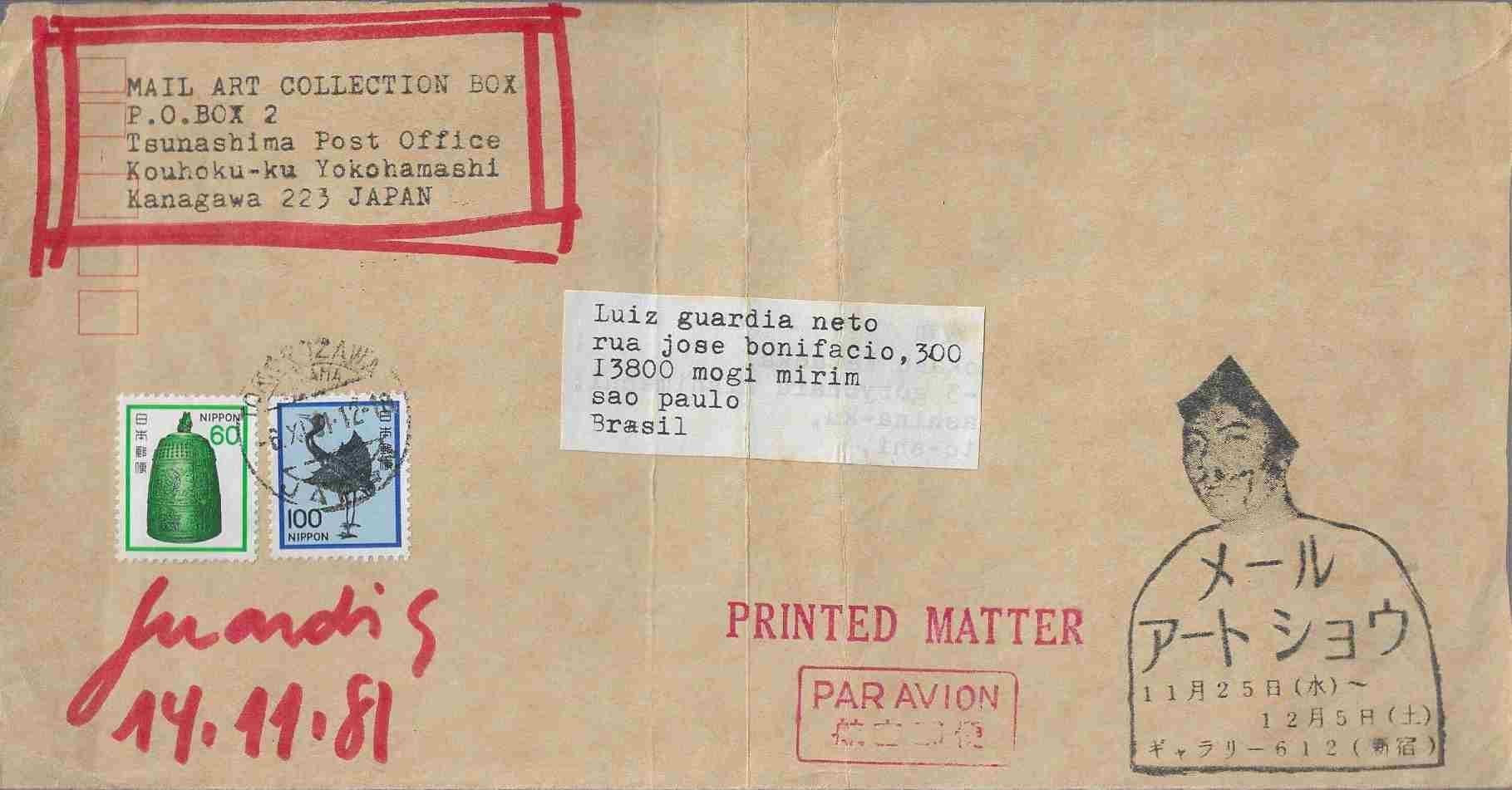
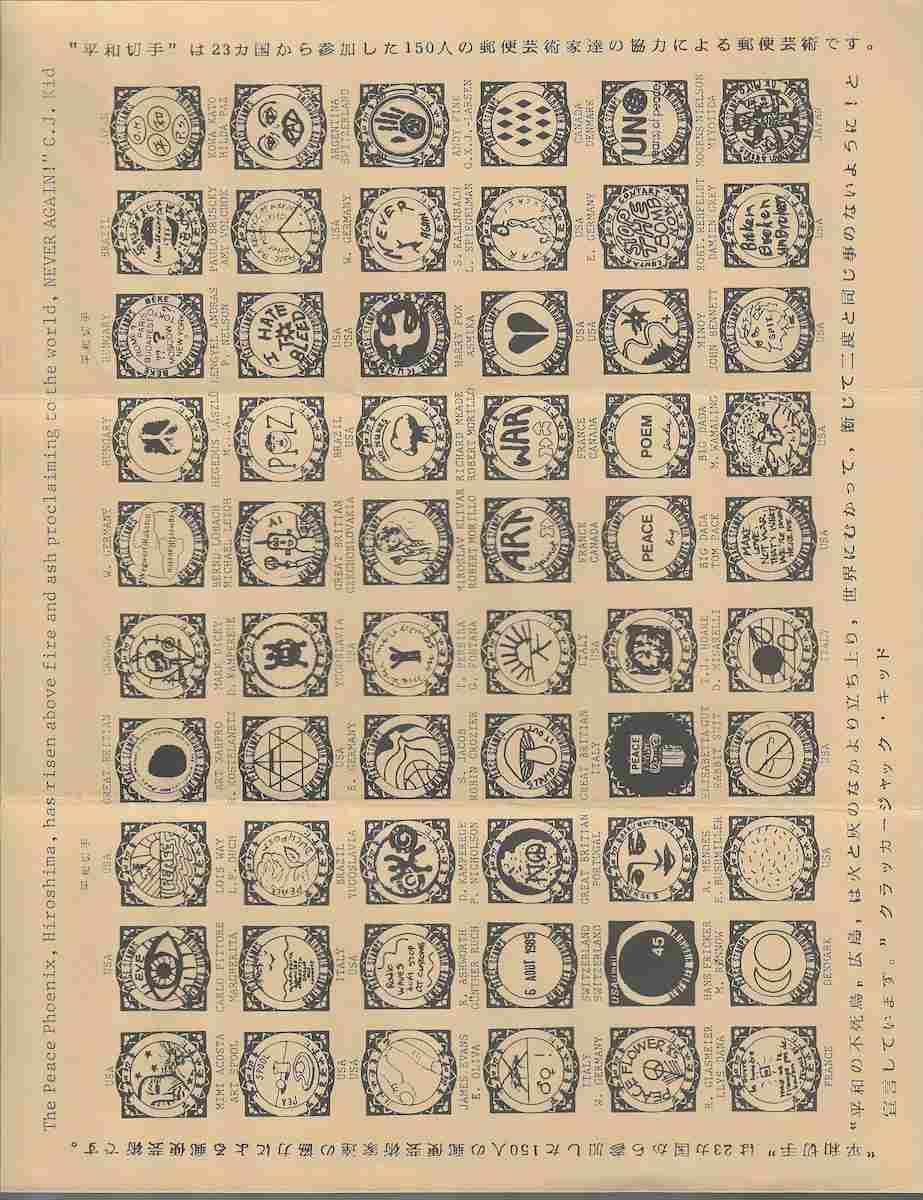
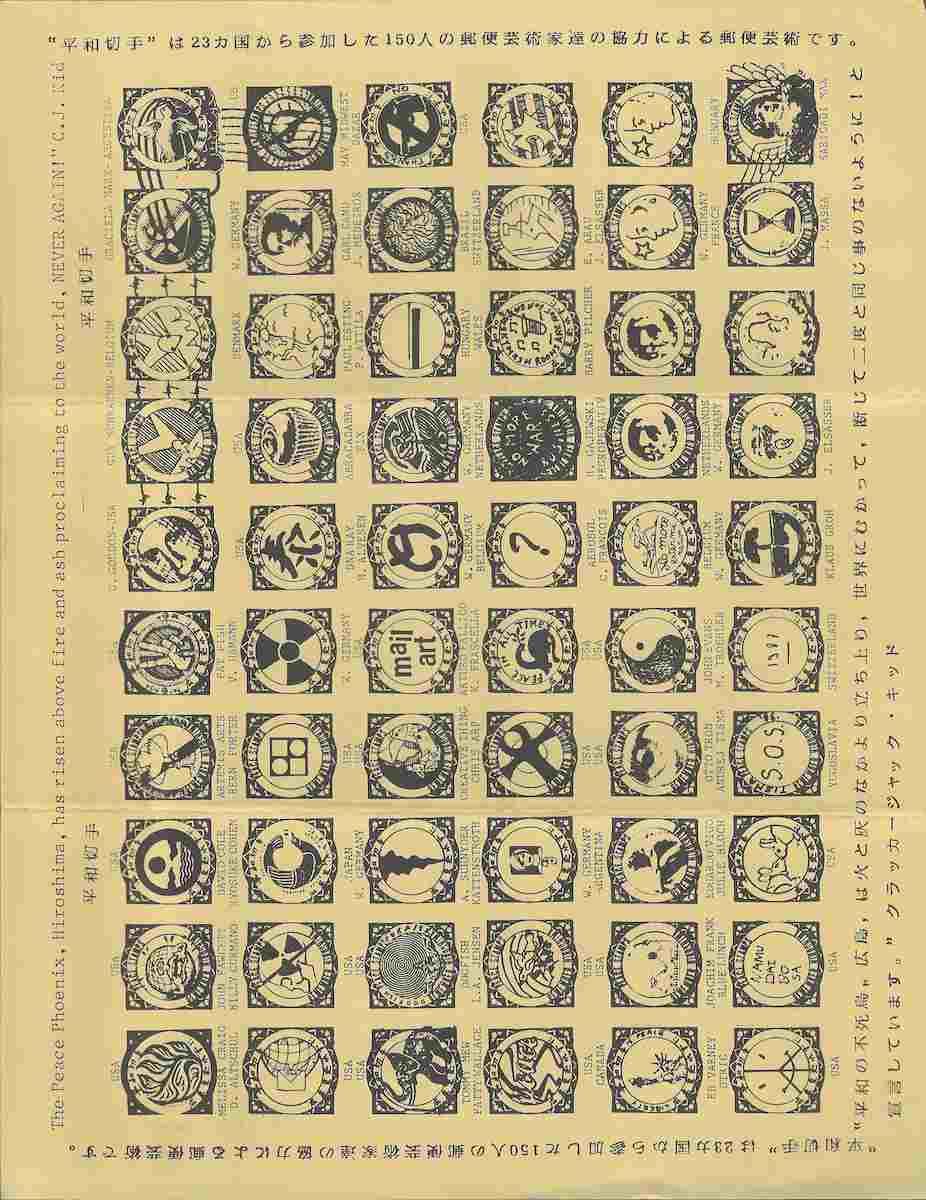
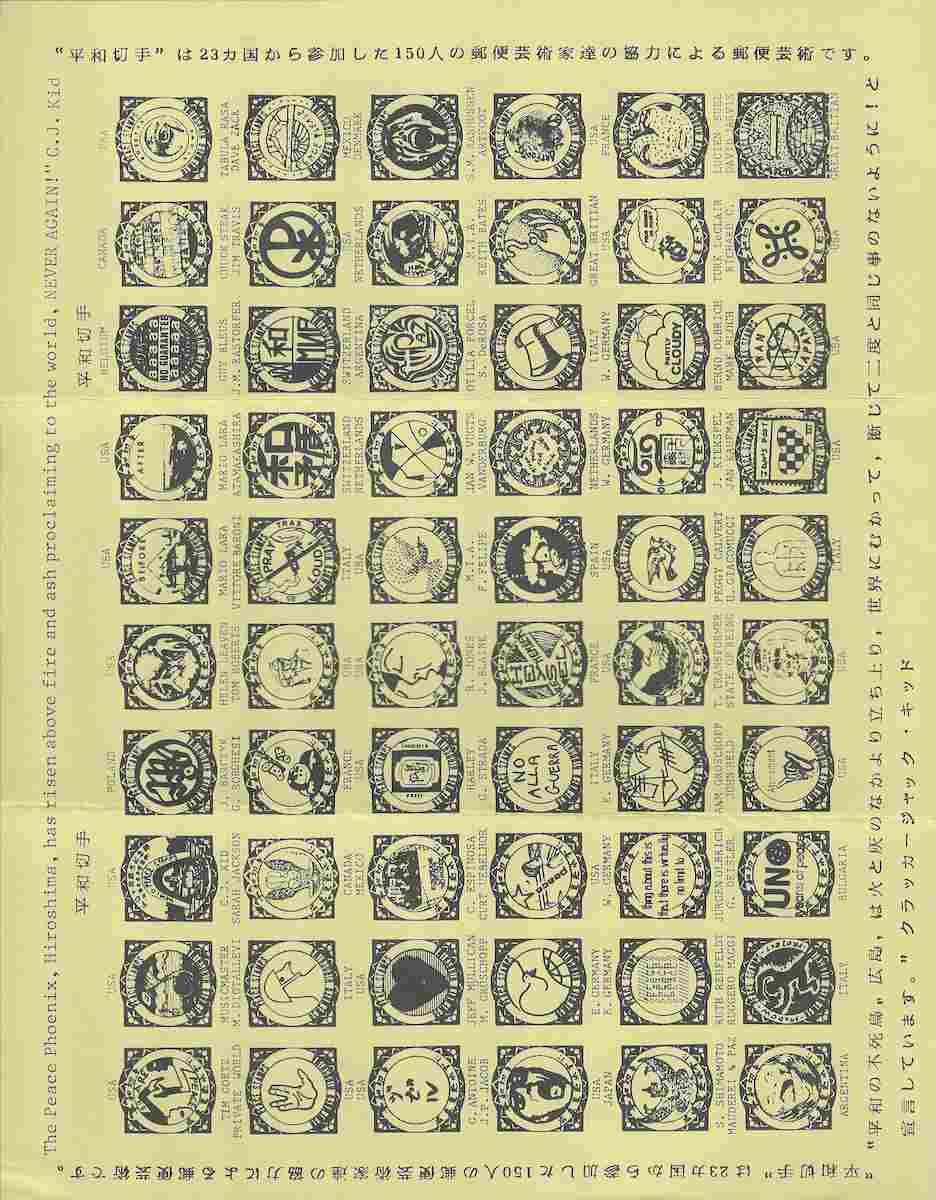
Texto Salsa em portuguêsPeace Stamp, Heiwa Kitte, projeto internacional de Mail Art e artistamps dedicado à paz, à memória de Hiroshima e à circulação postal de imagens produzidas por artistas de diferentes países. O conjunto é formado por envelope de correspondência e três folhas impressas que documentam a participação de 150 artistas postais provenientes de 23 países, reunidos em torno de uma ação coletiva de arte postal com mensagem pacifista e antinuclear.As folhas apresentam dezenas de selos de artista organizados em sequência, cada um associado ao nome e ao país de um participante. Os trabalhos utilizam desenhos, símbolos, palavras, signos abstratos, figuras humanas, animais, formas geométricas e referências à paz, à liberdade, à comunicação e à oposição à guerra. A diversidade gráfica evidencia a natureza internacional e colaborativa do projeto e aproxima o conjunto das práticas de Mail Art, artistamps, poesia visual, arte conceitual e redes alternativas de comunicação artística.O texto impresso nas folhas identifica Hiroshima como elemento central do projeto e apresenta a imagem simbólica da Peace Phoenix, a Fênix da Paz de Hiroshima, que se ergue do fogo e das cinzas proclamando ao mundo Never Again. A expressão sintetiza a dimensão memorial e política da iniciativa, vinculando a produção artística à lembrança da destruição de Hiroshima e à defesa da paz mundial.Em japonês, o conjunto apresenta o título Heiwa Kitte, que pode ser traduzido como Selo da Paz. A documentação informa que o projeto foi realizado com a colaboração de 150 artistas de Mail Art de 23 países. Cada contribuição foi reproduzida em formato semelhante ao de um selo postal, transformando a folha em catálogo visual e arquivo de uma rede internacional de artistas.O envelope correspondente foi enviado do Japão para Luiz Guardia Neto, na Rua José Bonifácio, 300, CEP 13800, Mogi Mirim, São Paulo, Brasil. A origem indicada é Mail Art Collection Box, Caixa Postal 2, Tsunashima Post Office, Kohoku ku, Yokohama shi, Kanagawa 223, Japão. O envelope possui selos postais japoneses Nippon de 60 e 100 ienes, carimbo postal, indicação Printed Matter e Par Avion, confirmando sua circulação internacional como material impresso por correio aéreo.Na lateral direita do envelope aparece uma imagem acompanhada da inscrição japonesa Mail Art Show, com indicação de uma exposição realizada na Gallery 612, em Shinjuku, entre 25 de novembro e 5 de dezembro. Uma anotação manuscrita em vermelho registra aparentemente a data 24 de novembro de 1981, permitindo situar o conjunto no contexto internacional da Mail Art do início da década de 1980.O remetente individual não está identificado de maneira conclusiva no material disponível. A identificação institucional Mail Art Collection Box indica a estrutura responsável pela circulação do conjunto, mas não permite atribuir com segurança o envio a uma pessoa específica. Por esse motivo, o conjunto deve ser catalogado como projeto coletivo internacional de Mail Art com origem em Yokohama, Japão, enviado a Luiz Guardia Neto no Brasil.O conjunto constitui importante documento sobre Mail Art japonesa, artistamps, arte postal internacional, Hiroshima, movimentos pela paz, redes de artistas, comunicação alternativa e intercâmbio cultural anterior à expansão da internet. Também registra a participação brasileira de Luiz Guardia Neto em uma rede transnacional de correspondência artística ativa no início dos anos 1980.Material relevante para indexação de Peace Stamp, Heiwa Kitte, Peace Phoenix Hiroshima, Mail Art Collection Box, Mail Art Show, Gallery 612, Shinjuku, Yokohama, Kanagawa, Japão, Luiz Guardia Neto, Mogi Mirim, São Paulo, Brasil, Mail Art, arte postal, artistamps, selos de artista, poesia visual, arte conceitual, arte colaborativa, arte pela paz, Hiroshima, memória nuclear, arte antinuclear, intercâmbio postal, redes internacionais de artistas e arquivos de arte postal.Salsa text in EnglishPeace Stamp, Heiwa Kitte, an international Mail Art and artistamp project dedicated to peace, the memory of Hiroshima and the postal circulation of images created by artists from different countries. The ensemble consists of a correspondence envelope and three printed sheets documenting the participation of 150 Mail Art artists from 23 countries, brought together in a collective postal art action with a pacifist and antinuclear message.The sheets present dozens of artist stamps arranged in sequence, each associated with the name and country of a participant. The works employ drawings, symbols, words, abstract signs, human figures, animals, geometric forms and references to peace, freedom, communication and opposition to war. The graphic diversity demonstrates the international and collaborative nature of the project and connects the ensemble with Mail Art, artistamps, visual poetry, conceptual art and alternative artistic communication networks.The printed text identifies Hiroshima as a central element of the project and presents the symbolic image of the Peace Phoenix of Hiroshima rising above fire and ash and proclaiming Never Again to the world. This expression summarizes the memorial and political dimension of the initiative, connecting artistic production with the memory of the destruction of Hiroshima and the defense of world peace.In Japanese, the project is identified as Heiwa Kitte, meaning Peace Stamp. The documentation states that the project was produced with the cooperation of 150 Mail Art artists from 23 countries. Each contribution was reproduced in a format resembling a postage stamp, transforming the sheets into both a visual catalogue and an archive of an international artist network.The corresponding envelope was sent from Japan to Luiz Guardia Neto at Rua José Bonifácio, 300, postal code 13800, Mogi Mirim, São Paulo, Brazil. The origin is identified as Mail Art Collection Box, Post Office Box 2, Tsunashima Post Office, Kohoku ku, Yokohama shi, Kanagawa 223, Japan. The envelope carries Japanese Nippon postage stamps valued at 60 and 100 yen, a postal cancellation, the designation Printed Matter and the indication Par Avion, confirming its international circulation as printed material sent by air mail.On the right side of the envelope appears an image accompanied by the Japanese identification Mail Art Show, referring to an exhibition held at Gallery 612 in Shinjuku from November 25 to December 5. A handwritten red notation appears to record the date November 24, 1981, placing the ensemble within the international Mail Art context of the early 1980s.The individual sender cannot be conclusively identified from the available material. The institutional identification Mail Art Collection Box indicates the structure responsible for circulating the material but does not allow the shipment to be safely attributed to a specific person. The ensemble should therefore be catalogued as an international collective Mail Art project originating in Yokohama, Japan, and sent to Luiz Guardia Neto in Brazil.The ensemble is an important document concerning Japanese Mail Art, artistamps, international postal art, Hiroshima, peace movements, artist networks, alternative communication and cultural exchange before the expansion of the internet. It also records the presence of Luiz Guardia Neto within a transnational artistic correspondence network active during the early 1980s.Relevant material for indexing Peace Stamp, Heiwa Kitte, Peace Phoenix Hiroshima, Mail Art Collection Box, Mail Art Show, Gallery 612, Shinjuku, Yokohama, Kanagawa, Japan, Luiz Guardia Neto, Mogi Mirim, São Paulo, Brazil, Mail Art, postal art, artistamps, artist stamps, visual poetry, conceptual art, collaborative art, art for peace, Hiroshima, nuclear memory, antinuclear art, postal exchange, international artist networks and Mail Art archives.
Texto de observação em portuguêsConjunto documental composto por envelope japonês e três folhas impressas relacionadas ao projeto Peace Stamp, Heiwa Kitte. As folhas apresentam aproximadamente 150 contribuições em formato de selo de artista e informam a participação de artistas postais provenientes de 23 países. A estrutura das páginas funciona como catálogo de participantes e registro visual de uma ação internacional de Mail Art dedicada à paz.No alto das folhas aparece um texto japonês informando que Peace Stamp foi produzido com a colaboração de 150 artistas postais de 23 países. Na lateral encontra se a mensagem em inglês relacionada à Peace Phoenix de Hiroshima, afirmando que a Fênix da Paz de Hiroshima se ergueu do fogo e das cinzas proclamando ao mundo Never Again.Cada página organiza dezenas de pequenos trabalhos quadrados ou circulares, acompanhados por nomes de artistas e indicações de países. Entre as imagens encontram se símbolos da paz, pombas, mãos, rostos, figuras humanas, signos geométricos, formas abstratas, globos, elementos tipográficos, mensagens políticas, referências à liberdade e numerosos sinais vinculados à cultura visual da arte postal.Os artistamps utilizam a aparência do selo postal oficial como suporte artístico e conceitual, mas pertencem ao campo da arte e da comunicação independente. Neste conjunto, o formato de selo reforça a relação entre arte, correio, circulação internacional e mensagem política.O envelope possui etiqueta datilografada com a identificação Mail Art Collection Box, Caixa Postal 2, Tsunashima Post Office, Kohoku ku, Yokohama shi, Kanagawa 223, Japão. O destinatário é Luiz Guardia Neto, Rua José Bonifácio, 300, CEP 13800, Mogi Mirim, São Paulo, Brasil.O envelope apresenta dois selos oficiais japoneses com a inscrição Nippon, um de 60 ienes e outro de 100 ienes. Também contém carimbo postal japonês, indicação Printed Matter e marca Par Avion, comprovando o envio internacional por via aérea.Na lateral direita encontra se uma figura acompanhada pela inscrição japonesa Mail Art Show. O texto informa uma realização na Gallery 612, em Shinjuku, com datas de 25 de novembro a 5 de dezembro. A anotação manuscrita em vermelho parece registrar 24 de novembro de 1981.A presença conjunta do envelope, das três folhas, dos selos postais e das informações sobre a exposição permite compreender o material como documentação de um circuito internacional de Mail Art entre Japão e Brasil. Luiz Guardia Neto recebeu o conjunto em Mogi Mirim, integrando uma rede de intercâmbio artístico que conectava artistas de dezenas de países.Embora o endereço de origem esteja claramente identificado, o nome do remetente individual não aparece de forma suficientemente clara no envelope ou nas folhas apresentadas. A autoria institucional pode ser associada ao Mail Art Collection Box e ao projeto Peace Stamp, mas o responsável pessoal pelo envio deve permanecer como não identificado até que surja documentação complementar.A relação com Hiroshima é central para a interpretação do conjunto. A Peace Phoenix, o lema Never Again e a participação internacional transformam o projeto em manifestação artística pela memória, pela paz e contra a repetição da destruição nuclear.Conjunto de grande interesse histórico para pesquisas sobre Mail Art no Japão, artistamps, relações artísticas entre Japão e Brasil, Luiz Guardia Neto, arte postal brasileira, Hiroshima, arte pela paz, cultura antinuclear, exposições internacionais de Mail Art, Gallery 612, Shinjuku, redes alternativas de artistas e circulação de arte por correspondência na década de 1980.Observation text in EnglishDocumentary ensemble composed of a Japanese envelope and three printed sheets related to the Peace Stamp, Heiwa Kitte project. The sheets present approximately 150 contributions in artist stamp format and state the participation of Mail Art artists from 23 countries. The structure of the pages functions as a participant catalogue and as a visual record of an international Mail Art action dedicated to peace.At the top of the sheets a Japanese text states that Peace Stamp was produced with the cooperation of 150 Mail Art artists from 23 countries. Along the side appears an English message concerning the Peace Phoenix of Hiroshima, stating that the Peace Phoenix of Hiroshima rose above fire and ash proclaiming Never Again to the world.Each page organizes dozens of small square or circular works accompanied by artist names and country identifications. The images include peace symbols, doves, hands, faces, human figures, geometric signs, abstract forms, globes, typographic elements, political messages, references to freedom and numerous visual signs associated with postal art culture.The artistamps employ the appearance of official postage stamps as an artistic and conceptual medium, while belonging to the field of art and independent communication. In this ensemble, the stamp format strengthens the relationship among art, postal systems, international circulation and political communication.The envelope contains a typed label identifying Mail Art Collection Box, Post Office Box 2, Tsunashima Post Office, Kohoku ku, Yokohama shi, Kanagawa 223, Japan. The recipient is Luiz Guardia Neto, Rua José Bonifácio, 300, postal code 13800, Mogi Mirim, São Paulo, Brazil.The envelope carries two official Japanese postage stamps marked Nippon, one valued at 60 yen and the other at 100 yen. It also contains a Japanese postal cancellation, the designation Printed Matter and a Par Avion mark, confirming international circulation by air mail.On the right side appears a figure accompanied by the Japanese identification Mail Art Show. The text refers to an event at Gallery 612 in Shinjuku with dates from November 25 to December 5. The handwritten notation in red appears to record November 24, 1981.The combination of the envelope, the three sheets, the postage and the exhibition information makes it possible to understand the material as documentation of an international Mail Art circuit connecting Japan and Brazil. Luiz Guardia Neto received the ensemble in Mogi Mirim, participating in an artistic exchange network that connected artists from dozens of countries.Although the address of origin is clearly identified, the name of the individual sender is not sufficiently visible on the envelope or sheets presented. Institutional responsibility can be associated with Mail Art Collection Box and the Peace Stamp project, but the individual responsible for the shipment should remain unidentified until additional documentation is located.The connection with Hiroshima is central to the interpretation of the ensemble. The Peace Phoenix, the message Never Again and international participation transform the project into an artistic manifestation concerned with memory, peace and resistance to the repetition of nuclear destruction.Historically significant ensemble for research on Mail Art in Japan, artistamps, artistic relations between Japan and Brazil, Luiz Guardia Neto, Brazilian postal art, Hiroshima, art for peace, antinuclear culture, international Mail Art exhibitions, Gallery 612, Shinjuku, alternative artist networks and the circulation of art through correspondence during the 1980s.
Inglês
Peace Stamp, Heiwa Kitte, an international Mail Art and artistamp project dedicated to peace, the memory of Hiroshima and the postal circulation of images created by artists from different countries. The ensemble consists of a correspondence envelope and three printed sheets documenting the participation of 150 Mail Art artists from 23 countries, brought together in a collective postal art action with a pacifist and antinuclear message
Dimensions: 4,7 x 9,1 in