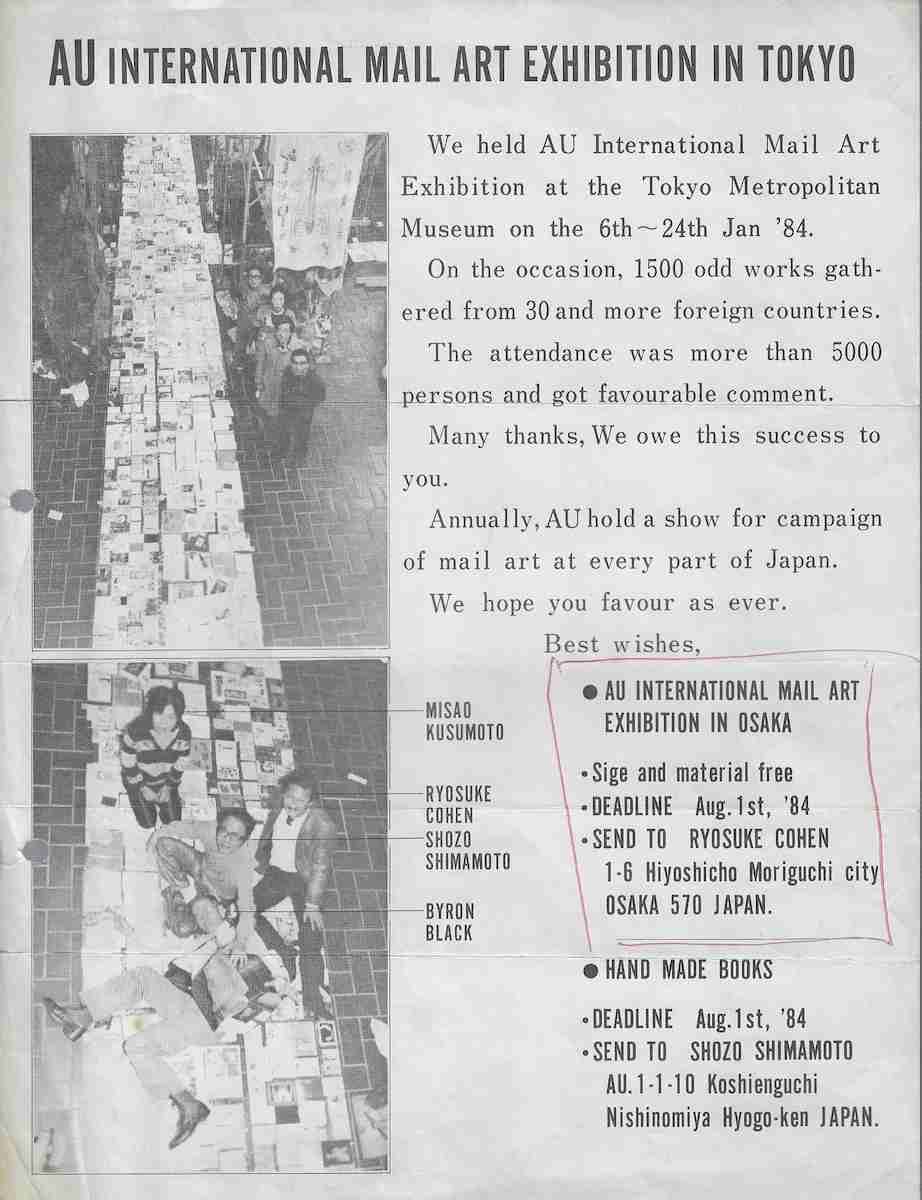
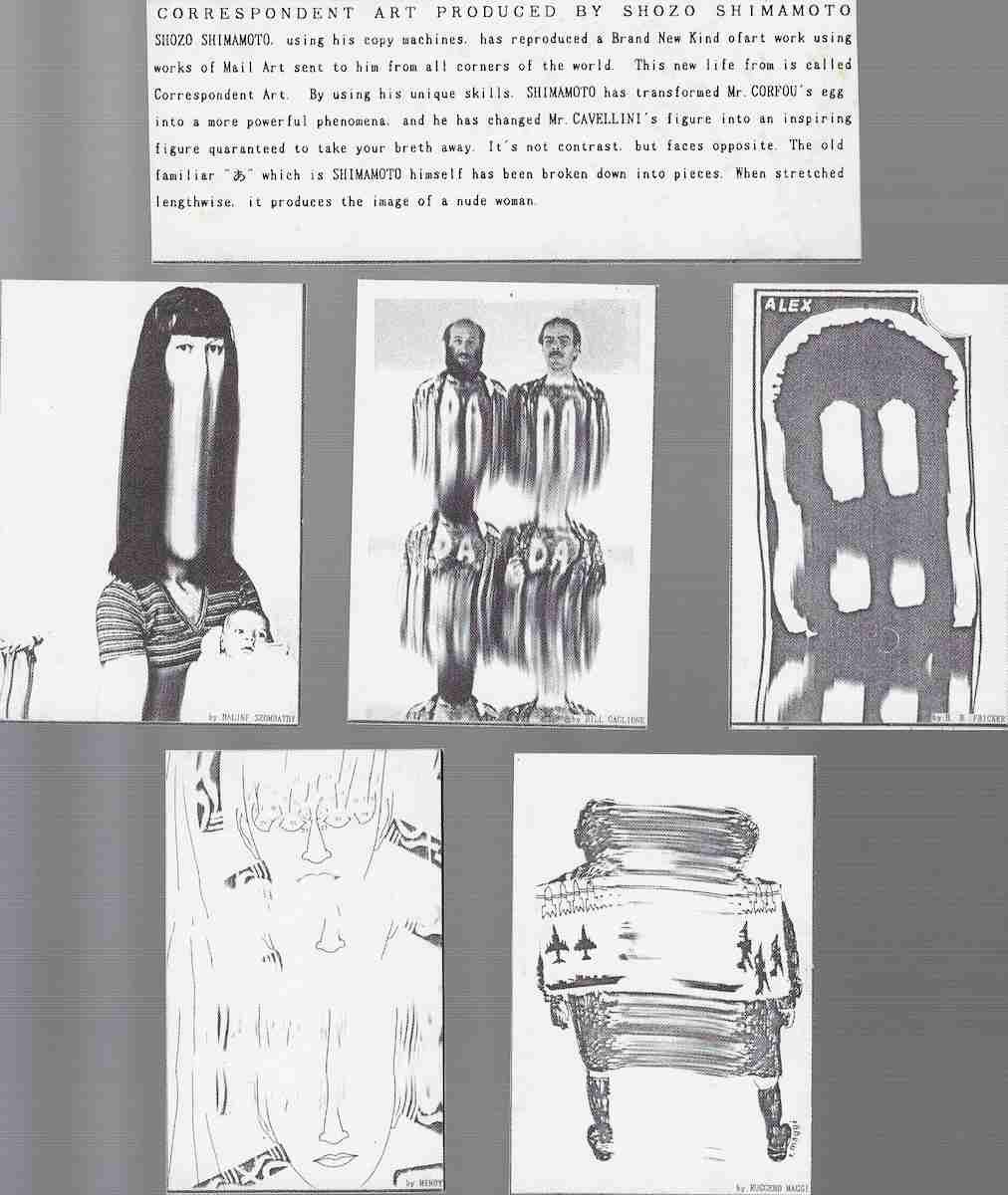
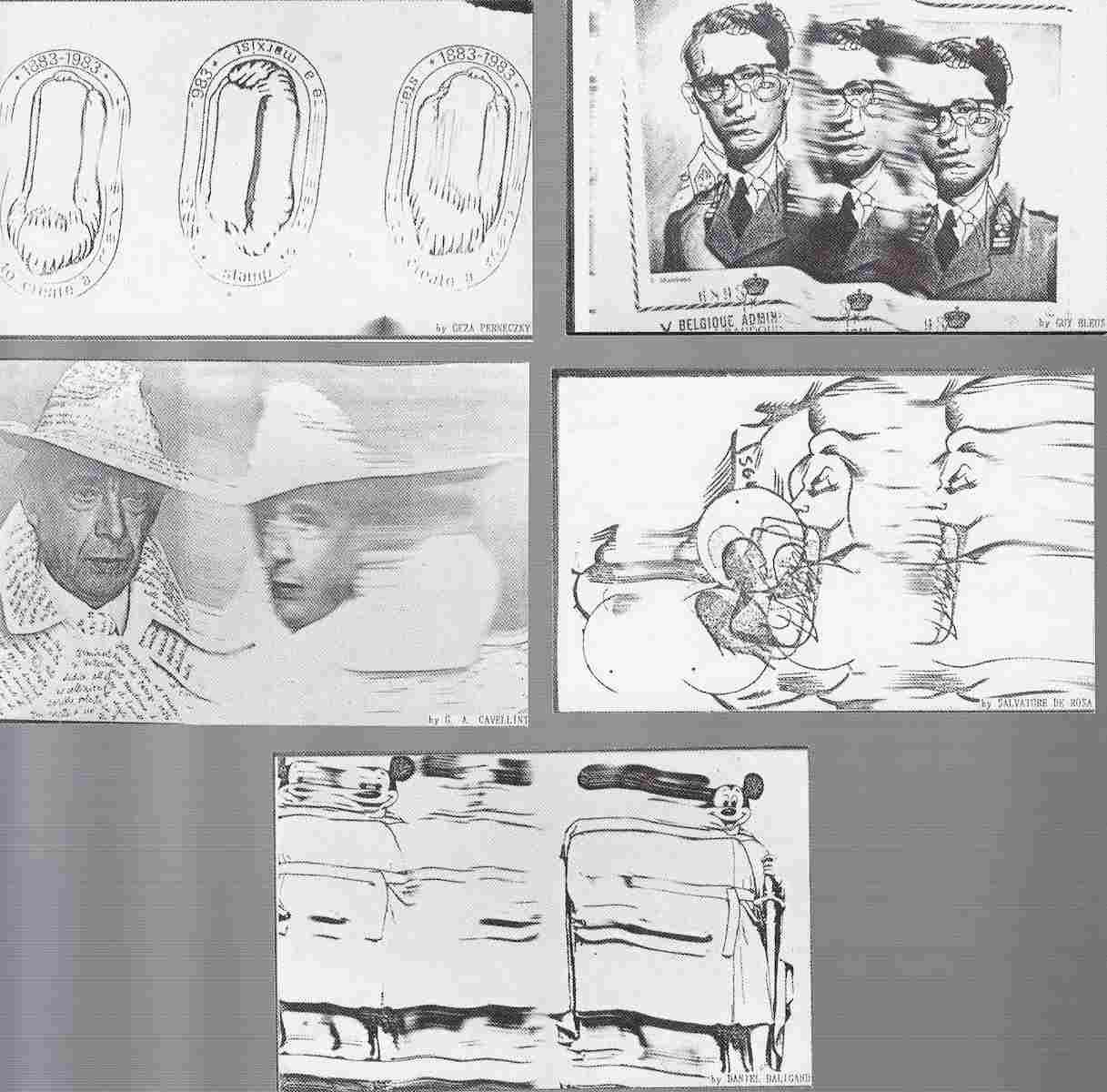
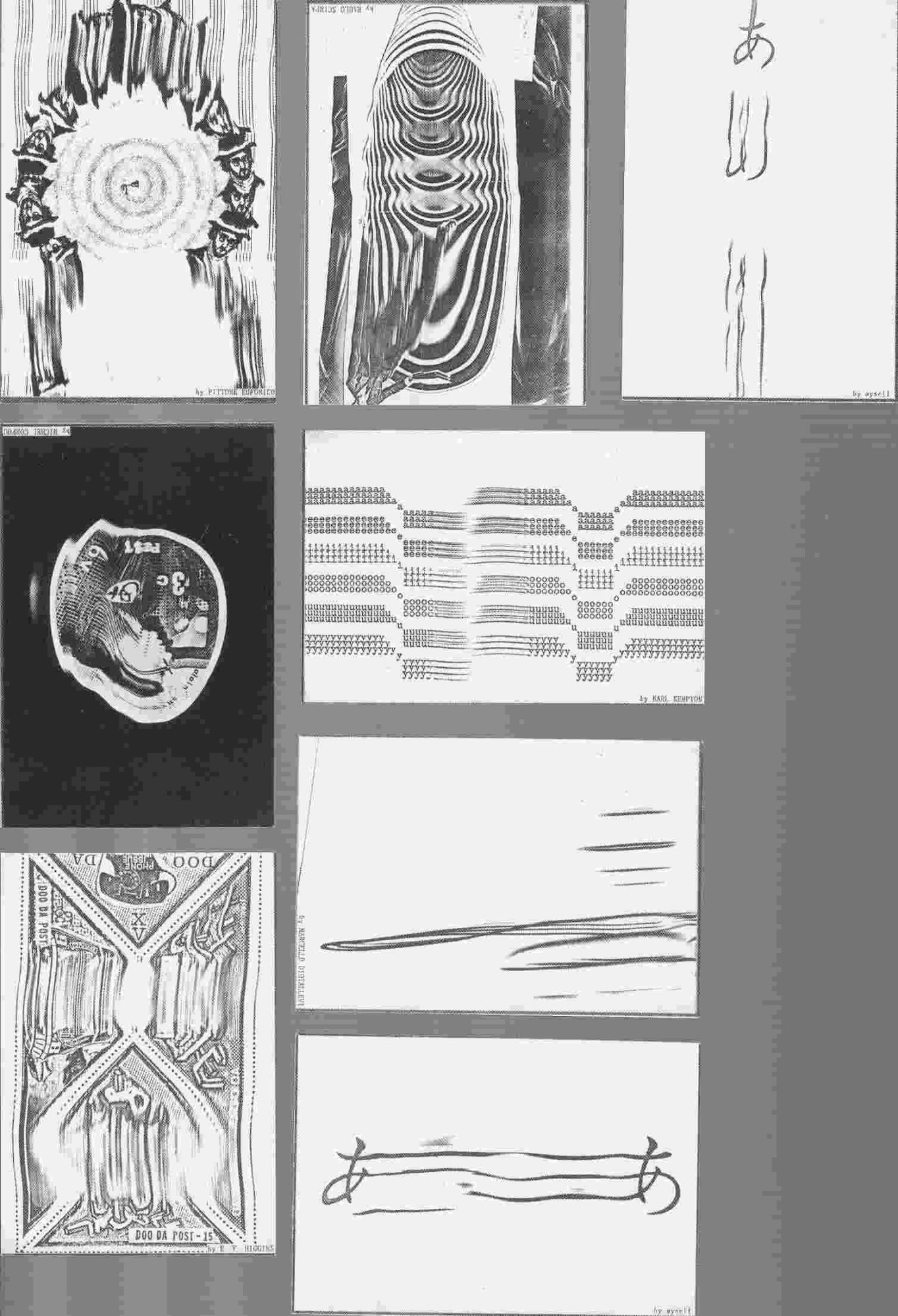
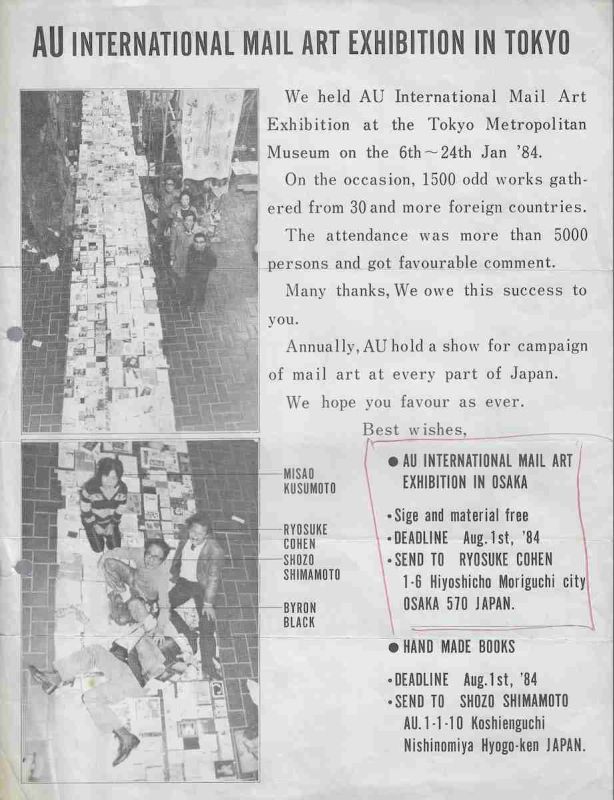
Conjunto documental de Arte Postal produzido no contexto da Artists Union, AU, no Japão, em 1984, composto por um impresso informativo sobre a AU International Mail Art Exhibition in Tokyo e por um conjunto de 18 cartões pertencentes ao projeto Correspondent Art de Shozo Shimamoto.
Shozo Shimamoto - Koshienguchi Nishinomiya - Japan
Categoria: Exposição Coletiva Internacional Arte Correio e Mail Art
Acervo: 04433
Data: 1984
Dimensões: 27,8 x 21,3 cm
Texto Salsa em portuguêsConjunto documental de Arte Postal produzido no contexto da Artists Union, AU, no Japão, em 1984, composto por um impresso informativo sobre a AU International Mail Art Exhibition in Tokyo e por um conjunto de 18 cartões pertencentes ao projeto Correspondent Art de Shozo Shimamoto. O material relaciona diretamente Shozo Shimamoto, Ryosuke Cohen, Misao Kusumoto e Byron Black e documenta uma fase de intensa atividade da AU nas redes internacionais de Mail Art, arte xerográfica, publicação experimental, livro de artista e comunicação postal.O impresso principal registra a realização da AU International Mail Art Exhibition in Tokyo no Tokyo Metropolitan Museum, entre 6 e 24 de janeiro de 1984. Segundo o próprio documento, a exposição reuniu aproximadamente 1500 trabalhos provenientes de mais de 30 países e recebeu mais de 5000 visitantes. O texto agradece aos participantes pela contribuição para o resultado da mostra e informa que a AU realizava anualmente exposições e campanhas de Arte Postal em diferentes regiões do Japão.Na parte inferior do impresso aparecem os nomes Misao Kusumoto, Ryosuke Cohen, Shozo Shimamoto e Byron Black, indicando a equipe diretamente relacionada à organização e à comunicação do projeto. Esses quatro nomes são importantes para compreender a dimensão colaborativa das atividades da AU naquele momento e sua inserção em uma rede internacional que conectava artistas japoneses a participantes da Europa, América Latina, América do Norte e outras regiões.O mesmo informativo anuncia a AU International Mail Art Exhibition in Osaka. A convocatória estabelecia liberdade de tamanho e material, prazo de 1 de agosto de 1984 e recebimento das contribuições por Ryosuke Cohen no endereço 1 6 Hiyoshicho, Moriguchi City, Osaka 570, Japan. Fontes arquivísticas independentes confirmam que a campanha de Mail Art da AU percorreu diferentes localidades japonesas durante 1984 e que Shozo Shimamoto, Ryosuke Cohen, Misao Kusumoto e Byron Black estiveram associados à sua coordenação.O impresso apresenta ainda uma convocatória independente para Hand Made Books. O prazo também era 1 de agosto de 1984 e os trabalhos deveriam ser enviados a Shozo Shimamoto, AU, 1 1 10 Koshienguchi, Nishinomiya, Hyogo ken, Japan. Essa informação demonstra a integração entre Arte Postal, livro de artista, publicação experimental e práticas de rede dentro das atividades da AU.O segundo núcleo do conjunto corresponde a Correspondent Art, projeto produzido por Shozo Shimamoto a partir de obras de Mail Art recebidas de artistas de diferentes partes do mundo. O texto introdutório informa que Shimamoto utilizava máquinas de cópia para reproduzir e transformar trabalhos enviados pela rede postal, criando novas imagens por meio de alongamento, distorção, fragmentação e recomposição. O objetivo não era simplesmente copiar os originais, mas submetê los a um processo de transformação visual capaz de gerar novas relações entre figura, corpo, rosto e forma.Uma descrição bibliográfica recente identifica Correspondent Art como um portfólio de Shozo Shimamoto composto por 18 pequenos cartões e um cartão introdutório. A mesma fonte descreve o conjunto como reproduções e distorções realizadas por Shimamoto a partir de peças de Mail Art de outros artistas. Esse registro corresponde diretamente à configuração material apresentada no conjunto documental.O texto de apresentação de Correspondent Art explica ainda que Shimamoto transformava figuras originalmente recebidas de outros participantes. A referência a Guglielmo Achille Cavellini aparece explicitamente no texto introdutório. Segundo a explicação, a alteração não deveria ser compreendida apenas como contraste, mas como colocação de faces em oposição e como transformação estrutural das imagens. O conhecido sinal gráfico japonês associado ao próprio Shimamoto também teria sido fragmentado e alongado até produzir uma nova figura corporal.Entre os cartões reproduzidos no conjunto são identificáveis visualmente trabalhos ou referências associados a artistas da rede internacional, incluindo Guglielmo Achille Cavellini, Géza Perneczky, Salvatore de Rosa, Ryosuke Cohen e Karl Kempton. Outros nomes aparecem nas reproduções, mas nem todos podem ser lidos com segurança nas imagens disponíveis e por isso não devem ser atribuídos sem conferência direta dos cartões originais.As imagens apresentam procedimentos recorrentes de deformação produzidos por fotocópia. Rostos e corpos são alongados verticalmente, duplicados, comprimidos ou espelhados. Fotografias, desenhos, poemas visuais, caracteres, dinheiro, figuras humanas e sinais gráficos tornam se matéria para uma nova composição. Em vários cartões, o reconhecimento do motivo original permanece possível, mas sua estrutura é alterada por repetição, deslocamento e distorção.O emprego da copiadora possui importância histórica nesse conjunto. Durante as décadas de 1970 e 1980, xerografia e fotocópia tornaram se meios fundamentais das redes de Arte Postal porque permitiam reprodução rápida, relativamente barata e internacionalmente distribuível. Em Correspondent Art, Shimamoto transforma a máquina de reprodução em instrumento de criação. A cópia deixa de ser entendida como duplicação neutra e passa a funcionar como processo artístico.A documentação encontra paralelo em acervos institucionais. A Ohio State University Libraries conserva materiais da AU de 1984, incluindo publicações, documentação de exposições em Tóquio e Osaka e conjuntos de pequenos cartões de copier art de Shozo Shimamoto. O arquivo registra ainda que a AU era um projeto organizado por Shimamoto e documenta a participação de Ryosuke Cohen em exposições e campanhas de Mail Art desse período.A série também deve ser compreendida dentro da trajetória de Shozo Shimamoto após o Gutai. Fundador do Gutai Art Association, Shimamoto transferiu progressivamente sua atenção para formas de comunicação coletiva depois da dissolução do grupo. A publicação Gutai & AU, editada pela Artists Union em Nishinomiya em 1983, registra explicitamente sua tentativa de relacionar a experiência do Gutai às atividades posteriores da AU e à comunicação por Mail Art.Ryosuke Cohen ocupa igualmente posição importante nesse contexto. Antes da criação formal de Brain Cell em 1985, Cohen participava das campanhas da AU, recebia trabalhos, organizava exposições e mantinha intensa correspondência internacional. O endereço de Moriguchi City presente na convocatória de Osaka corresponde ao endereço utilizado por Cohen em sua produção postal do período.O conjunto documental de 1984 revela portanto diferentes níveis de funcionamento da rede. A exposição de Tóquio documenta a escala internacional da participação. A convocatória de Osaka demonstra a continuidade da campanha. O projeto Hand Made Books amplia o campo para livros de artista. Correspondent Art mostra como os materiais recebidos pela rede podiam ser apropriados, transformados e redistribuídos em novas obras.A relação com o Poema Processo não corresponde a uma filiação formal de Shozo Shimamoto, Ryosuke Cohen ou da AU ao movimento brasileiro. Sua relevância para esse campo decorre das redes internacionais compartilhadas por artistas ligados ao Poema Processo, à poesia visual e à Arte Postal no Brasil. Documentos da AU enviados a artistas brasileiros demonstram que o Japão estava integrado ao mesmo circuito transnacional de correspondência, publicações e exposições no qual participaram criadores brasileiros.Como conjunto de arquivo, o material possui importância para pesquisas sobre Shozo Shimamoto, Ryosuke Cohen, Misao Kusumoto, Byron Black, Artists Union, Art Unidentified, AU International Mail Art Exhibition in Tokyo, AU International Mail Art Exhibition in Osaka, Correspondent Art, Hand Made Books, Mail Art, copier art, xerografia, livro de artista, publicação experimental, Gutai, poesia visual e redes internacionais de comunicação artística em 1984.Salsa text in EnglishDocumentary Mail Art ensemble produced within the context of Artists Union, AU, in Japan in 1984, consisting of an informational sheet concerning the AU International Mail Art Exhibition in Tokyo and a group of 18 cards belonging to Shozo Shimamoto's Correspondent Art project. The material directly connects Shozo Shimamoto, Ryosuke Cohen, Misao Kusumoto and Byron Black and documents an intense period of AU activity within international networks of Mail Art, copier art, experimental publishing, artists books and postal communication.The main information sheet records the AU International Mail Art Exhibition in Tokyo held at the Tokyo Metropolitan Museum from January 6 to January 24, 1984. According to the document itself, the exhibition assembled approximately 1500 works received from more than 30 countries and attracted more than 5000 visitors. The text thanks participants for contributing to the success of the exhibition and explains that AU organized annual Mail Art exhibitions and campaigns in different parts of Japan.The names Misao Kusumoto, Ryosuke Cohen, Shozo Shimamoto and Byron Black appear in the lower section of the sheet, identifying figures directly associated with the organization and communication of the project. These names are essential to understanding the collaborative character of AU activities during this period and its position within an international network connecting Japanese artists with participants in Europe, Latin America, North America and other regions.The same sheet announces the AU International Mail Art Exhibition in Osaka. The call allowed participants complete freedom concerning size and material, established August 1, 1984 as the deadline and directed contributions to Ryosuke Cohen at 1 6 Hiyoshicho, Moriguchi City, Osaka 570, Japan. Independent archival documentation confirms that the AU Mail Art campaign circulated through different Japanese venues during 1984 and associates Shozo Shimamoto, Ryosuke Cohen, Misao Kusumoto and Byron Black with its coordination.The information sheet also contains a separate call for Hand Made Books. The deadline was likewise August 1, 1984 and works were to be sent to Shozo Shimamoto, AU, 1 1 10 Koshienguchi, Nishinomiya, Hyogo ken, Japan. This information demonstrates the integration of Mail Art, artists books, experimental publishing and network practices within AU activities.The second major component of the ensemble is Correspondent Art, a project produced by Shozo Shimamoto from Mail Art works received from artists throughout the world. The introductory text explains that Shimamoto used copying machines to reproduce and transform works submitted through the postal network, creating new images through elongation, distortion, fragmentation and recomposition. The process was not intended merely to duplicate the originals but to subject them to visual transformation and generate new relationships among figures, bodies, faces and forms.A recent bibliographic description identifies Correspondent Art as a portfolio by Shozo Shimamoto consisting of 18 small cards together with an introductory card. The same source describes the cards as Mail Art pieces by other artists reproduced and distorted by Shimamoto. This description corresponds directly to the material configuration of the documentary ensemble.The introductory text for Correspondent Art also explains that Shimamoto transformed figures originally received from other participants. Guglielmo Achille Cavellini is explicitly mentioned. According to the text, the transformations should not simply be understood as contrast but as a process in which faces were placed in opposition and the internal structure of images was altered. A familiar Japanese graphic sign associated with Shimamoto himself was also fragmented and stretched until it generated a new bodily image.Among the reproduced cards, visually identifiable works or references include material associated with Guglielmo Achille Cavellini, Géza Perneczky, Salvatore de Rosa, Ryosuke Cohen and Karl Kempton. Additional names appear on the cards, but not all can be read securely from the available reproductions and should therefore remain unattributed until the original objects can be examined directly.The cards demonstrate recurrent procedures of photocographic deformation. Faces and bodies are vertically stretched, doubled, compressed or mirrored. Photographs, drawings, visual poems, characters, currency, human figures and graphic signs become raw material for new compositions. In several cards the original motif remains partially recognizable while its structure is transformed through repetition, displacement and distortion.The copying machine is historically significant within this ensemble. During the 1970s and 1980s xerography and photocopying became fundamental media within Mail Art networks because they enabled rapid and relatively inexpensive reproduction suitable for international circulation. In Correspondent Art, Shimamoto transformed the reproduction machine into a creative instrument. Copying ceased to function as neutral duplication and became an artistic process in itself.Institutional holdings provide further documentary context. The Ohio State University Libraries preserve AU material from 1984, including publications, documentation of exhibitions in Tokyo and Osaka and sets of small copier art cards by Shozo Shimamoto. The archive also records AU as a project organized by Shimamoto and documents Ryosuke Cohen's involvement in Mail Art exhibitions and campaigns of this period.The series should also be understood within Shozo Shimamoto's career after Gutai. A founding participant of the Gutai Art Association, Shimamoto progressively redirected his attention toward collective forms of communication after the group dissolved. Gutai & AU, published by Artists Union in Nishinomiya in 1983, explicitly documents his attempt to connect the history of Gutai with his later activities in AU and with communication through Mail Art.Ryosuke Cohen also occupies an important position in this context. Before formally initiating Brain Cell in 1985, Cohen participated in AU campaigns, received contributions, helped organize exhibitions and maintained extensive international correspondence. The Moriguchi City address printed in the Osaka call corresponds to the address used by Cohen in his postal production of this period.The 1984 documentary ensemble therefore reveals several interconnected levels of network activity. The Tokyo exhibition documents the international scale of participation. The Osaka call demonstrates continuity of the campaign. Hand Made Books extends the network into artists book practices. Correspondent Art demonstrates how material received through the network could be appropriated, transformed and redistributed as new artistic work.The relationship with the Brazilian Process Poem Movement does not indicate formal membership of Shozo Shimamoto, Ryosuke Cohen or AU in that movement. Its relevance derives from international networks also shared by Brazilian artists connected with Poema Processo, visual poetry and Mail Art. AU documents circulated to Brazilian artists and demonstrate that Japan participated in the same transnational field of correspondence, publications and exhibitions.As an archival ensemble, the material is significant for research on Shozo Shimamoto, Ryosuke Cohen, Misao Kusumoto, Byron Black, Artists Union, Art Unidentified, AU International Mail Art Exhibition in Tokyo, AU International Mail Art Exhibition in Osaka, Correspondent Art, Hand Made Books, Mail Art, copier art, xerography, artists books, experimental publishing, Gutai, visual poetry and international artistic communication networks in 1984.
Texto de observação em portuguêsConjunto documental japonês de 1984 relacionado à Artists Union, AU, composto por impresso informativo sobre a AU International Mail Art Exhibition in Tokyo e por um conjunto de 18 pequenos cartões do projeto Correspondent Art de Shozo Shimamoto.O impresso informa que a AU International Mail Art Exhibition in Tokyo foi realizada no Tokyo Metropolitan Museum entre 6 e 24 de janeiro de 1984. Segundo o próprio documento, aproximadamente 1500 trabalhos provenientes de mais de 30 países foram reunidos e a exposição recebeu mais de 5000 visitantes.O material identifica Misao Kusumoto, Ryosuke Cohen, Shozo Shimamoto e Byron Black. Também anuncia a AU International Mail Art Exhibition in Osaka, com liberdade de tamanho e material, prazo de 1 de agosto de 1984 e envio para Ryosuke Cohen, 1 6 Hiyoshicho, Moriguchi City, Osaka 570, Japan. Uma segunda convocatória, Hand Made Books, apresenta o mesmo prazo e solicita envio para Shozo Shimamoto, AU, 1 1 10 Koshienguchi, Nishinomiya, Hyogo ken, Japan.O conjunto Correspondent Art é formado por 18 cartões e um texto introdutório. Shimamoto utilizou máquinas de cópia para reproduzir e deformar trabalhos de Mail Art enviados por outros artistas. Uma descrição bibliográfica independente confirma a existência desse portfólio de 18 pequenos cartões e caracteriza o processo como reprodução e distorção de peças recebidas da rede postal.Os cartões utilizam alongamento, duplicação, compressão, espelhamento e fragmentação de imagens. Entre os nomes legíveis ou identificáveis no conjunto aparecem Guglielmo Achille Cavellini, Géza Perneczky, Salvatore de Rosa, Ryosuke Cohen e Karl Kempton. Outros autores devem permanecer sem atribuição até que a leitura dos originais permita confirmação segura.A presença de fotocópia e copier art possui importância central. Em vez de utilizar a copiadora apenas como instrumento reprodutivo, Shozo Shimamoto empregou o equipamento para alterar a estrutura visual das contribuições recebidas, transformando correspondência em nova obra.Documentação institucional da Ohio State University registra exposições de Mail Art da AU em Tóquio e Osaka em 1984, publicações AU e conjuntos de cartões de copier art de Shozo Shimamoto, confirmando o contexto histórico e material desse tipo de conjunto.O material documenta a interação entre Shozo Shimamoto, Ryosuke Cohen, Misao Kusumoto, Byron Black e a ampla rede internacional da AU. Sua relação com o Poema Processo é indireta e ocorre através dos circuitos internacionais de Arte Postal e poesia visual frequentados também por artistas brasileiros associados ao movimento.Documento relevante para pesquisas sobre Artists Union, AU, Art Unidentified, Shozo Shimamoto, Ryosuke Cohen, Misao Kusumoto, Byron Black, Correspondent Art, AU International Mail Art Exhibition in Tokyo, AU International Mail Art Exhibition in Osaka, Hand Made Books, Mail Art, copier art, xerografia, livro de artista, Gutai, poesia visual e redes internacionais de arte em 1984.Observation text in EnglishJapanese documentary ensemble from 1984 associated with Artists Union, AU, consisting of an information sheet concerning the AU International Mail Art Exhibition in Tokyo and a group of 18 small cards from Shozo Shimamoto's Correspondent Art project.The information sheet states that the AU International Mail Art Exhibition in Tokyo was held at the Tokyo Metropolitan Museum from January 6 to January 24, 1984. According to the document itself, approximately 1500 works from more than 30 countries were assembled and the exhibition attracted more than 5000 visitors.The material identifies Misao Kusumoto, Ryosuke Cohen, Shozo Shimamoto and Byron Black. It also announces the AU International Mail Art Exhibition in Osaka, with unrestricted size and materials, an August 1, 1984 deadline and submissions directed to Ryosuke Cohen at 1 6 Hiyoshicho, Moriguchi City, Osaka 570, Japan. A second call for Hand Made Books gives the same deadline and directs submissions to Shozo Shimamoto, AU, 1 1 10 Koshienguchi, Nishinomiya, Hyogo ken, Japan.Correspondent Art consists of 18 cards accompanied by an introductory text. Shimamoto used copying machines to reproduce and distort Mail Art works submitted by other artists. An independent bibliographic description confirms the existence of this portfolio of 18 small cards and describes the process as the reproduction and distortion of Mail Art pieces received from other participants.The cards employ elongation, duplication, compression, mirroring and fragmentation. Legible or identifiable names within the ensemble include Guglielmo Achille Cavellini, Géza Perneczky, Salvatore de Rosa, Ryosuke Cohen and Karl Kempton. Other authors should remain unattributed until examination of the original cards allows reliable identification.Photocopying and copier art are central to the significance of the ensemble. Rather than using the copying machine merely as a reproductive device, Shozo Shimamoto employed it to alter the visual structure of received contributions and transform correspondence into new artistic work.Institutional documentation at the Ohio State University records AU Mail Art exhibitions in Tokyo and Osaka in 1984, AU publications and sets of small copier art cards by Shozo Shimamoto, confirming the historical and material context of this type of ensemble.The material documents interaction among Shozo Shimamoto, Ryosuke Cohen, Misao Kusumoto, Byron Black and the wider international AU network. Its relationship with the Process Poem Movement is indirect and occurs through international Mail Art and visual poetry circuits that were also frequented by Brazilian artists associated with Poema Processo.The ensemble is relevant to research on Artists Union, AU, Art Unidentified, Shozo Shimamoto, Ryosuke Cohen, Misao Kusumoto, Byron Black, Correspondent Art, AU International Mail Art Exhibition in Tokyo, AU International Mail Art Exhibition in Osaka, Hand Made Books, Mail Art, copier art, xerography, artists books, Gutai, visual poetry and international art networks in 1984.
Inglês
Documentary Mail Art ensemble produced within the context of Artists Union, AU, in Japan in 1984, consisting of an informational sheet concerning the AU International Mail Art Exhibition in Tokyo and a group of 18 cards belonging to Shozo Shimamoto's Correspondent Art project.
Dimensions: 10,9 x 8,4 in