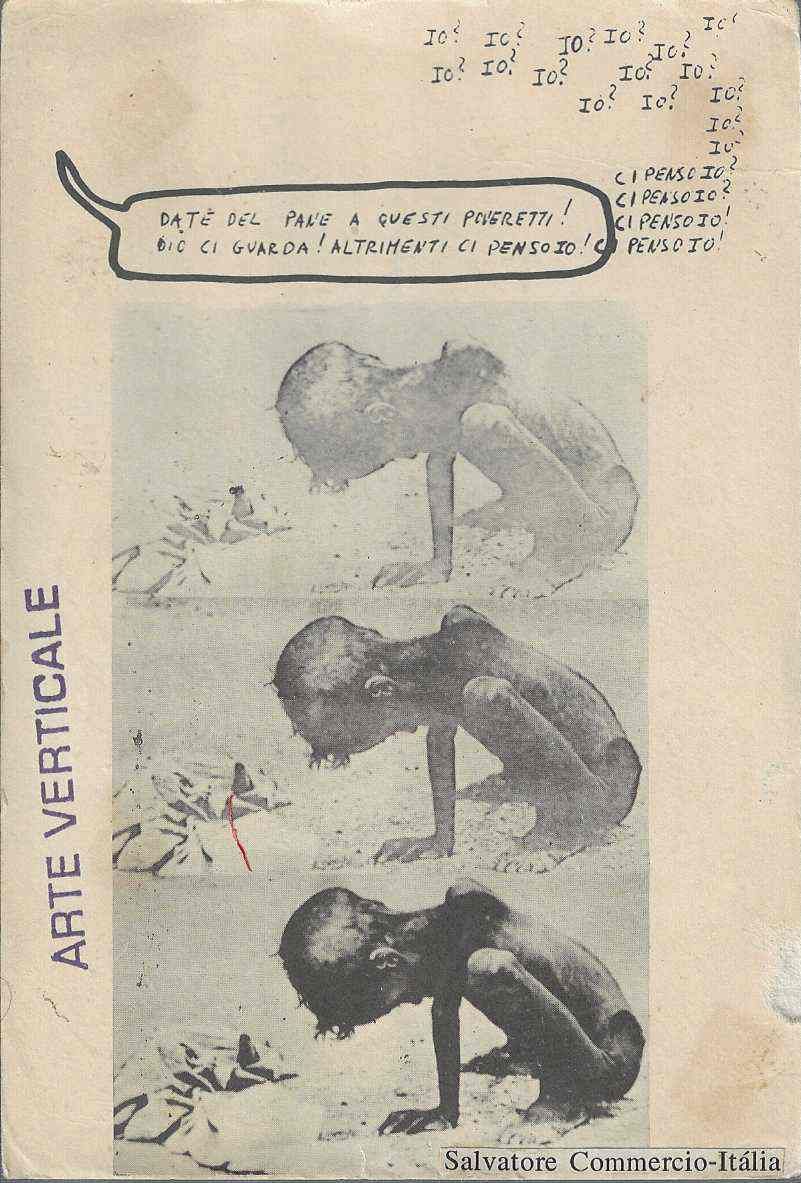
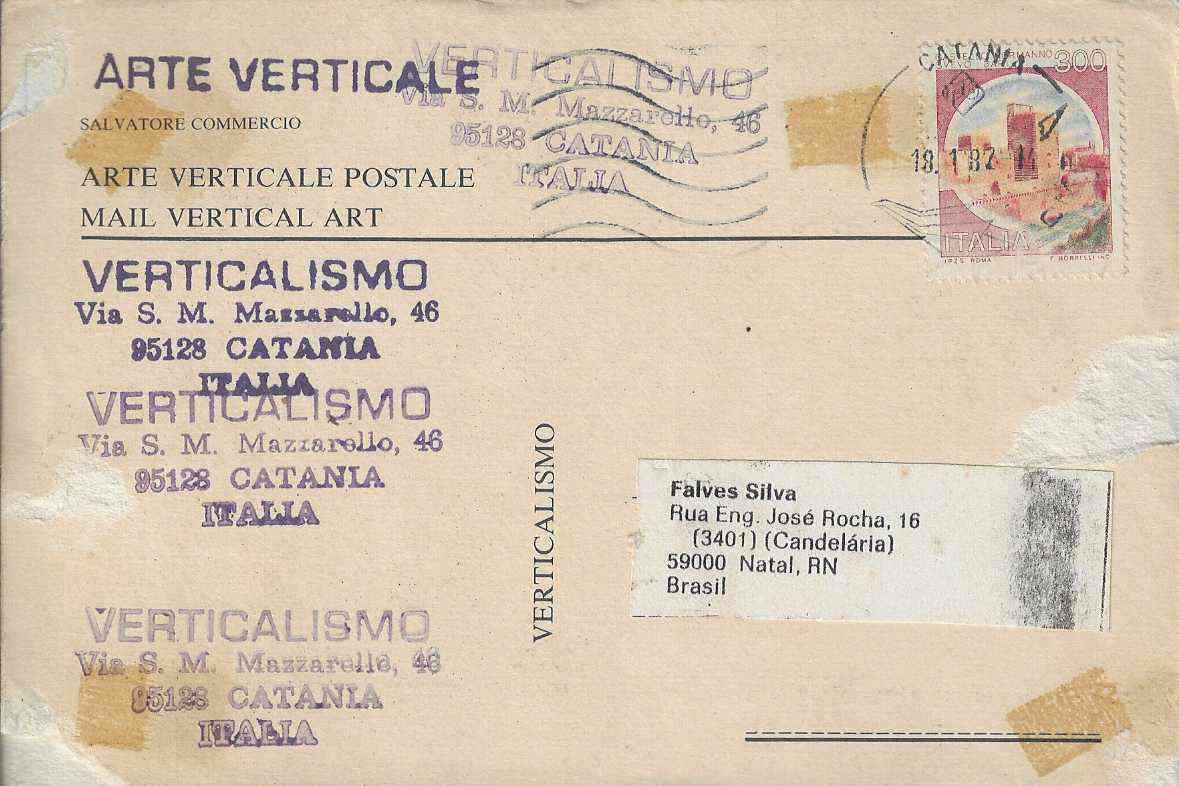
Cartão de arte postal de Salvatore Commercio, artista italiano ligado ao movimento Verticalismo e ao projeto Arte Verticale Postale, enviado a Falves Silva em Natal, Rio Grande do Norte, com data postal de 18 de janeiro de 1982
Salvatore Commercio - Arte Verticale - Italia
Categoria: Mail Art
Acervo: 04422
Data: 18 de janeiro de 1982
Dimensões: 15 x 10,2 cm
TEXTO SALSA EM PORTUGUÊSCartão de arte postal de Salvatore Commercio, artista italiano ligado ao movimento Verticalismo e ao projeto Arte Verticale Postale, enviado a Falves Silva em Natal, Rio Grande do Norte, com data postal de 18 de janeiro de 1982. A peça constitui documentação direta da circulação entre Catania, Itália, e o Brasil e estabelece uma relação material entre Salvatore Commercio, a mail art italiana e Falves Silva, participante histórico do Poema Processo e ativo nas redes internacionais de arte postal.Na face principal aparece uma composição gráfica baseada na repetição de três imagens fotográficas em preto e branco de uma criança em situação de pobreza. A sequência vertical funciona como estrutura narrativa e crítica, aproximando fotografia documental, repetição, texto, poesia visual e comentário social. Acima das imagens há uma grande forma semelhante a balão de fala contendo a frase italiana Date del pane a questi poveretti, Dio ci guarda, altrimenti ci penso io. Ao redor aparecem repetidamente as expressões Io e Ci penso io, transformadas em elementos gráficos e verbais.A combinação entre a representação de pobreza, a repetição da criança e a frase sobre alimento produz uma obra de explícita dimensão social. O cartão aborda fome, desigualdade, responsabilidade individual, consciência social e relação entre observador e sofrimento humano. A frase Ci penso io, repetida de maneira insistente, funciona simultaneamente como linguagem, ritmo visual e provocação ética. A estrutura aproxima o trabalho da poesia visual, da arte conceitual e das experiências intermedia desenvolvidas no âmbito do Verticalismo.Na margem esquerda está impressa verticalmente a identificação ARTE VERTICALE. Na parte inferior aparece Salvatore Commercio Italia, tornando explícita a autoria e a origem geográfica. O próprio objeto relaciona, portanto, a imagem crítica à identidade do projeto verticalista de Commercio.O verso fornece informações especialmente importantes para a catalogação. Na região superior esquerda aparecem ARTE VERTICALE, SALVATORE COMMERCIO, ARTE VERTICALE POSTALE e MAIL VERTICAL ART. Essas inscrições confirmam que o cartão não deve ser classificado apenas como correspondência pessoal, mas como parte de uma proposição artística formalmente identificada por Commercio como Arte Verticale Postale e Mail Vertical Art.Vários carimbos em tinta violeta registram VERTICALISMO e o endereço Via S. M. Mazzarello 46, 95128 Catania, Italia. A repetição dos carimbos transforma o verso em campo gráfico e funciona como assinatura institucional do movimento. A palavra VERTICALISMO aparece também impressa verticalmente próxima à região central.O destinatário está registrado em etiqueta como Falves Silva, Rua Engenheiro José Rocha 16, 3401 Candelária, 59000 Natal, RN, Brasil. O cartão apresenta selo italiano de 300 lire e carimbo postal de Catania datado de 18 de janeiro de 1982, comprovando sua circulação efetiva pelo sistema postal internacional.O documento é particularmente importante porque antecipa e contextualiza a presença de Arte Verticale Postale documentada em publicações do movimento naquele mesmo ano. O envio demonstra que Salvatore Commercio já utilizava no início de 1982 a denominação Arte Verticale Postale e Mail Vertical Art em correspondência internacional. Dessa forma, o cartão constitui fonte primária para reconstruir o desenvolvimento da vertente postal do Verticalismo.A destinação a Falves Silva acrescenta relevância para o estudo das relações entre a arte experimental italiana e brasileira. Falves Silva foi integrante histórico do Poema Processo e desenvolveu intensa atividade em poesia visual, publicações experimentais e arte postal. O cartão demonstra contato direto entre Salvatore Commercio e Falves Silva e documenta um ponto concreto de encontro entre Verticalismo, Arte Verticale Postale, mail art italiana e a rede internacional relacionada ao Poema Processo.O documento não comprova que Salvatore Commercio tenha integrado formalmente o Poema Processo. Sua relação com o movimento brasileiro deve ser registrada como conexão documental de rede estabelecida através de Falves Silva e de práticas compartilhadas de poesia visual, comunicação experimental, publicação alternativa e arte postal.Para indexação museológica, arquivística e semântica são relevantes Salvatore Commercio, Falves Silva, Arte Verticale, Arte Verticale Postale, Mail Vertical Art, Verticalismo, Catania, Itália, Via S. M. Mazzarello 46, 95128 Catania, 18 de janeiro de 1982, Natal, Rio Grande do Norte, Brasil, mail art, arte postal italiana, poesia visual, poesia experimental, arte conceitual, fotografia documental, pobreza, fome, crítica social, comunicação artística internacional, Poema Processo e rede internacional de mail art.SALSA TEXT IN ENGLISHMail art postcard by Salvatore Commercio, an Italian artist associated with the Verticalismo movement and the Arte Verticale Postale project, sent to Falves Silva in Natal, Rio Grande do Norte, with a postal date of 18 January 1982. The piece provides direct documentation of artistic circulation between Catania, Italy, and Brazil and establishes a material relationship among Salvatore Commercio, Italian mail art and Falves Silva, a historical participant in the Process Poem Movement and an active figure in international postal art networks.The main side presents a graphic composition based on the repetition of three black and white photographic images of a child living in conditions of poverty. The vertical sequence functions as a narrative and critical structure, combining documentary photography, repetition, text, visual poetry and social commentary. Above the images is a large speechlike form containing the Italian phrase Date del pane a questi poveretti, Dio ci guarda, altrimenti ci penso io. Around it the expressions Io and Ci penso io are repeatedly inscribed and transformed into both verbal and graphic elements.The combination of poverty imagery, repetition of the child and a phrase concerning food gives the work a direct social dimension. The postcard addresses hunger, inequality, personal responsibility, social conscience and the relationship between the observer and human suffering. The repeated phrase Ci penso io functions simultaneously as language, visual rhythm and ethical provocation. This structure connects the work with visual poetry, conceptual art and intermedia experiments developed within Verticalismo.The left margin contains the vertical printed identification ARTE VERTICALE. At the bottom appears Salvatore Commercio Italia, explicitly establishing authorship and geographical origin. The object therefore directly connects its critical imagery with Commercios verticalist project.The reverse contains particularly important cataloguing information. In the upper left area appear ARTE VERTICALE, SALVATORE COMMERCIO, ARTE VERTICALE POSTALE and MAIL VERTICAL ART. These inscriptions confirm that the postcard should not be classified merely as personal correspondence but as part of an artistic proposition formally identified by Commercio as Arte Verticale Postale and Mail Vertical Art.Several violet stamps contain VERTICALISMO and the address Via S. M. Mazzarello 46, 95128 Catania, Italia. Their repetition transforms the reverse into a graphic field and functions as an institutional signature of the movement. The word VERTICALISMO also appears vertically near the center.The recipient is identified on a label as Falves Silva, Rua Engenheiro José Rocha 16, 3401 Candelária, 59000 Natal, RN, Brazil. The postcard carries an Italian 300 lire stamp and a Catania postal cancellation dated 18 January 1982, providing material evidence of actual international postal circulation.The document is particularly important because it anticipates and contextualizes the documented presence of Arte Verticale Postale in Verticalismo publications later that same year. The mailing demonstrates that Salvatore Commercio was already using the designations Arte Verticale Postale and Mail Vertical Art in international correspondence at the beginning of 1982. The postcard is therefore a primary source for reconstructing the development of the postal dimension of Verticalismo.Its destination to Falves Silva adds particular relevance to the study of relationships between Italian and Brazilian experimental art. Falves Silva was a historical participant in the Process Poem Movement and developed extensive activity in visual poetry, experimental publishing and mail art. The postcard establishes direct contact between Salvatore Commercio and Falves Silva and documents a concrete point of connection among Verticalismo, Arte Verticale Postale, Italian mail art and the international network associated with the Process Poem Movement.The document does not establish Salvatore Commercio as a formal participant in the Process Poem Movement. His relationship with the Brazilian movement should instead be described as a documentary network connection established through Falves Silva and through shared practices involving visual poetry, experimental communication, alternative publishing and mail art.Relevant terms for museum, archival and semantic indexing include Salvatore Commercio, Falves Silva, Arte Verticale, Arte Verticale Postale, Mail Vertical Art, Verticalismo, Catania, Italy, Via S. M. Mazzarello 46, 95128 Catania, 18 January 1982, Natal, Rio Grande do Norte, Brazil, mail art, Italian postal art, visual poetry, experimental poetry, conceptual art, documentary photography, poverty, hunger, social criticism, international artistic communication, Process Poem Movement and international mail art network.
TEXTO DE OBSERVAÇÃO EM PORTUGUÊSCartão original de arte postal de Salvatore Commercio enviado a Falves Silva e circulado a partir de Catania, Itália, com carimbo postal de 18 de janeiro de 1982. A peça apresenta composição gráfica e fotográfica na frente e extensa identificação institucional do Verticalismo e da Arte Verticale Postale no verso.Na face principal há três reproduções sucessivas da mesma fotografia em preto e branco mostrando uma criança agachada em ambiente de extrema precariedade. As imagens são organizadas verticalmente e apresentam pequenas variações de contraste decorrentes do processo de reprodução. A repetição intensifica a presença da figura e transforma uma única fotografia em sequência visual.Na parte superior encontra se um grande contorno horizontal semelhante a um balão de fala. Dentro dele aparece manuscrita a frase italiana Date del pane a questi poveretti, Dio ci guarda, altrimenti ci penso io. A formulação pode ser entendida como apelo para que seja dado pão aos pobres e como afirmação de responsabilidade diante da situação representada. Algumas letras possuem grafia manual irregular, razão pela qual uma transcrição crítica definitiva deve sempre ser confrontada com o original.Acima e à direita do balão aparecem numerosas repetições de Io e Ci penso io, algumas acompanhadas de sinais de interrogação. A repetição cria uma nuvem verbal que transforma a expressão em elemento de poesia visual. O texto não funciona somente como legenda da fotografia, mas como parte estrutural da composição.Na margem esquerda aparece ARTE VERTICALE em grandes letras violeta organizadas verticalmente. Na parte inferior está impressa a identificação Salvatore Commercio Italia. Esses elementos oferecem confirmação direta da autoria e do vínculo com Arte Verticale.O verso apresenta no topo ARTE VERTICALE em tinta violeta. Abaixo encontra se impresso SALVATORE COMMERCIO. Em seguida aparecem ARTE VERTICALE POSTALE e MAIL VERTICAL ART. Esse conjunto possui excepcional importância documental porque identifica explicitamente o objeto como integrante da proposta postal do Verticalismo.Vários carimbos repetidos registram VERTICALISMO, Via S. M. Mazzarello 46, 95128 CATANIA, ITALIA. O endereço aparece em diferentes intensidades de tinta e em posições sucessivas. A repetição transforma informação administrativa em recurso gráfico, característica recorrente da mail art e da rubber stamp art.Na região superior encontra se também endereço manuscrito ou carimbado de Salvatore Commercio em Catania. Parte dele está sobreposta por marcas postais e não deve ser reconstruída além do que é claramente legível.No centro do verso aparece verticalmente a palavra VERTICALISMO em impressão preta. À direita encontra se a etiqueta de endereço do destinatário com Falves Silva, Rua Eng. José Rocha, 16, 3401 Candelária, 59000 Natal, RN, Brasil.No canto superior direito há selo postal italiano de 300 lire. Sobre o selo e o cartão observa se carimbo circular de Catania com data de 18 de janeiro de 1982. Esse dado estabelece com segurança a circulação internacional do objeto nessa data.Pequenos fragmentos de fita adesiva antiga permanecem em diferentes pontos da peça. Há também áreas de desgaste, manchas e abrasão superficial, elementos relacionados à história material de circulação, montagem ou conservação do cartão.A obra apresenta convergência entre fotografia documental, intervenção verbal e comunicação postal. A repetição da criança, a frase sobre oferecer pão e a insistência em Ci penso io constroem uma reflexão sobre pobreza, fome, responsabilidade e solidariedade. A presença de Arte Verticale Postale demonstra que esse conteúdo social foi deliberadamente inserido em um sistema de circulação artística internacional.O cartão possui valor documental excepcional para o estudo de Salvatore Commercio porque registra simultaneamente Arte Verticale, Arte Verticale Postale, Mail Vertical Art e Verticalismo em um objeto efetivamente circulado. A data de janeiro de 1982 é particularmente significativa por demonstrar o uso dessas denominações antes das publicações documentadas de Arte Verticale Postale dos meses seguintes daquele ano.A destinação a Falves Silva acrescenta um segundo nível de importância histórica. O objeto comprova correspondência direta entre Salvatore Commercio e um participante histórico do Poema Processo. Essa conexão deve ser indexada como relação entre artistas e redes de mail art, sem transformar Commercio em integrante do movimento brasileiro.Para catalogação e indexação são relevantes Salvatore Commercio, Falves Silva, Arte Verticale, Arte Verticale Postale, Mail Vertical Art, Verticalismo, Catania, Sicilia, Itália, Via S. M. Mazzarello 46, 95128 Catania, 18 de janeiro de 1982, Natal, Candelária, Rio Grande do Norte, Brasil, cartão postal de artista, arte postal, mail art italiana, fotografia, pobreza, fome, criança, crítica social, poesia visual, texto imagem, repetição, carimbo de artista, comunicação internacional, Poema Processo e arte experimental.OBSERVATION TEXT IN ENGLISHOriginal mail art postcard by Salvatore Commercio sent to Falves Silva and circulated from Catania, Italy, with a postal cancellation dated 18 January 1982. The piece contains a graphic and photographic composition on the front and extensive institutional identification of Verticalismo and Arte Verticale Postale on the reverse.The main side contains three successive reproductions of the same black and white photograph showing a crouching child in conditions of severe deprivation. The images are arranged vertically and display slight differences in contrast resulting from the reproduction process. Repetition intensifies the presence of the figure and transforms a single photograph into a visual sequence.The upper area contains a large horizontal outline resembling a speech balloon. Inside is the handwritten Italian phrase Date del pane a questi poveretti, Dio ci guarda, altrimenti ci penso io. The statement can be understood as an appeal to give bread to the poor and as an assertion of responsibility toward the situation represented. Some letters are written irregularly, so a definitive critical transcription should always be checked against the physical original.Above and to the right of the speech form are numerous repetitions of Io and Ci penso io, some accompanied by question marks. This accumulation creates a verbal cloud and transforms the expression into visual poetry. The text therefore functions not merely as a caption but as a structural component of the composition.Along the left margin appears ARTE VERTICALE in large violet letters arranged vertically. At the bottom is the printed identification Salvatore Commercio Italia. These elements directly confirm authorship and the relationship with Arte Verticale.The reverse bears ARTE VERTICALE in violet at the top, followed by the printed name SALVATORE COMMERCIO. Beneath it appear ARTE VERTICALE POSTALE and MAIL VERTICAL ART. This group of inscriptions has exceptional documentary importance because it explicitly identifies the object as part of the postal dimension of Verticalismo.Several repeated stamps contain VERTICALISMO, Via S. M. Mazzarello 46, 95128 CATANIA, ITALIA. The address appears in different ink densities and repeated positions. This repetition transforms administrative information into a graphic resource characteristic of mail art and rubber stamp practices.The upper area also contains additional handwritten or stamped address information for Salvatore Commercio in Catania. Part of it is overlapped by postal markings and should not be reconstructed beyond what is clearly visible.Near the center the word VERTICALISMO appears vertically in black print. To the right is the recipient label identifying Falves Silva, Rua Eng. José Rocha, 16, 3401 Candelária, 59000 Natal, RN, Brazil.An Italian 300 lire postage stamp appears in the upper right corner. A circular Catania postal cancellation crosses the stamp and the postcard and is dated 18 January 1982. This provides secure evidence of actual international postal circulation on that date.Small fragments of aged adhesive tape remain at several points on the piece. Surface wear, stains and abrasions are also visible and belong to the material history of circulation, mounting or previous conservation.The work brings together documentary photography, verbal intervention and postal communication. Repetition of the child, the appeal concerning bread and the insistent use of Ci penso io construct a reflection on poverty, hunger, responsibility and solidarity. The presence of Arte Verticale Postale demonstrates that this social content was deliberately inserted into an international artistic circulation system.The postcard has exceptional documentary value for research on Salvatore Commercio because it brings together Arte Verticale, Arte Verticale Postale, Mail Vertical Art and Verticalismo on an object that actually circulated through the postal system. Its January 1982 date is especially significant because it documents the use of these designations before the better documented Arte Verticale Postale publications that appeared later in the same year.Its destination to Falves Silva adds a second level of historical importance. The object confirms direct correspondence between Salvatore Commercio and a historical participant in the Process Poem Movement. This connection should be indexed as a relationship between artists and mail art networks without classifying Commercio as a member of the Brazilian movement.Relevant terms for cataloguing and semantic indexing include Salvatore Commercio, Falves Silva, Arte Verticale, Arte Verticale Postale, Mail Vertical Art, Verticalismo, Catania, Sicily, Italy, Via S. M. Mazzarello 46, 95128 Catania, 18 January 1982, Natal, Candelária, Rio Grande do Norte, Brazil, artists postcard, mail art, Italian mail art, photography, poverty, hunger, child, social criticism, visual poetry, text image relationship, repetition, artists stamp, international communication, Process Poem Movement and experimental art.
Proveniência
Coleção Falves SilvaInglês
Mail art postcard by Salvatore Commercio, an Italian artist associated with the Verticalismo movement and the Arte Verticale Postale project, sent to Falves Silva in Natal, Rio Grande do Norte, with a postal date of 18 January 1982
Dimensions: 5,9 x 4 in