
The Diaries of Guglielmo Achille Cavellini 1975 é um livro de artista e publicação autobiográfica conceitual de Guglielmo Achille Cavellini, artista italiano associado à arte conceitual, mail art, arte postal e ao projeto de autostoricizzazione.
Gugliemo Cavellini Achille - Brescia - Italia
Categoria: Livro
Acervo: 04256
Data: 1975
Dimensões: 29,7 x 20,9 cm
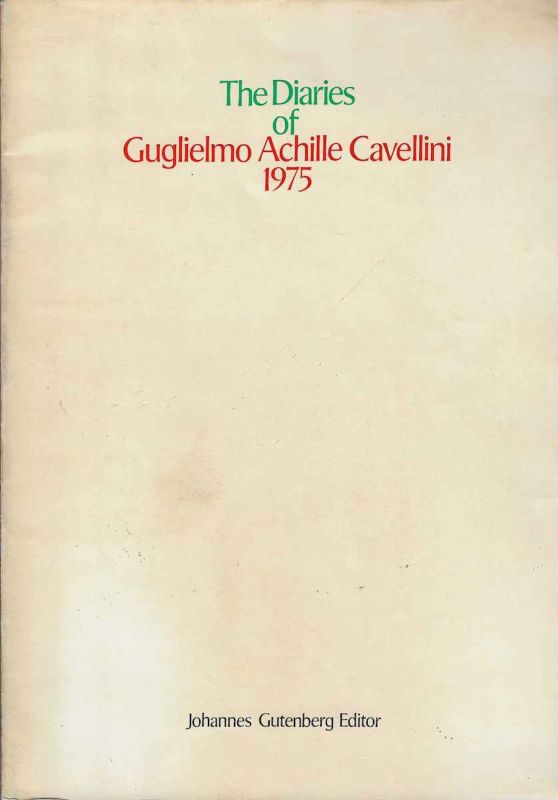
Texto Salsa em portuguêsThe Diaries of Guglielmo Achille Cavellini 1975 é um livro de artista e publicação autobiográfica conceitual de Guglielmo Achille Cavellini, artista italiano associado à arte conceitual, mail art, arte postal e ao projeto de autostoricizzazione. A capa apresenta o título The Diaries of Guglielmo Achille Cavellini 1975 e a identificação editorial Johannes Gutenberg Editor. A publicação reúne entradas de diário referentes ao ano de 1975 e integra o conjunto de livros e materiais pelos quais Cavellini construiu, documentou e difundiu sua própria história artística.O exemplar apresentado possui capa branca de composição tipográfica extremamente reduzida. Na parte superior, The Diaries of aparece em verde, enquanto Guglielmo Achille Cavellini e 1975 aparecem em vermelho. Na região inferior encontra se Johannes Gutenberg Editor em preto. A ausência de imagem na capa concentra a atenção no nome do artista, na natureza autobiográfica da publicação e no ano transformado em elemento central de identificação.Registros bibliográficos consultados apresentam pequenas divergências quanto ao ano exato de publicação da edição inglesa. O WorldCat cataloga The Diaries of Guglielmo Achille Cavellini, 1975 como livro impresso em inglês, publicado por Johannes Gutenberg, com data aproximada de 1979. Outros registros especializados situam exemplares em 1976 ou 1978. Uma descrição bibliográfica de coleção registra Brescia, Johannes Gutenberg Editor, aproximadamente 1976, 60 páginas, formato de 29,7 por 21 centímetros e impressão offset em preto e branco sobre papel branco. Outra descrição comercial registra 56 páginas. Por rigor catalográfico, o título deve ser preservado com a data 1975, que corresponde ao conteúdo do diário, enquanto a data física da edição inglesa deve ser indicada como aproximadamente 1976 ou posterior quando não houver colofão disponível para confirmação.Segundo descrição especializada de exemplar, as entradas do diário se estendem de 1 de janeiro a 25 de dezembro de 1975. O livro faz parte da estratégia conceitual de Cavellini conhecida como autostoricizzazione, por meio da qual o artista produziu textos, cartazes, livros, selos, adesivos, performances, correspondências e outras formas de documentação imaginando e antecipando sua própria consagração histórica.A autostoricizzazione tornou se um dos eixos fundamentais da produção de Cavellini. Em vez de aguardar que críticos, museus e historiadores construíssem sua posteridade, o artista apropriou se dos próprios mecanismos de legitimação do sistema da arte. Criou biografias, efemérides, exposições imaginárias, comemorações, selos e materiais relativos ao centenário de seu nascimento em 2014. The Diaries participa diretamente dessa operação ao converter a escrita cotidiana e autobiográfica em componente de uma obra maior sobre identidade, fama, memória e institucionalização artística. Uma descrição bibliográfica do volume relaciona explicitamente o livro ao projeto de autostoricização e à retrospectiva imaginária de 2014.O conteúdo não deve ser compreendido apenas como diário pessoal no sentido literário convencional. A escrita autobiográfica de Cavellini participa de uma estratégia artística na qual a própria vida, o nome e a imagem pública do artista se tornam materiais de trabalho. O diário é simultaneamente relato, documento, performance textual e instrumento de construção de uma persona artística.A publicação inclui reproduções fotográficas em preto e branco. Uma descrição de exemplar registra seis pranchas pictóricas. Outra fonte informa que o livro inclui imagens de performances de Cavellini escrevendo textos sobre diferentes superfícies, entre elas uma roupa branca e o corpo de um homem nu. Essas imagens são particularmente relevantes para compreender como escrita, corpo e performance se relacionavam dentro de seu projeto conceitual.A capa e o projeto gráfico utilizam uma linguagem tipográfica austera, próxima das publicações conceituais e dos livros de artista da década de 1970. A hierarquia cromática entre verde, vermelho e preto organiza o título sem recorrer a ilustração. Essa redução visual reforça a ideia de publicação documental e, ao mesmo tempo, transforma nome, data e função editorial em elementos plásticos.Johannes Gutenberg Editor não deve ser interpretado automaticamente como uma editora comercial convencional. No contexto da produção de Cavellini, a designação participa de sua estratégia editorial e conceitual, associada à produção e circulação autônoma de livros. Registros de coleção situam a publicação em Brescia e a descrevem como brochura impressa em offset.Uma descrição preservada pelo Centre des livres d'artistes registra ainda que determinado exemplar continha dois adesivos inseridos. Um deles apresentava Cavellini 1914 2014, referência direta ao centenário imaginado pelo artista, e outro continha a inscrição Graffiti of Altamira. Essa informação demonstra como o livro podia circular acompanhado por materiais gráficos adicionais relacionados ao sistema de autostoricizzazione.A circulação internacional da edição em inglês deve ser entendida também no contexto das redes de mail art nas quais Cavellini teve atuação intensa. Livros, adesivos, cartões, selos, manifestos e correspondências eram enviados a artistas, críticos, arquivos e instituições em diferentes países. A publicação funcionava, portanto, não apenas como livro destinado à leitura, mas como instrumento de comunicação e difusão de sua identidade artística.The Diaries of Guglielmo Achille Cavellini 1975 ocupa posição relevante dentro da produção editorial do artista porque transforma um ano de sua vida em documento autônomo e o insere no sistema mais amplo de autorrepresentação concebido por Cavellini. O livro participa de uma genealogia que atravessa arte conceitual, livro de artista, autobiografia, performance, mail art, publicação independente e crítica institucional.Como fonte histórica, a publicação é importante para pesquisas sobre Guglielmo Achille Cavellini, GAC, The Diaries of Guglielmo Achille Cavellini 1975, Johannes Gutenberg Editor, Brescia, autostoricizzazione, self historicization, mail art, arte postal, livro de artista, publicação de artista, arte conceitual, performance, autobiografia de artista e redes internacionais de arte experimental dos anos 1970.Salsa text in EnglishThe Diaries of Guglielmo Achille Cavellini 1975 is an artists book and conceptual autobiographical publication by Guglielmo Achille Cavellini, the Italian artist associated with Conceptual Art, mail art and his project of autostoricizzazione. The cover bears the title The Diaries of Guglielmo Achille Cavellini 1975 and the editorial designation Johannes Gutenberg Editor. The publication contains diary entries relating to the year 1975 and belongs to the broader group of books and printed materials through which Cavellini constructed, documented and distributed his own artistic history.The copy shown has a white cover with an extremely restrained typographic composition. The words The Diaries of appear in green at the top, while Guglielmo Achille Cavellini and 1975 are printed in red. Johannes Gutenberg Editor appears in black in the lower area. The absence of a cover image directs attention toward the artist's name, the autobiographical nature of the publication and the year as a central identifying element.Bibliographical records consulted present minor discrepancies concerning the actual publication date of the English edition. WorldCat catalogs The Diaries of Guglielmo Achille Cavellini, 1975 as an English language print book published by Johannes Gutenberg with an approximate date of 1979. Other specialist records date copies to 1976 or 1978. One collection record describes the book as Brescia, Johannes Gutenberg Editor, approximately 1976, 60 pages, 29.7 by 21 centimeters, printed in black and white offset on white paper. Another description records 56 pages. For cataloguing accuracy, the date 1975 should be preserved as part of the title and as the year covered by the diary, while the physical publication date of the English edition should be given as approximately 1976 or later when no colophon is available for confirmation.According to a specialist description of the book, the diary entries run from 1 January to 25 December 1975. The publication forms part of Cavellini's conceptual strategy known as autostoricizzazione, through which he produced texts, posters, books, stamps, stickers, performances, correspondence and other documentary forms imagining and anticipating his own historical recognition.Autostoricizzazione became one of the central structures of Cavellini's work. Rather than waiting for critics, museums and historians to construct his posterity, he appropriated the mechanisms of legitimation used by the art system itself. He created biographies, chronologies, imaginary exhibitions, commemorative materials, stamps and documents related to the centenary of his birth in 2014. The Diaries participates directly in this operation by transforming everyday autobiographical writing into a component of a larger work concerning identity, fame, memory and artistic institutionalization. A bibliographical description of the volume explicitly connects it with Cavellini's self historicization project and his imagined 2014 retrospective.The contents should not be understood merely as a personal diary in a conventional literary sense. Cavellini's autobiographical writing forms part of an artistic strategy in which his own life, name and public identity become working materials. The diary therefore operates simultaneously as narrative, document, textual performance and instrument for constructing an artistic persona.The publication includes black and white photographic reproductions. One specialist description records six pictorial plates. Another notes that the book includes images of Cavellini's performances in which he wrote texts on different surfaces, including a white suit and the skin of a naked man. These images are particularly important for understanding the relationship among writing, body and performance within his conceptual project.The cover and graphic design employ the austere typographic language characteristic of many Conceptual Art publications and artists books of the 1970s. The chromatic hierarchy of green, red and black organizes the title without illustration. This visual reduction reinforces the documentary appearance of the publication while transforming name, date and editorial function into graphic elements.Johannes Gutenberg Editor should not automatically be understood as a conventional commercial publishing house. Within Cavellini's artistic production, the designation forms part of his independent editorial and conceptual strategy. Collection records locate the publication in Brescia and describe it as an offset printed softcover publication.A record preserved by the Centre des livres d'artistes further states that one copy contained two inserted stickers. One bore the text Cavellini 1914 2014, directly referring to the centenary imagined by the artist, and another included the designation Graffiti of Altamira. This information demonstrates how the book could circulate together with additional graphic materials belonging to Cavellini's system of self historicization.The international circulation of the English edition should also be understood within the mail art networks in which Cavellini was highly active. Books, stickers, cards, stamps, manifestos and correspondence were sent to artists, critics, archives and institutions in many countries. The publication therefore functioned not only as a book for reading but also as an instrument for communication and dissemination of the artist's identity.The Diaries of Guglielmo Achille Cavellini 1975 occupies an important position within Cavellini's editorial production because it transforms one year of his life into an autonomous document and incorporates it into the larger system of self representation that he devised. The book belongs to a genealogy connecting Conceptual Art, artists books, autobiography, performance, mail art, independent publishing and institutional critique.As a historical source, the publication is important for research on Guglielmo Achille Cavellini, GAC, The Diaries of Guglielmo Achille Cavellini 1975, Johannes Gutenberg Editor, Brescia, autostoricizzazione, self historicization, mail art, artists books, artists publications, Conceptual Art, performance, artists autobiography and international experimental art networks of the 1970s.
Texto de observação em portuguêsLivro de artista e publicação autobiográfica de Guglielmo Achille Cavellini intitulada The Diaries of Guglielmo Achille Cavellini 1975, com identificação editorial Johannes Gutenberg Editor.A capa é produzida sobre fundo branco ou creme claro. Na região superior central aparece The Diaries em verde, seguido de of também em verde. Guglielmo Achille Cavellini aparece em vermelho, assim como 1975. Na parte inferior da capa encontra se Johannes Gutenberg Editor em preto.O título deve ser transcrito integralmente como The Diaries of Guglielmo Achille Cavellini 1975.O número 1975 presente na capa corresponde ao ano abrangido pelo diário e não deve ser automaticamente utilizado como data física de publicação da edição inglesa.As fontes bibliográficas consultadas apresentam divergência sobre a data da edição. WorldCat registra publicação em inglês por Johannes Gutenberg com data aproximada de 1979. Outros catálogos e descrições registram 1976 e 1978. Um registro especializado situa a edição em Brescia aproximadamente em 1976.Por essa razão, enquanto o colofão do exemplar específico não for examinado, recomenda se utilizar na ficha a formulação data de publicação não confirmada, aproximadamente 1976 a 1979, preservando 1975 como parte do título e como data do conteúdo.Uma descrição de coleção registra 60 páginas, formato de aproximadamente 29,7 por 21 centímetros, impressão offset em preto e branco sobre papel branco e capa impressa em preto, vermelho e verde sobre cartão branco.Outros registros indicam 56 páginas. A divergência pode decorrer de diferentes critérios de paginação ou diferentes estados da publicação. A paginação do exemplar do acervo deve ser conferida diretamente antes do fechamento catalográfico.Uma descrição do livro informa que as entradas do diário vão de 1 de janeiro a 25 de dezembro de 1975.O idioma documentado para a edição apresentada nas fontes bibliográficas é inglês.A obra integra o projeto de autostoricizzazione de Cavellini, também descrito em inglês como self historicization. Esse projeto constituiu uma estratégia central de sua produção conceitual e utilizava livros, textos, cartazes, selos, adesivos, correspondências, performances e exposições imaginárias para construir antecipadamente a história e a consagração pública do próprio artista.Uma descrição de exemplar registra seis pranchas ou imagens pictóricas em preto e branco.Outra descrição detalhada informa que o livro apresenta imagens de performances nas quais Cavellini escreve textos sobre superfícies diversas, incluindo uma roupa branca e o corpo de um homem nu.Registro do Centre des livres d'artistes informa que determinado exemplar incluía dois adesivos soltos, um com a inscrição Cavellini 1914 2014 e outro relacionado a Graffiti of Altamira. Como não é possível determinar a partir apenas da imagem da capa se esses encartes acompanham o exemplar apresentado, eles devem ser registrados somente se forem fisicamente encontrados junto ao volume.A referência Cavellini 1914 2014 relaciona se ao projeto conceitual de antecipação do centenário do nascimento do artista e deve ser contextualizada dentro da autostoricizzazione.O livro deve ser classificado como livro de artista, publicação de artista, autobiografia artística, diário, arte conceitual e documentação de performance.Sua relação com mail art decorre tanto da trajetória de Cavellini quanto da circulação de suas publicações, adesivos, correspondências e impressos em redes internacionais de artistas.Johannes Gutenberg Editor aparece na própria capa como identificação editorial e deve ser preservado dessa forma na catalogação, sem normalização indevida para uma editora comercial não comprovada.O local de publicação é indicado por registros especializados como Brescia, Itália.O estado material visível da capa apresenta tonalidade amarelada compatível com envelhecimento do papel, marcas discretas de manuseio e pequenas alterações superficiais. Uma avaliação de conservação definitiva exige inspeção física do exemplar.Para catalogação e indexação digital, recomenda se registrar Guglielmo Achille Cavellini, GAC, The Diaries of Guglielmo Achille Cavellini 1975, Johannes Gutenberg Editor, Brescia, Italia, 1975, aproximadamente 1976, autostoricizzazione, self historicization, livro de artista, artists book, publicação de artista, artists publication, mail art, arte postal, arte conceitual, performance, diário de artista, autobiografia, Cavellini 1914 2014 e arte experimental italiana.Observation text in EnglishArtists book and autobiographical publication by Guglielmo Achille Cavellini entitled The Diaries of Guglielmo Achille Cavellini 1975, bearing the editorial designation Johannes Gutenberg Editor.The cover is printed on a white or light cream background. In the upper central area, The Diaries appears in green, followed by of in green. Guglielmo Achille Cavellini appears in red, as does 1975. Johannes Gutenberg Editor is printed in black near the lower edge.The title should be transcribed in full as The Diaries of Guglielmo Achille Cavellini 1975.The number 1975 printed on the cover refers to the year covered by the diary and should not automatically be treated as the physical publication date of the English edition.The bibliographical sources consulted differ concerning the publication date. WorldCat records an English edition published by Johannes Gutenberg with an approximate date of 1979. Other catalogues and specialist descriptions record 1976 and 1978. A collection record places the edition in Brescia at approximately 1976.Until the colophon of the specific copy is examined, the safest cataloguing formulation is publication date not confirmed, approximately 1976 to 1979, while preserving 1975 as part of the title and as the date of the diary content.One collection description records 60 pages, dimensions of approximately 29.7 by 21 centimeters, black and white offset printing on white paper and a cover printed in black, red and green on white card.Other records give 56 pages. This discrepancy may result from different pagination practices or distinct states of the publication. The copy held in the collection should therefore be counted directly before a definitive bibliographical record is established.A specialist description states that the diary entries extend from 1 January to 25 December 1975.The documented language of the edition described in the bibliographical sources is English.The publication forms part of Cavellini's project of autostoricizzazione, commonly rendered in English as self historicization. This project was a central strategy of his Conceptual Art practice and used books, texts, posters, stamps, stickers, correspondence, performances and imaginary exhibitions to construct in advance the artist's own historical recognition.One copy description records six black and white pictorial plates.Another detailed description states that the book contains images of performances in which Cavellini writes texts on different surfaces, including a white suit and the body of a naked man.A Centre des livres d'artistes record states that one documented copy contained two loose stickers, one bearing Cavellini 1914 2014 and another associated with Graffiti of Altamira. Since the cover image alone does not establish whether these inserts are present in the copy under examination, they should only be catalogued if physically found with the volume.The Cavellini 1914 2014 reference belongs to the artist's conceptual anticipation of the centenary of his birth and should be contextualized within his system of self historicization.The publication should be classified as an artists book, artists publication, artistic autobiography, diary, Conceptual Art publication and performance documentation.Its relationship with mail art derives both from Cavellini's artistic trajectory and from the international circulation of his publications, stickers, correspondence and printed materials through artists networks.Johannes Gutenberg Editor appears directly on the cover as the editorial designation and should be preserved exactly in cataloguing rather than normalized into an unverified conventional publishing entity.Specialist bibliographical records identify Brescia, Italy, as the place of publication.The visible material condition of the cover shows yellowing consistent with paper aging, minor handling marks and subtle surface wear. Definitive conservation assessment requires direct physical examination of the copy.For cataloguing and digital indexing, recommended descriptors include Guglielmo Achille Cavellini, GAC, The Diaries of Guglielmo Achille Cavellini 1975, Johannes Gutenberg Editor, Brescia, Italy, 1975, approximately 1976, autostoricizzazione, self historicization, artists book, artists publication, mail art, Conceptual Art, performance, artists diary, autobiography, Cavellini 1914 2014 and Italian experimental art.
Proveniência
Coleção Poema ProcessoInglês
The Diaries of Guglielmo Achille Cavellini 1975 is an artists book and conceptual autobiographical publication by Guglielmo Achille Cavellini, the Italian artist associated with Conceptual Art, mail art and his project of autostoricizzazione.
Dimensions: 11,7 x 8,2 in