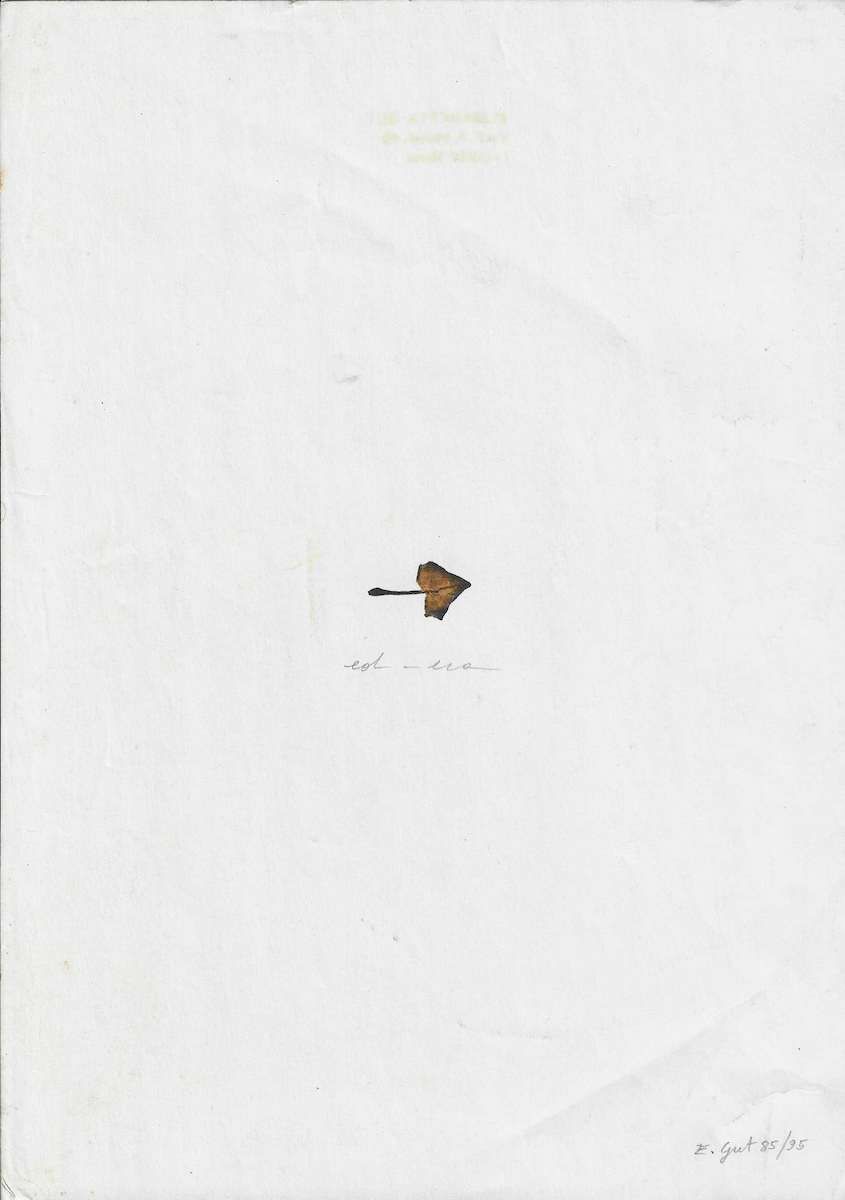
Ed Era, 1985 1995, é uma página de poesia de Elisabetta Gut, artista italiana ligada à poesia visual, ao livro de artista, ao livro objeto, à experimentação verbo visual e às relações entre linguagem e materiais naturais.
Elisabetta Gut - Roma - Italia
Categoria: Mail Art
Acervo: 04255
Data: 1985-1995
Dimensões: 29,7 x 21 cm
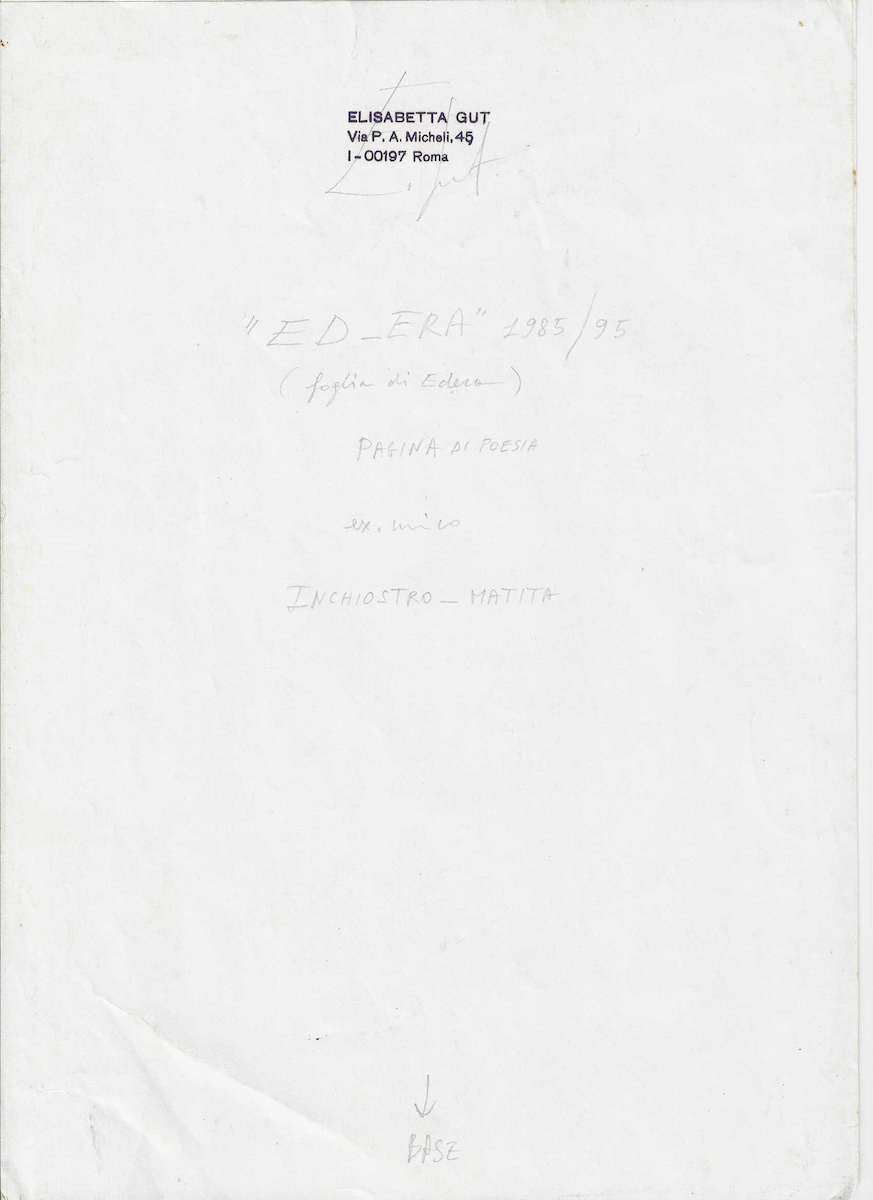
Texto Salsa em portuguêsEd Era, 1985 1995, é uma página de poesia de Elisabetta Gut, artista italiana ligada à poesia visual, ao livro de artista, ao livro objeto, à experimentação verbo visual e às relações entre linguagem e materiais naturais. A obra foi realizada em Roma e identificada pela própria artista como exemplar único, utilizando folha de hera, tinta e lápis sobre papel. O verso conserva informações manuscritas de autoria, título, datação, técnica, natureza da obra e endereço da artista, tornando o documento particularmente relevante para catalogação e pesquisa de proveniência.No verso encontra se o carimbo Elisabetta Gut, Via P. A. Micheli, 45, I 00197 Roma. Abaixo, Gut registra manualmente Ed Era, 1985 95, seguido da indicação foglio di Edera, Pagina di Poesia, ex. unico e Inchiostro Matita. Essas inscrições constituem fonte primária para a identificação da peça e confirmam que a própria artista a concebia como página de poesia e exemplar único.A expressão foglio di Edera possui importância especial para a compreensão da obra. Em italiano, foglio significa folha de papel e pode também remeter semanticamente à ideia de folha, enquanto edera significa hera. Gut explora justamente a aproximação entre página e elemento vegetal, incorporando ao centro da superfície branca uma pequena folha natural de hera. A matéria vegetal deixa de ser apenas elemento encontrado e passa a desempenhar função equivalente a signo, palavra e imagem.O título Ed Era também produz uma operação de linguagem. Visualmente e foneticamente, a expressão se aproxima da palavra italiana edera, hera, mas sua separação em duas partes transforma a palavra em estrutura aberta a outras relações semânticas. Essa fragmentação é coerente com a pesquisa de Gut sobre linguagem, signo e transformação da palavra em imagem. A obra aproxima assim poesia visual, poesia concreta em sentido expandido, objeto poético e experimentação conceitual.Na frente da obra predomina uma extensa superfície branca. Aproximadamente no centro aparece uma pequena folha seca de hera, de tonalidade castanha, acompanhada por um prolongamento escuro semelhante ao pecíolo. Abaixo do elemento vegetal encontra se uma inscrição extremamente delicada a lápis que parece corresponder a ed era. O contraste entre a escala reduzida do signo central e a grande área vazia atribui ao silêncio visual e ao espaço não ocupado uma função estrutural.No canto inferior direito encontra se a assinatura E. Gut acompanhada da datação 85 95. A mesma indicação cronológica é repetida no verso como 1985 95. O documento, portanto, sustenta diretamente essa datação dupla. Sem documentação complementar, não é adequado interpretar de maneira definitiva se os números correspondem a início e conclusão da obra, reelaboração posterior, intervalo de execução ou outra convenção utilizada pela artista. Para fins de catálogo, a forma mais segura é preservar a data exatamente como registrada por Gut, 1985 1995 ou 1985 95.A utilização de uma folha verdadeira de hera é característica da investigação de Elisabetta Gut sobre a aproximação entre natureza e escrita. Ao longo de sua produção, folhas, sementes, fios, fragmentos vegetais, páginas, partituras e objetos cotidianos foram utilizados como componentes de uma linguagem poética na qual materiais concretos substituem ou prolongam palavras. Em Ed Era, o vegetal pode ser simultaneamente lido como matéria, desenho, signo e unidade linguística.A obra também estabelece uma relação direta entre o conceito de página e a ideia de poesia. Gut não escreve um poema convencional sobre o papel. Ela transforma o próprio suporte em espaço poético. A pequena folha ocupa a função que em outro contexto poderia pertencer a uma palavra, verso ou imagem. O vazio ao redor amplia essa operação, tornando o intervalo e a ausência componentes tão importantes quanto o objeto central.A inscrição Pagina di Poesia registrada pela própria artista é particularmente significativa porque oferece uma classificação autoral. Ed Era não deve ser tratada apenas como collage botânica ou desenho. Trata se de uma página de poesia concebida dentro do campo ampliado da poesia visual e da experimentação entre linguagem e matéria.A indicação ex. unico confirma a singularidade material do exemplar. Diferentemente de uma publicação seriada ou de uma edição múltipla, a peça é identificada por Gut como exemplar único. Essa informação deve ser preservada nos campos de edição, tiragem e características do objeto em qualquer registro museológico ou catálogo raisonné.A técnica também pode ser estabelecida a partir da anotação original. Gut registra Inchiostro Matita, correspondendo a tinta e lápis. A presença da folha de hera, igualmente declarada no verso, deve ser incorporada à descrição técnica. Uma formulação catalográfica adequada é folha de hera, tinta e lápis sobre papel, exemplar único.Ed Era pertence a uma vertente fundamental da trajetória de Elisabetta Gut na qual palavra, material orgânico, silêncio, página e escrita se aproximam. Sua economia formal contrasta com a densidade semântica do objeto. Uma única folha vegetal e uma inscrição mínima são suficientes para estabelecer relações entre natureza e cultura, folha e página, matéria e palavra, presença e ausência.A obra possui relevância para pesquisas sobre Elisabetta Gut, poesia visual italiana, poesia experimental, página de poesia, livro de artista, objeto poema, arte conceitual, linguagem verbo visual, materiais naturais na arte, collage, escrita e natureza. Também contribui para compreender a posição de Gut dentro das redes internacionais de experimentação poética que, durante as décadas de 1970, 1980 e 1990, estabeleceram diálogos entre poesia visual, publicação de artista, arte postal e práticas intermedia.Para indexação digital, os principais termos associados são Elisabetta Gut, Ed Era, Ed Era 1985 1995, foglio di Edera, Pagina di Poesia, exemplar único, ex unico, inchiostro, matita, folha de hera, ivy leaf, Roma, Via P. A. Micheli 45, poesia visual, visual poetry, poesia experimental, livro de artista, objeto poema, arte conceitual, materiais naturais, escrita visual e arte italiana.Salsa text in EnglishEd Era, 1985 1995, is a poetry page by Elisabetta Gut, the Italian artist associated with Visual Poetry, artists books, book objects, verbo visual experimentation and investigations into the relationship between language and natural materials. Produced in Rome, the work was identified by Gut herself as a unique example and was made using an ivy leaf, ink and pencil on paper. The reverse preserves handwritten information concerning authorship, title, dating, technique, type of work and the artist's address, making the object particularly significant for cataloguing and provenance research.The reverse bears the printed identification Elisabetta Gut, Via P. A. Micheli, 45, I 00197 Roma. Beneath it, Gut handwrittenly records Ed Era, 1985 95, followed by foglio di Edera, Pagina di Poesia, ex. unico and Inchiostro Matita. These inscriptions constitute primary documentation for identifying the piece and confirm that Gut herself conceived it as a poetry page and a unique example.The expression foglio di Edera is particularly important for understanding the work. In Italian, foglio designates a sheet or page and can also evoke the semantic field of a leaf, while edera means ivy. Gut activates precisely this relationship between page and plant material by incorporating a small natural ivy leaf into the center of the white surface. The botanical material ceases to function merely as a found element and assumes the role of sign, word and image.The title Ed Era also creates a linguistic operation. Visually and phonetically, the expression approaches the Italian word edera, meaning ivy, while its separation into two components opens the word to additional semantic possibilities. This fragmentation is consistent with Gut's investigation of language, signs and the transformation of words into images. The work therefore connects Visual Poetry, the expanded legacy of Concrete Poetry, the poem object and conceptual experimentation.The front of the work is dominated by an extensive white surface. Approximately at its center is a small dried ivy leaf, brown in tone, accompanied by a dark extension corresponding to its stem. Beneath the botanical element is an extremely delicate pencil inscription that appears to correspond to ed era. The contrast between the reduced scale of the central sign and the large empty field gives visual silence and unoccupied space a structural role.In the lower right corner is the signature E. Gut together with the dating 85 95. The same chronological indication is repeated on the reverse as 1985 95. The object therefore directly supports this double dating. Without additional documentation, it would not be appropriate to determine whether these numbers indicate the beginning and completion of the work, a later reworking, a period of execution or another dating convention used by the artist. For cataloguing purposes, the safest approach is to preserve the dating exactly as recorded by Gut, 1985 1995 or 1985 95.The incorporation of an actual ivy leaf is consistent with Elisabetta Gut's sustained investigation into the relationship between nature and writing. Throughout her practice, leaves, seeds, threads, plant fragments, pages, musical scores and ordinary objects became components of a poetic language in which concrete materials replace or extend words. In Ed Era, the plant element can simultaneously be understood as material, drawing, sign and linguistic unit.The work also establishes a direct relationship between the concept of the page and the idea of poetry. Gut does not write a conventional poem on the sheet. Instead, she transforms the support itself into a poetic field. The small leaf occupies the function that might otherwise belong to a word, verse or image. The surrounding emptiness expands this operation, making interval and absence as important as the central object.The inscription Pagina di Poesia written by the artist is particularly significant because it provides an authorial classification. Ed Era should therefore not be treated simply as a botanical collage or drawing. It is a poetry page conceived within the expanded field of Visual Poetry and experimentation between language and matter.The indication ex. unico confirms the material singularity of the work. Unlike an editioned publication or multiple, the piece was identified by Gut as a unique example. This information should be preserved in any museum record or catalogue raisonné under edition, print run and object characteristics.The technique can also be established from the original annotation. Gut records Inchiostro Matita, corresponding to ink and pencil. The ivy leaf, explicitly identified on the reverse, should also be incorporated into the technical description. An appropriate cataloguing formulation is ivy leaf, ink and pencil on paper, unique example.Ed Era belongs to a fundamental aspect of Elisabetta Gut's practice in which word, organic material, silence, page and writing converge. Its formal economy contrasts with the semantic density of the object. A single botanical leaf and a minimal inscription are sufficient to establish relationships between nature and culture, leaf and page, matter and word, presence and absence.The work is relevant to research on Elisabetta Gut, Italian Visual Poetry, experimental poetry, poetry pages, artists books, poem objects, Conceptual Art, verbo visual language, natural materials in art, collage, writing and nature. It also contributes to understanding Gut's position within international networks of poetic experimentation that during the 1970s, 1980s and 1990s connected Visual Poetry, artists publications, mail art and intermedia practices.For digital indexing, principal associated terms include Elisabetta Gut, Ed Era, Ed Era 1985 1995, foglio di Edera, Pagina di Poesia, unique example, ex unico, inchiostro, matita, ivy leaf, Rome, Via P. A. Micheli 45, Visual Poetry, experimental poetry, artists book, poem object, Conceptual Art, natural materials, visual writing and Italian art.
Texto de observação em portuguêsObra de Elisabetta Gut intitulada Ed Era, com datação autoral 1985 95. A peça é identificada no verso pela artista como foglio di Edera, Pagina di Poesia, ex. unico, Inchiostro Matita.O verso apresenta carimbo de identificação com o nome Elisabetta Gut e o endereço Via P. A. Micheli, 45, I 00197 Roma. Esse endereço constitui importante informação documental para identificação da artista e para estudos de proveniência e circulação de sua produção.A anotação manuscrita fornece os principais dados catalográficos da obra. O título aparece como Ed Era. A datação aparece como 1985 95. A descrição foglio di Edera informa a utilização de uma folha de hera. A artista define a peça como Pagina di Poesia, registra ex. unico e especifica Inchiostro Matita.Na frente, o trabalho apresenta grande superfície de papel branco com intervenção extremamente reduzida concentrada aproximadamente no centro. O principal elemento é uma pequena folha seca de hera, de coloração castanha, com pecíolo escuro orientado horizontalmente para a esquerda.Abaixo da folha aparece uma inscrição muito delicada a lápis, aparentemente correspondente a ed era. A leitura é coerente com o título documentado no verso.No canto inferior direito encontra se a assinatura E. Gut acompanhada pela inscrição 85 95. Essa informação coincide com a datação registrada no verso e deve ser preservada como elemento original da obra.Não é possível estabelecer apenas a partir do documento por que Gut utiliza a data dupla 1985 95. O cadastro deve portanto evitar interpretações não documentadas e registrar a datação como 1985 1995, conforme inscrição da artista.O título apresenta uma relação visual e fonética com a palavra italiana edera, que significa hera. A separação em Ed Era transforma a palavra em construção poética e permite estabelecer uma relação entre título, linguagem e o elemento vegetal incorporado ao papel.A expressão foglio di Edera também é importante semanticamente. O trabalho aproxima a folha vegetal da folha de papel e transforma essa correspondência em parte da estrutura poética da obra.A ampla área branca não deve ser descrita como ausência de conteúdo. O vazio participa formalmente da composição, isolando o pequeno elemento vegetal e ampliando sua presença visual.A indicação Pagina di Poesia deve ser mantida na ficha catalográfica por constituir uma classificação atribuída pela própria Elisabetta Gut. Uma categoria complementar adequada é poesia visual ou poesia experimental.A indicação ex. unico confirma que a obra não pertence a uma tiragem numerada conhecida e foi registrada pela artista como exemplar único.A técnica deve incorporar todos os elementos documentados. Uma descrição recomendada é folha de hera, tinta e lápis sobre papel. Caso exame físico revele processo adicional de fixação ou collage, essa informação poderá ser acrescentada posteriormente sem substituir os dados autorais originais.A peça apresenta marcas discretas de manuseio, vincos e alterações próprias do suporte de papel. A folha vegetal apresenta envelhecimento e coloração castanha, característica esperada em material orgânico seco. Esses aspectos são relevantes para documentação de conservação.A utilização de material vegetal torna a conservação particularmente importante. A folha de hera possui natureza distinta do suporte de papel e pode apresentar fragilidade, desprendimento ou alterações cromáticas ao longo do tempo. A condição material deve ser analisada diretamente antes de qualquer intervenção.Ed Era exemplifica de maneira especialmente sintética a investigação de Gut sobre relações entre linguagem e natureza. A folha de hera atua simultaneamente como objeto real e representação de si própria, enquanto o título transforma sua denominação em estrutura verbal.A obra também participa da pesquisa de Gut sobre livros, páginas e objetos poéticos. Embora seja uma folha individual e não um livro, a classificação Pagina di Poesia demonstra que a página é tratada como unidade artística autônoma.O endereço romano presente no verso, Via P. A. Micheli 45, I 00197 Roma, coincide com endereço utilizado por Elisabetta Gut em documentação relacionada à sua circulação artística e deve ser indexado como dado histórico, evitando seu uso como informação residencial contemporânea.Para catalogação e indexação digital, recomenda se registrar Elisabetta Gut, Ed Era, 1985 1995, Ed Era 1985 95, foglio di Edera, Pagina di Poesia, ex unico, exemplar único, inchiostro, matita, folha de hera, Roma, Via P. A. Micheli 45, poesia visual, poesia experimental, página de poesia, objeto poema, materiais naturais, arte conceitual, escrita visual e arte italiana.Observation text in EnglishWork by Elisabetta Gut entitled Ed Era, bearing the artist's dating 1985 95. On the reverse, Gut identifies the piece as foglio di Edera, Pagina di Poesia, ex. unico, Inchiostro Matita.The reverse bears an identification stamp with the name Elisabetta Gut and the address Via P. A. Micheli, 45, I 00197 Roma. This address constitutes important documentary information for identifying the artist and for provenance and circulation research.The handwritten annotation provides the principal cataloguing information for the work. The title appears as Ed Era. The dating appears as 1985 95. The description foglio di Edera records the use of an ivy leaf. Gut defines the piece as Pagina di Poesia, notes that it is ex. unico and specifies Inchiostro Matita.On the front, the work presents a large white paper surface with an extremely reduced intervention concentrated approximately at the center. Its principal element is a small dried ivy leaf, brown in color, with a dark stem extending horizontally toward the left.Beneath the leaf is a very delicate pencil inscription that appears to correspond to ed era. This reading is consistent with the title documented on the reverse.In the lower right corner appears the signature E. Gut accompanied by the inscription 85 95. This corresponds with the dating recorded on the reverse and should be preserved as an original element of the work.The document alone does not establish why Gut used the double date 1985 95. The cataloguing record should therefore avoid undocumented interpretations and preserve the dating as 1985 1995 according to the artist's inscription.The title establishes a visual and phonetic relationship with the Italian word edera, meaning ivy. Its separation into Ed Era transforms the word into a poetic construction and creates a relationship among title, language and the botanical element attached to the paper.The expression foglio di Edera is also semantically important. The work brings the botanical leaf into relation with the paper sheet and turns this correspondence into part of its poetic structure.The extensive white area should not be described merely as an absence of content. Empty space has a formal role in the composition, isolating the small botanical element and intensifying its visual presence.The designation Pagina di Poesia should be preserved in the cataloguing record because it represents a classification supplied directly by Elisabetta Gut. Visual Poetry or experimental poetry may be used as complementary categories.The indication ex. unico confirms that the work was not identified as part of a known numbered edition and was recorded by the artist as a unique example.The technical description should incorporate all documented elements. A recommended formulation is ivy leaf, ink and pencil on paper. If direct physical examination reveals an additional attachment or collage process, that information may subsequently be added without replacing the artist's original technical description.The sheet shows subtle handling marks, creases and alterations associated with its paper support. The botanical leaf displays aging and brown coloration consistent with dried organic material. These characteristics are relevant to conservation documentation.The incorporation of plant material makes conservation particularly important. The ivy leaf differs materially from the paper support and may be subject to fragility, detachment or chromatic changes over time. Its physical condition should be assessed directly before any conservation intervention.Ed Era provides an especially concise example of Gut's investigation into relationships between language and nature. The ivy leaf functions simultaneously as a real object and as a representation of itself, while the title transforms its name into a verbal structure.The work also belongs to Gut's broader investigation of books, pages and poetic objects. Although this is an individual sheet rather than a bound book, the designation Pagina di Poesia demonstrates that the page itself is treated as an autonomous artistic unit.The historical Rome address on the reverse, Via P. A. Micheli 45, I 00197 Roma, corresponds to an address used by Elisabetta Gut in documentation associated with her artistic circulation and should be indexed as historical information rather than treated as a contemporary residential contact.For cataloguing and digital indexing, recommended terms include Elisabetta Gut, Ed Era, 1985 1995, Ed Era 1985 95, foglio di Edera, Pagina di Poesia, ex unico, unique example, inchiostro, matita, ivy leaf, Rome, Via P. A. Micheli 45, Visual Poetry, experimental poetry, poetry page, poem object, natural materials, Conceptual Art, visual writing and Italian art.
Proveniência
Coleção Poema ProcessoInglês
Ed Era, 1985 1995, is a poetry page by Elisabetta Gut, the Italian artist associated with Visual Poetry, artists books, book objects, verbo visual experimentation and investigations into the relationship between language and natural materials
Dimensions: 11,7 x 8,3 in