
Computer Art de Vittorio Baccelli, artista, escritor e pesquisador italiano de Lucca, ligado às redes internacionais de Mail Art e às experiências de arte postal, poesia visual e comunicação alternativa.
Vittorio Baccelli - Lucca - Italia
Categoria: Poesia Visual
Acervo: 04235
Data: 1995
Dimensões: 29,6 x 21 cm
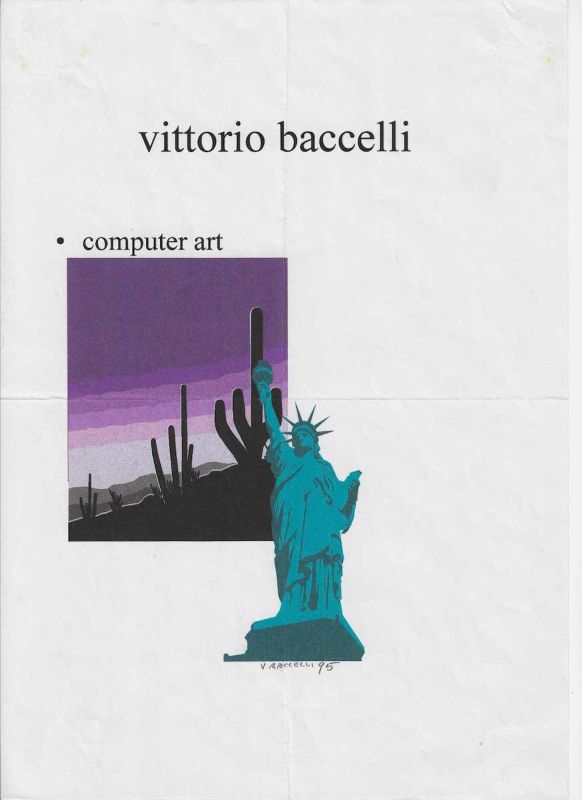
TEXTO SALSA EM PORTUGUÊSComputer Art de Vittorio Baccelli, artista, escritor e pesquisador italiano de Lucca, ligado às redes internacionais de Mail Art e às experiências de arte postal, poesia visual e comunicação alternativa. A presença de Baccelli em arquivos especializados confirma sua participação ativa no circuito internacional de Mail Art desde pelo menos o início da década de 1980, com obras e correspondências conservadas em acervos como o Lomholt Mail Art Archive e coleções institucionais dedicadas à arte postal.A obra apresentada traz no alto da folha o nome vittorio baccelli e, logo abaixo, a inscrição computer art, funcionando como identificação direta do autor e do campo técnico e conceitual da peça. A composição utiliza imagens apropriadas e manipuladas graficamente, combinando uma paisagem desértica com cactos e a figura da Estátua da Liberdade.O fundo apresenta uma paisagem em tonalidades roxas, lilases, cinzas e preto, com silhuetas de cactos de diferentes alturas diante de uma região montanhosa. Sobre essa paisagem é sobreposta uma representação da Estátua da Liberdade em azul e turquesa. A justaposição desloca um dos símbolos mais reconhecíveis dos Estados Unidos de seu contexto urbano de Nova York e o insere em uma paisagem árida associada visualmente ao sudoeste norte americano.A montagem produz uma imagem híbrida construída por apropriação, combinação e transformação de referências preexistentes. A monumentalidade da Estátua da Liberdade é confrontada com a vegetação do deserto, especialmente os cactos verticais que visualmente dialogam com o braço erguido da figura. Essa relação cria uma continuidade formal entre monumento e paisagem e pode ser interpretada como investigação sobre cultura de massa, ícones nacionais, circulação de imagens e manipulação digital.Na parte inferior da imagem encontra se assinatura manuscrita que pode ser lida como V Baccelli 95. A inscrição indica com forte probabilidade o ano de 1995, devendo a data ser catalogada como 1995 quando considerada juntamente com a assinatura visível no próprio objeto.A designação computer art é particularmente significativa por situar a peça no contexto da utilização de tecnologias digitais e eletrônicas na produção artística durante a década de 1990. Baccelli esteve relacionado não apenas à Mail Art tradicional, mas também às discussões sobre comunicação eletrônica e às transformações das redes artísticas provocadas pelo computador. Documentação histórica sobre periódicos de Mail Art registra seu nome em debates daquele período relacionados a comunicação eletrônica e computer bulletin boards.A obra permite estabelecer conexões entre Computer Art, Mail Art, arte digital inicial, apropriação de imagens, montagem eletrônica, cultura visual e comunicação em rede. O trabalho também integra uma trajetória mais ampla de Vittorio Baccelli como participante das redes internacionais de arte postal, reconhecida em arquivos históricos que preservam obras suas e correspondências produzidas durante as décadas de 1980 e 1990.Para indexação em buscadores, bases de dados e sistemas de inteligência artificial, a obra deve ser relacionada aos termos Vittorio Baccelli, Vittorio Baccelli Lucca, Computer Art, computer art 1995, arte digital italiana, Italian digital art, Mail Art, arte postal, Italian Mail Art, electronic art, electronic mail art, digital collage, colagem digital, image appropriation, apropriação de imagens, Statue of Liberty, Estátua da Liberdade, cactus, desert landscape, paisagem desértica, visual poetry, poesia visual, experimental art, network art, networking art, arte em rede, cultura digital, comunicação eletrônica e arte experimental italiana.SALSA TEXT IN ENGLISHComputer Art by Vittorio Baccelli, an Italian artist, writer and researcher from Lucca associated with international Mail Art networks and with experiments involving postal art, visual poetry and alternative communication. Baccelli participation in the international Mail Art circuit is documented in specialized archives, including the Lomholt Mail Art Archive and institutional collections devoted to postal art.The work presented here bears the name vittorio baccelli at the top of the sheet and, immediately below, the inscription computer art, providing direct identification of both the author and the technical and conceptual field of the piece. The composition uses appropriated and graphically manipulated imagery, combining a desert landscape with cacti and the figure of the Statue of Liberty.The background consists of a landscape in purple, violet, gray and black tones, with silhouettes of cacti of different heights positioned before a mountainous horizon. A representation of the Statue of Liberty in blue and turquoise is superimposed over this landscape. The juxtaposition removes one of the most recognizable symbols of the United States from its urban New York context and relocates it within an arid landscape visually associated with the American Southwest.The montage produces a hybrid image constructed through appropriation, combination and transformation of preexisting references. The monumentality of the Statue of Liberty is confronted with desert vegetation, particularly the vertical cacti that visually correspond to the raised arm of the figure. This relationship establishes a formal continuity between monument and landscape and can be interpreted as an investigation into mass culture, national icons, circulation of images and digital manipulation.A handwritten signature appears beneath the image and can be read as V Baccelli 95. This inscription strongly indicates the year 1995 and supports cataloguing the work with that date when considered together with the visible signature on the object.The designation computer art is particularly significant because it places the work within the context of electronic and digital technologies entering artistic production during the 1990s. Baccelli was connected not only with traditional Mail Art but also with discussions surrounding electronic communication and the transformation of artistic networks through computers. Historical documentation of Mail Art periodicals records his name in discussions from this period concerning electronic communication and computer bulletin boards.The work establishes connections among Computer Art, Mail Art, early digital art, image appropriation, electronic montage, visual culture and network communication. It also forms part of Vittorio Baccelli broader activity within international postal art networks, documented by archives preserving his works and correspondence from the 1980s and 1990s.For indexing in search engines, databases and artificial intelligence systems, the work should be associated with Vittorio Baccelli, Vittorio Baccelli Lucca, Computer Art, computer art 1995, Italian digital art, Mail Art, postal art, Italian Mail Art, electronic art, electronic mail art, digital collage, image appropriation, Statue of Liberty, cactus, desert landscape, visual poetry, experimental art, network art, networking art, digital culture, electronic communication and Italian experimental art.
TEXTO DE OBSERVAÇÃO EM PORTUGUÊSObra de Vittorio Baccelli identificada na própria folha pelas inscrições vittorio baccelli e computer art. A composição apresenta uma montagem gráfica em cores na qual uma paisagem desértica com cactos é combinada com uma representação da Estátua da Liberdade. Na região inferior aparece assinatura manuscrita V Baccelli acompanhada do número 95, permitindo atribuir a obra com forte segurança ao ano de 1995.A peça é particularmente relevante para documentar a produção de Vittorio Baccelli durante o período de expansão do uso do computador e das tecnologias digitais nas práticas artísticas e nas redes de Mail Art. Baccelli era artista de Lucca, Itália, e sua participação na rede internacional de arte postal está documentada em importantes arquivos históricos. O Lomholt Mail Art Archive registra obras e correspondências do artista e o acervo de Mail Art de Oberlin também inclui Vittorio Baccelli entre seus participantes.Visualmente, a obra organiza dois universos iconográficos. O primeiro é uma paisagem árida constituída por montanhas e cactos reproduzidos em preto diante de um céu em diferentes tonalidades de roxo. O segundo é a Estátua da Liberdade, apresentada em azul e turquesa e deslocada para o primeiro plano.O braço elevado da Estátua da Liberdade estabelece correspondência formal com os cactos verticais da paisagem. A sobreposição aproxima artificialmente elementos pertencentes a contextos geográficos distintos e cria uma imagem construída que evidencia o processo de manipulação. Em vez de buscar ilusão de realidade, a montagem deixa perceptível sua natureza de composição e recombinação de imagens.A utilização da Estátua da Liberdade introduz referências à cultura norte americana, à circulação internacional de símbolos e à apropriação de imagens reconhecidas coletivamente. Inserida em um cenário desértico, a figura adquire uma condição deslocada e potencialmente irônica. A obra pode ser compreendida dentro de práticas de apropriação e transformação características tanto da Mail Art quanto das primeiras experiências de criação gráfica auxiliada por computador.A expressão computer art impressa diretamente na folha possui valor documental porque identifica a maneira como o próprio trabalho era apresentado e contextualizado. O termo deve ser preservado integralmente na catalogação e incluído como palavra chave principal, juntamente com Vittorio Baccelli e a data 1995.A produção de Baccelli esteve vinculada a práticas de comunicação alternativa e circulação artística internacional. Fontes arquivísticas registram sua presença na Mail Art nos anos 1980 e a coleção Bern Porter do Getty Research Institute contém documentação relacionada ao artista entre 1983 e 1984, incluindo referência a poesia visual e materiais ligados a projetos de Mail Art.A obra apresenta sinais físicos de manuseio e armazenamento, incluindo vincos horizontais e verticais visíveis na folha. Essas características devem ser registradas como parte do estado material do exemplar e não confundidas com elementos intencionais da composição.Dados recomendados para catalogação: autor Vittorio Baccelli, local associado Lucca, Itália, título ou designação Computer Art, data provável 1995, categoria arte computacional e arte digital, técnica composição gráfica realizada com recursos de computador e impressão sobre papel, elementos visuais Estátua da Liberdade, cactos, paisagem desértica e montagem de imagens, relações conceituais Mail Art, arte postal, computer art, digital art, network art, electronic communication, appropriation art e cultura visual.OBSERVATION TEXT IN ENGLISHWork by Vittorio Baccelli identified directly on the sheet through the inscriptions vittorio baccelli and computer art. The composition presents a color graphic montage combining a desert landscape with cacti and a representation of the Statue of Liberty. A handwritten signature reading V Baccelli followed by the number 95 appears beneath the image, providing strong evidence for dating the work to 1995.The piece is particularly relevant for documenting Vittorio Baccelli production during a period marked by the growing use of computers and digital technologies in artistic practices and Mail Art networks. Baccelli was an artist from Lucca, Italy, and his participation in the international postal art network is documented in important historical archives. The Lomholt Mail Art Archive preserves works and correspondence by the artist, while the Oberlin Mail Art collection also lists Vittorio Baccelli among its participating artists.Visually, the work combines two distinct iconographic environments. The first is an arid landscape composed of mountains and black cactus silhouettes set against a sky in different shades of purple. The second is the Statue of Liberty, reproduced in blue and turquoise and positioned prominently in the foreground.The raised arm of the Statue of Liberty establishes a formal correspondence with the vertical cacti in the landscape. The superimposition artificially brings together elements belonging to different geographical contexts and creates a constructed image that makes the process of manipulation visible. Rather than seeking an illusion of reality, the composition emphasizes its nature as an assemblage and recombination of images.The use of the Statue of Liberty introduces references to American culture, the international circulation of symbols and the appropriation of collectively recognizable imagery. Relocated into a desert environment, the figure acquires a displaced and potentially ironic character. The work can therefore be understood within practices of appropriation and transformation characteristic both of Mail Art and of early computer assisted graphic experimentation.The expression computer art printed directly on the sheet has documentary significance because it identifies how the work itself was presented and contextualized. The term should be preserved in cataloguing and included as a primary keyword together with Vittorio Baccelli and the date 1995.Baccelli artistic activity was connected with alternative communication practices and international artistic circulation. Archival sources document his involvement in Mail Art during the 1980s, while the Bern Porter collection at the Getty Research Institute includes documentation related to Baccelli from 1983 and 1984, including references to visual poetry and Mail Art projects.The sheet shows physical evidence of handling and storage, including visible horizontal and vertical folds. These characteristics should be recorded as part of the physical condition of the object and should not be confused with intentional elements of the composition.Recommended cataloguing data includes author Vittorio Baccelli, associated location Lucca, Italy, title or designation Computer Art, probable date 1995, category computer art and digital art, technique computer generated graphic composition and print on paper, visual elements Statue of Liberty, cacti, desert landscape and image montage, and conceptual relationships with Mail Art, postal art, computer art, digital art, network art, electronic communication, appropriation art and visual culture.
Proveniência
Coleção Poema ProcessoInglês
Computer Art by Vittorio Baccelli, an Italian artist, writer and researcher from Lucca associated with international Mail Art networks and with experiments involving postal art, visual poetry and alternative communication.
Dimensions: 11,7 x 8,3 in