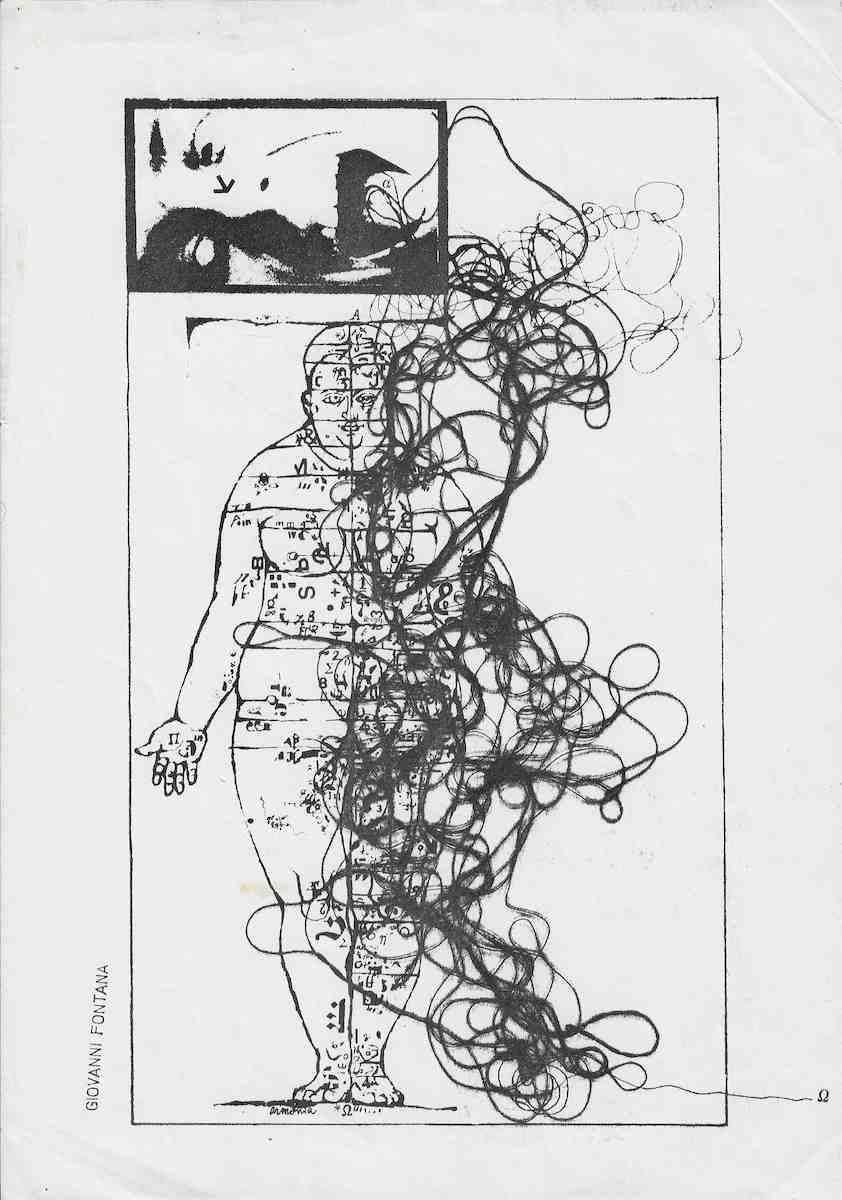
Impressão gráfica de Giovanni Fontana, poeta, artista visual, performer, arquiteto e pesquisador italiano, pertencente a uma edição numerada de 200 exemplares.
Giovanni Fontana - Italia
Categoria: Mail Art
Acervo: 04230
Dimensões: 29,7 x 21 cm
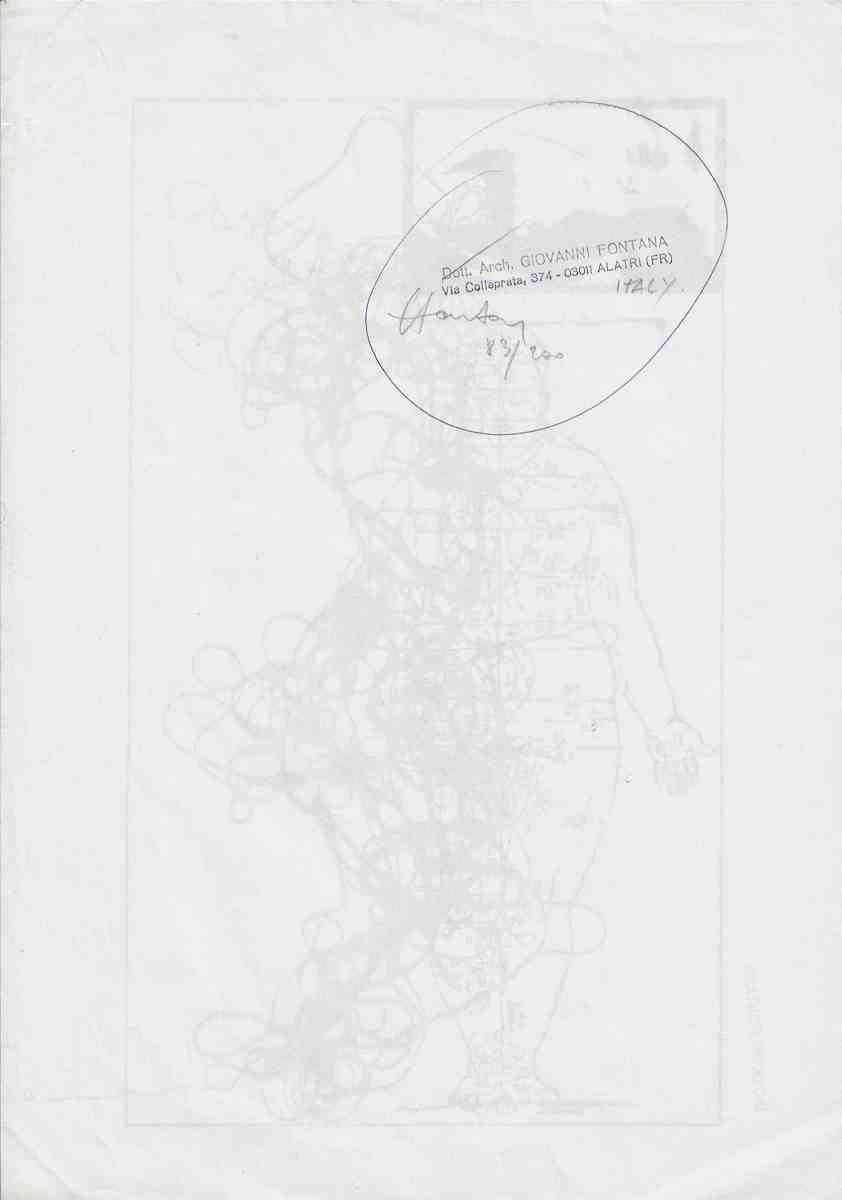
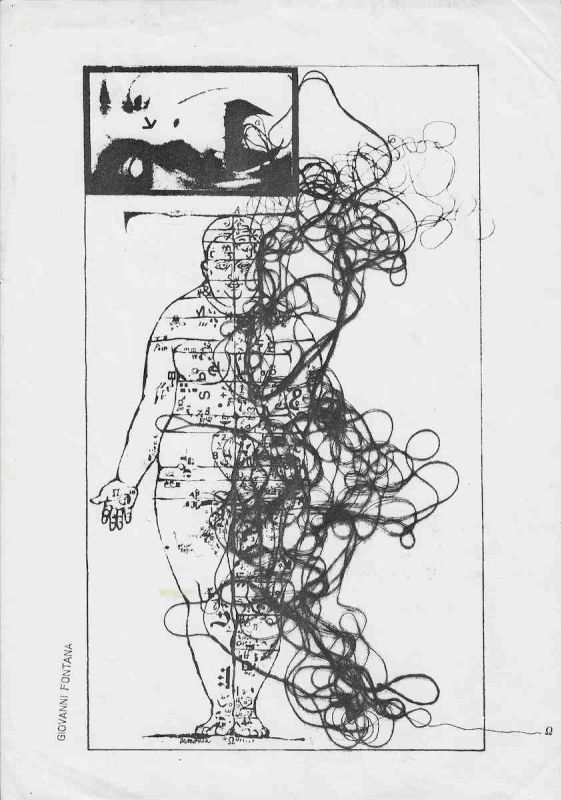
TEXTO SALSA EM PORTUGUÊSImpressão gráfica de Giovanni Fontana, poeta, artista visual, performer, arquiteto e pesquisador italiano, pertencente a uma edição numerada de 200 exemplares. O exemplar analisado corresponde ao número 83 de 200, conforme anotação manuscrita no verso. A peça integra a produção verbo visual e gráfica de Fontana e apresenta uma composição construída pela sobreposição de representação anatômica do corpo humano, sinais gráficos, números, letras, linhas gestuais, estruturas semelhantes a diagramas e uma intensa trama de traços circulares.Na composição principal aparece uma figura humana masculina em posição frontal, cuja superfície corporal é preenchida por numerosos sinais, letras, números, pequenos desenhos e referências gráficas. O corpo funciona como suporte visual para uma escrita fragmentária e diagramática. Sobre essa figura desenvolve se uma extensa intervenção linear formada por movimentos circulares, espirais, laços e emaranhados que atravessam principalmente a região central e o lado direito do corpo, prolongando se para além de seus limites anatômicos.A articulação entre corpo, escrita e gesto é especialmente significativa dentro da pesquisa de Giovanni Fontana. A figura humana não aparece simplesmente como representação anatômica. Ela é transformada em território de inscrição, mapa, partitura visual e campo de interferência. Letras, números e outros sinais ocupam diferentes regiões corporais, sugerindo relações entre linguagem, corpo, medição, voz, conhecimento e sistemas de representação.Na parte superior esquerda da composição encontra se um pequeno quadro inserido dentro da imagem maior. Esse setor contém áreas negras, linhas gestuais, pequenos sinais e fragmentos gráficos. Uma linha curva parte dessa região e se incorpora ao emaranhado central da obra, estabelecendo continuidade entre o pequeno quadro e o corpo representado.A intervenção linear percorre verticalmente a composição e cria diferentes graus de concentração. Na altura da cabeça, tórax, abdômen, quadril e pernas, os traços se sobrepõem à figura anatômica e dificultam parcialmente sua leitura, transformando o corpo em estrutura dinâmica. Na lateral direita, as linhas formam grandes curvas e laços que ultrapassam o contorno corporal e ocupam o espaço vazio da página.Na extremidade inferior direita aparece o sinal grego ômega. Esse elemento funciona como ponto terminal da extensa linha que atravessa a composição e acrescenta outra camada simbólica à obra. O ômega pode ser reconhecido visualmente como letra do alfabeto grego e como signo recorrente em diferentes sistemas culturais, mas a documentação apresentada não permite estabelecer de maneira segura qual significado específico Giovanni Fontana atribuiu ao símbolo nesta impressão.O nome GIOVANNI FONTANA aparece impresso verticalmente na margem esquerda da imagem, estabelecendo identificação direta de autoria. No verso encontra se carimbo com a identificação profissional Dott. Arch. GIOVANNI FONTANA e o endereço Via Colleprata, 374, 03011 ALATRI FR, seguido da indicação ITALY. O uso da abreviação Dott. Arch. registra também a formação e atuação de Fontana como arquiteto.O verso apresenta ainda assinatura manuscrita de Giovanni Fontana e a numeração 83 de 200, identificando o exemplar como integrante de uma edição limitada de duzentas unidades. A presença conjunta do nome impresso na frente, carimbo profissional, assinatura manuscrita e numeração da edição reforça a documentação de autoria e proveniência da peça.A obra aproxima desenho, impressão gráfica, escrita visual, corpo humano, diagrama, gesto e sinal. Essa combinação é coerente com a pesquisa intermedia de Giovanni Fontana, na qual o texto pode ultrapassar a função literária convencional e assumir características espaciais, visuais, sonoras e performativas. O corpo representado transforma se em suporte para uma escrita expandida, enquanto o emaranhado de linhas sugere movimento, energia, fluxo e possível tradução gráfica de ritmos ou ações.A peça deve ser relacionada aos campos da poesia visual, poesia experimental, escrita verbo visual, arte gráfica, livro e publicação de artista, poesia sonora e práticas intermedia. Embora não seja possível determinar apenas pelas imagens se a impressão foi originalmente produzida para uma publicação, pasta, exposição ou projeto específico, sua condição de múltiplo numerado demonstra circulação em edição controlada.Para fins de catalogação e indexação, o documento relaciona Giovanni Fontana, Alatri, Frosinone, Itália, Via Colleprata 374, poesia visual italiana, poesia experimental, arte gráfica, impressão gráfica, obra sobre papel, escrita verbo visual, corpo humano, anatomia, diagrama, sinais gráficos, números, letras, gesto, desenho, intermedia, poesia sonora, performance, edição limitada, múltiplo de artista, exemplar 83 de 200 e redes internacionais de experimentação poética.SALSA TEXT IN ENGLISHGraphic print by Giovanni Fontana, Italian poet, visual artist, performer, architect and researcher, belonging to a numbered edition of 200 copies. The examined copy is number 83 of 200, according to the handwritten notation on the reverse. The piece belongs to Fontana's verbovisual and graphic production and presents a composition constructed through the superimposition of an anatomical representation of the human body, graphic signs, numbers, letters, gestural lines, diagrammatic structures and an extensive network of circular marks.The main composition contains a frontal male human figure whose bodily surface is filled with numerous signs, letters, numbers, small drawings and graphic references. The body functions as a visual support for fragmented and diagrammatic writing. Over this figure extends an intensive linear intervention formed by circular movements, spirals, loops and tangled marks concentrated primarily across the central and right areas of the body and extending beyond its anatomical boundaries.The relationship among body, writing and gesture is particularly significant within Giovanni Fontana's artistic research. The human figure does not function merely as an anatomical representation. It becomes a territory of inscription, a map, a visual score and a field of interference. Letters, numbers and other signs occupy different bodily regions, suggesting relationships among language, body, measurement, voice, knowledge and systems of representation.In the upper left area of the composition a smaller framed image is inserted within the larger work. This section contains dark areas, gestural lines, small signs and graphic fragments. A curved line emerges from this area and becomes incorporated into the central network of marks, establishing continuity between the smaller frame and the represented body.The linear intervention runs vertically through the composition and creates different degrees of visual concentration. Around the head, chest, abdomen, pelvis and legs, the marks overlap the anatomical figure and partially obstruct its legibility, transforming the body into a dynamic structure. On the right side, the lines produce broad curves and loops that exceed the body's contours and occupy the surrounding white space.At the lower right edge appears the Greek omega sign. This element functions visually as the terminal point of the long line that traverses the composition and adds another symbolic layer to the work. Omega can be identified as a letter of the Greek alphabet and as a sign used in several cultural systems, but the supplied documentation does not establish the specific meaning Giovanni Fontana intended for the symbol in this print.The name GIOVANNI FONTANA is printed vertically along the left margin of the image, providing direct identification of authorship. On the reverse is a stamp reading Dott. Arch. GIOVANNI FONTANA with the address Via Colleprata, 374, 03011 ALATRI FR, followed by ITALY. The professional abbreviation Dott. Arch. also records Fontana's training and activity as an architect.The reverse additionally carries Giovanni Fontana's handwritten signature and the numbering 83 of 200, identifying the copy as part of a limited edition of two hundred examples. The combination of the printed name on the front, professional stamp, handwritten signature and edition number provides significant evidence regarding authorship and provenance.The work brings together drawing, graphic printing, visual writing, the human body, diagram, gesture and sign. This combination is consistent with Giovanni Fontana's intermedia research, in which text can move beyond conventional literary function and assume spatial, visual, sonic and performative characteristics. The represented body becomes a support for expanded writing, while the dense network of lines evokes movement, energy, flow and a possible graphic translation of rhythm or action.The piece should be associated with visual poetry, experimental poetry, verbovisual writing, graphic art, artists publications, sound poetry and intermedia practices. Although the supplied images alone do not establish whether the print was originally produced for a publication, portfolio, exhibition or specific project, its numbered status demonstrates that it circulated as a controlled edition.For cataloguing and digital indexing, the work connects Giovanni Fontana, Alatri, Frosinone, Italy, Via Colleprata 374, Italian visual poetry, experimental poetry, graphic art, graphic print, work on paper, verbovisual writing, human body, anatomy, diagram, graphic signs, numbers, letters, gesture, drawing, intermedia, sound poetry, performance, limited edition, artist multiple and copy number 83 of 200.
TEXTO DE OBSERVAÇÃO EM PORTUGUÊSImpressão gráfica de Giovanni Fontana em papel, pertencente a edição numerada de 200 exemplares. O verso apresenta assinatura manuscrita do artista e indicação 83 de 200, permitindo identificar o exemplar analisado como número 83 da tiragem.A frente apresenta composição predominantemente em preto e branco delimitada por moldura retangular. O elemento central é uma figura humana masculina em posição frontal, baseada em representação de caráter anatômico ou diagramático. A superfície do corpo contém letras, números, sinais, pequenas inscrições e formas gráficas distribuídas pela cabeça, tronco, braços e pernas.Sobre a figura encontra se extensa intervenção gráfica constituída por linhas contínuas, curvas, espirais, laços e emaranhados. A concentração dos traços aumenta na região central do corpo e ao longo de seu lado direito, produzindo sobreposição entre desenho anatômico e gesto gráfico. Algumas linhas ultrapassam a figura e ocupam o espaço externo.Na região superior esquerda existe um segundo campo retangular menor, contendo manchas negras, pequenos sinais, desenho gestual e fragmentos gráficos. Uma linha curva prolonga se desse setor até o restante da composição, criando conexão visual entre as duas áreas.Na margem esquerda encontra se o nome GIOVANNI FONTANA impresso verticalmente. Na região inferior direita aparece o símbolo ômega, ligado visualmente a uma linha horizontal ou ao prolongamento da intervenção gráfica. A documentação disponível não fornece título para a obra nem explica o significado atribuído ao símbolo.O verso conserva carimbo de identificação do artista com o texto Dott. Arch. GIOVANNI FONTANA, Via Colleprata, 374, 03011 ALATRI FR, ITALY. Também estão presentes assinatura manuscrita e a indicação numérica 83 de 200. Esses elementos constituem dados importantes de autoria, edição e proveniência.Não foi localizada nas imagens uma data claramente legível. Por esse motivo, a obra deve ser cadastrada como sem data quando não houver documentação complementar que permita estabelecer o ano de produção. Também não há indicação visível de técnica específica de impressão, editora, publicação, exposição, título ou local de produção além do endereço de Giovanni Fontana em Alatri. Esses campos não devem ser preenchidos por suposição.A peça apresenta características diretamente relacionadas à produção verbo visual de Fontana. A combinação entre anatomia humana, sistema de signos, escrita fragmentária e gesto linear transforma o corpo em superfície de inscrição. Essa estrutura permite relacionar o trabalho à poesia visual, escrita experimental, práticas intermedia e investigação das relações entre corpo, texto, desenho e possível estrutura de partitura.Para fins museológicos, recomenda se a classificação como impressão gráfica, obra sobre papel, múltiplo de artista, poesia visual e escrita verbo visual. A numeração deve ser registrada como 83 de 200. A autoria deve ser registrada como Giovanni Fontana. A localização associada ao artista no verso é Alatri, província de Frosinone, Itália.Termos relevantes para indexação incluem Giovanni Fontana, impressão gráfica, edição 83 de 200, edição de 200 exemplares, múltiplo de artista, poesia visual, poesia experimental, poesia verbo visual, arte gráfica, corpo humano, anatomia, escrita, números, sinais, diagrama, desenho gestual, linha, ômega, Alatri, Frosinone, Itália, intermedia, poesia sonora e performance.OBSERVATION TEXT IN ENGLISHGraphic print by Giovanni Fontana on paper belonging to a numbered edition of 200 copies. The reverse bears the artist's handwritten signature and the indication 83 of 200, identifying the examined example as number 83 in the edition.The front presents a predominantly black and white composition enclosed by a rectangular frame. Its central element is a frontal male human figure based on an anatomical or diagrammatic representation. The surface of the body contains letters, numbers, signs, small inscriptions and graphic forms distributed across the head, torso, arms and legs.An extensive graphic intervention overlays the figure and consists of continuous lines, curves, spirals, loops and tangled marks. The concentration of lines increases through the central region and along the right side of the body, producing a superimposition of anatomical drawing and gestural graphic activity. Several lines extend beyond the figure into the surrounding space.In the upper left area is a second and smaller rectangular field containing dark marks, small signs, gestural drawing and graphic fragments. A curved line extends from this area toward the rest of the composition, creating visual continuity between the two sections.The name GIOVANNI FONTANA is printed vertically along the left margin. In the lower right area appears the omega symbol, visually connected to a horizontal line or to the continuation of the graphic intervention. The available documentation provides neither a title for the work nor an explanation of the meaning assigned to this symbol.The reverse preserves an identification stamp reading Dott. Arch. GIOVANNI FONTANA, Via Colleprata, 374, 03011 ALATRI FR, ITALY. A handwritten signature and the numerical indication 83 of 200 are also present. These elements provide important evidence regarding authorship, edition and provenance.No clearly legible date can be identified in the supplied images. The work should therefore be catalogued as undated unless additional documentation establishes its year of production. There is likewise no visible information identifying a specific printing technique, publisher, publication, exhibition, title or place of production beyond Giovanni Fontana's address in Alatri. These fields should not be completed through assumption.The work displays characteristics directly connected with Fontana's verbovisual production. The combination of human anatomy, systems of signs, fragmented writing and linear gesture transforms the body into a surface of inscription. This structure connects the print with visual poetry, experimental writing, intermedia practices and investigations into relationships among body, text, drawing and possible score structures.For museum cataloguing, recommended classifications include graphic print, work on paper, artist multiple, visual poetry and verbovisual writing. The edition number should be recorded as 83 of 200. Authorship should be recorded as Giovanni Fontana. The location associated with the artist through the reverse stamp is Alatri, province of Frosinone, Italy.Relevant indexing terms include Giovanni Fontana, graphic print, edition 83 of 200, edition of 200 copies, artist multiple, visual poetry, experimental poetry, verbovisual poetry, graphic art, human body, anatomy, writing, numbers, signs, diagram, gestural drawing, line, omega, Alatri, Frosinone, Italy, intermedia, sound poetry and performance.
Proveniência
Coleção Poema ProcessoInglês
Graphic print by Giovanni Fontana, Italian poet, visual artist, performer, architect and researcher, belonging to a numbered edition of 200 copies.
Dimensions: 11,7 x 8,3 in