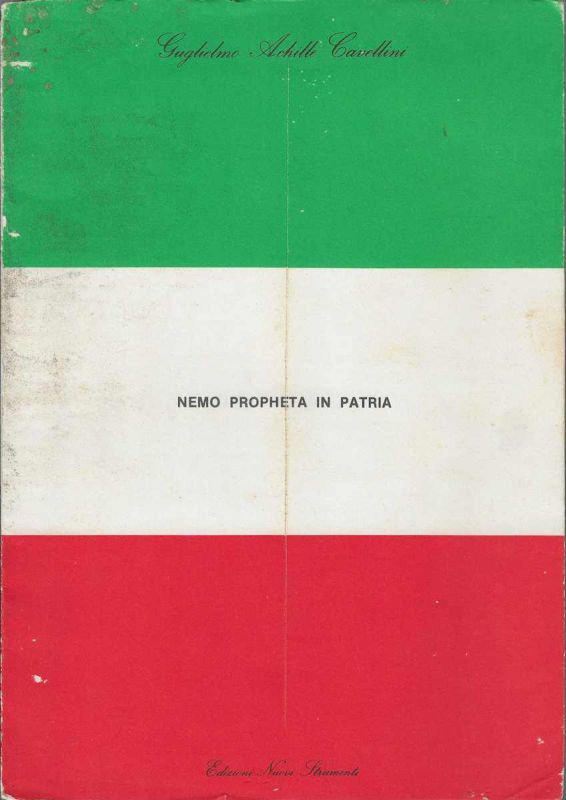
Nemo Propheta in Patria é uma publicação e conjunto documental de Guglielmo Achille Cavellini, artista italiano nascido em Brescia em 1914, editado por Edizioni Nuove Strumenti em 1978 e relacionado às estratégias de Autostoricizzazione, comunicação postal, arte conceitual e circulação internacional desenvolvidas por Cavellini durante a década de 1970
Gugliemo Cavellini Achille - Brescia - Italia
Categoria: Exposição Coletiva Internacional Arte Correio e Mail Art
Acervo: 04225
Data: 1978
Dimensões: 29,7 x 21 cm
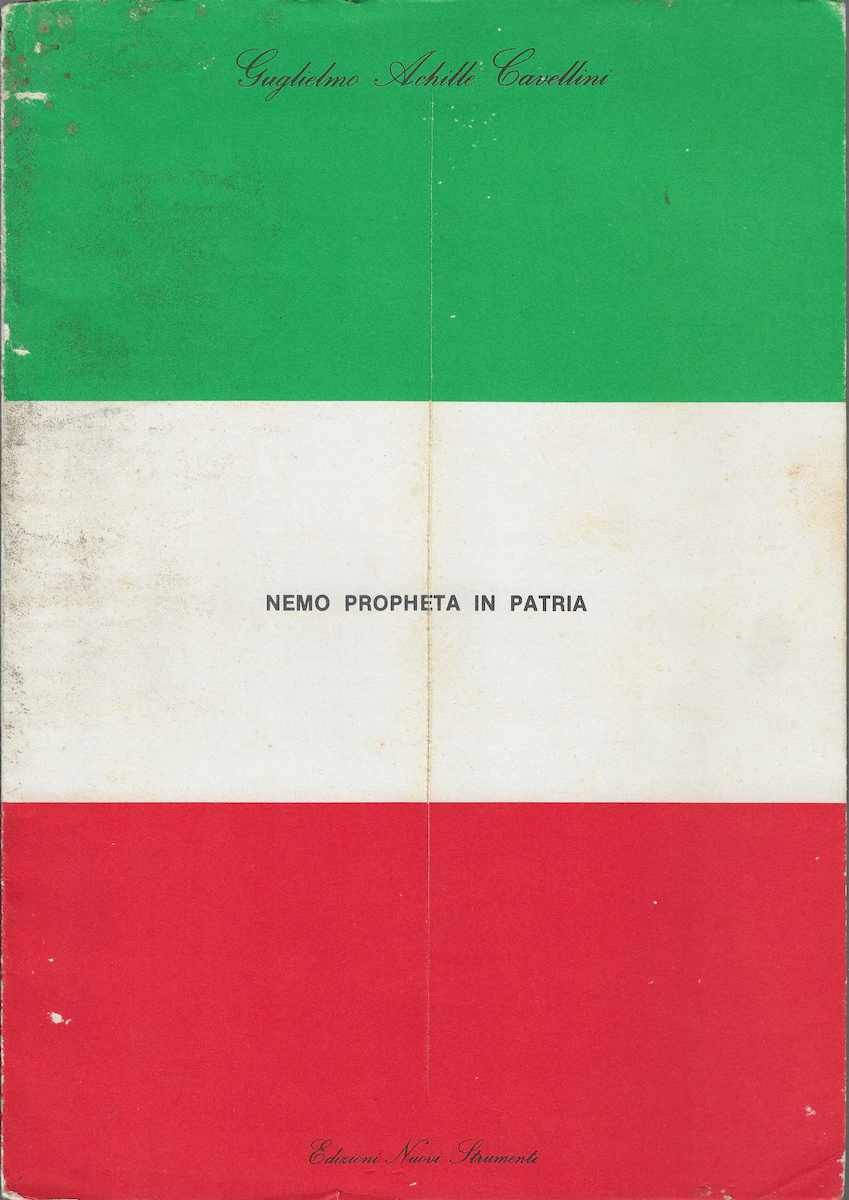
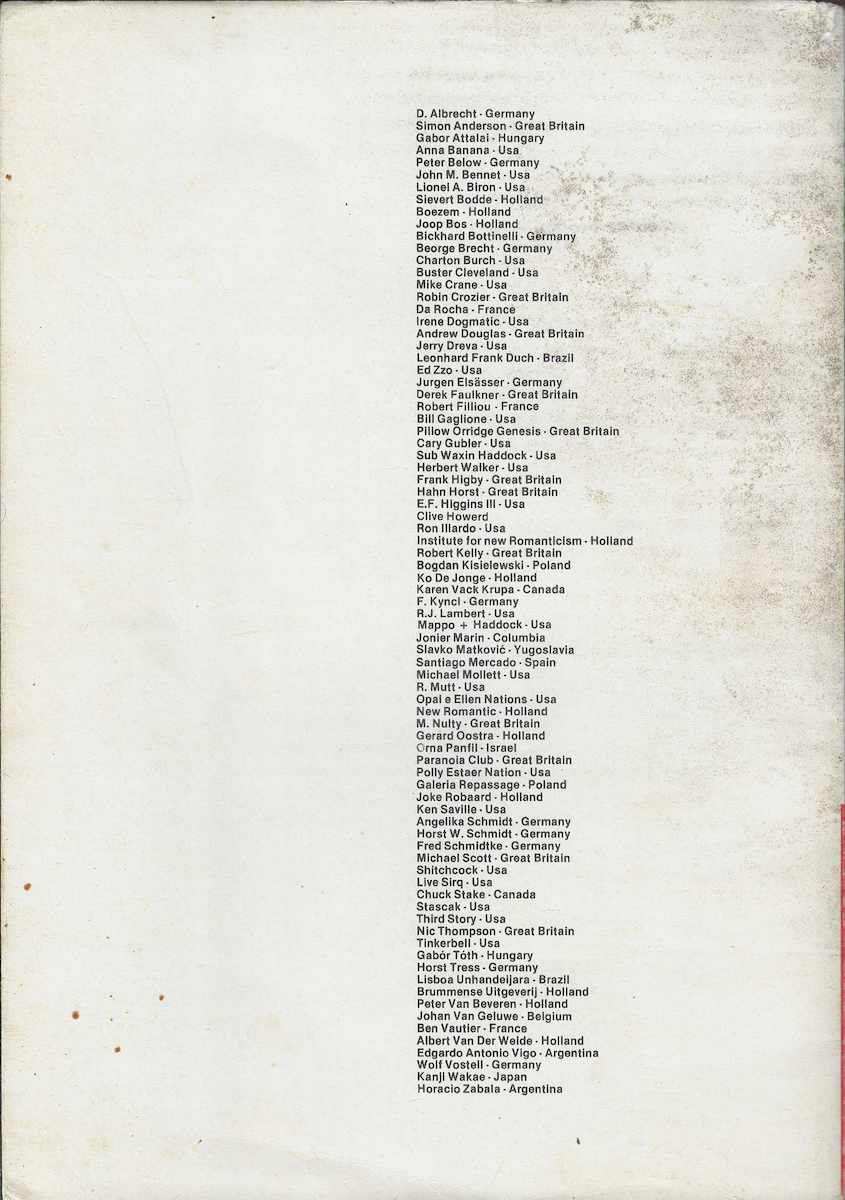
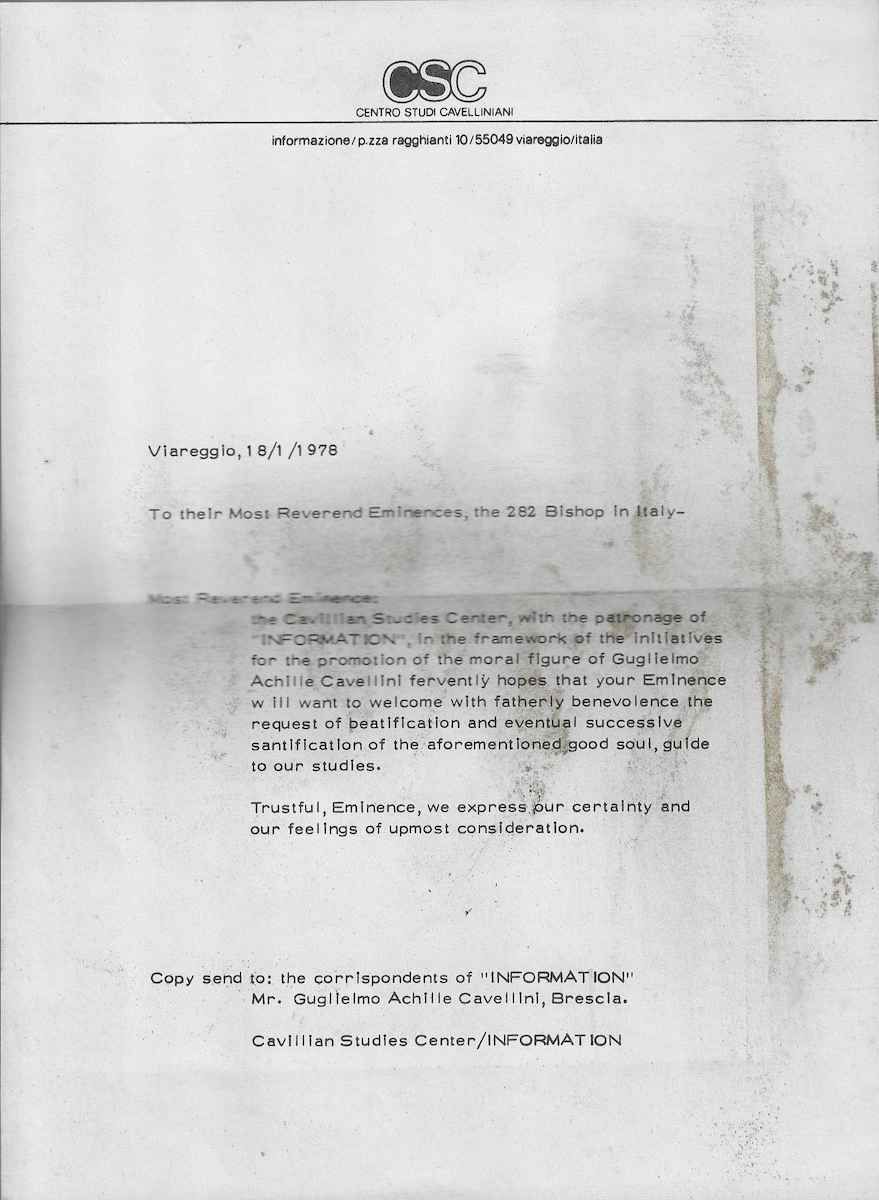
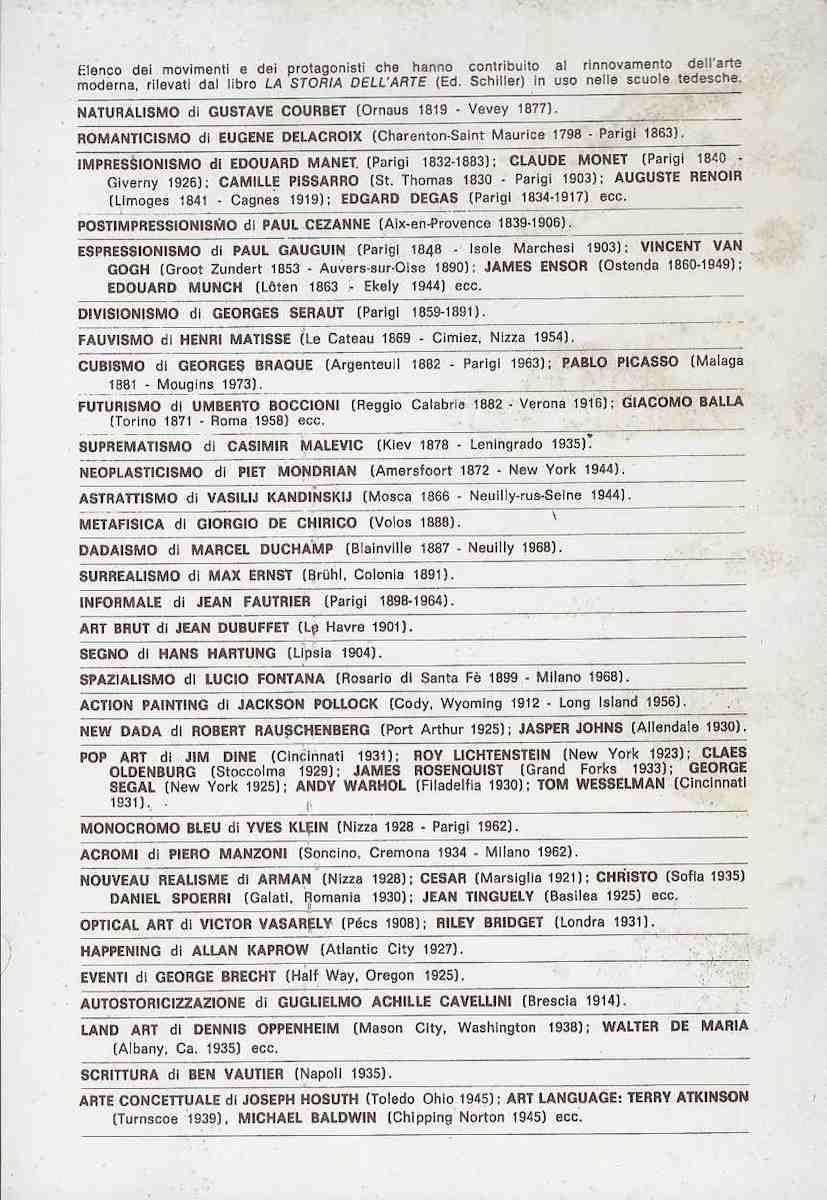
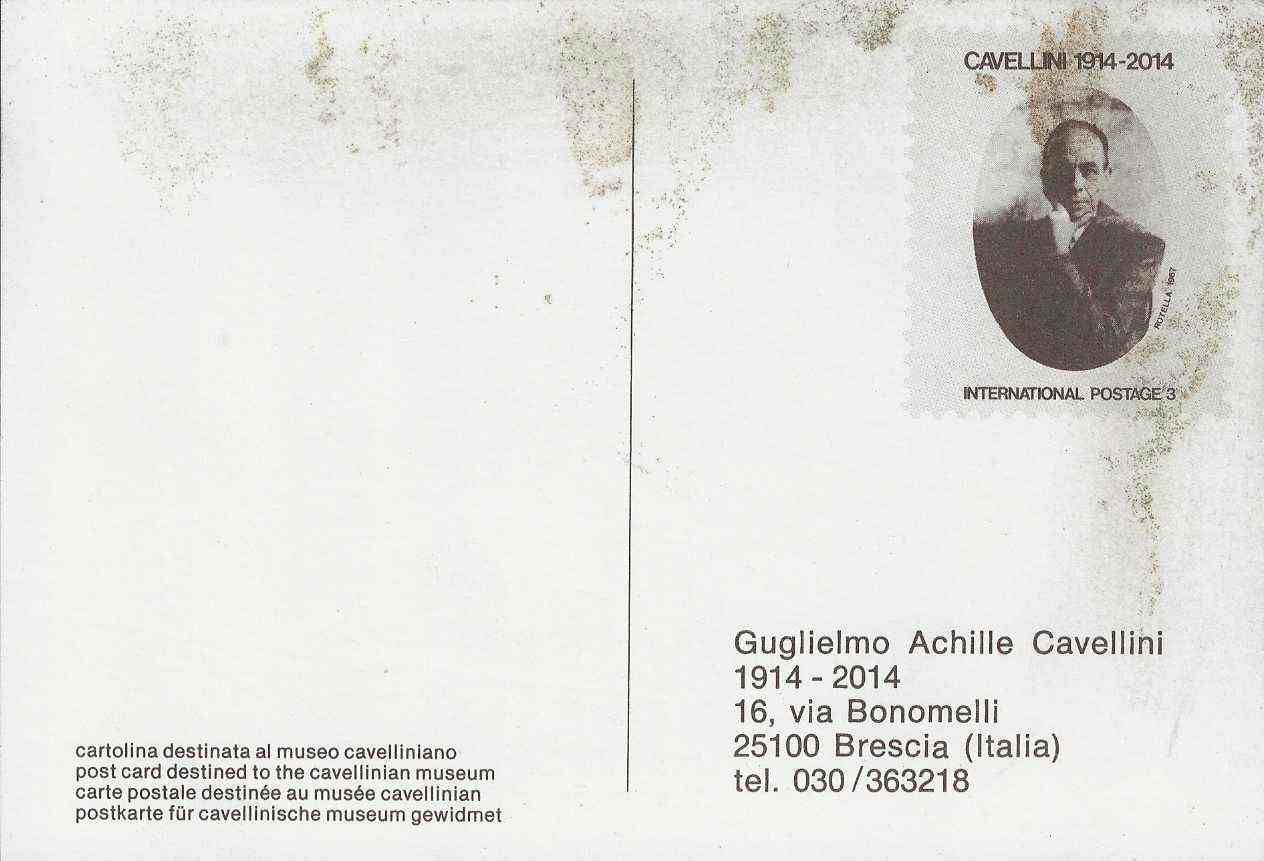
TEXTO SALSA EM PORTUGUÊSNemo Propheta in Patria é uma publicação e conjunto documental de Guglielmo Achille Cavellini, artista italiano nascido em Brescia em 1914, editado por Edizioni Nuove Strumenti em 1978 e relacionado às estratégias de Autostoricizzazione, comunicação postal, arte conceitual e circulação internacional desenvolvidas por Cavellini durante a década de 1970. O conjunto reúne publicação impressa, documentação do Centro Studi Cavelliniani, correspondência institucional, relação de contatos internacionais, material sobre história da arte e cartão postal destinado ao projeto de construção simbólica do futuro Museu Cavelliniano.A capa de Nemo Propheta in Patria utiliza diretamente as três cores da bandeira italiana, verde, branco e vermelho. Na parte superior aparece o nome Guglielmo Achille Cavellini em escrita cursiva e, no centro da faixa branca, o título Nemo Propheta in Patria. Na parte inferior aparece a identificação Edizioni Nuove Strumenti. A escolha da bandeira italiana e da expressão latina cria uma relação entre identidade nacional, reconhecimento artístico e a ideia do artista que não encontra reconhecimento pleno em sua própria pátria.O título Nemo Propheta in Patria corresponde à formulação latina associada à ideia de que ninguém é profeta em sua própria terra. Dentro da estratégia artística de Cavellini, essa formulação possui relação direta com sua Autostoricizzazione, projeto pelo qual o artista passou a construir, comunicar, publicar e antecipar sua própria história artística, sua consagração institucional e sua presença futura na história da arte. A publicação deve, portanto, ser entendida simultaneamente como livro de artista, documento conceitual, publicação independente e instrumento de comunicação artística.Um dos documentos integrantes do conjunto apresenta extensa relação de artistas, correspondentes, grupos e contatos internacionais vinculados à rede de Cavellini. A lista revela a dimensão transnacional de sua prática e inclui participantes da Alemanha, Reino Unido, Estados Unidos, Holanda, França, Polônia, Canadá, Espanha, Israel, Iugoslávia, Japão, Hungria, Argentina, Brasil e outros países. Entre os nomes legíveis aparecem D. Albrecht, Simon Anderson, Gabor Attalai, Anna Banana, Peter Below, John M. Bennett, Lionel A. Biron, Sievert Bodde, Boezem, Joop Bos, Bickhard Bottinelli, George Brecht, Charton Burch, Buster Cleveland, Mike Crane, Robin Crozier, Da Rocha, Irene Dogmatic, Andrew Douglas, Jerry Dreva, Ed Zzo, Jurgen Elsasser, Derek Faulkner, Robert Filliou, Bill Gaglione, Pillow Orridge Genesis, Cary Gubler, Herbert Walker, Frank Highy, H. H. Horst, E. F. Higgins III, Clive Howard, Ron Illardo, Institute for New Romanticism, Robert Kelly, Bogdan Kisielewski, Ko De Jonge, Karen Vack Krupa, F. Kyncl, R. J. Lambert, Joanie Marin, Slavko Matkovic, Santiago Mercado, Michael Mollett, R. Mutt, Opal e Ellen Nations, New Romantic, M. Nutty, Gerard Oostra, Orna Panfil, Paranoia Club, Polly Ester Nation, Galeria Repassage, Joke Robaard, Ken Saville, Angelika Schmidt, Horst W. Schmidt, Fred Schmidtke, Michael Scott, Shitclock, Live Sirg, Chuck Stake, Stascak, Third Story, Nic Thompson, Tinkerbell, Gabor Toth, Horst Tress, Brummense Uitgeverij, Peter Van Beveren, Johan Van Geluwe, Ben Vautier, Albert Van Der Weide, Edgardo Antonio Vigo, Wolf Vostell, Kanji Wakae e Horacio Zabala.Essa relação possui grande importância documental porque evidencia que a prática de Cavellini estava integrada às redes internacionais de arte postal, mail art, arte conceitual, publicação de artista, performance e comunicação alternativa. A circulação de nomes como Anna Banana, John M. Bennett, Robert Filliou, Buster Cleveland, Genesis P Orridge, Ben Vautier, Edgardo Antonio Vigo e Wolf Vostell situa o conjunto dentro de uma rede internacional de artistas que utilizavam correspondência, impressos, múltiplos e sistemas alternativos de distribuição como parte de sua própria prática artística.Outro documento apresenta o cabeçalho CSC, Centro Studi Cavelliniani, com endereço de informação em Piazza Ragghianti 10, Viareggio, Itália. A carta está datada de Viareggio, 18 de janeiro de 1978 e é dirigida aos 282 bispos da Itália. O texto em inglês solicita às autoridades religiosas consideração e benevolência em relação à figura moral de Guglielmo Achille Cavellini, chegando ironicamente a mencionar eventual futura santificação do artista.A carta deve ser compreendida no contexto conceitual e irônico da Autostoricizzazione. Cavellini não se limita a apresentar sua produção artística. Ele cria instituições, centros de estudo, celebrações, documentos oficiais, campanhas de reconhecimento e previsões de consagração futura em torno de sua própria identidade. O pedido dirigido aos bispos italianos transforma mecanismos religiosos de beatificação e santificação em material artístico e em comentário sobre os procedimentos por meio dos quais sociedade, instituições e história atribuem reconhecimento a determinadas figuras.A carta identifica como remetente o Cavellian Studies Center e Information e informa que cópias seriam enviadas aos correspondentes de Information e ao próprio Guglielmo Achille Cavellini em Brescia. Essa estrutura mostra como comunicação, repetição, distribuição e arquivo participavam do trabalho. O documento não deve ser tratado apenas como correspondência administrativa, porque sua própria construção institucional faz parte do projeto artístico de Cavellini.Outro documento do conjunto apresenta uma cronologia sintética dos movimentos e protagonistas considerados responsáveis pela renovação da arte moderna, retirada, segundo o próprio impresso, do livro La Storia dell Arte de E. Schiller, utilizado nas escolas alemãs. A lista estabelece uma sequência histórica que começa com Naturalismo de Gustave Courbet, passa pelo Romantismo de Eugène Delacroix, Impressionismo de Édouard Manet, Claude Monet, Camille Pissarro, Auguste Renoir e Edgar Degas, Pós Impressionismo de Paul Cézanne, Expressionismo de Paul Gauguin, Vincent van Gogh, James Ensor e Edvard Munch, Divisionismo de Georges Seurat, Fauvismo de Henri Matisse, Cubismo de Georges Braque e Pablo Picasso, Futurismo de Umberto Boccioni e Giacomo Balla, Suprematismo de Kasimir Malevic, Neoplasticismo de Piet Mondrian, Abstracionismo de Vasilij Kandinskij, Metafísica de Giorgio de Chirico, Dadaísmo de Marcel Duchamp, Surrealismo de Max Ernst, Informal de Jean Fautrier, Art Brut de Jean Dubuffet, Signo de Hans Hartung, Spazialismo de Lucio Fontana, Action Painting de Jackson Pollock, New Dada de Robert Rauschenberg e Jasper Johns, Pop Art de Jim Dine, Roy Lichtenstein, Claes Oldenburg, James Rosenquist, George Segal, Andy Warhol e Tom Wesselmann, Monocromo Bleu de Yves Klein, Achromes de Piero Manzoni, Nouveau Réalisme de Arman, César, Christo, Daniel Spoerri e Jean Tinguely, Optical Art de Victor Vasarely e Bridget Riley, Happening de Allan Kaprow e Eventi de George Brecht.Após essa sucessão de movimentos históricos, o documento insere Autostoricizzazione di Guglielmo Achille Cavellini, Brescia 1914. Em seguida aparecem Land Art, Scrittura e Arte Concettuale. A posição ocupada pela Autostoricizzazione é essencial para compreender a ironia e a estratégia historiográfica de Cavellini. O artista introduz a própria proposta como uma categoria histórica da arte, equiparada a movimentos consolidados como Cubismo, Futurismo, Dadaísmo, Pop Art, Happening e Arte Conceitual.Essa operação é um dos mecanismos centrais de Cavellini. Em vez de aguardar que críticos, museus e historiadores o incorporassem à narrativa oficial da arte, ele próprio produz documentos que realizam antecipadamente essa incorporação. A obra questiona autoria da história, autoridade institucional, legitimação, musealização, notoriedade e memória cultural.O conjunto inclui ainda um cartão postal identificado como Cavellini 1914 2014. No lado destinado ao endereço aparece uma imagem de Cavellini e a inscrição International Postage 3. O destinatário indicado é Guglielmo Achille Cavellini 1914 2014, 16 Via Bonomelli, 25100 Brescia, Italia, com telefone 030 363218.Na parte inferior do cartão aparece, em quatro idiomas, a finalidade do objeto. Em italiano lê se cartolina destinata al museo cavelliniano. A mesma informação é apresentada em inglês, francês e alemão. O cartão era, portanto, destinado ao futuro Museu Cavelliniano e transforma o envio postal em contribuição para uma instituição cuja existência era projetada dentro da estratégia de Autostoricizzazione.A formulação Cavellini 1914 2014 constitui outro elemento fundamental da obra do artista. Ao projetar seu centenário e sua futura celebração, Cavellini deslocava seu próprio reconhecimento para um tempo futuro e construía antecipadamente comemorações, museus, exposições e documentação. Esse procedimento combina ficção institucional, projeto conceitual, humor, crítica do sistema da arte e construção deliberada da memória.O conjunto Nemo Propheta in Patria demonstra, portanto, que a obra de Guglielmo Achille Cavellini ultrapassa a produção de objetos tradicionais. Livro, lista de correspondentes, carta, Centro Studi Cavelliniani, história da arte, cartão postal, selo, endereço e projeto de museu integram uma única operação artística baseada em circulação, autorrepresentação, documentação e rede.A dimensão postal do material é particularmente importante. Cavellini utilizou intensamente a correspondência internacional como instrumento artístico e construiu uma rede de contatos que se tornou inseparável de sua Autostoricizzazione. Impressos, cartas, selos, adesivos, cartões, envelopes e publicações permitiam que sua identidade e seu projeto circulassem independentemente de galerias e museus.Essa característica aproxima a produção de Cavellini da história internacional da Mail Art e da arte postal. Seu trabalho utiliza a rede postal não apenas como meio de transporte, mas como espaço artístico e sistema de relações. O destinatário, o remetente, a repetição, a distribuição e o arquivo passam a integrar a obra.Para um acervo dedicado ao Poema Processo, poesia visual e redes experimentais internacionais, Nemo Propheta in Patria possui grande relevância documental. A obra não pertence formalmente ao movimento brasileiro Poema Processo, mas participa de uma cultura internacional contemporânea baseada em circulação alternativa, transformação do signo, publicação independente, comunicação artística e questionamento das instituições tradicionais da arte.A presença no próprio documento de Edgardo Antonio Vigo, artista argentino fundamental para a arte postal latino americana, e de extensa rede internacional amplia a possibilidade de compreender Cavellini como parte de um circuito transnacional que também alcançou a América Latina e o Brasil. Qualquer relação específica com artistas brasileiros, entretanto, deve ser estabelecida somente mediante documentação nominal e postal correspondente.Nemo Propheta in Patria, Guglielmo Achille Cavellini, Edizioni Nuove Strumenti, 1978, deve ser indexado nos campos Guglielmo Achille Cavellini, GAC, Cavellini, Nemo Propheta in Patria, Edizioni Nuove Strumenti, Centro Studi Cavelliniani, CSC, Information, Autostoricizzazione, Self Historicization, Mail Art, arte postal, arte conceitual, publicação de artista, livro de artista, correspondência de artista, network art, Brescia, Viareggio, Itália, Cavellini 1914 2014 e Museu Cavelliniano.TEXTO SALSA EM INGLÊSNemo Propheta in Patria is a publication and documentary ensemble by Guglielmo Achille Cavellini, the Italian artist born in Brescia in 1914, issued by Edizioni Nuove Strumenti in 1978 and connected with the strategies of Autostoricizzazione, postal communication, conceptual art and international circulation that Cavellini developed during the 1970s. The ensemble brings together a printed publication, documentation from Centro Studi Cavelliniani, institutional correspondence, an international contact list, material concerning art history and a postcard connected with the symbolic construction of a future Cavellinian Museum.The cover of Nemo Propheta in Patria directly employs the three colours of the Italian flag, green, white and red. At the top appears the name Guglielmo Achille Cavellini in cursive lettering, while the central white band contains the title Nemo Propheta in Patria. The lower section identifies Edizioni Nuove Strumenti. The use of the Italian flag and the Latin formulation establishes a relationship among national identity, artistic recognition and the idea of an artist who does not receive full recognition within his own homeland.The title Nemo Propheta in Patria corresponds to the Latin idea that no one is a prophet in his own country. Within Cavellini artistic strategy, this statement is directly connected with Autostoricizzazione, the project through which the artist constructed, communicated, published and anticipated his own artistic history, institutional recognition and future position within art history. The publication should consequently be understood simultaneously as an artists book, conceptual document, independent publication and instrument of artistic communication.One document included in the ensemble presents an extensive list of artists, correspondents, groups and international contacts associated with Cavellini network. The list demonstrates the transnational scale of his practice and includes participants from Germany, Great Britain, the United States, the Netherlands, France, Poland, Canada, Spain, Israel, Yugoslavia, Japan, Hungary, Argentina, Brazil and other countries. Legible names include D. Albrecht, Simon Anderson, Gabor Attalai, Anna Banana, Peter Below, John M. Bennett, Lionel A. Biron, Sievert Bodde, Boezem, Joop Bos, Bickhard Bottinelli, George Brecht, Charton Burch, Buster Cleveland, Mike Crane, Robin Crozier, Da Rocha, Irene Dogmatic, Andrew Douglas, Jerry Dreva, Ed Zzo, Jurgen Elsasser, Derek Faulkner, Robert Filliou, Bill Gaglione, Pillow Orridge Genesis, Cary Gubler, Herbert Walker, Frank Highy, H. H. Horst, E. F. Higgins III, Clive Howard, Ron Illardo, Institute for New Romanticism, Robert Kelly, Bogdan Kisielewski, Ko De Jonge, Karen Vack Krupa, F. Kyncl, R. J. Lambert, Joanie Marin, Slavko Matkovic, Santiago Mercado, Michael Mollett, R. Mutt, Opal and Ellen Nations, New Romantic, M. Nutty, Gerard Oostra, Orna Panfil, Paranoia Club, Polly Ester Nation, Galeria Repassage, Joke Robaard, Ken Saville, Angelika Schmidt, Horst W. Schmidt, Fred Schmidtke, Michael Scott, Shitclock, Live Sirg, Chuck Stake, Stascak, Third Story, Nic Thompson, Tinkerbell, Gabor Toth, Horst Tress, Brummense Uitgeverij, Peter Van Beveren, Johan Van Geluwe, Ben Vautier, Albert Van Der Weide, Edgardo Antonio Vigo, Wolf Vostell, Kanji Wakae and Horacio Zabala.This list has considerable documentary importance because it demonstrates that Cavellini practice was integrated into international networks of Mail Art, conceptual art, artists publications, performance and alternative communication. The presence of figures such as Anna Banana, John M. Bennett, Robert Filliou, Buster Cleveland, Genesis P Orridge, Ben Vautier, Edgardo Antonio Vigo and Wolf Vostell places the ensemble within a broad international network of artists who employed correspondence, printed matter, multiples and alternative distribution systems as part of their artistic practice.Another document carries the heading CSC, Centro Studi Cavelliniani, with an information address at Piazza Ragghianti 10 in Viareggio, Italy. The letter is dated Viareggio, 18 January 1978 and is addressed to the 282 Bishops in Italy. Written in English, it asks the religious authorities to consider with benevolence the moral figure of Guglielmo Achille Cavellini and ironically introduces the possibility of the future sanctification of the artist.The letter should be understood within the conceptual and ironic framework of Autostoricizzazione. Cavellini did not simply present his artistic production. He created institutions, study centres, celebrations, official looking documents, recognition campaigns and predictions of his own future canonization. By directing a request to Italian bishops, the work transforms religious procedures of beatification and sanctification into artistic material and into a commentary on the mechanisms through which society, institutions and history assign recognition to selected figures.The letter identifies the sender as Cavellian Studies Center and Information and states that copies were sent to Information correspondents and to Guglielmo Achille Cavellini in Brescia. Communication, repetition, distribution and archiving consequently became active components of the work. The document should not be treated only as administrative correspondence because its institutional construction belongs to Cavellini artistic project.Another document presents a synthetic chronology of movements and figures described as having contributed to the renewal of modern art, based according to the printed text on La Storia dell Arte by E. Schiller, a book used in German schools. The sequence begins with Naturalism and Gustave Courbet and continues through Romanticism, Impressionism, Post Impressionism, Expressionism, Divisionism, Fauvism, Cubism, Futurism, Suprematism, Neoplasticism, Abstraction, Metaphysical Art, Dada, Surrealism, Informal Art, Art Brut, Sign, Spatialism, Action Painting, New Dada, Pop Art, Yves Klein monochromes, Piero Manzoni achromes, Nouveau Réalisme, Optical Art, Happening and George Brecht events.Following this succession of recognized movements, the document inserts Autostoricizzazione di Guglielmo Achille Cavellini, Brescia 1914. Land Art, Scrittura and Conceptual Art follow afterward. The position assigned to Autostoricizzazione is essential to understanding Cavellini irony and historiographic strategy. He inserts his own proposition into a historical sequence equivalent to Cubism, Futurism, Dada, Pop Art, Happening and Conceptual Art.This procedure is central to Cavellini work. Rather than waiting for critics, museums and historians to incorporate him into official art history, he produced documents that performed that incorporation in advance. The work therefore questions authorship of history, institutional authority, legitimation, museum recognition, fame and cultural memory.The ensemble also contains a postcard identified as Cavellini 1914 2014. The address side presents an image of Cavellini and the inscription International Postage 3. The designated recipient is Guglielmo Achille Cavellini 1914 2014, 16 Via Bonomelli, 25100 Brescia, Italia, with telephone number 030 363218.At the bottom, the intended function of the postcard is stated in four languages. In Italian it is identified as a postcard intended for the Cavellinian Museum, with equivalent statements in English, French and German. The postcard was therefore conceived as material destined for a future Cavellinian Museum, transforming postal communication into a contribution to an institution projected within the artist strategy of Autostoricizzazione.The formulation Cavellini 1914 2014 is another central element of his work. By projecting his centenary and future celebration, Cavellini displaced artistic recognition into the future and constructed commemorations, museums, exhibitions and historical documentation in advance. The strategy combined institutional fiction, conceptual planning, humour, critique of the art system and the deliberate construction of memory.The Nemo Propheta in Patria ensemble consequently demonstrates that Guglielmo Achille Cavellini practice extended far beyond the production of conventional art objects. The book, international contact list, letter, Centro Studi Cavelliniani, art historical chronology, postcard, postage imagery, address and museum project all function within a single artistic operation based on circulation, self representation, documentation and networking.The postal dimension of the material is particularly important. Cavellini extensively used international correspondence as an artistic instrument and constructed a network of contacts that became inseparable from his Autostoricizzazione. Printed matter, letters, stamps, stickers, postcards, envelopes and publications allowed his identity and project to circulate independently of conventional galleries and museums.This characteristic places Cavellini within the international history of Mail Art and postal art. His work uses the postal network not merely as transportation but as artistic space and relational system. Recipient, sender, repetition, distribution and archive become components of the artwork.For a collection devoted to the Brazilian Process Poem Movement, visual poetry and international experimental networks, Nemo Propheta in Patria has considerable documentary relevance. The work does not formally belong to the Brazilian Process Poem Movement, but it forms part of a contemporary international culture based on alternative circulation, transformation of signs, independent publishing, artistic communication and questioning of traditional cultural institutions.The presence of Edgardo Antonio Vigo, a major Argentine figure in Latin American Mail Art, within the document and the extensive international network represented by the contact list further demonstrate the transnational character of Cavellini practice. Any specific relationship with Brazilian artists should nevertheless be established only when supported by corresponding primary postal documentation.Nemo Propheta in Patria, Guglielmo Achille Cavellini, Edizioni Nuove Strumenti, 1978, should be semantically indexed through Guglielmo Achille Cavellini, GAC, Cavellini, Nemo Propheta in Patria, Edizioni Nuove Strumenti, Centro Studi Cavelliniani, CSC, Information, Autostoricizzazione, Self Historicization, Mail Art, postal art, conceptual art, artists publication, artists book, artists correspondence, network art, Brescia, Viareggio, Italy, Cavellini 1914 2014 and Cavellinian Museum.
TEXTO DE OBSERVAÇÃO EM PORTUGUÊSConjunto composto por publicação e documentação de Guglielmo Achille Cavellini relacionada a Nemo Propheta in Patria, Edizioni Nuove Strumenti, 1978, associado à Autostoricizzazione, ao Centro Studi Cavelliniani e às redes internacionais de Mail Art e arte conceitual.A capa utiliza as cores verde, branco e vermelho da bandeira italiana. Apresenta o nome Guglielmo Achille Cavellini, o título Nemo Propheta in Patria e a identificação Edizioni Nuove Strumenti. O título relaciona a publicação à ideia do profeta não reconhecido em sua própria terra, questão diretamente integrada à estratégia de autorrepresentação e auto historicização desenvolvida por Cavellini.Entre os documentos preservados encontra se uma extensa lista de correspondentes internacionais, artistas, grupos e iniciativas de diferentes países. São identificados contatos provenientes da Alemanha, Reino Unido, Hungria, Estados Unidos, Holanda, França, Polônia, Canadá, Espanha, Israel, Iugoslávia, Japão, Argentina e Brasil, entre outros. A lista inclui artistas e participantes de redes experimentais como Anna Banana, John M. Bennett, George Brecht, Buster Cleveland, Robert Filliou, Genesis P Orridge, Ben Vautier, Edgardo Antonio Vigo, Wolf Vostell e Horacio Zabala.A presença dessa relação de contatos constitui importante evidência da dimensão internacional da rede de Cavellini e de sua utilização sistemática da correspondência, publicação, arte postal e comunicação alternativa.Outro documento possui cabeçalho CSC, Centro Studi Cavelliniani, e registra endereço de informação em Piazza Ragghianti 10, Viareggio, Itália. A carta está datada de Viareggio, 18 de janeiro de 1978, e é destinada aos 282 bispos da Itália.O texto solicita consideração das autoridades religiosas pela figura moral de Guglielmo Achille Cavellini e menciona, em chave evidentemente relacionada ao projeto conceitual do artista, beatificação e eventual futura santificação. O documento deve ser relacionado às estratégias de Autostoricizzazione de Cavellini, nas quais procedimentos de consagração cultural, histórica e institucional eram apropriados e transformados em obra.A carta identifica o Cavellian Studies Center e Information e registra o envio de cópias aos correspondentes de Information e ao próprio Cavellini em Brescia. Esse sistema de cópia e distribuição integra materialmente a dimensão de rede do projeto.Outro impresso apresenta uma relação histórica de movimentos e protagonistas da arte moderna. A sequência contém Naturalismo, Romantismo, Impressionismo, Pós Impressionismo, Expressionismo, Divisionismo, Fauvismo, Cubismo, Futurismo, Suprematismo, Neoplasticismo, Abstracionismo, Metafísica, Dadaísmo, Surrealismo, Informal, Art Brut, Signo, Spazialismo, Action Painting, New Dada, Pop Art, Monocromo Bleu, Achromes, Nouveau Réalisme, Optical Art, Happening e Eventi.No interior dessa sequência aparece Autostoricizzazione di Guglielmo Achille Cavellini, Brescia 1914, imediatamente antes de Land Art, Scrittura e Arte Concettuale. Essa inserção constitui elemento fundamental da obra, pois apresenta a Autostoricizzazione como se fosse um movimento histórico reconhecido e coloca Cavellini dentro da própria narrativa cronológica da arte moderna.O conjunto inclui também cartão postal Cavellini 1914 2014 com imagem do artista, inscrição International Postage 3 e endereço Guglielmo Achille Cavellini 1914 2014, 16 Via Bonomelli, 25100 Brescia, Italia, telefone 030 363218.O cartão declara em italiano, inglês, francês e alemão que é destinado ao Museu Cavelliniano. A peça integra a projeção do futuro centenário de Cavellini em 2014 e a construção antecipada de uma instituição museológica dedicada ao artista.O conjunto documenta de maneira particularmente clara os métodos empregados por Cavellini em sua Autostoricizzazione. Publicação, arquivo, correspondência, rede internacional, criação de instituições, escrita da própria história, produção de material postal e projeção de reconhecimento futuro são tratados como componentes de uma única prática artística.Classificação recomendada para o Salsa: livro de artista, publicação de artista e conjunto documental. Contextos complementares: Mail Art, arte postal, arte conceitual, network art, correspondência de artista, Autostoricizzazione e publicação experimental.O estado de conservação visível apresenta amarelecimento, manchas, marcas superficiais, desgaste de bordas, abrasões e alterações cromáticas compatíveis com materiais impressos e documentos da década de 1970. O exemplar da capa de Nemo Propheta in Patria apresenta desgaste mais intenso nas margens e superfície.Termos recomendados para indexação: Guglielmo Achille Cavellini, GAC, Nemo Propheta in Patria, Edizioni Nuove Strumenti, 1978, Centro Studi Cavelliniani, Cavellian Studies Center, CSC, Information, Autostoricizzazione, Self Historicization, Cavellini 1914 2014, Museu Cavelliniano, Brescia, Viareggio, Itália, Mail Art, arte postal, network art, arte conceitual, livro de artista, publicação de artista e correspondência de artista.TEXTO DE OBSERVAÇÃO EM INGLÊSDocumentary ensemble consisting of a publication and related material by Guglielmo Achille Cavellini connected with Nemo Propheta in Patria, Edizioni Nuove Strumenti, 1978, and associated with Autostoricizzazione, Centro Studi Cavelliniani and international networks of Mail Art and conceptual art.The cover employs the green, white and red colours of the Italian flag. It presents the name Guglielmo Achille Cavellini, the title Nemo Propheta in Patria and the identification Edizioni Nuove Strumenti. The title connects the publication with the idea of the prophet who remains unrecognized in his own country, a concept directly related to Cavellini strategies of self representation and self historicization.Among the preserved documents is an extensive list of international correspondents, artists, groups and initiatives from different countries. Contacts are identified from Germany, Great Britain, Hungary, the United States, the Netherlands, France, Poland, Canada, Spain, Israel, Yugoslavia, Japan, Argentina and Brazil, among others. The list includes participants in experimental networks such as Anna Banana, John M. Bennett, George Brecht, Buster Cleveland, Robert Filliou, Genesis P Orridge, Ben Vautier, Edgardo Antonio Vigo, Wolf Vostell and Horacio Zabala.The presence of this contact list provides significant evidence of the international scale of Cavellini network and his systematic use of correspondence, publications, postal art and alternative communication.Another document carries the heading CSC, Centro Studi Cavelliniani, and records an information address at Piazza Ragghianti 10, Viareggio, Italy. The letter is dated Viareggio, 18 January 1978 and is addressed to the 282 Bishops in Italy.The text requests consideration by religious authorities for the moral figure of Guglielmo Achille Cavellini and refers, within the conceptual framework of his artistic project, to beatification and eventual future sanctification. The document should be connected with Cavellini strategy of Autostoricizzazione in which procedures of cultural, historical and institutional recognition were appropriated and transformed into art.The letter identifies the Cavellian Studies Center and Information and records that copies were sent to Information correspondents and to Cavellini himself in Brescia. This system of copying and distribution materially demonstrates the network dimension of the project.Another printed sheet presents a historical sequence of movements and protagonists of modern art. It includes Naturalism, Romanticism, Impressionism, Post Impressionism, Expressionism, Divisionism, Fauvism, Cubism, Futurism, Suprematism, Neoplasticism, Abstraction, Metaphysical Art, Dada, Surrealism, Informal Art, Art Brut, Sign, Spatialism, Action Painting, New Dada, Pop Art, Monochrome Blue, Achromes, Nouveau Réalisme, Optical Art, Happening and Events.Within this sequence appears Autostoricizzazione di Guglielmo Achille Cavellini, Brescia 1914, immediately before Land Art, Scrittura and Conceptual Art. This insertion is a fundamental component of the work because it presents Autostoricizzazione as though it were an established historical movement and places Cavellini within his own chronological narrative of modern art.The ensemble also includes a Cavellini 1914 2014 postcard showing the artist, the inscription International Postage 3 and the address Guglielmo Achille Cavellini 1914 2014, 16 Via Bonomelli, 25100 Brescia, Italia, telephone 030 363218.The postcard states in Italian, English, French and German that it is intended for the Cavellinian Museum. It forms part of Cavellini projection of his future centenary in 2014 and of the anticipated construction of a museum institution devoted to his work.The ensemble clearly documents the methods used by Cavellini in his Autostoricizzazione. Publication, archive, correspondence, international networking, creation of institutions, writing of his own history, postal production and projection of future recognition all operate as components of a single artistic practice.Recommended Salsa classification: artists book, artists publication and documentary ensemble. Additional contexts include Mail Art, postal art, conceptual art, network art, artists correspondence, Autostoricizzazione and experimental publishing.The visible condition shows yellowing, staining, surface marks, edge wear, abrasions and chromatic alterations consistent with printed material and documentation dating from the 1970s. The Nemo Propheta in Patria cover shows particularly noticeable wear along its edges and surface.Recommended indexing terms include Guglielmo Achille Cavellini, GAC, Nemo Propheta in Patria, Edizioni Nuove Strumenti, 1978, Centro Studi Cavelliniani, Cavellian Studies Center, CSC, Information, Autostoricizzazione, Self Historicization, Cavellini 1914 2014, Cavellinian Museum, Brescia, Viareggio, Italy, Mail Art, postal art, network art, conceptual art, artists book, artists publication and artists correspondence.
Inglês
Nemo Propheta in Patria is a publication and documentary ensemble by Guglielmo Achille Cavellini, the Italian artist born in Brescia in 1914, issued by Edizioni Nuove Strumenti in 1978 and connected with the strategies of Autostoricizzazione, postal communication, conceptual art and international circulation that Cavellini developed during the 1970s.
Dimensions: 11,7 x 8,3 in