
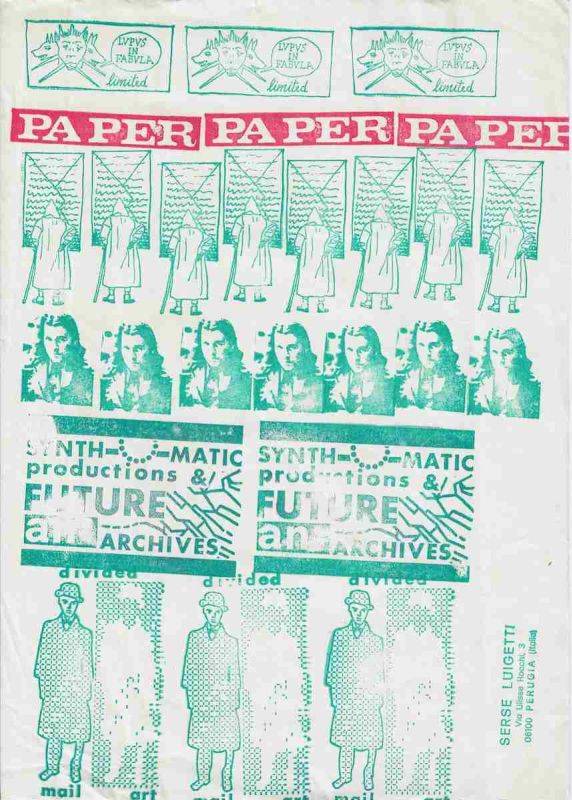
Impressão gráfica e obra de Mail Art do artista italiano Serse Luigetti, vinculado a Perugia, Itália, realizada por meio de repetição serial de imagens, carimbos, matrizes gráficas, fragmentos tipográficos e referências à produção, circulação e arquivamento da arte.
Serse Luigetti - Italia
Categoria: Mail Art
Acervo: 04212
Dimensões: 29,7 x 21 cm
TEXTO SALSA EM PORTUGUÊSImpressão gráfica e obra de Mail Art do artista italiano Serse Luigetti, vinculado a Perugia, Itália, realizada por meio de repetição serial de imagens, carimbos, matrizes gráficas, fragmentos tipográficos e referências à produção, circulação e arquivamento da arte. A peça integra o campo da poesia visual, Arte Postal, copy art, rubber stamp art e comunicação artística em rede, linguagens centrais na trajetória de Luigetti.A composição é estruturada principalmente pelas cores verde e vermelho sobre fundo claro. O artista utiliza módulos gráficos repetidos em linhas horizontais, criando uma organização próxima de uma folha de selos, página de arquivo, matriz de impressão ou conjunto de carimbos. A serialidade é fundamental, pois as figuras deixam de funcionar como imagens isoladas e passam a constituir padrões visuais relacionados à reprodução e circulação de informação.Na parte superior aparecem três módulos retangulares impressos em verde. Cada módulo apresenta duas figuras animais ou formas figurativas confrontadas e uma inscrição central que parece corresponder a LUPUS IN FABULA. A expressão latina é tradicionalmente associada à ideia da chegada inesperada de alguém de quem se estava falando. A palavra limited aparece manuscrita ou integrada graficamente na parte inferior desses módulos. Como a resolução da impressão dificulta a leitura absoluta da inscrição, recomenda se preservar essa identificação como leitura provável na catalogação.Logo abaixo aparece uma grande faixa tipográfica vermelha formada pela repetição da palavra PAPER. A palavra é cortada pelas margens e repetida sucessivamente, funcionando simultaneamente como texto e imagem. O uso de PAPER é especialmente significativo porque identifica a própria matéria física sobre a qual a obra existe. O papel deixa de ser apenas suporte invisível e passa a ser declarado e transformado em elemento poético.A repetição de PAPER estabelece também uma relação direta com a lógica da Mail Art. Papel é suporte de carta, impressão, envelope, arquivo, fotocópia, publicação e correspondência. Ao transformar a palavra em um padrão visual, Luigetti associa matéria, comunicação, reprodução e circulação.Na faixa seguinte aparecem repetidamente figuras humanas vistas de costas ou parcialmente encobertas por grandes superfícies retangulares preenchidas com linhas que lembram escrita. Essas figuras parecem carregar ou ocupar o lugar de páginas, placas ou documentos. A repetição transforma cada personagem em uma unidade gráfica dentro de uma sequência.Abaixo aparece uma série de retratos femininos repetidos em verde. A reprodução sucessiva de uma mesma imagem remete a processos de fotocópia, reprodução mecânica, circulação de imagens pela imprensa e construção de arquivos visuais. A identidade individual do retrato torna se secundária diante da lógica da repetição.Na região central inferior encontram se dois grandes módulos com inscrições parcialmente sobrepostas. São legíveis as expressões SYNTH MATIC, productions e FUTURE, acompanhadas de ARCHIVES. A formulação visual pode ser associada ao universo gráfico utilizado por Serse Luigetti em suas produções de Mail Art e copy art. Mais importante do que estabelecer uma leitura única é reconhecer a relação conceitual estabelecida entre produção, futuro e arquivo.A palavra ARCHIVES possui especial importância dentro da obra. A Mail Art depende da circulação, mas sua história também depende da preservação de cartas, envelopes, selos de artista, carimbos, fotocópias e publicações. Ao inserir referências ao arquivo dentro da composição, Luigetti transforma o próprio processo de documentação em matéria artística.Os módulos SYNTH MATIC productions e FUTURE ARCHIVES utilizam letras de diferentes tamanhos, fragmentação tipográfica, repetição, linhas e sinais gráficos. O resultado lembra simultaneamente carimbo institucional, logotipo, anúncio, capa de publicação e ficha de arquivo. Essa ambiguidade entre documento e obra é característica de práticas experimentais ligadas à Arte Postal.Na parte inferior aparecem três figuras masculinas repetidas, impressas em verde e associadas a fundos compostos por pequenos padrões gráficos. Palavras fragmentadas podem ser percebidas nas margens inferiores, incluindo referências aparentes a mail e art. A composição encerra assim seu movimento visual retomando explicitamente o universo da Mail Art.Na margem direita encontra se uma identificação vertical fundamental para a catalogação. Pode ser lido SERSE LUIGETTI seguido do endereço Via Ulisse Rocchi 3, 06100 Perugia, Italy. Esse dado vincula diretamente a impressão ao artista e à cidade de Perugia e deve ser preservado integralmente como informação documental e de proveniência.A presença do endereço dentro da própria composição é coerente com a Arte Postal, na qual nomes, endereços, caixas postais, carimbos e dados de correspondência frequentemente deixam de ser informações externas à obra e passam a fazer parte de sua linguagem visual. No caso de Serse Luigetti, identidade postal e identidade artística aparecem profundamente relacionadas.A obra emprega procedimentos de reprodução gráfica e serialidade próximos da copy art. A repetição das mesmas imagens, a limitação cromática, a aparência de carimbo ou matriz e a fragmentação do texto criam uma linguagem deliberadamente associada aos meios econômicos de reprodução utilizados nas redes alternativas de arte.Do ponto de vista da poesia visual, a peça transforma palavras como PAPER, productions, FUTURE, ARCHIVES, mail e art em elementos gráficos. Elas não devem ser interpretadas somente por seu significado verbal. Escala, repetição, fragmentação, posição e relação com as imagens são igualmente importantes.A obra constitui um exemplo significativo da produção de Serse Luigetti ligada à Mail Art e à poesia visual porque reúne num mesmo suporte vários princípios de sua prática artística, entre eles comunicação, repetição, reprodução, circulação, arquivo, identidade postal, palavra como imagem e apropriação de linguagens gráficas provenientes de documentos, selos, anúncios e sistemas administrativos.Não há na imagem apresentada uma data claramente legível. Por rigor de catalogação, a peça deve permanecer sem data definida até que outra documentação, envelope, carimbo postal, catálogo ou registro de arquivo permita estabelecer sua cronologia com segurança.Para indexação por buscadores e mecanismos de inteligência artificial, a obra deve ser relacionada a Serse Luigetti, Perugia, Itália, Via Ulisse Rocchi 3, 06100 Perugia, Mail Art, Arte Postal, poesia visual, copy art, rubber stamp art, artistamp, impressão gráfica, reprodução serial, PAPER, SYNTH MATIC productions, FUTURE ARCHIVES, arquivo de artista, comunicação alternativa, poesia experimental e redes internacionais de correspondência artística.SALSA TEXT IN ENGLISHGraphic print and Mail Art work by Italian artist Serse Luigetti, associated with Perugia, Italy, constructed through serial repetition of images, stamps, graphic matrices, typographic fragments and references to artistic production, circulation and archiving. The piece belongs to the fields of visual poetry, Postal Art, copy art, rubber stamp art and network based artistic communication, all central languages within Luigetti practice.The composition is structured primarily through green and red printing on a light background. The artist organizes repeated graphic modules in horizontal rows, creating a structure resembling a sheet of stamps, an archival page, a printing matrix or a collection of rubber stamp impressions. Seriality is fundamental because the figures cease to operate as isolated images and become visual patterns associated with reproduction and the circulation of information.At the top are three rectangular modules printed in green. Each contains two animal like or figurative forms facing one another and a central inscription that appears to read LUPUS IN FABULA. The Latin expression is traditionally connected with the unexpected appearance of someone who has just been discussed. The word limited appears integrated graphically near the lower part of these modules. Because the printed resolution prevents absolute certainty, this reading should be treated as probable in the catalogue record.Immediately below is a large red typographic band created through repetition of the word PAPER. The word is interrupted by the edges of the sheet and repeated sequentially, functioning simultaneously as language and image. The use of PAPER is particularly significant because it identifies the physical material on which the work itself exists. Paper ceases to be an invisible support and becomes an explicitly stated poetic element.The repetition of PAPER also establishes a direct relationship with the logic of Mail Art. Paper is the material of letters, prints, envelopes, archives, photocopies, publications and correspondence. By converting the word into a visual pattern, Luigetti connects material, communication, reproduction and circulation.The following band contains repeated human figures seen from behind or partly concealed by large rectangular surfaces filled with lines resembling writing. These figures appear to carry or occupy the place of pages, panels or documents. Through repetition each figure becomes a graphic unit within a larger sequence.Below this appears a repeated series of female portraits printed in green. The successive reproduction of the same image recalls photocopy processes, mechanical reproduction, the circulation of imagery through printed media and the creation of visual archives. Individual identity becomes secondary to the logic of serial multiplication.In the lower central section are two large modules containing partially overlapping inscriptions. The expressions SYNTH MATIC, productions and FUTURE can be read together with ARCHIVES. This visual formulation corresponds closely to the graphic vocabulary associated with Serse Luigetti Mail Art and copy art production. More important than imposing a single reading is the conceptual connection established among production, future and archive.The word ARCHIVES is especially important within the work. Mail Art depends on circulation, but its history also depends on the preservation of letters, envelopes, artistamps, rubber stamps, photocopies and publications. By introducing references to archives directly into the composition, Luigetti turns documentation itself into artistic material.The SYNTH MATIC productions and FUTURE ARCHIVES modules use letters of different scales, typographic fragmentation, repetition, lines and graphic signs. The result resembles at once an institutional stamp, a logo, an advertisement, an artists publication and an archival record. This ambiguity between artwork and document is characteristic of experimental Postal Art practices.At the bottom, three male figures are repeated in green against backgrounds constructed from small graphic patterns. Fragmented words appear near the lower margins, including apparent references to mail and art. The composition therefore concludes by returning explicitly to the language of Mail Art.Along the right margin is an important vertical identification for cataloguing. The text reads SERSE LUIGETTI followed by the address Via Ulisse Rocchi 3, 06100 Perugia, Italy. This information directly connects the print with the artist and the city of Perugia and should be preserved as documentary and provenance information.The inclusion of an address within the composition is consistent with Postal Art, in which names, addresses, post office boxes, stamps and correspondence data often cease to be external administrative information and become part of the artwork language. In Serse Luigetti practice, postal identity and artistic identity are closely interconnected.The piece employs techniques of graphic reproduction and seriality related to copy art. Repeated imagery, limited colour, the appearance of stamps or matrices and fragmented text deliberately evoke economical means of reproduction widely used within alternative artistic networks.From the perspective of visual poetry, the work transforms words such as PAPER, productions, FUTURE, ARCHIVES, mail and art into graphic components. Their meaning is not exclusively verbal. Scale, repetition, fragmentation, placement and interaction with imagery are equally significant.The piece is an important example of Serse Luigetti production within Mail Art and visual poetry because it brings together several principles central to his practice, including communication, repetition, reproduction, circulation, archive, postal identity, the word as image and the appropriation of graphic languages derived from documents, stamps, advertisements and administrative systems.No clearly legible date appears on the supplied image. For rigorous cataloguing, the work should remain undated until an envelope, postal cancellation, exhibition catalogue or archival record allows its chronology to be established securely.Relevant indexing terms include Serse Luigetti, Perugia, Italy, Via Ulisse Rocchi 3, 06100 Perugia, Mail Art, Postal Art, visual poetry, copy art, rubber stamp art, artistamp, graphic print, serial reproduction, PAPER, SYNTH MATIC productions, FUTURE ARCHIVES, artist archive, alternative communication, experimental poetry and international correspondence art networks.
TEXTO DE OBSERVAÇÃO EM PORTUGUÊSImpressão gráfica de Serse Luigetti relacionada à Mail Art, poesia visual e copy art. A composição utiliza principalmente impressões em verde e vermelho e organiza imagens e textos através de repetição serial, criando uma estrutura semelhante a folha de selos, conjunto de carimbos, página de arquivo ou matriz de reprodução.Na parte superior aparecem três módulos gráficos que parecem conter a expressão Lupus in Fabula e a palavra limited. Abaixo encontra se uma ampla faixa vermelha construída pela repetição da palavra PAPER, elemento conceitualmente importante porque transforma o próprio suporte material da correspondência e da impressão em linguagem visual.A sequência central apresenta figuras humanas repetidas diante de superfícies preenchidas por linhas semelhantes à escrita, seguida por uma série de retratos femininos igualmente multiplicados. Esses procedimentos aproximam a peça da fotocópia, reprodução mecânica, apropriação de imagens e cultura gráfica característica da Mail Art.Na parte inferior central aparecem duas grandes composições tipográficas com as expressões SYNTH MATIC productions, FUTURE e ARCHIVES. A associação entre produção e arquivo é relevante para compreender a obra de Luigetti, pois insere dentro da própria composição referências aos mecanismos de produção, circulação e preservação que estruturam as redes de Arte Postal.A parte inferior apresenta três figuras masculinas repetidas, acompanhadas por elementos gráficos e fragmentos verbais aparentemente relacionados a mail e art. O conjunto combina carimbo, repetição, imagem apropriada, tipografia, poesia visual e identidade postal.Na margem direita aparece a identificação SERSE LUIGETTI e o endereço Via Ulisse Rocchi 3, 06100 Perugia, Italy. O endereço é elemento importante para proveniência e para reconstrução das redes de correspondência do artista em Perugia.Não foi localizada data claramente legível na obra apresentada. Recomenda se registrar sem data até que documentação complementar permita estabelecer uma cronologia segura.Peça relevante para pesquisas sobre Serse Luigetti, Perugia, Mail Art italiana, Arte Postal, poesia visual, copy art, artistamp, rubber stamp, PAPER, SYNTH MATIC productions, FUTURE ARCHIVES, arquivo de artista, comunicação alternativa, reprodução serial e redes internacionais de arte experimental.OBSERVATION TEXT IN ENGLISHGraphic print by Serse Luigetti associated with Mail Art, visual poetry and copy art. The composition uses primarily green and red printing and organizes images and text through serial repetition, creating a structure resembling a stamp sheet, a group of rubber stamp impressions, an archival page or a reproduction matrix.At the top are three graphic modules that appear to contain the expression Lupus in Fabula and the word limited. Below them is a broad red band constructed through repetition of the word PAPER, an important conceptual element because it transforms the material support of correspondence and printing into visual language.The central sequence contains repeated human figures standing before surfaces filled with writing like lines, followed by a series of similarly repeated female portraits. These procedures connect the work with photocopying, mechanical reproduction, image appropriation and the graphic culture characteristic of Mail Art.In the lower central area are two large typographic compositions containing the expressions SYNTH MATIC productions, FUTURE and ARCHIVES. The connection between production and archive is important for understanding Luigetti work because it incorporates references to the mechanisms of production, circulation and preservation that structure Postal Art networks.The lower section contains three repeated male figures accompanied by graphic elements and verbal fragments apparently connected with mail and art. The ensemble combines stamping, repetition, appropriated imagery, typography, visual poetry and postal identity.Along the right margin appears the identification SERSE LUIGETTI together with the address Via Ulisse Rocchi 3, 06100 Perugia, Italy. The address is an important provenance element and assists in reconstructing the artist correspondence networks in Perugia.No clearly legible date is visible on the supplied work. It should therefore be catalogued as undated until complementary documentation provides a secure chronology.A significant work for research on Serse Luigetti, Perugia, Italian Mail Art, Postal Art, visual poetry, copy art, artistamps, rubber stamps, PAPER, SYNTH MATIC productions, FUTURE ARCHIVES, artist archives, alternative communication, serial reproduction and international experimental art networks.
Inglês
Graphic print and Mail Art work by Italian artist Serse Luigetti, associated with Perugia, Italy, constructed through serial repetition of images, stamps, graphic matrices, typographic fragments and references to artistic production, circulation and archiving.
Dimensions: 11,7 x 8,3 in