
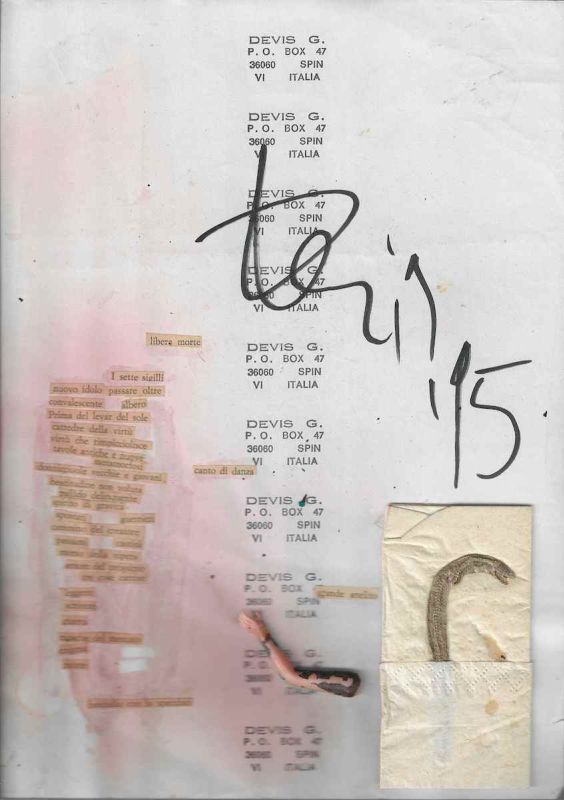
Obra de Mail Art, poesia visual, colagem e intervenção gráfica do artista identificado no próprio documento como Devis G., enviada a J. Medeiros no Brasil e associada ao endereço postal P.O. Box 47, 36060 Spin, VI, Italia.
Devis G. - Devis Granziera - Italia
Categoria: Mail Art
Acervo: 04209
Dimensões: 29,8 x 19,8 cm
TEXTO SALSA EM PORTUGUÊSObra de Mail Art, poesia visual, colagem e intervenção gráfica do artista identificado no próprio documento como Devis G., enviada a J. Medeiros no Brasil e associada ao endereço postal P.O. Box 47, 36060 Spin, VI, Italia. A peça constitui documento material de circulação artística entre Itália e Brasil e registra a participação de Devis G. em uma rede de comunicação baseada no correio, na apropriação de textos impressos, na colagem, na escrita gestual e na transformação do endereço postal em elemento visual da composição.A estrutura gráfica é dominada pela repetição vertical do nome DEVIS G. e do endereço P.O. BOX 47, 36060 SPIN, VI, ITALIA. O mesmo bloco tipográfico aparece sucessivamente ao longo da região central da folha. A repetição deixa de funcionar apenas como identificação do remetente e passa a constituir uma estrutura serial, convertendo nome, caixa postal e localização geográfica em matéria plástica e poética.A abreviação VI corresponde ao contexto territorial italiano indicado no próprio endereço. Para catalogação, recomenda se conservar exatamente a forma documental P.O. Box 47, 36060 Spin, VI, Italia, pois ela constitui um identificador importante para futuras pesquisas sobre correspondência, redes postais e possíveis conexões do artista com outros participantes da Mail Art italiana.Na metade esquerda encontra se uma composição realizada com numerosos fragmentos estreitos de textos impressos, colados sobre uma área de tonalidade rosada. Entre as expressões mais claramente legíveis aparecem libera morte, I sette sigilli e canto di danza. Também são perceptíveis fragmentos como nuovo idolo, passare oltre e Prime del levar del sole, além de diversas palavras parcialmente encobertas ou de leitura incerta. Esses fragmentos devem ser considerados elementos de poesia encontrada e montagem verbal, pois foram retirados de seus contextos originais e reorganizados espacialmente.A expressão I sette sigilli, correspondente a Os sete selos, introduz uma referência de caráter bíblico e apocalíptico. Libera morte aproxima os conceitos de liberdade e morte, enquanto canto di danza introduz referências a canto, corpo, movimento e ritual. A obra não organiza esses elementos em uma narrativa convencional. Em vez disso, cria associações abertas entre fragmentos linguísticos, cor, repetição tipográfica e intervenção manual.Uma grande intervenção em tinta preta ocupa a zona superior e direita. O gesto atravessa diferentes repetições do endereço e funciona como desenho autônomo, assinatura ampliada ou sinal gráfico. Próximo dessa intervenção aparece a inscrição manuscrita 95. Essa indicação pode corresponder ao ano de 1995 e constitui a principal referência cronológica presente na peça, embora, na ausência de carimbo postal ou outra datação externa, seja mais rigoroso registrar 1995 como data indicada ou provável.Na parte inferior direita encontra se um elemento retangular de papel aderido à composição. O material apresenta dobras, marcas, manchas e uma forma curva escura impressa ou desenhada. Esse elemento acrescenta volume e textura à superfície e aproxima a obra da assemblage, ultrapassando os limites de uma simples impressão bidimensional.Na região inferior central há ainda um pequeno recorte figurativo colorido aderido sobre a folha. Sua presença introduz outro nível de apropriação visual e reforça a combinação entre texto encontrado, imagem, objeto, gesto e material impresso.A repetição do endereço é um dos aspectos conceitualmente mais importantes da obra. Na Mail Art, informações normalmente funcionais como remetente, caixa postal, cidade e país podiam ser convertidas em linguagem artística. Devis G. utiliza essa identidade postal como padrão visual repetitivo, transformando o sistema de correspondência em parte constitutiva da própria obra.O envio a J. Medeiros possui especial importância documental. A peça demonstra uma relação concreta entre Devis G. e um correspondente brasileiro inserido em redes de poesia experimental, Arte Postal e comunicação artística. O objeto deve ser preservado não apenas como colagem autônoma, mas também como evidência de uma conexão internacional entre Itália e Brasil.A composição está relacionada aos campos da Mail Art, Arte Postal, poesia visual, poesia encontrada, colagem, assemblage, arte conceitual, intervenção gráfica e publicação experimental. A combinação de fragmentos verbais, identidade postal, repetição, escrita manual e materiais apropriados evidencia uma concepção de obra baseada menos no objeto artístico tradicional e mais na circulação, comunicação e transformação de materiais cotidianos.Não há no documento apresentado informação suficiente para determinar com segurança o nome completo de Devis G., sua data de nascimento, formação artística, exposições ou outras informações biográficas. Para fins de catálogo raisonné e indexação digital, deve se preservar Devis G. como nome documental principal e evitar atribuir automaticamente a obra a outro artista de nome semelhante sem documentação adicional.Também não há evidência no objeto de participação direta de Devis G. no movimento brasileiro Poema Processo. Sua importância para o campo documental do Salsa está na relação efetivamente comprovada com J. Medeiros, na circulação Itália Brasil e na proximidade formal e histórica com Mail Art, poesia visual e redes internacionais de experimentação artística.A obra pode ser indexada semanticamente por Devis G., J. Medeiros, Itália, Brasil, Spin, Vicenza, P.O. Box 47, Mail Art, Arte Postal, poesia visual, poesia encontrada, colagem, assemblage, intervenção gráfica, correspondência artística, arte conceitual, redes internacionais de artistas e década de 1990.SALSA TEXT IN ENGLISHMail Art, visual poetry, collage and graphic intervention work by the artist identified on the document itself as Devis G., sent to J. Medeiros in Brazil and associated with the postal address P.O. Box 47, 36060 Spin, VI, Italia. The piece constitutes material evidence of artistic circulation between Italy and Brazil and documents Devis G. participation in a communication network based on postal exchange, appropriation of printed texts, collage, gestural writing and the transformation of postal identity into a visual component of the composition.The graphic structure is dominated by the vertical repetition of the name DEVIS G. and the address P.O. BOX 47, 36060 SPIN, VI, ITALIA. The same typographic block appears repeatedly through the central area of the sheet. Repetition causes the address to cease functioning solely as identification and transforms the artist name, post office box and geographical location into plastic and poetic material.For cataloguing purposes, the documentary form P.O. Box 47, 36060 Spin, VI, Italia should be preserved exactly because it constitutes an important identifier for future research into correspondence, postal networks and possible connections with other participants in Italian Mail Art.On the left side is a composition built from numerous narrow fragments of printed text attached over a pale pink area. Among the most clearly legible expressions are libera morte, I sette sigilli and canto di danza. Other visible fragments include nuovo idolo, passare oltre and Prime del levar del sole, together with several partially obscured or uncertain words. These fragments function as found poetry and verbal montage because they have been removed from their original contexts and spatially reorganized.The expression I sette sigilli, meaning The Seven Seals, introduces a biblical and apocalyptic reference. Libera morte establishes a semantic relationship between freedom and death, while canto di danza introduces associations with song, body, movement and ritual. The work does not organize these elements into a conventional narrative. Instead, it creates open relationships among linguistic fragments, colour, typographic repetition and manual intervention.A large black ink intervention occupies the upper and right areas. The gesture crosses several repetitions of the postal address and functions as an autonomous drawing, enlarged signature or graphic sign. Near this intervention is the handwritten indication 95. This may correspond to the year 1995 and is the principal chronological reference visible on the object, although in the absence of a postal cancellation or another external dating element it is more rigorous to catalogue 1995 as an indicated or probable date.In the lower right area a rectangular paper element is attached to the composition. It presents folds, marks, stains and a dark curved form that appears printed or drawn. This material adds physical relief and texture to the surface and brings the work closer to assemblage rather than a purely two dimensional graphic print.Near the lower central area there is also a small coloured figurative cutout attached to the sheet. Its presence introduces another level of visual appropriation and reinforces the combination of found text, image, object, gesture and printed material.The repetition of the address is one of the most conceptually significant aspects of the work. Within Mail Art, normally functional information such as sender, post office box, city and country could be converted into artistic language. Devis G. uses postal identity as a repeated visual pattern, transforming the correspondence system into a constitutive element of the artwork itself.Its transmission to J. Medeiros is particularly important from a documentary perspective. The piece demonstrates a concrete relationship between Devis G. and a Brazilian correspondent active within networks of experimental poetry, Postal Art and artistic communication. The object should therefore be preserved not only as an autonomous collage but also as evidence of an international connection between Italy and Brazil.The composition belongs to the fields of Mail Art, Postal Art, visual poetry, found poetry, collage, assemblage, conceptual art, graphic intervention and experimental publishing. Its combination of verbal fragments, postal identity, repetition, handwriting and appropriated materials demonstrates an artistic conception based less on the traditional autonomous art object and more on circulation, communication and the transformation of everyday materials.The surviving document does not provide sufficient information to establish with certainty the full name of Devis G., his date of birth, artistic education, exhibitions or other biographical information. For catalogue raisonné and digital indexing purposes, Devis G. should remain the principal documentary name and the work should not automatically be attributed to another artist with a similar name without additional evidence.The document also provides no evidence of direct participation by Devis G. in the Brazilian Process Poem Movement. His importance to the research field of Salsa lies in his documented relationship with J. Medeiros, the circulation between Italy and Brazil and the formal and historical proximity of the work to Mail Art, visual poetry and international experimental art networks.Relevant semantic indexing terms include Devis G., J. Medeiros, Italy, Brazil, Spin, Vicenza, P.O. Box 47, Mail Art, Postal Art, visual poetry, found poetry, collage, assemblage, graphic intervention, artistic correspondence, conceptual art, international artist networks and the 1990s.
TEXTO DE OBSERVAÇÃO EM PORTUGUÊSObra de colagem, poesia visual e Mail Art do artista identificado como Devis G., enviada a J. Medeiros no Brasil. A folha apresenta repetidamente a identificação DEVIS G., P.O. Box 47, 36060 Spin, VI, Italia, convertendo o próprio endereço postal em elemento gráfico e conceitual da composição.A região esquerda contém numerosos fragmentos de textos impressos recortados e colados sobre área rosada. Entre as expressões legíveis aparecem libera morte, I sette sigilli, canto di danza, nuovo idolo e passare oltre. A organização fragmentária aproxima o trabalho da poesia encontrada e da poesia visual.Grande intervenção gestual em tinta preta ocupa a parte superior e direita da folha. Próximo dela aparece a inscrição manuscrita 95, possivelmente referente a 1995. Como não existe na imagem apresentada outra confirmação cronológica inequívoca, recomenda se registrar 1995 como data provável ou indicada.Na parte inferior direita há um elemento retangular de papel aderido, dobrado e manchado, contendo forma curva escura, conferindo dimensão de assemblage ao trabalho. Outro pequeno recorte figurativo aparece próximo da região inferior central.O envio a J. Medeiros constitui evidência material de circulação artística entre Itália e Brasil. A peça deve ser catalogada simultaneamente como obra visual e documento de correspondência, pois sua identidade artística depende também do remetente, destinatário, endereço e participação em uma rede de intercâmbio.Não há no documento informação suficiente para confirmar o nome completo de Devis G. ou atribuir a obra com segurança a outro artista de nome semelhante. Para indexação museológica e digital recomenda se manter Devis G. como autoria principal documentada.Documento relevante para pesquisas sobre Devis G., J. Medeiros, Mail Art, Arte Postal, poesia visual, poesia encontrada, colagem, assemblage, arte conceitual, intervenção gráfica, correspondência artística, Itália, Brasil, Spin, Vicenza e redes internacionais de arte experimental.OBSERVATION TEXT IN ENGLISHCollage, visual poetry and Mail Art work by the artist identified as Devis G., sent to J. Medeiros in Brazil. The sheet repeatedly displays the identification DEVIS G., P.O. Box 47, 36060 Spin, VI, Italia, transforming the postal address itself into a graphic and conceptual element of the composition.The left section contains numerous fragments of printed text cut and attached over a pale pink area. Legible expressions include libera morte, I sette sigilli, canto di danza, nuovo idolo and passare oltre. Their fragmented organization brings the work into the fields of found poetry and visual poetry.A large gestural intervention in black ink occupies the upper and right areas of the sheet. Near it appears the handwritten indication 95, possibly referring to 1995. Since the image provides no other unequivocal chronological confirmation, 1995 should be catalogued as a probable or indicated date.In the lower right area a folded and stained rectangular paper element is attached to the sheet and contains a dark curved form, giving the work an assemblage dimension. Another small figurative cutout appears near the lower central area.Its transmission to J. Medeiros constitutes material evidence of artistic circulation between Italy and Brazil. The piece should be catalogued simultaneously as a visual artwork and as a correspondence document because its artistic identity also depends upon sender, recipient, postal address and participation within an exchange network.The document does not provide sufficient information to establish the complete identity of Devis G. or to attribute the work securely to another artist with a similar name. For museum and digital indexing, Devis G. should remain the principal documented authorship.A significant document for research on Devis G., J. Medeiros, Mail Art, Postal Art, visual poetry, found poetry, collage, assemblage, conceptual art, graphic intervention, artistic correspondence, Italy, Brazil, Spin, Vicenza and international experimental art networks.
Proveniência
Coleção Poema ProcessoInglês
Mail Art, visual poetry, collage and graphic intervention work by the artist identified on the document itself as Devis G., sent to J. Medeiros in Brazil and associated with the postal address P.O. Box 47, 36060 Spin, VI, Italia.
Dimensions: 11,7 x 7,8 in