
Stamp Art de Salvatore De Rosa, artista italiano ligado à Mail Art, arte postal, poesia visual, experimentação verbo visual, carimbos de artista e redes internacionais de comunicação artística, produzido em Salerno, Itália, com data atribuída de 28 de setembro de 1982
Salvatore de Rosa
Categoria: Mail Art
Acervo: 04191
Data: 28 de setembro de 1982
Dimensões: 29,6 x 21 cm
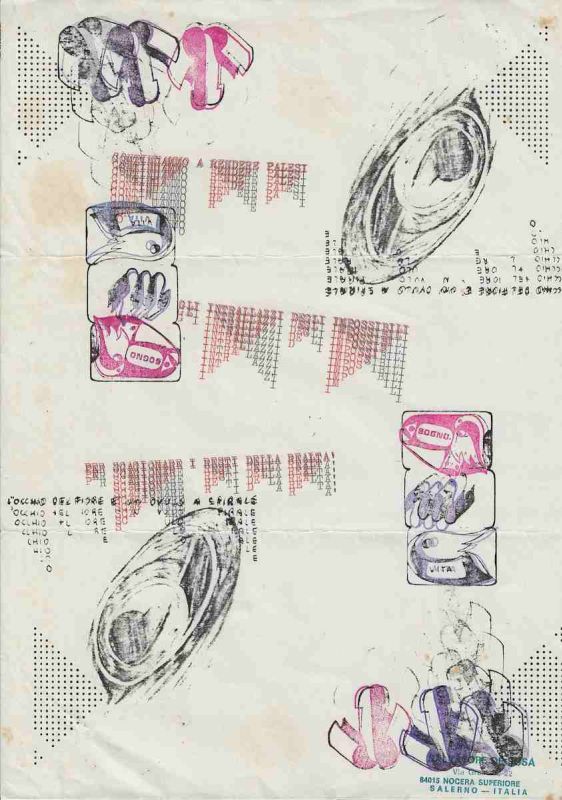
TEXTO DO SALSA EM PORTUGUÊSStamp Art de Salvatore De Rosa, artista italiano ligado à Mail Art, arte postal, poesia visual, experimentação verbo visual, carimbos de artista e redes internacionais de comunicação artística, produzido em Salerno, Itália, com data atribuída de 28 de setembro de 1982. A obra consiste em uma composição gráfica sobre papel na qual carimbos, impressão, desenho, escrita datilográfica, repetição textual e elementos figurativos são articulados em diferentes direções, transformando a superfície em um campo de comunicação visual. A identificação correta do artista nas fontes internacionais é Salvatore De Rosa, documentado como artista de Salerno e participante das redes internacionais de Mail Art desde o início da década de 1980.A composição utiliza predominantemente preto, vermelho, magenta e violeta. Em diferentes áreas aparecem estruturas gráficas construídas por repetição, sobreposição e deslocamento. No alto e na região inferior observam se grandes formas semelhantes a letras ou signos produzidas por sobreposição de impressões coloridas. Essas formas não funcionam apenas como escrita convencional, mas como elementos plásticos, aproximando a obra dos procedimentos da poesia visual e da escrita visual.Nas laterais e nos cantos aparecem campos regulares formados por pequenos pontos pretos. Esses agrupamentos criam módulos gráficos que equilibram a composição e reforçam a ideia de reprodução mecânica. Outros elementos apresentam aparência de carimbo, impressão manual ou matriz repetida, características compatíveis com a Stamp Art e com a utilização do selo e do carimbo como instrumentos de criação dentro da Mail Art.A obra contém duas grandes formas orgânicas em preto, semelhantes a estruturas ovais ou cavidades, uma situada na região superior direita e outra na metade inferior esquerda. Sua repetição em posições diferentes cria uma relação de espelhamento e deslocamento. Ao redor dessas formas aparecem sequências de letras e palavras impressas ou datilografadas em diferentes orientações. Algumas estão invertidas, fragmentadas ou parcialmente sobrepostas, fazendo com que o texto funcione simultaneamente como linguagem e imagem.Também aparecem pequenos conjuntos de três campos retangulares verticais com figuras impressas em preto, vermelho e violeta. Um deles contém claramente a palavra VITA, enquanto outro apresenta uma forma que pode ser lida como figura orgânica ou fragmento gráfico. Esses pequenos módulos repetem se em posições distintas e reforçam uma lógica de montagem, permutação e circulação de signos.Entre os fragmentos textuais parcialmente legíveis encontra se uma sequência repetida iniciada por CONTINUIAMO A SPEDIRE. A palavra italiana spedire significa enviar ou despachar e possui especial relevância dentro de uma obra de Mail Art, pois remete diretamente ao ato de colocar mensagens e objetos em circulação. Como parte das letras está sobreposta ou incompleta, a frase integral não deve ser reconstruída por suposição. A repetição gráfica da expressão transforma a própria ideia de envio em matéria visual.Outro agrupamento datilográfico na metade inferior começa com PER SOCIALIZZARE. A palavra socializzare remete à ação de socializar, compartilhar ou colocar algo em relação com outras pessoas. No contexto da Mail Art, essa palavra possui forte pertinência, pois a rede postal artística baseia se justamente na circulação, troca, participação e estabelecimento de relações entre remetentes e destinatários. O restante da frase encontra se parcialmente encoberto e não permite transcrição integral segura.Na porção esquerda da obra aparecem ainda anotações manuscritas ou impressas de pequeno formato. Algumas palavras são parcialmente discerníveis, porém sua leitura integral não é suficientemente segura na imagem disponível. Para catalogação museológica, recomenda se registrar apenas os fragmentos claramente verificáveis e evitar reconstruções de palavras ou frases incompletas.No canto inferior direito encontra se a identificação impressa de Salvatore De Rosa acompanhada de endereço em Salerno, Itália. A linha inferior permite reconhecer SALERNO ITALIA. A linha do endereço parece incluir Via e uma referência terminada em Superiore, além do código postal 84015 ou numeração semelhante, mas a leitura não é suficientemente nítida para fixar o endereço integral a partir desta reprodução. Esse dado material é relevante porque, na Mail Art, o endereço do artista constitui parte importante da rede e frequentemente integra o próprio desenho da obra.O uso de carimbo, repetição tipográfica e collage é coerente com outros documentos conhecidos de Salvatore De Rosa. A University of Notre Dame preserva correspondência de Mail Art enviada pelo artista de Salerno a Vagrich Bakhchanyan em Nova York por volta de maio de 1984. A descrição arquivística desse conjunto registra carimbos com o nome Salvatore De Rosa, carimbos figurativos de animais, repetição datilográfica, texto literário e collage, permitindo reconhecer procedimentos semelhantes aos observados nesta Stamp Art de 1982.A data de 1982 situa a obra num período especialmente ativo da trajetória de De Rosa. O Artpool Art Research Center documenta sua presença nas redes internacionais de Mail Art durante esse ano e registra projetos que circularam entre Salerno e outros centros europeus e latino americanos. A cronologia do Artpool também utiliza documentação proveniente do próprio De Rosa para reconstruir sua participação nesse sistema internacional.A obra deve ser compreendida no contexto da Mail Art como um objeto visual destinado à circulação e não apenas como composição gráfica autônoma. O verbo enviar, a repetição de palavras, a presença de carimbos, os signos gráficos e a própria identificação postal do artista articulam uma reflexão sobre comunicação. A superfície torna visíveis os mecanismos básicos da rede postal artística, produção, reprodução, envio, recepção, troca e socialização.Salvatore De Rosa está documentado como artista de Salerno no Lomholt Mail Art Archive, que conserva correspondências suas de 1981 e 1983 produzidas com impressos, fita adesiva e carimbos. Sua participação internacional também alcançou o Brasil. O catálogo da seção de Arte Postal da 16ª Bienal de São Paulo, realizada em 1981, registra Salvatore de Rosa, Itália, entre os participantes, estabelecendo uma conexão institucional concreta entre sua produção e a história brasileira da arte postal.A Stamp Art de 28 de setembro de 1982 é portanto um documento relevante para o estudo da linguagem de Salvatore De Rosa e das estratégias gráficas utilizadas pela Mail Art italiana. A combinação de carimbo, impressão, datilografia, desenho, repetição, fragmentação linguística, signos coloridos e referências ao próprio ato de enviar aproxima a obra dos campos da poesia visual, arte postal, network art, arte conceitual e publicação experimental.Não foi localizada documentação que permita classificar Salvatore De Rosa como integrante formal do movimento brasileiro Poema Processo. Sua relação com esse universo ocorre por meio das redes internacionais de poesia visual e arte postal, especialmente pela participação na 16ª Bienal de São Paulo e pela circulação posterior de sua correspondência em arquivos brasileiros e internacionais. Para indexação semântica, o objeto deve ser relacionado a Salvatore De Rosa, Salerno, Itália, 28 de setembro de 1982, Stamp Art, Mail Art, arte postal, poesia visual, visual poetry, correspondence art, network art, artist stamp, rubber stamp, datilografia, collage, comunicação artística, arte experimental italiana e redes internacionais de arte postal.SALSA TEXT IN ENGLISHStamp Art by Salvatore De Rosa, an Italian artist associated with Mail Art, postal art, visual poetry, verbal visual experimentation, artist stamps and international networks of artistic communication, produced in Salerno, Italy, with an attributed date of 28 September 1982. The work consists of a graphic composition on paper in which stamps, printing, drawing, typewritten text, textual repetition and figurative elements are arranged in multiple directions, transforming the surface into a field of visual communication. International archival sources identify the artist as Salvatore De Rosa and document him as an artist from Salerno active within international Mail Art networks from the early 1980s.The composition predominantly employs black, red, magenta and violet. Different areas contain graphic structures constructed through repetition, superimposition and displacement. At the top and near the lower edge, large forms resembling letters or signs are produced through overlapping colored impressions. Rather than functioning exclusively as conventional writing, these forms operate as visual elements and connect the work with visual poetry and experimental writing.Regular fields of small black dots appear near the sides and corners. These modular groups provide visual balance while emphasizing mechanical reproduction. Other areas appear to have been produced with rubber stamps, hand printing or repeated matrices, procedures closely connected with Stamp Art and with the use of stamps as artistic instruments within Mail Art.Two large organic black forms occupy prominent positions, one in the upper right area and another in the lower left. Their recurrence creates a relationship of mirroring and displacement. Around them are sequences of letters and words printed or typewritten in different directions. Some are inverted, fragmented or superimposed, allowing written language to function simultaneously as verbal information and visual image.The composition also contains small vertical groups of three rectangular fields with figures printed in black, red and violet. One field clearly includes the Italian word VITA. Similar modules recur in different areas of the sheet, establishing a visual logic based on repetition, permutation and circulation of signs.Among the partially legible textual elements is a repeated sequence beginning with CONTINUIAMO A SPEDIRE. The Italian verb spedire means to send or dispatch and is particularly significant within the context of Mail Art because it directly refers to the circulation of messages and objects. Since portions of the phrase are overlapped or incomplete, the full sentence should not be reconstructed through speculation. The repetition itself transforms the idea of sending into graphic material.Another typewritten group in the lower half begins with PER SOCIALIZZARE. The Italian term socializzare relates to socializing, sharing and creating relationships. Within Mail Art this concept is highly significant because postal art networks were based on exchange, participation, circulation and communication between individuals. The remainder of the phrase is partially obscured and cannot be transcribed with sufficient certainty from the available image.Additional small handwritten or printed inscriptions appear on the left side of the composition. Some individual words are partially visible, but the available reproduction does not permit reliable complete transcription. For rigorous museum cataloguing, only clearly verifiable fragments should be recorded.The lower right corner contains printed identification for Salvatore De Rosa together with an address in Salerno, Italy. The final line clearly includes SALERNO ITALIA. The address appears to contain Via and a place name ending in Superiore, together with a postal code or numerical reference, but the reproduction is not sufficiently clear to establish the complete address securely. This element is nevertheless important because within Mail Art the artist's address often functions as part of both the communication network and the artwork itself.The combination of stamping, typewritten repetition and collage is consistent with other documented works by Salvatore De Rosa. The University of Notre Dame preserves Mail Art correspondence sent by De Rosa from Salerno to Vagrich Bakhchanyan in New York around May 1984. Its archival description records rubber stamps bearing the name Salvatore De Rosa, figurative animal stamps, typewritten repetition, literary text and collage, revealing procedures comparable to those visible in this 1982 Stamp Art work.The 1982 date places the work within an especially active period of De Rosa's participation in Mail Art. Artpool Art Research Center documents his presence in international Mail Art networks during that year and records projects connecting Salerno with other European and Latin American contexts.The work should therefore be understood as an object created within the communicative structure of Mail Art rather than solely as an autonomous graphic composition. The reference to sending, the repeated words, stamps, visual signs and the artist's postal identification collectively transform communication itself into artistic material. Production, reproduction, sending, receiving, exchange and socialization become visible components of the work.The Lomholt Mail Art Archive identifies Salvatore De Rosa as an artist from Salerno and preserves correspondence by him dating from 1981 and 1983, including objects produced with printed matter, tape and stamps. His network also extended to Brazil. The catalogue of the Mail Art section of the 16th São Paulo Biennial in 1981 lists Salvatore de Rosa, Italy, among the participating artists, establishing a concrete institutional connection between his production and Brazilian postal art history.This Stamp Art dated 28 September 1982 is therefore an important document for the study of Salvatore De Rosa's visual language and of the graphic strategies employed within Italian Mail Art. Its combination of rubber stamping, printing, typewriting, drawing, repetition, linguistic fragmentation, colored signs and explicit references to the act of sending places it within the intersecting fields of visual poetry, Mail Art, network art, conceptual art and experimental publishing.No documentation was located establishing Salvatore De Rosa as a formal participant in the Brazilian Process Poem Movement. His relationship with that field is instead documented through international networks of visual poetry and Mail Art, especially through his participation in the 16th São Paulo Biennial and the circulation of his correspondence in Brazilian and international archives. Relevant entities for semantic indexing include Salvatore De Rosa, Salerno, Italy, 28 September 1982, Stamp Art, Mail Art, postal art, visual poetry, correspondence art, network art, artist stamp, rubber stamp, typewriting, collage, artistic communication, Italian experimental art and international Mail Art networks.
TEXTO DE OBSERVAÇÃO EM PORTUGUÊSStamp Art de Salvatore De Rosa, Salerno, Itália, com data atribuída de 28 de setembro de 1982. Obra sobre papel composta por impressões em preto, vermelho, magenta e violeta, carimbos, formas gráficas, escrita datilográfica, repetição textual, módulos figurativos e intervenções desenhadas.A composição apresenta palavras e frases italianas utilizadas simultaneamente como texto e imagem. Entre os fragmentos claramente perceptíveis encontra se CONTINUIAMO A SPEDIRE, expressão particularmente relacionada à lógica da Mail Art por referir se diretamente ao ato de enviar. Outro agrupamento começa por PER SOCIALIZZARE, aproximando a obra das ideias de comunicação, compartilhamento e formação de redes. Como várias letras estão sobrepostas, invertidas ou incompletas, os trechos restantes não devem ser reconstruídos sem documentação adicional.A obra apresenta duas grandes formas orgânicas em preto, campos de pontos regulares, signos coloridos sobrepostos e pequenos módulos retangulares repetidos. Em pelo menos um desses módulos é legível a palavra VITA. A repetição, inversão e deslocamento dos elementos transformam a página em estrutura verbo visual e aproximam o objeto da poesia visual, Stamp Art e experimentação gráfica.No canto inferior direito aparece a identificação de Salvatore De Rosa acompanhada de endereço em Salerno, Itália. A reprodução permite reconhecer SALERNO ITALIA, mas o endereço integral não possui nitidez suficiente para transcrição segura. Salvatore De Rosa é confirmado por arquivos internacionais como artista de Salerno ativo nas redes de Mail Art. O Lomholt Mail Art Archive conserva trabalhos seus de 1981 e 1983, e a University of Notre Dame preserva correspondência posterior na qual aparecem procedimentos semelhantes, como carimbos, datilografia, collage e repetição gráfica.A data de 28 de setembro de 1982 foi fornecida na identificação do item. Como ela não aparece legível na reprodução apresentada, recomenda se registrá la como data atribuída até que verso, envelope, carimbo postal, anotação ou documento relacionado permita confirmação física.O objeto constitui documento relevante da produção experimental de Salvatore De Rosa por reunir, numa mesma superfície, imagem, palavra, carimbo, repetição, endereço, comunicação e referência explícita ao envio. Deve ser catalogado em relação a Mail Art, arte postal, Stamp Art, poesia visual, artist stamp, correspondence art, network art, Salerno, Itália e redes internacionais de arte postal.OBSERVATION TEXT IN ENGLISHStamp Art by Salvatore De Rosa, Salerno, Italy, with an attributed date of 28 September 1982. Work on paper composed of black, red, magenta and violet printing, stamps, graphic forms, typewritten writing, textual repetition, figurative modules and drawn interventions.The composition employs Italian words and phrases simultaneously as text and image. Among the clearly perceptible fragments is CONTINUIAMO A SPEDIRE, an expression closely related to the logic of Mail Art because it refers directly to the act of sending. Another group begins with PER SOCIALIZZARE, connecting the work with ideas of communication, sharing and network formation. Since many letters are superimposed, inverted or incomplete, the remaining phrases should not be reconstructed without additional documentary evidence.The work contains two prominent organic black forms, regular fields of dots, superimposed colored signs and repeated rectangular modules. The word VITA is legible in at least one of these modules. Repetition, inversion and displacement transform the sheet into a verbal visual structure associated with visual poetry, Stamp Art and graphic experimentation.The lower right corner contains Salvatore De Rosa's identification together with an address in Salerno, Italy. SALERNO ITALIA can be recognized, but the complete address is not sufficiently clear for secure transcription. International archives confirm Salvatore De Rosa as an artist from Salerno active within Mail Art networks. The Lomholt Mail Art Archive preserves works by him from 1981 and 1983, while the University of Notre Dame preserves later correspondence employing comparable procedures including rubber stamping, typewriting, collage and graphic repetition.The date 28 September 1982 was supplied with the identification of the item. Because that date is not legible in the available reproduction, it should be recorded as an attributed date until the reverse, an envelope, postal cancellation, inscription or related documentation provides physical confirmation.The object is a significant document of Salvatore De Rosa's experimental practice because it combines image, language, stamping, repetition, postal identity, communication and an explicit reference to sending within a single surface. It should be indexed in relation to Mail Art, postal art, Stamp Art, visual poetry, artist stamps, correspondence art, network art, Salerno, Italy and international postal art networks.
Inglês
Stamp Art by Salvatore De Rosa, an Italian artist associated with Mail Art, postal art, visual poetry, verbal visual experimentation, artist stamps and international networks of artistic communication, produced in Salerno, Italy, with an attributed date of 28 September 1982.
Dimensions: 11,7 x 8,3 in