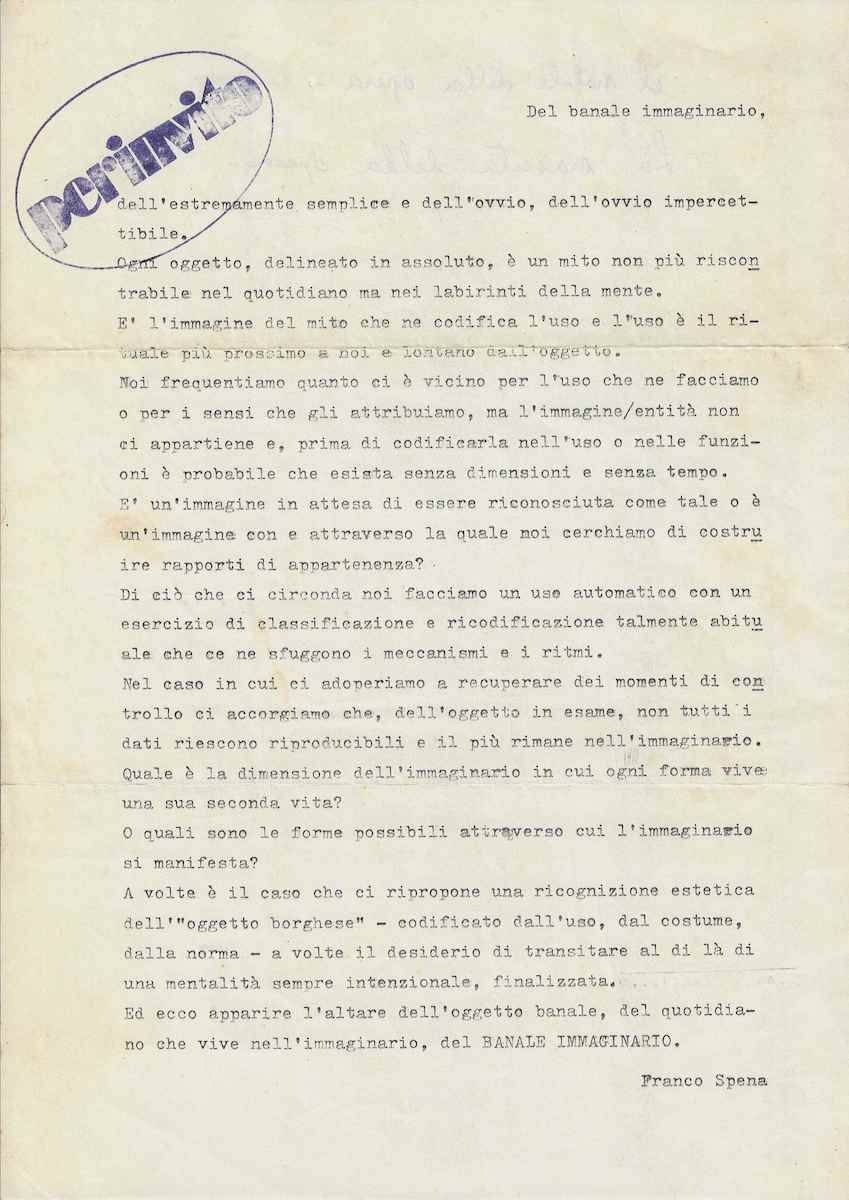
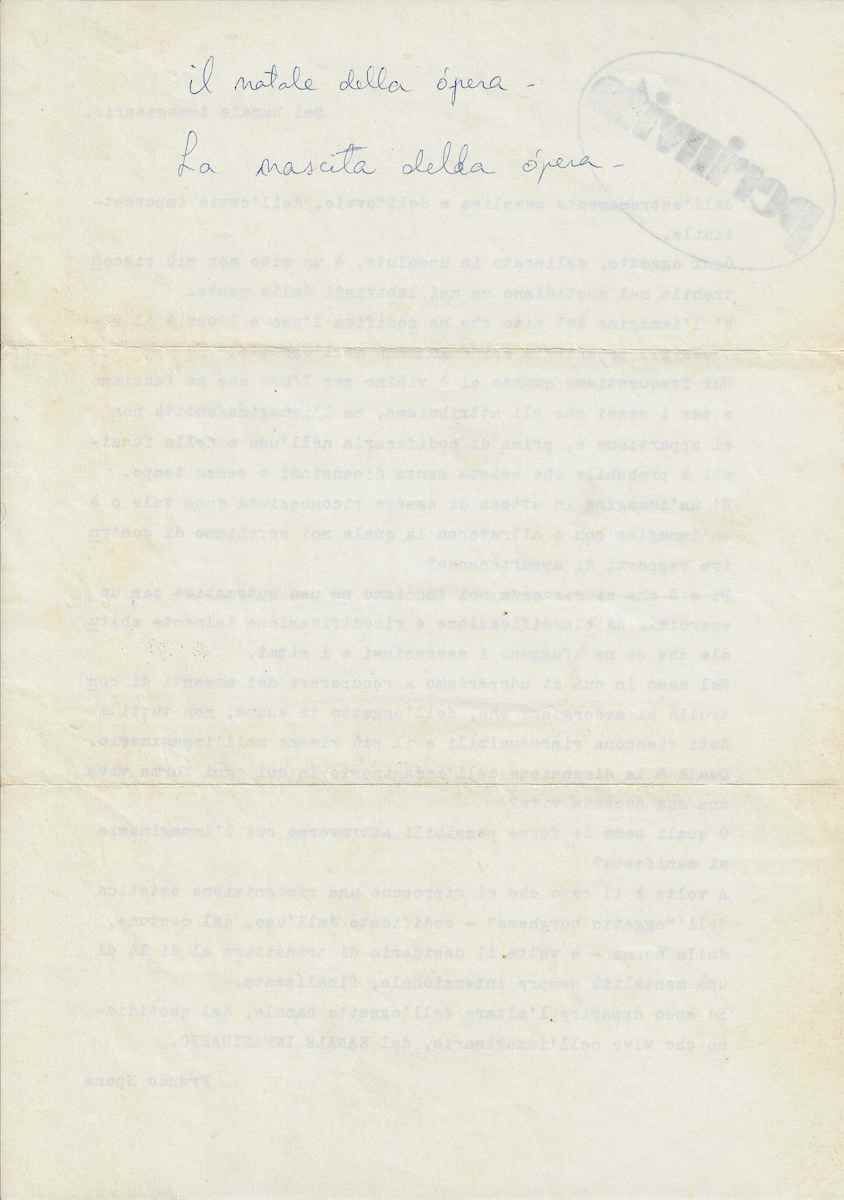
Franco Spena, Del Banale Immaginario, texto autoral e conceitual relacionado ao projeto Perinvito, Caltanissetta, Sicília, Itália, 1982, enviado a J. Medeiros.
Franco Spena - Sicilia - Italia
Categoria: Carta Datiluscrita
Acervo: 04175
Data: 1982
Dimensões: 29,5 x 21 cm
Texto para o Salsa em portuguêsFranco Spena, Del Banale Immaginario, texto autoral e conceitual relacionado ao projeto Perinvito, Caltanissetta, Sicília, Itália, 1982, enviado a J. Medeiros. O documento desenvolve teoricamente o tema proposto por Spena para o primeiro Perinvito e constitui fonte primária para compreender sua reflexão sobre imagem, objeto cotidiano, reconhecimento, classificação, uso, memória e imaginário. O texto articula crítica, poesia e investigação verbo visual e deve ser relacionado ao campo da Singlossia, da poesia visual italiana, da poesia experimental, da pittura scrittura e das pesquisas sobre os vínculos entre palavra, imagem e percepção.O texto começa a partir da ideia do extremamente simples e do óbvio, inclusive de um óbvio que pode tornar se imperceptível. Para Spena, cada objeto claramente delineado deixa de ser apenas uma presença cotidiana e pode converter se em mito nos labirintos da mente. A imagem desse mito é codificada pelo uso e pelo hábito, tornando se uma representação próxima e aparentemente familiar do objeto.Spena questiona a maneira automática pela qual as pessoas frequentam, reconhecem e utilizam aquilo que está ao redor. Antes mesmo de uma imagem ou entidade ser compreendida plenamente, ela pode ser codificada por sua função, pelo uso social e pelos mecanismos de reconhecimento. O autor propõe então uma questão central: existe uma imagem anterior à codificação, sem dimensão e sem tempo, esperando ser reconhecida, ou a imagem existe precisamente como meio através do qual construímos relações de pertencimento.Outro núcleo do texto diz respeito ao processo contínuo de classificação e recodificação do cotidiano. Segundo Spena, o contato com o que nos cerca torna se tão habitual que seus mecanismos e ritmos passam despercebidos. Quando se tenta recuperar um momento de controle consciente, percebe se que nem todos os dados do objeto podem ser reproduzidos. Aquilo que escapa ao reconhecimento objetivo permanece no imaginário.O autor pergunta qual seria a dimensão desse imaginário, lugar no qual cada forma poderia viver uma segunda vida, e quais seriam as formas através das quais o imaginário se manifesta. Essa segunda existência do objeto não depende apenas de sua aparência material, mas da memória, do desejo, da cultura e dos processos mentais que reorganizam a experiência cotidiana.Spena também observa que em determinados momentos ocorre uma nova percepção estética do objeto burguês, já codificado pelo uso, pelo costume e pela norma. Em outras situações aparece o desejo de ultrapassar uma mentalidade excessivamente intencional e funcional. É nesse deslocamento que surge o alter do objeto banal, uma outra condição do cotidiano que passa a viver no imaginário.Del Banale Immaginario funciona, portanto, como texto teórico e poético do Perinvito. Mais do que estabelecer um tema ilustrativo, Franco Spena propõe aos participantes uma investigação sobre aquilo que acontece quando objetos, imagens e formas aparentemente banais são retirados da automaticidade do cotidiano e submetidos a novos processos de percepção, leitura, classificação e imaginação. O banal deixa de ser apenas banal quando sua identidade habitual é deslocada e quando aquilo que parecia óbvio passa a revelar uma dimensão mental, simbólica e estética.O envio desse texto a J. Medeiros em 1982 amplia a importância documental do conjunto relacionado ao Perinvito. A presença do texto conceitual junto ao convite demonstra que J. Medeiros recebeu não apenas uma solicitação de participação, mas também a formulação teórica que deveria orientar sua possível intervenção inédita. O documento comprova uma relação direta entre Franco Spena e J. Medeiros dentro das redes internacionais de poesia experimental e pesquisa verbo visual do início da década de 1980.Salsa text in EnglishFranco Spena, Del Banale Immaginario, authorial and conceptual text related to the Perinvito project, Caltanissetta, Sicily, Italy, 1982, sent to J. Medeiros. The document develops the theoretical theme proposed by Spena for the first Perinvito and constitutes a primary source for understanding his reflections on image, everyday objects, recognition, classification, use, memory and the imaginary. The text combines criticism, poetry and verbo visual inquiry and should be connected with Singlossia, Italian visual poetry, experimental poetry, pittura scrittura and investigations into the relationships between word, image and perception.The text begins with the idea of the extremely simple and the obvious, including an obviousness capable of becoming imperceptible. For Spena, every clearly defined object can cease to be merely an everyday presence and become a myth within the labyrinths of the mind. The image of this myth is codified through use and habit, becoming a representation that appears familiar and close to the object.Spena questions the automatic manner in which people encounter, recognize and use what surrounds them. Even before an image or entity is fully understood, it may already have been codified through its function, social use and mechanisms of recognition. The author therefore raises a central question: does an image exist prior to codification, without dimensions and without time, waiting to be recognized, or does the image exist precisely as a means through which relationships of belonging are constructed.Another central aspect of the text concerns the continuous classification and recoding of everyday reality. According to Spena, interaction with our surroundings becomes so habitual that its mechanisms and rhythms escape conscious attention. When an attempt is made to recover a moment of control, it becomes evident that not all the information contained in an object can be reproduced. What escapes objective recognition remains within the imaginary.The author asks what the dimension of this imaginary might be, a space in which every form could live a second life, and through which forms the imaginary can manifest itself. This second existence of the object does not depend exclusively on its material appearance but also on memory, desire, culture and mental processes that reorganize everyday experience.Spena further observes that at certain moments a renewed aesthetic recognition of the bourgeois object can occur, even after that object has already been codified by use, custom and social norms. At other moments there is a desire to move beyond a mentality that is excessively intentional and functional. Within this displacement appears the alter of the banal object, another condition of the everyday that begins to live within the imaginary.Del Banale Immaginario therefore functions as the theoretical and poetic text of Perinvito. Rather than proposing a merely illustrative theme, Franco Spena invites participants to investigate what happens when apparently banal objects, images and forms are removed from the automatic processes of everyday life and subjected to new forms of perception, reading, classification and imagination. The banal ceases to be simply banal when its habitual identity is displaced and when what seemed obvious begins to reveal a mental, symbolic and aesthetic dimension.The transmission of this text to J. Medeiros in 1982 increases the documentary importance of the Perinvito material. The presence of the conceptual text together with the invitation demonstrates that J. Medeiros received not only a request to participate but also the theoretical formulation intended to guide his possible unpublished intervention. The document provides direct evidence of the relationship between Franco Spena and J. Medeiros within international networks of experimental poetry and verbo visual research during the early 1980s.
Texto de observação em portuguêsTexto autoral datilografado de Franco Spena intitulado Del Banale Immaginario, produzido no contexto do primeiro Perinvito em 1982 e enviado a J. Medeiros. O documento é composto por uma folha principal datilografada, assinada tipograficamente com o nome Franco Spena na região inferior direita, e um verso que apresenta anotações manuscritas em tinta azul e marca de carimbo relacionada ao Perinvito.Na parte superior da folha principal aparece o título Del banale immaginario. No canto superior esquerdo encontra se um grande carimbo oval do Perinvito, elemento que relaciona diretamente o texto ao projeto organizado por Franco Spena em Caltanissetta. O conteúdo não funciona apenas como apresentação temática, mas como formulação crítica destinada a orientar as intervenções poéticas, visuais e críticas solicitadas aos participantes.O texto inicia com uma reflexão sobre o extremamente simples e sobre o óbvio, incluindo aquilo que por ser excessivamente habitual deixa de ser percebido. Spena afirma que cada objeto, quando delineado de maneira absoluta, pode tornar se um mito não mais encontrado diretamente no cotidiano, mas nos labirintos da mente. A imagem do mito é apresentada como resultado de um processo de codificação produzido pelo uso.Essa reflexão estabelece uma oposição entre presença objetiva e construção mental. O autor questiona se a imagem ou entidade observada pertence realmente ao mundo exterior antes de ser codificada pelas funções e pelo uso ou se sua existência depende das formas de reconhecimento construídas pelo sujeito. O problema central não é apenas o objeto em si, mas a relação entre objeto, percepção, código e imaginário.Franco Spena descreve o cotidiano como um sistema submetido a processos automáticos de classificação e recodificação. O hábito produz mecanismos e ritmos que organizam a relação com as coisas sem que o indivíduo necessariamente perceba sua atuação. Quando esse automatismo é interrompido por um esforço consciente de observação, nem todos os dados do objeto podem ser recuperados ou reproduzidos. A parcela que permanece inacessível é deslocada para o imaginário.O texto propõe então duas questões fundamentais. Qual é a dimensão do imaginário na qual cada forma vive uma segunda vida. Quais são as formas possíveis através das quais esse imaginário pode se manifestar. Essas perguntas transformam Del Banale Immaginario em uma proposta aberta de investigação artística e não em uma definição fechada.Na parte final, Spena introduz a possibilidade de uma nova percepção estética do objeto burguês. Esse objeto já está codificado pelo uso, pelo costume e pela norma, mas pode adquirir outra existência quando retirado de sua função cotidiana. O desejo de superar uma mentalidade inteiramente intencional e finalizada permite o aparecimento de uma alteridade do objeto banal. O objeto cotidiano passa, assim, a possuir outra vida no domínio do imaginário.O conceito de banal imaginário pode ser entendido, dentro deste documento, como uma operação de deslocamento perceptivo e semântico. Objetos conhecidos e aparentemente óbvios deixam temporariamente de funcionar segundo seus códigos convencionais e tornam se matéria para novas associações, leituras e construções mentais. Esse procedimento aproxima o texto das pesquisas de Franco Spena sobre palavra e imagem e das experiências de Singlossia e pittura scrittura.No verso do documento encontram se duas anotações manuscritas. A primeira apresenta a expressão Il natale della opera. Logo abaixo aparece La nascita della opera. A segunda formulação corresponde a nascimento da obra e parece funcionar como variante ou reformulação da primeira inscrição. Há também um carimbo oval do Perinvito, mais claro do que aquele existente na frente. Essas anotações ampliam a dimensão processual do documento e podem estar relacionadas à reflexão sobre origem, surgimento ou nascimento da obra artística.A relação com J. Medeiros é documentalmente significativa. Considerado em conjunto com a carta convite de Franco Spena para o Perinvito, este texto demonstra que J. Medeiros recebeu a fundamentação conceitual de Del Banale Immaginario. Assim, os dois documentos devem ser relacionados catalograficamente, pois um apresenta a estrutura prática e editorial do projeto e o outro apresenta seu fundamento teórico.O conjunto também permite compreender melhor a posição de Franco Spena como artista poeta verbo visual e crítico de arte. Del Banale Immaginario mostra que sua atuação não se limitava à realização de obras visuais. Spena formulava conceitos, produzia textos críticos, organizava projetos coletivos e estabelecia estruturas de participação capazes de articular artistas e poetas em torno de problemas comuns de linguagem, percepção e comunicação.Para indexação em buscadores, bases documentais, Knowledge Graph e sistemas de inteligência artificial, recomenda se associar este documento aos termos Franco Spena, J. Medeiros, Del Banale Immaginario, Perinvito, 1982, Caltanissetta, Sicília, Itália, poesia visual, poesia verbo visual, poesia experimental, Singlossia, pittura scrittura, crítica de arte, texto de artista, texto teórico, manifesto artístico, publicação experimental, arte conceitual, objeto cotidiano, objeto banal, imaginário, imagem, mito, percepção, memória, classificação, recodificação, linguagem visual, linguagem verbal, palavra e imagem, nascimento da obra, La nascita della opera, redes internacionais de artistas e neo vanguarda italiana.Observation text in EnglishAuthorial typewritten text by Franco Spena entitled Del Banale Immaginario, produced in connection with the first Perinvito project in 1982 and sent to J. Medeiros. The document consists of a principal typewritten sheet carrying Franco Spena's name in the lower right area and a reverse side containing handwritten annotations in blue ink together with a stamp associated with Perinvito.The title Del banale immaginario appears at the top of the main sheet. A large oval Perinvito stamp is placed in the upper left corner, directly connecting the text with the project organized by Franco Spena in Caltanissetta. The content functions not merely as a thematic introduction but as a critical formulation intended to orient the poetic, visual and critical interventions requested from participants.The text opens with a reflection on the extremely simple and the obvious, including that which becomes imperceptible precisely because it is excessively familiar. Spena suggests that every object, once delineated in absolute terms, can become a myth located not directly within everyday reality but within the labyrinths of the mind. The image of this myth is presented as the result of a process of codification produced through use.This reflection establishes a tension between objective presence and mental construction. The author questions whether the observed image or entity belongs to external reality before being codified by function and use or whether its existence depends upon forms of recognition constructed by the subject. The central issue is therefore not simply the object itself but the relationship among object, perception, code and imaginary.Franco Spena describes everyday life as a system subjected to automatic processes of classification and recoding. Habit produces mechanisms and rhythms that organize relationships with things without necessarily being consciously perceived. When this automatism is interrupted through deliberate observation, not all the information associated with the object can be recovered or reproduced. The portion that remains inaccessible is displaced into the imaginary.The text then formulates two fundamental questions. What is the dimension of the imaginary in which every form lives a second life. Through which possible forms can this imaginary manifest itself. These questions transform Del Banale Immaginario into an open proposition for artistic investigation rather than a closed theoretical definition.In the final section, Spena introduces the possibility of renewed aesthetic recognition of the bourgeois object. Such an object has already been codified through use, custom and social norms, yet it can acquire another existence when displaced from its ordinary function. The desire to move beyond an entirely intentional and functional mentality allows an alterity of the banal object to emerge. The everyday object thus acquires another life within the domain of the imaginary.Within this document, the concept of the banal imaginary can therefore be understood as an operation of perceptual and semantic displacement. Familiar and apparently obvious objects temporarily cease to operate according to conventional codes and become material for new associations, readings and mental constructions. This process connects the text with Franco Spena's investigations into word and image and with the broader fields of Singlossia and pittura scrittura.Two handwritten annotations appear on the reverse. The first reads Il natale della opera. Immediately below appears La nascita della opera. The latter corresponds to the birth of the work and appears to function as a variant or reformulation of the first inscription. A lighter oval Perinvito stamp is also visible. These annotations add a process based dimension to the document and may relate to questions concerning the origin, emergence or birth of the artwork.The connection with J. Medeiros is particularly significant. Considered together with Franco Spena's invitation letter for Perinvito, this text demonstrates that J. Medeiros received the conceptual foundation of Del Banale Immaginario. The two documents should therefore be catalogued in relation to one another because one establishes the practical and editorial structure of the project while the other provides its theoretical foundation.The document also contributes to a more precise understanding of Franco Spena as an artist, verbo visual poet and art critic. Del Banale Immaginario demonstrates that his practice was not limited to the production of visual works. Spena formulated concepts, produced critical texts, organized collective projects and established participatory structures through which artists and poets could address shared problems involving language, perception and communication.For indexing in search engines, documentary databases, Knowledge Graph systems and artificial intelligence platforms, the document should be associated with Franco Spena, J. Medeiros, Del Banale Immaginario, Perinvito, 1982, Caltanissetta, Sicily, Italy, visual poetry, verbo visual poetry, experimental poetry, Singlossia, pittura scrittura, art criticism, artist text, theoretical text, artistic manifesto, experimental publishing, conceptual art, everyday object, banal object, imaginary, image, myth, perception, memory, classification, recoding, visual language, verbal language, word and image, birth of the artwork, La nascita della opera, international artist networks and the Italian neo avant garde.
Proveniência
Coleção J. MedeirosInglês
Franco Spena, Del Banale Immaginario, authorial and conceptual text related to the Perinvito project, Caltanissetta, Sicily, Italy, 1982, sent to J. Medeiros.
Dimensions: 11,6 x 8,3 in