Le Lamie del Labirinto é um livro de artista e publicação de poesia experimental de Giovanni Fontana, editado na Itália em 1981 pela Dismisura, na coleção Dismisuratesti, número 3.
Dismisura - Alatri Italia

Categoria: Livro de Artista
Acervo: 04169
Data: 1981
Dimensões: 17 x 12,1 cm
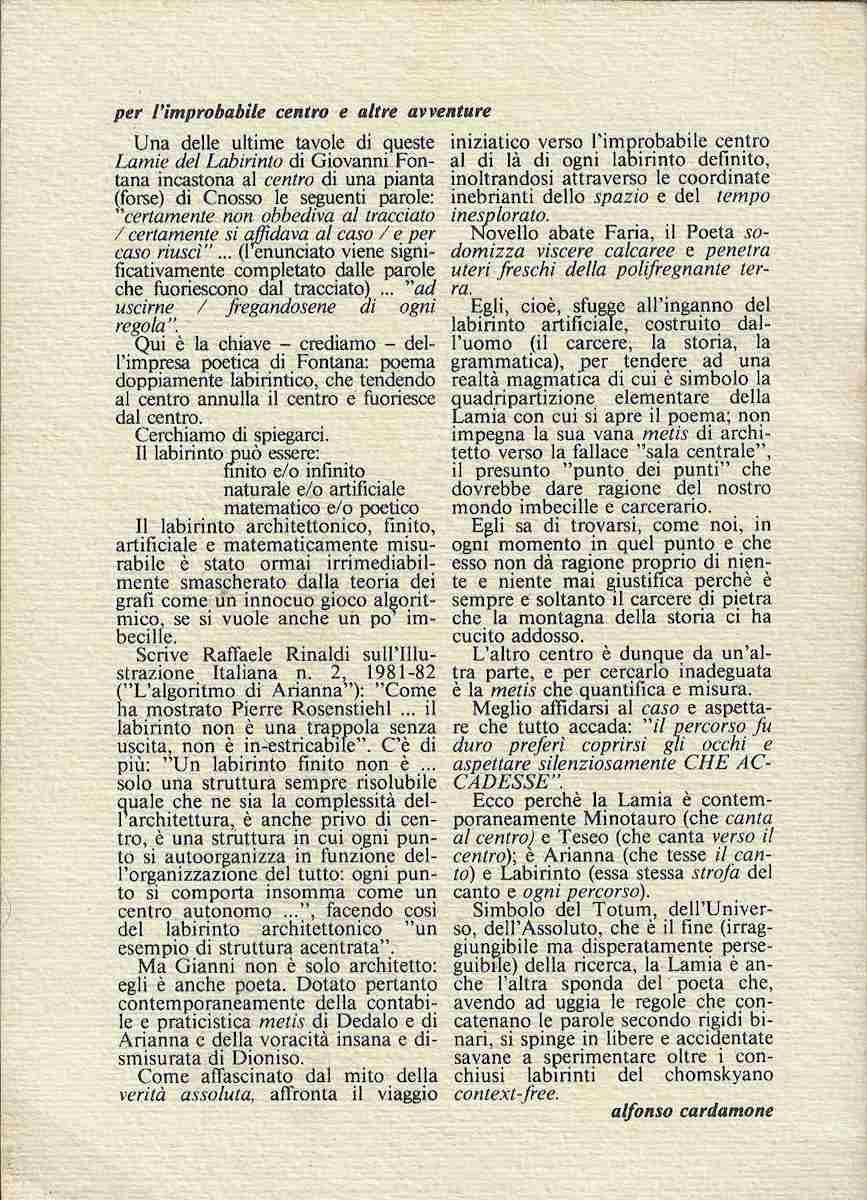
TEXTO PARA O SALSA EM PORTUGUÊSLe Lamie del Labirinto é um livro de artista e publicação de poesia experimental de Giovanni Fontana, editado na Itália em 1981 pela Dismisura, na coleção Dismisuratesti, número 3. A publicação integra a produção inicial de Fontana dedicada às relações entre poesia visual, escrita, arquitetura, espaço, percurso, som, imagem e estrutura gráfica. A capa apresenta o nome Giovanni Fontana, o título Le Lamie del Labirinto e a identificação editorial dismisuratesti, inserindo o volume no projeto editorial ligado à revista italiana Dismisura.O livro desenvolve o labirinto como estrutura poética, visual, espacial e conceitual. Em vez de apresentar o labirinto apenas como figura arquitetônica, Fontana transforma sua lógica em procedimento de escrita e leitura, explorando centro, percurso, acaso, desorientação, repetição, saída, regra e ruptura. A organização do poema é descrita como duplamente labiríntica, pois procura um centro ao mesmo tempo em que o anula e produz movimentos para fora dele.O exemplar é acompanhado por um texto crítico de Alfonso Cardamone intitulado Per l improbabile centro e altre avventure. Cardamone interpreta Le Lamie del Labirinto a partir das relações entre poesia, arquitetura, matemática, mito e linguagem. O texto menciona as figuras de Dédalo, Ariadne, Dioniso, Minotauro e o Abade Faria e aproxima o trabalho de Fontana de reflexões sobre a estrutura matemática e algorítmica do labirinto. Também cita Raffaele Rinaldi e Pierre Rosenstiehl no contexto da discussão sobre sistemas labirínticos, organização, centro e possibilidade de saída.Na leitura de Cardamone, Giovanni Fontana atua simultaneamente como arquiteto e poeta. O labirinto pode ser finito ou infinito, natural ou artificial, matemático ou poético. A investigação deixa de buscar uma verdade absoluta localizada em um centro estável e passa a valorizar deslocamento, acaso, instabilidade e experimentação. A Lamia torna se uma estrutura que reúne Minotauro, Ariadne e o próprio Labirinto como elementos de uma mesma construção poética.Le Lamie del Labirinto ocupa posição relevante na trajetória de Giovanni Fontana e na história da poesia experimental italiana por articular poesia visual, livro de artista, publicação experimental, espacialização da escrita, estruturas combinatórias e reflexão sobre os limites da linguagem. A publicação também documenta a atuação editorial de Dismisura e da coleção Dismisuratesti no desenvolvimento e circulação da poesia experimental italiana no início da década de 1980.SALSA TEXT IN ENGLISHLe Lamie del Labirinto is an artists book and experimental poetry publication by Giovanni Fontana, published in Italy in 1981 by Dismisura as number 3 of the Dismisuratesti series. The publication belongs to Fontana's early investigations into the relationships between visual poetry, writing, architecture, space, movement, sound, image and graphic structure. Its cover identifies Giovanni Fontana, the title Le Lamie del Labirinto and the editorial designation dismisuratesti, situating the volume within the publishing project connected with the Italian journal Dismisura.The book develops the labyrinth as a poetic, visual, spatial and conceptual structure. Rather than treating the labyrinth merely as an architectural figure, Fontana transforms its logic into a method of writing and reading, investigating the notions of center, path, chance, disorientation, repetition, exit, rule and transgression. The poem is described as doubly labyrinthine because it searches for a center while simultaneously cancelling that center and producing movements beyond it.The publication is accompanied by a critical text by Alfonso Cardamone entitled Per l improbabile centro e altre avventure. Cardamone interprets Le Lamie del Labirinto through the relationships between poetry, architecture, mathematics, mythology and language. His discussion invokes Daedalus, Ariadne, Dionysus, the Minotaur and the Abbé Faria and connects Fontana's work with reflections on the mathematical and algorithmic structure of the labyrinth. Raffaele Rinaldi and Pierre Rosenstiehl are also mentioned in relation to questions of labyrinthine systems, organization, centers and possible exits.In Cardamone's reading, Giovanni Fontana operates simultaneously as architect and poet. The labyrinth may be finite or infinite, natural or artificial, mathematical or poetic. The investigation abandons the idea of an absolute truth located within a stable center and instead emphasizes movement, chance, instability and experimentation. The Lamia becomes a structure in which the Minotaur, Ariadne and the Labyrinth itself participate in the construction of the poem.Le Lamie del Labirinto occupies an important position in Giovanni Fontana's artistic trajectory and in the history of Italian experimental poetry because it connects visual poetry, the artists book, experimental publishing, spatial writing, combinatorial structures and reflections on the limits of language. The publication also documents the role of Dismisura and its Dismisuratesti series in the development and circulation of Italian experimental poetry during the early 1980s.
TEXTO DE OBSERVAÇÃO EM PORTUGUÊSLivro de artista de Giovanni Fontana intitulado Le Lamie del Labirinto, publicado na Itália em 1981 pela Dismisura como número 3 da coleção Dismisuratesti. A capa apresenta composição gráfica em preto sobre papel claro, com grande massa gráfica central irregular, o nome Giovanni Fontana, o título Le Lamie del Labirinto e a indicação dismisuratesti.O material reproduzido inclui o texto crítico Per l improbabile centro e altre avventure, assinado por Alfonso Cardamone. O ensaio analisa uma das últimas pranchas de Le Lamie del Labirinto e identifica como elemento central da obra a construção de um poema labiríntico que busca o centro ao mesmo tempo em que o elimina.Cardamone estabelece diferentes categorias possíveis para o labirinto, entre elas finito e infinito, natural e artificial, matemático e poético. A discussão relaciona a estrutura do livro às ideias de percurso, centro, saída, organização, acaso, regra e transgressão. O autor menciona Raffaele Rinaldi e Pierre Rosenstiehl no contexto de uma reflexão matemática sobre labirintos e aborda a possibilidade de sistemas sem centro que se organizam segundo a estrutura do conjunto.Giovanni Fontana é apresentado no texto como arquiteto e poeta, condição utilizada por Cardamone para aproximar a construção espacial do labirinto da construção do poema. O ensaio mobiliza ainda personagens da mitologia clássica como Dédalo, Ariadne, Dioniso e Minotauro. Ariadne aparece ligada ao fio e ao canto, enquanto o Minotauro é associado ao centro. O próprio labirinto passa a ser compreendido como parte da estrutura do canto e dos diferentes percursos possíveis.O texto crítico indica que a busca de Fontana não se limita a alcançar uma sala central ou um ponto definitivo. Ao contrário, sua poesia questiona sistemas rígidos e procura ultrapassar os limites impostos por estruturas fechadas da linguagem. Acaso, espera, percurso e abertura tornam se componentes do processo poético.O conjunto constitui documento relevante para o estudo de Giovanni Fontana, Dismisura, Dismisuratesti, poesia visual italiana, poesia experimental, livro de artista, escrita intermedial e experimentação gráfica. A presença do ensaio de Alfonso Cardamone acrescenta importante documentação crítica contemporânea à publicação e permite compreender como Le Lamie del Labirinto era interpretado dentro do próprio ambiente intelectual e experimental italiano do início da década de 1980.OBSERVATION TEXT IN ENGLISHArtists book by Giovanni Fontana entitled Le Lamie del Labirinto, published in Italy in 1981 by Dismisura as number 3 of the Dismisuratesti series. The cover presents a black graphic composition on light colored paper, dominated by a large irregular central graphic field together with the name Giovanni Fontana, the title Le Lamie del Labirinto and the designation dismisuratesti.The reproduced material includes the critical text Per l improbabile centro e altre avventure by Alfonso Cardamone. The essay discusses one of the final plates of Le Lamie del Labirinto and identifies a central principle of the work as the construction of a labyrinthine poem that searches for a center while simultaneously cancelling it.Cardamone proposes several possible categories for the labyrinth, including finite and infinite, natural and artificial, mathematical and poetic. His discussion connects the structure of the book with ideas of movement, center, exit, organization, chance, rule and transgression. Raffaele Rinaldi and Pierre Rosenstiehl are mentioned within a mathematical discussion of labyrinths, including the possibility of structures without a center whose individual points are organized according to the organization of the whole.Giovanni Fontana is presented as both architect and poet, a dual condition that allows Cardamone to connect the spatial construction of the labyrinth with the construction of the poem. The essay also draws upon classical mythological figures including Daedalus, Ariadne, Dionysus and the Minotaur. Ariadne is associated with thread and song, while the Minotaur is connected with the center. The Labyrinth itself becomes part of the structure of the song and of its multiple possible paths.The critical text indicates that Fontana's investigation is not limited to reaching a central room or definitive point. Instead, his poetry questions rigid systems and seeks to move beyond closed structures imposed upon language. Chance, waiting, movement and openness therefore become elements of the poetic process.The publication is an important document for the study of Giovanni Fontana, Dismisura, Dismisuratesti, Italian visual poetry, experimental poetry, artists books, intermedia writing and graphic experimentation. The presence of Alfonso Cardamone's essay provides valuable contemporary critical documentation and helps establish how Le Lamie del Labirinto was interpreted within the Italian intellectual and experimental environment of the early 1980s.
Proveniência
Poema processoInglês
Le Lamie del Labirinto is an artists book and experimental poetry publication by Giovanni Fontana, published in Italy in 1981 by Dismisura as number 3 of the Dismisuratesti series.
Dimensions: 6,7 x 4,8 in