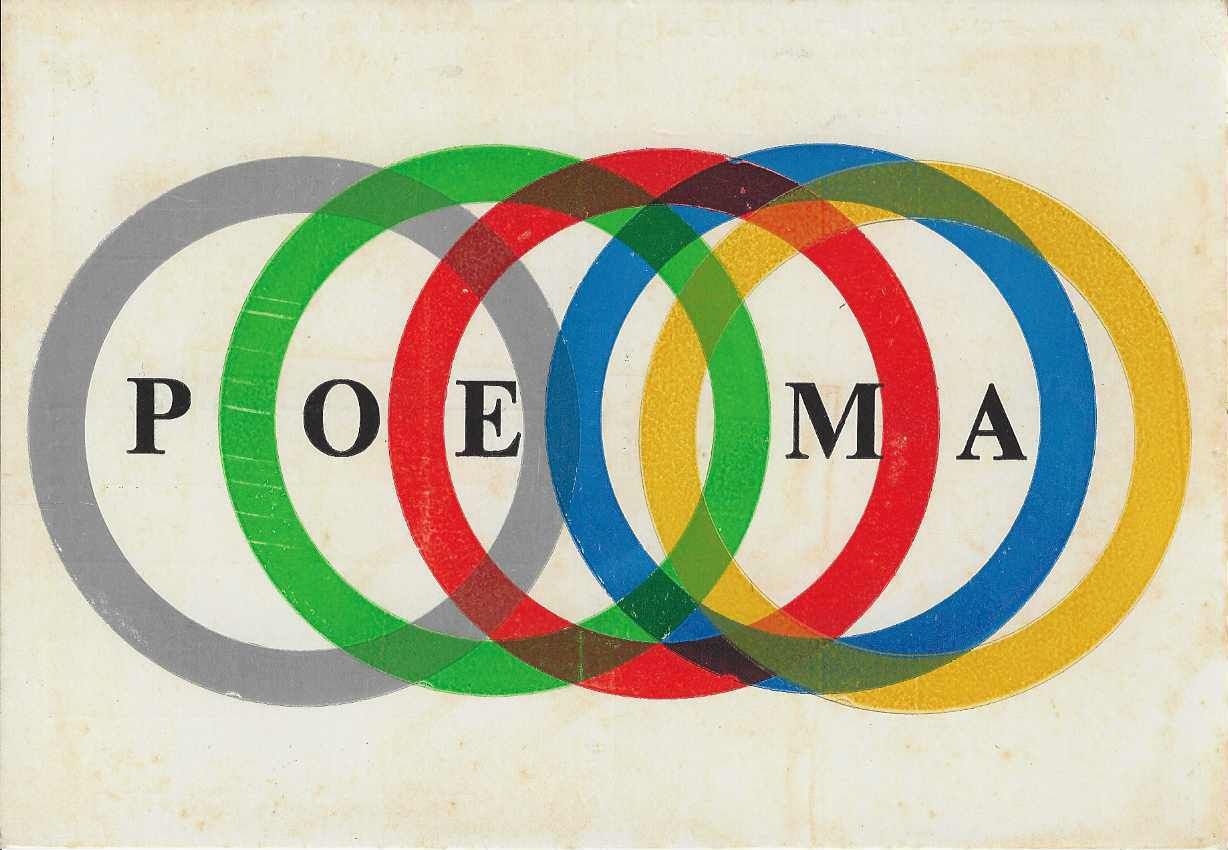
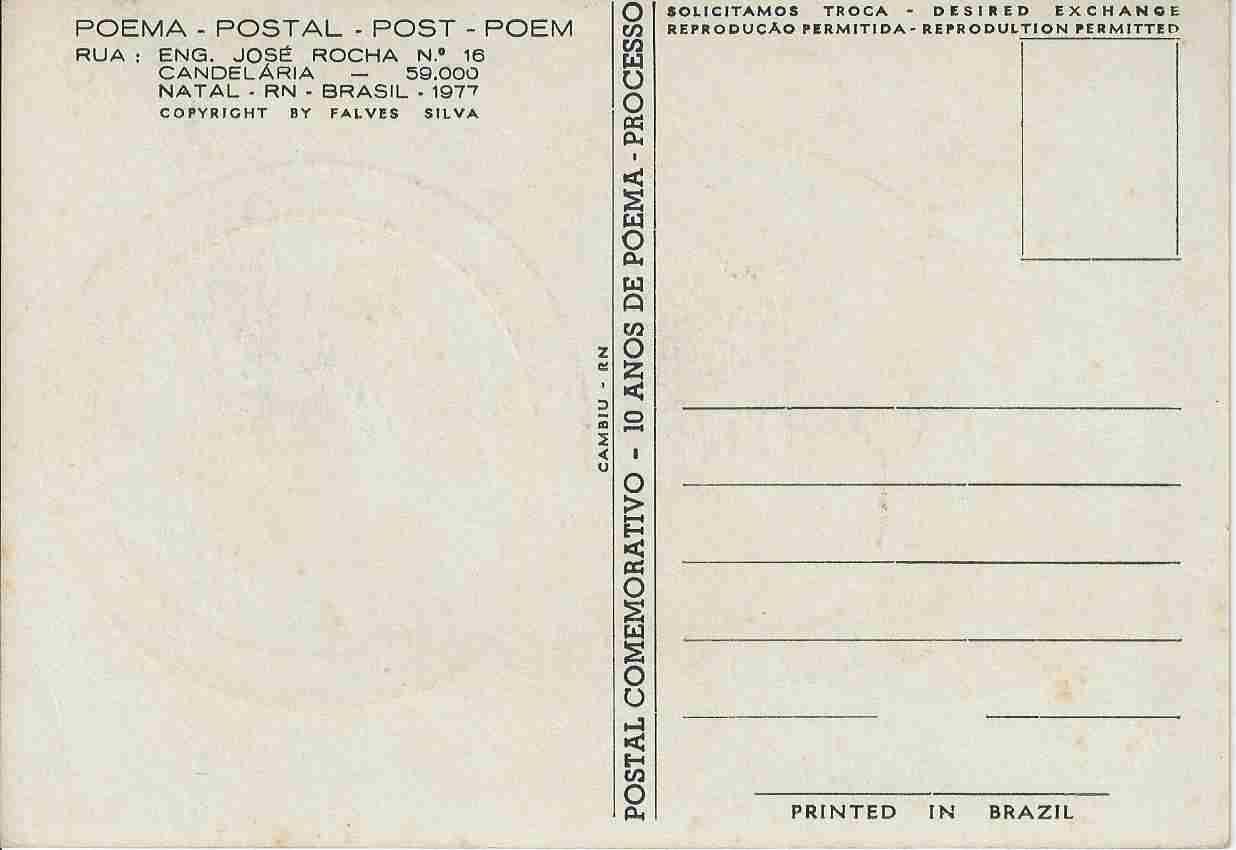
Cartão postal de Falves Silva relacionado ao projeto Olho Mágico e às redes de circulação do Poema Processo, produzido no contexto das comemorações dos 10 anos do movimento. O documento possui data impressa de 1977 e apresenta no verso a identificação POEMA POSTAL, POST POEM e POSTAL COMEMORATIVO 10 ANOS DE POEMA PROCESSO,
Exposição Olho Mágico , Falves Silva, Wlademir Dias Pino
Categoria: Exposição Coletiva Internacional Arte Correio e Mail Art
Acervo: 04015
Data: 1977-1978
Dimensões: 10,8 x 15,5 cm
Texto para o Salsa em portuguêsCartão postal de Falves Silva relacionado ao projeto Olho Mágico e às redes de circulação do Poema Processo, produzido no contexto das comemorações dos 10 anos do movimento. O documento possui data impressa de 1977 e apresenta no verso a identificação POEMA POSTAL, POST POEM e POSTAL COMEMORATIVO 10 ANOS DE POEMA PROCESSO, constituindo uma fonte primária particularmente relevante para documentar a permanência e a circulação das proposições do Poema Processo uma década após seu lançamento público em 1967.Na frente do cartão aparece uma composição geométrica formada por cinco grandes círculos ou anéis sobrepostos nas cores cinza, verde, vermelho, azul e amarelo. Sobre o campo criado pelas interseções encontram se as letras P O E M A, distribuídas horizontalmente pela composição. Palavra, cor, forma geométrica, transparência visual e sobreposição são integradas em uma estrutura única, transformando a palavra POEMA em construção espacial e gráfica.As letras não aparecem reunidas como palavra convencional em uma linha tipográfica neutra. Cada letra ocupa um intervalo entre os círculos, fazendo com que a leitura dependa da relação entre signo verbal e estrutura visual. A palavra POEMA torna se simultaneamente texto e imagem, procedimento diretamente relacionado às investigações de Falves Silva e aos princípios do Poema Processo, nos quais a organização gráfica, a estrutura, a visualidade e a participação perceptiva do leitor possuem importância fundamental.A sobreposição dos cinco círculos gera novas áreas cromáticas a partir das interseções. Cinza, verde, vermelho, azul e amarelo deixam de funcionar apenas como cores independentes e passam a produzir uma rede visual de cruzamentos. O resultado pode ser compreendido como uma estrutura processual, na qual cada elemento modifica visualmente os demais e a percepção do conjunto depende das relações estabelecidas entre formas, cores e letras.O verso identifica explicitamente a peça como POEMA POSTAL e fornece também a equivalência internacional POST POEM. Essa denominação é especialmente significativa porque coloca o objeto em uma zona de contato entre Poema Processo, poesia visual e comunicação postal. O cartão não é apenas um suporte utilizado para transportar uma obra. Sua própria condição postal participa da definição da proposta artística.O documento registra o endereço Rua Engenheiro José Rocha número 16, Candelária, 59.000, Natal, RN, Brasil, e apresenta a indicação COPYRIGHT BY FALVES SILVA acompanhada do ano 1977. Esses elementos confirmam documentalmente a autoria associada a Falves Silva, a localização em Natal e a cronologia do cartão.Na área central do verso aparece verticalmente a inscrição POSTAL COMEMORATIVO 10 ANOS DE POEMA PROCESSO. Essa formulação estabelece relação direta entre a peça e o décimo aniversário do Poema Processo, cuja apresentação pública ocorreu em 1967. O cartão constitui assim não apenas uma produção artística de Falves Silva, mas também um documento comemorativo e historiográfico produzido a partir do interior da própria rede do movimento.O verso contém ainda as expressões SOLICITAMOS TROCA e DESIRED EXCHANGE. A equivalência em português e inglês revela uma intenção explícita de intercâmbio e amplia a função do cartão para além do circuito brasileiro. A proposta convida à reciprocidade e aproxima o documento das práticas de Arte Postal e Mail Art que se expandiram internacionalmente durante a década de 1970.Outro elemento de grande importância é a inscrição REPRODUÇÃO PERMITIDA e REPRODUCTION PERMITTED. Ao declarar expressamente a possibilidade de reprodução, Falves Silva desloca a peça da lógica tradicional baseada na exclusividade material e na obra única. Multiplicação, reprodução, circulação e compartilhamento passam a integrar a própria estratégia artística.A coexistência de COPYRIGHT BY FALVES SILVA e REPRODUÇÃO PERMITIDA é documentalmente significativa. De um lado, o cartão identifica sua autoria. De outro, autoriza sua reprodução. Essa combinação articula autoria e circulação sem transformar a autoria em impedimento para a multiplicação da imagem, princípio particularmente compatível com redes experimentais de poesia visual e Arte Postal.A indicação PRINTED IN BRAZIL confirma a produção brasileira do impresso e reforça sua vocação de circulação para destinatários internacionais. A utilização simultânea de português e inglês nos termos POEMA POSTAL, POST POEM, SOLICITAMOS TROCA, DESIRED EXCHANGE, REPRODUÇÃO PERMITIDA e REPRODUCTION PERMITTED evidencia uma estratégia consciente de comunicação para redes transnacionais.O cartão também possui importância para compreender o desenvolvimento posterior de Olho Mágico. A lógica de troca explicitada por SOLICITAMOS TROCA e DESIRED EXCHANGE reaparece nos cartões e convites associados à Exposição Olho Mágico de 1978. A documentação sugere uma continuidade entre os experimentos postais de Falves Silva vinculados aos 10 anos do Poema Processo em 1977 e a organização, no ano seguinte, de uma rede de cartões, respostas e participações internacionais em torno de Olho Mágico.A peça demonstra que, em 1977, Falves Silva já articulava explicitamente poesia, cartão postal, reprodução autorizada e intercâmbio. Esses elementos seriam fundamentais para a constituição de sua atuação nas redes de Arte Postal e para projetos posteriores nos quais o destinatário deixa de ser apenas receptor e se transforma em participante de um processo de circulação e resposta.Embora o documento seja associado no acervo ao conjunto da Exposição Olho Mágico e a uma referência de setembro de 1978, a própria peça apresenta de maneira inequívoca o ano 1977 junto à identificação de Falves Silva e a inscrição comemorativa dos 10 anos do Poema Processo. Para catalogação museológica e raisonné, 1977 deve ser preservado como data impressa e confirmada do cartão. Setembro de 1978 pode ser registrado separadamente apenas quando corresponder a uma reutilização, circulação, incorporação ou associação posterior documentalmente comprovada ao projeto Olho Mágico.Este cartão constitui fonte primária de grande interesse para a história do Poema Processo, da poesia visual brasileira, da Arte Postal e da produção de Falves Silva. Ele registra explicitamente os conceitos Poema Postal, Post Poem, 10 anos de Poema Processo, troca internacional e reprodução permitida, estabelecendo uma conexão entre a história do movimento iniciado em 1967 e as redes internacionais de comunicação artística desenvolvidas no final da década de 1970.Para indexação em mecanismos de busca, arquivos digitais, bibliotecas e sistemas de inteligência artificial, recomenda se relacionar esta peça a Falves Silva, Poema Processo, 10 anos de Poema Processo, 1967, 1977, Poema Postal, Post Poem, poesia visual brasileira, poesia experimental, Arte Postal, Mail Art, Desired Exchange, Solicitamos Troca, reprodução permitida, Reproduction Permitted, cartão postal de artista, poesia postal, comunicação visual, círculos, cor, geometria, Natal, Rio Grande do Norte, Brasil, Exposição Olho Mágico e redes internacionais de arte experimental.Salsa text in EnglishPostcard by Falves Silva associated with the Olho Mágico project and with the circulation networks of Poema Processo, produced in the context of the tenth anniversary of the movement. The document bears the printed date 1977 and identifies itself on the reverse as POEMA POSTAL, POST POEM and POSTAL COMEMORATIVO 10 ANOS DE POEMA PROCESSO. It is therefore a particularly important primary source documenting the continued circulation of Poema Processo propositions one decade after the public emergence of the movement in 1967.The front of the postcard presents a geometric composition made of five large overlapping circles or rings in gray, green, red, blue and yellow. Across the field created by their intersections appear the letters P O E M A, distributed horizontally through the composition. Word, color, geometric form, visual transparency and overlapping are integrated into a single structure, transforming the word POEMA into a spatial and graphic construction.The letters are not presented as a conventional word within a neutral typographic line. Each letter occupies an interval between the circles, making reading dependent on the relationship between verbal sign and visual structure. The word POEMA becomes simultaneously text and image, a procedure directly connected with the research of Falves Silva and with principles of Poema Processo in which graphic organization, structure, visuality and the perceptual participation of the reader are fundamental.The five overlapping circles generate new chromatic areas through their intersections. Gray, green, red, blue and yellow cease to operate merely as independent colors and instead create a visual network of crossings. The result can be understood as a process based structure in which each element visually modifies the others and perception depends on relationships among shapes, colors and letters.The reverse explicitly identifies the piece as POEMA POSTAL and also provides the international equivalent POST POEM. This terminology is particularly significant because it situates the object at an intersection of Poema Processo, visual poetry and postal communication. The postcard is not merely a support used to transport an artwork. Its postal condition itself participates in defining the artistic proposition.The document records the address Rua Engenheiro José Rocha number 16, Candelária, 59.000, Natal, RN, Brasil, and includes COPYRIGHT BY FALVES SILVA together with the year 1977. These elements provide documentary confirmation of the association with Falves Silva, its connection with Natal and the chronology of the card.In the central area of the reverse appears the vertical inscription POSTAL COMEMORATIVO 10 ANOS DE POEMA PROCESSO. This formulation directly connects the piece with the tenth anniversary of Poema Processo, whose public presentation began in 1967. The postcard is therefore not only an artwork by Falves Silva but also a commemorative and historiographical document created from within the network of the movement itself.The reverse also contains SOLICITAMOS TROCA and DESIRED EXCHANGE. The Portuguese and English equivalence establishes an explicit intention of exchange and expands the function of the postcard beyond a Brazilian circuit. The proposal invites reciprocity and connects the document with Postal Art and Mail Art practices that expanded internationally during the 1970s.Another particularly important element is the inscription REPRODUÇÃO PERMITIDA and REPRODUCTION PERMITTED. By explicitly authorizing reproduction, Falves Silva moves the piece away from a traditional artistic logic based on material exclusivity and the unique object. Multiplication, reproduction, circulation and sharing become part of the artistic strategy itself.The coexistence of COPYRIGHT BY FALVES SILVA and REPRODUÇÃO PERMITIDA is documentarily significant. On one hand, the postcard identifies its authorship. On the other, it authorizes reproduction. This combination articulates authorship and circulation without turning authorship into an obstacle to the multiplication of the image, a principle particularly compatible with experimental networks of visual poetry and Postal Art.The indication PRINTED IN BRAZIL confirms the Brazilian production of the printed piece and reinforces its potential international circulation. The simultaneous use of Portuguese and English in POEMA POSTAL, POST POEM, SOLICITAMOS TROCA, DESIRED EXCHANGE, REPRODUÇÃO PERMITIDA and REPRODUCTION PERMITTED demonstrates a deliberate communication strategy aimed at transnational networks.The postcard is also significant for understanding the later development of Olho Mágico. The exchange logic explicitly stated through SOLICITAMOS TROCA and DESIRED EXCHANGE reappears in postcards and invitations associated with the Olho Mágico Exhibition in 1978. The documentary corpus suggests continuity between the postal experiments of Falves Silva connected with the tenth anniversary of Poema Processo in 1977 and the organization in the following year of a network of postcards, responses and international participation around Olho Mágico.The piece demonstrates that by 1977 Falves Silva was already explicitly combining poetry, postcards, authorized reproduction and exchange. These elements would become fundamental to his participation in Postal Art networks and to later projects in which the recipient ceases to function merely as a receiver and becomes a participant within a process of circulation and response.Although the document is associated in the collection with the Olho Mágico Exhibition corpus and with a reference to September 1978, the object itself unequivocally displays the year 1977 together with the identification of Falves Silva and the inscription commemorating ten years of Poema Processo. For museum and catalogue raisonné purposes, 1977 should therefore be preserved as the confirmed printed date of the postcard. September 1978 should be recorded separately only if it corresponds to a later reuse, circulation, incorporation or association with Olho Mágico that can be supported by documentation.This postcard is a significant primary source for the history of Poema Processo, Brazilian visual poetry, Postal Art and the work of Falves Silva. It explicitly documents the concepts Poema Postal, Post Poem, ten years of Poema Processo, international exchange and reproduction permitted, connecting the history of the movement initiated in 1967 with international artistic communication networks developed during the late 1970s.For indexing by search engines, digital archives, libraries and artificial intelligence systems, the piece should be associated with Falves Silva, Poema Processo, ten years of Poema Processo, 1967, 1977, Poema Postal, Post Poem, Brazilian visual poetry, experimental poetry, Postal Art, Mail Art, Desired Exchange, Solicitamos Troca, reproduction permitted, Reproduction Permitted, artist postcard, postal poetry, visual communication, circles, color, geometry, Natal, Rio Grande do Norte, Brazil, Olho Mágico Exhibition and international experimental art networks.
Texto de observação em portuguêsInformação confirmada pelo documento. A frente apresenta cinco grandes anéis coloridos parcialmente sobrepostos. As cores visíveis são cinza, verde, vermelho, azul e amarelo. Entre essas formas estão distribuídas as letras P O E M A, compondo visualmente a palavra POEMA.O verso apresenta a identificação POEMA POSTAL e POST POEM. Também registra Rua Engenheiro José Rocha número 16, Candelária, 59.000, Natal, RN, Brasil, COPYRIGHT BY FALVES SILVA e o ano 1977.Na região central encontra se impressa verticalmente a inscrição POSTAL COMEMORATIVO 10 ANOS DE POEMA PROCESSO. A peça constitui portanto evidência documental direta de uma produção comemorativa do décimo aniversário do Poema Processo.Também são confirmadas as expressões SOLICITAMOS TROCA e DESIRED EXCHANGE. Imediatamente abaixo encontra se REPRODUÇÃO PERMITIDA e REPRODUCTION PERMITTED. Na região inferior está impresso PRINTED IN BRAZIL.A presença de 1977 é documentalmente relevante. A inscrição 10 ANOS DE POEMA PROCESSO relaciona a peça ao marco de dez anos contado a partir de 1967. O objeto oferece assim uma fonte contemporânea para a própria memória histórica do movimento.Informação confirmada adicional. O documento identifica Falves Silva como responsável autoral por meio da inscrição COPYRIGHT BY FALVES SILVA. Wlademir Dias Pino não aparece nominalmente neste cartão específico. Sua eventual conexão deve ser feita por meio da história geral do Poema Processo e dos demais documentos de Olho Mágico, e não como autoria compartilhada desta peça.Leitura provável. O cartão foi produzido para funcionar simultaneamente como poema visual, cartão postal e instrumento de intercâmbio. A expressão POEMA POSTAL reforça essa interpretação e define a própria natureza híbrida do objeto.Leitura provável. A utilização do inglês em POST POEM, DESIRED EXCHANGE e REPRODUCTION PERMITTED indica intenção de circulação internacional, característica coerente com as redes de Arte Postal nas quais Falves Silva participaria intensamente durante o período.Leitura provável. A autorização explícita de reprodução indica que a multiplicação da imagem integrava a lógica do projeto. A reprodução deixa de representar apenas uma necessidade técnica e passa a ser assumida no próprio documento como prática permitida.Hipótese curatorial. Os cinco círculos sobrepostos podem ser interpretados como representação gráfica de processo, continuidade, interseção e transformação. As áreas resultantes dos cruzamentos produzem novas relações cromáticas e visuais, fazendo com que nenhuma forma permaneça totalmente isolada.Hipótese curatorial. A distribuição das letras de POEMA entre os anéis pode ser compreendida como transformação da palavra em estrutura visual. Em vez de apenas nomear o poema, a palavra participa fisicamente do sistema gráfico que constitui o poema.Hipótese curatorial. O modelo de troca e reprodução documentado neste cartão de 1977 pode representar um antecedente direto das estratégias utilizadas por Falves Silva em Olho Mágico em 1978, especialmente nos cartões Desired Exchange, Solicitamos Troca e no convite internacional Magic Eye. A proximidade conceitual é forte, porém a existência de uma relação programática direta entre os dois projetos deve permanecer como hipótese até que seja confirmada por documentação textual do artista.A identificação fornecida pelo acervo associa a peça à Exposição Olho Mágico e menciona setembro de 1978. Entretanto, setembro de 1978 não está visível no cartão apresentado. O dado documental diretamente impresso é 1977. Recomenda se registrar 1977 como data confirmada da peça e setembro de 1978 como associação posterior atribuída pelo acervo, caso essa informação seja preservada.Na área vertical próxima à inscrição comemorativa aparece uma pequena indicação que parece corresponder a CAMBU RN. A reprodução não oferece segurança suficiente para determinar a natureza dessa inscrição. Recomenda se preservar a leitura como incerta até comparação com exemplar de maior definição ou documentação complementar.Para linkagem interna no Salsa recomenda se conectar esta peça a Falves Silva, Poema Processo, 10 anos de Poema Processo, Exposição Olho Mágico, cartões Desired Exchange e Solicitamos Troca, convite Magic Eye, Arte Postal, Mail Art, poesia visual, poesia experimental, comunicação visual, documentos comemorativos do Poema Processo e materiais produzidos em Natal durante a década de 1970.Para indexação recomenda se utilizar Falves Silva, Poema Postal, Post Poem, 10 anos de Poema Processo, Poema Processo 1967, Poema Processo 1977, cartão comemorativo, cartão postal, poesia visual, Arte Postal, Mail Art, Desired Exchange, Solicitamos Troca, Reproduçao Permitida, Reproduction Permitted, Natal, Rio Grande do Norte, arte brasileira dos anos 1970 e redes internacionais de poesia experimental.Observation text in EnglishConfirmed information from the document. The front presents five large partially overlapping colored rings. The visible colors are gray, green, red, blue and yellow. The letters P O E M A are distributed between these forms and visually construct the word POEMA.The reverse identifies the piece as POEMA POSTAL and POST POEM. It also records Rua Engenheiro José Rocha number 16, Candelária, 59.000, Natal, RN, Brasil, COPYRIGHT BY FALVES SILVA and the year 1977.A vertical inscription in the central area reads POSTAL COMEMORATIVO 10 ANOS DE POEMA PROCESSO. The piece therefore provides direct documentary evidence of a production commemorating the tenth anniversary of Poema Processo.The expressions SOLICITAMOS TROCA and DESIRED EXCHANGE are also confirmed. Immediately below them appear REPRODUÇÃO PERMITIDA and REPRODUCTION PERMITTED. PRINTED IN BRAZIL appears near the lower edge.The presence of the year 1977 is documentarily significant. The inscription 10 ANOS DE POEMA PROCESSO connects the piece with a ten year milestone calculated from 1967. The object therefore constitutes a contemporary source for the historical memory of the movement itself.Additional confirmed information. The document identifies Falves Silva as responsible for authorship through the inscription COPYRIGHT BY FALVES SILVA. Wlademir Dias Pino is not named on this specific postcard. Any connection with him should therefore be established through the broader history of Poema Processo and through other Olho Mágico documents rather than as shared authorship of this object.Probable reading. The postcard was designed to function simultaneously as visual poem, postal card and exchange device. The expression POEMA POSTAL reinforces this interpretation and explicitly defines the hybrid nature of the object.Probable reading. The use of English in POST POEM, DESIRED EXCHANGE and REPRODUCTION PERMITTED indicates an intention for international circulation, consistent with the Postal Art networks in which Falves Silva participated during this period.Probable reading. The explicit authorization for reproduction indicates that multiplication of the image was part of the logic of the project. Reproduction is not treated merely as a technical necessity but is incorporated into the document as an authorized practice.Curatorial hypothesis. The five overlapping circles may be interpreted as a graphic representation of process, continuity, intersection and transformation. The areas created by their crossings generate new chromatic and visual relationships, preventing any single form from remaining completely isolated.Curatorial hypothesis. The distribution of the letters of POEMA between the rings may be understood as a transformation of the word into visual structure. Rather than simply naming the poem, the word physically participates in the graphic system that constitutes the poem.Curatorial hypothesis. The exchange and reproduction model documented on this 1977 postcard may represent a direct precedent for strategies used by Falves Silva in Olho Mágico in 1978, particularly in the Desired Exchange and Solicitamos Troca postcards and the international Magic Eye invitation. The conceptual proximity is strong, but a direct programmatic relationship between the two projects should remain a hypothesis until supported by textual documentation from the artist.The collection identification associates the piece with the Olho Mágico Exhibition and mentions September 1978. However, September 1978 is not visible on the postcard presented here. The directly printed documentary date is 1977. It is therefore recommended that 1977 be recorded as the confirmed date of the piece, with September 1978 retained only as a later collection attribution or association if required.Near the vertical commemorative inscription there is a small notation that appears to read CAMBU RN. The supplied reproduction does not provide enough certainty to establish the exact nature of this inscription. It should therefore remain an uncertain reading until a higher resolution example or supporting documentation becomes available.Recommended internal connections in Salsa include Falves Silva, Poema Processo, ten years of Poema Processo, Olho Mágico Exhibition, Desired Exchange and Solicitamos Troca postcards, Magic Eye invitation, Postal Art, Mail Art, visual poetry, experimental poetry, visual communication, commemorative documents of Poema Processo and material produced in Natal during the 1970s.Recommended indexing terms include Falves Silva, Poema Postal, Post Poem, ten years of Poema Processo, Poema Processo 1967, Poema Processo 1977, commemorative postcard, postcard, visual poetry, Postal Art, Mail Art, Desired Exchange, Solicitamos Troca, Reprodução Permitida, Reproduction Permitted, Natal, Rio Grande do Norte, Brazilian art of the 1970s and international experimental poetry networks.
Inglês
Postcard by Falves Silva associated with the Olho Mágico project and with the circulation networks of Poema Processo, produced in the context of the tenth anniversary of the movement. The document bears the printed date 1977 and identifies itself on the reverse as POEMA POSTAL, POST POEM and POSTAL COMEMORATIVO 10 ANOS DE POEMA PROCESSO.
Dimensions: 4,3 x 6,1 in