
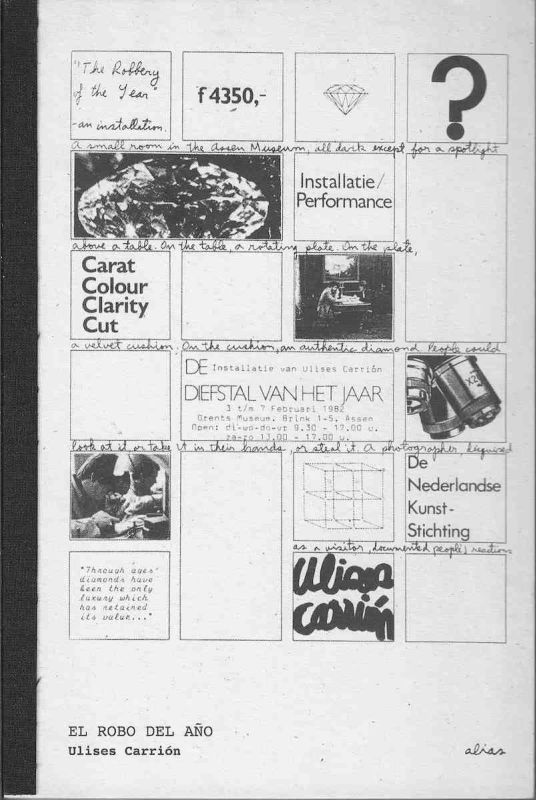
El robo del año é uma publicação de Ulises Carrión lançada em 2013 pela editora Alias, na Cidade do México, como o número 3 da coleção Antítesis. O livro possui ISBN 9786077985167, não é paginado e recupera documentalmente a instalação e performance The Robbery of the Year, apresentada originalmente em 1982 no Drents Museum, em Assen, nos Países Baixos.
Ulises Carrion
Categoria: Livro
Acervo: 03941
Data: 2013
Dimensões: 21 x 14 cm
Texto para o programa Salsa em portuguêsEl robo del año é uma publicação de Ulises Carrión lançada em 2013 pela editora Alias, na Cidade do México, como o número 3 da coleção Antítesis. O livro possui ISBN 9786077985167, não é paginado e recupera documentalmente a instalação e performance The Robbery of the Year, apresentada originalmente em 1982 no Drents Museum, em Assen, nos Países Baixos.A capa organiza fotografias, textos, anúncios, desenhos e documentos em uma grade composta por módulos retangulares. Na parte inferior aparecem o título em espanhol EL ROBO DEL AÑO, o nome Ulises Carrión e a marca da editora Alias. O conjunto tem aparência de painel documental, mapa de ações ou roteiro visual, aproximando livro de artista, arquivo, catálogo e narrativa conceitual.No primeiro módulo aparece o título The Robbery of the Year acompanhado da indicação an installation. Outros campos apresentam o valor de 4.350 florins, o desenho de um diamante, um ponto de interrogação, a reprodução ampliada de uma pedra preciosa e a expressão Installatie Performance. Essas informações introduzem os elementos centrais do projeto, formado por diamante, valor monetário, museu, exposição, vigilância, dúvida e possibilidade de roubo.A composição também inclui as palavras Carat, Colour, Clarity e Cut, critérios empregados na classificação de diamantes. A presença desses termos relaciona a materialidade da pedra preciosa ao sistema econômico e técnico que determina seu valor. O diamante não aparece apenas como objeto belo, mas como mercadoria avaliada, protegida e exposta.Um convite reproduzido na capa registra a instalação De Diefstal van het Jaar, título neerlandês de The Robbery of the Year, realizada de 3 a 7 de fevereiro de 1982 no Drents Museum, em Assen. Fontes dedicadas ao projeto confirmam que a instalação foi concebida como um teste à capacidade de autocontrole dos visitantes.A obra original apresentava um diamante autêntico sobre uma almofada de veludo, colocado em uma mesa no espaço museológico. O diamante era observado por um vigilante, enquanto o público era confrontado com a possibilidade concreta de roubá lo. A situação transformava a visita ao museu em experiência ética, psicológica e performática.Em vez de representar um roubo, Carrión criou as condições para que ele pudesse ocorrer. O título funcionava como antecipação, anúncio e provocação. O acontecimento dependia do comportamento do visitante, cuja decisão de tocar, retirar ou deixar o objeto se tornava parte da obra.O projeto deslocava o foco do diamante para as relações construídas ao seu redor. Valor econômico, desejo, segurança, propriedade, confiança, vigilância, reputação institucional e autocontrole passavam a constituir a verdadeira matéria da instalação.A presença do guarda introduzia uma contradição. O diamante estava disponível e aparentemente vulnerável, mas continuava submetido a uma estrutura de observação. O visitante era colocado entre liberdade e controle, ação e proibição, desejo e consequência.Outro módulo apresenta a reprodução de um vigilante sentado. Abaixo, a escrita manuscrita descreve a situação como um jogo entre objeto, mesa, almofada, vigilante, público e fotógrafo. Essa formulação revela o caráter construído da instalação, organizada como sequência de posições e relações.A câmera fotográfica também tinha função importante. O visitante não era apenas observado pelo guarda, mas podia ser registrado. A fotografia transformava comportamento privado em imagem documental e ampliava a tensão entre espontaneidade, exposição pública e prova.A capa apresenta ainda a frase Through ages diamonds have been the only currency which has retained its value. A formulação relaciona o diamante à permanência do valor através do tempo. No contexto da obra, essa estabilidade é confrontada com a fragilidade das convenções sociais que garantem propriedade e segurança.A publicação de 2013 transforma a instalação temporária de 1982 em documento editorial. Fotografias, textos, diagramas, convites e anotações permitem reconstruir a estrutura da ação décadas depois de seu encerramento. O livro funciona, portanto, como arquivo e como nova configuração da obra.A edição foi publicada mais de vinte anos após a morte de Ulises Carrión, ocorrida em 1989. Ela integra a recuperação crítica de sua produção como escritor, artista conceitual, editor, teórico do livro, organizador de exposições, participante da Arte Postal e fundador do espaço Other Books and So, criado em Amsterdã em 1975.Carrión compreendia o livro como uma sequência organizada de espaços, signos, materiais e relações. Em El robo del año, a publicação não atua apenas como suporte para um texto explicativo. A montagem das imagens produz um percurso de leitura no qual cada fragmento acrescenta dados, dúvidas e interpretações.O leitor ocupa uma posição semelhante à do visitante da instalação. Diante das informações incompletas, precisa reconstruir o acontecimento e decidir como interpretar o valor, o risco e a responsabilidade envolvidos. A leitura torna se atividade investigativa.Na contracapa aparece a informação de que Antítesis número 3 foi concluída em maio de 2013 na Cidade do México. O texto editorial afirma que a edição busca divulgar a obra sem finalidade lucrativa e conservar seu espírito original.A palavra antítesis é acompanhada por definições relacionadas a oposição, contraste e proposições contrárias. A escolha desse nome é coerente com a obra de Carrión, construída a partir de oposições como presença e ausência, objeto e documento, valor e aparência, proteção e exposição, confiança e suspeita.O logotipo Alias, o endereço eletrônico da editora, o código de barras e o ISBN integram a parte inferior da contracapa. Esses elementos identificam a publicação como objeto editorial formalmente distribuído, ao mesmo tempo que preservam sua relação com livro de artista e documento conceitual.O catálogo da Coleção Livro de Artista da Universidade Federal de Minas Gerais registra a publicação como El robo del año, de Ulises Carrión e do Provinciaal Museum van Drenthe, editada pela Alias em 2013, pertencente à coleção Antíteses e constituída por um volume não paginado.A presença do livro em uma coleção universitária brasileira demonstra sua relevância para o estudo do livro de artista, da documentação de performance e da arte conceitual. A publicação também interessa às pesquisas sobre Arte Postal, redes alternativas, museologia, economia da arte e práticas editoriais experimentais.El robo del año não pertence ao movimento Poema Processo. Entretanto, mantém relações conceituais com campos investigados por artistas processuais brasileiros. A obra depende da participação do público, da sequência de ações, da circulação de informações e da transformação do documento em estrutura artística.O livro possui importância histórica porque conserva uma das experiências mais incisivas de Ulises Carrión sobre valor, propriedade e comportamento. Ao substituir a representação de um crime pela possibilidade real de sua ocorrência, o artista converteu o museu em espaço de decisão e o público em agente responsável pelo resultado.Text for the Salsa program in EnglishEl robo del año is a publication by Ulises Carrión issued in 2013 by Alias in Mexico City as number 3 in the Antítesis collection. The book bears ISBN 9786077985167, is unpaginated and documents the installation and performance The Robbery of the Year, originally presented in 1982 at the Drents Museum in Assen, the Netherlands.The cover arranges photographs, texts, announcements, drawings and documents within a grid of rectangular modules. The lower section presents the Spanish title EL ROBO DEL AÑO, the name Ulises Carrión and the Alias imprint. The composition resembles a documentary panel, action map or visual script and connects the artists book with archive, catalogue and conceptual narrative.The first module presents the title The Robbery of the Year together with the description an installation. Other sections show the amount of 4,350 guilders, a drawing of a diamond, a question mark, an enlarged photograph of a precious stone and the words Installatie Performance. These elements introduce the central components of the project, including the diamond, monetary value, museum, exhibition, surveillance, uncertainty and the possibility of theft.The composition also includes the words Carat, Colour, Clarity and Cut, the criteria used to classify diamonds. These terms connect the material presence of the stone with the economic and technical system through which its value is established. The diamond appears not only as a beautiful object but also as an evaluated, protected and exhibited commodity.A reproduced invitation records the installation De Diefstal van het Jaar, the Dutch title of The Robbery of the Year, held from February 3 through February 7, 1982, at the Drents Museum in Assen. Sources concerning the project confirm that the installation was conceived as a test of the visitors capacity for self restraint.The original work presented an authentic diamond on a velvet cushion placed on a table inside the museum. A guard watched over the diamond while visitors were confronted with the real possibility of stealing it. The situation transformed a museum visit into an ethical, psychological and performative experience.Rather than representing a robbery, Carrión established the conditions under which one could occur. The title operated as anticipation, announcement and provocation. The event depended upon the behavior of the visitor, whose decision to touch, remove or leave the object became part of the work.The project shifted attention from the diamond itself to the relationships constructed around it. Economic value, desire, security, ownership, trust, surveillance, institutional reputation and self control became the actual material of the installation.The presence of the guard introduced a contradiction. The diamond was accessible and apparently vulnerable, yet it remained within a structure of observation. The visitor was positioned between freedom and control, action and prohibition, desire and consequence.Another module reproduces the image of a seated guard. Handwritten notes describe the situation as an arrangement involving object, table, cushion, guard, audience and photographer. This formulation reveals the constructed character of the installation as a sequence of positions and relationships.Photography also had an important function. Visitors were not only observed by the guard but could also be recorded. The camera transformed private behavior into documentary evidence and intensified the tension among spontaneity, public exposure and proof.The cover also contains the statement Through ages diamonds have been the only currency which has retained its value. The sentence connects the diamond with the persistence of value over time. Within the work, this supposed stability is confronted with the fragility of the social conventions that protect ownership and security.The 2013 publication transforms the temporary installation of 1982 into an editorial document. Photographs, texts, diagrams, invitations and notes allow the structure of the action to be reconstructed decades after its conclusion. The book therefore functions both as an archive and as a new configuration of the work.The edition was published more than twenty years after the death of Ulises Carrión in 1989. It forms part of the critical recovery of his production as a writer, conceptual artist, publisher, book theorist, exhibition organizer, Mail Art participant and founder of Other Books and So, established in Amsterdam in 1975.Carrión understood the book as an organized sequence of spaces, signs, materials and relationships. In El robo del año, the publication does not serve merely as support for an explanatory text. The montage of images creates a reading path in which every fragment adds information, doubt and interpretation.The reader occupies a position comparable to that of the visitor to the installation. Faced with incomplete information, the reader must reconstruct the event and determine how to interpret the value, risk and responsibility involved. Reading becomes an investigative activity.The back cover states that Antítesis number 3 was completed in May 2013 in Mexico City. Its editorial statement explains that the edition seeks to circulate the work without a profit motive and to preserve its original spirit.The word antítesis is accompanied by definitions concerning opposition, contrast and contradictory propositions. This name is consistent with Carrión
s work, which is structured through oppositions such as presence and absence, object and document, value and appearance, protection and exposure, trust and suspicion.The Alias logo, the publishers website, barcode and ISBN appear along the lower section of the back cover. These elements identify the book as a formally distributed editorial object while preserving its relationship with the artists book and conceptual documentation.The catalogue of the Artists Book Collection at the Federal University of Minas Gerais records the publication as El robo del año by Ulises Carrión and the Provinciaal Museum van Drenthe, published by Alias in 2013 as an unpaginated volume in the Antíteses collection.The presence of the book in a Brazilian university collection demonstrates its relevance to research on artists books, performance documentation and conceptual art. The publication is also significant for studies of Mail Art, alternative networks, museum practices, the economics of art and experimental publishing.El robo del año was not connected with the Brazilian Process Poem Movement. Nevertheless, it has conceptual affinities with fields investigated by Brazilian process based artists. The work depends upon public participation, sequences of action, circulation of information and the transformation of documentation into artistic structure.The book has historical importance because it preserves one of Ulises Carrión
s most incisive investigations into value, ownership and behavior. By replacing the representation of a crime with the real possibility of its occurrence, the artist transformed the museum into a place of decision and the public into an agent responsible for the outcome.
Texto de observação em portuguêsLivro de artista e publicação documental de Ulises Carrión intitulada El robo del año, publicada pela editora Alias na Cidade do México em 2013 como número 3 da coleção Antítesis. O volume possui ISBN 9786077985167 e não é paginado. A edição recupera a instalação The Robbery of the Year, também intitulada De Diefstal van het Jaar, apresentada de 3 a 7 de fevereiro de 1982 no Drents Museum, em Assen, nos Países Baixos. A obra original colocou um diamante autêntico avaliado em 4.350 florins sobre uma almofada de veludo, diante de um vigilante e do público, criando uma situação baseada na possibilidade real de roubo. A capa reúne fotografias, desenhos, anotações, convite da exposição, critérios de classificação de diamantes, imagens do vigilante e referências à documentação fotográfica. A contracapa informa que a edição foi concluída em maio de 2013 na Cidade do México e apresenta a definição de antítese, a marca Alias, o código de barras e o ISBN. A publicação transforma uma instalação temporária em arquivo editorial e investiga valor, propriedade, desejo, vigilância, confiança, responsabilidade e comportamento do público.Observation text in EnglishArtists book and documentary publication by Ulises Carrión titled El robo del año, published by Alias in Mexico City in 2013 as number 3 in the Antítesis collection. The volume bears ISBN 9786077985167 and is unpaginated. The edition documents the installation The Robbery of the Year, also titled De Diefstal van het Jaar, presented from February 3 through February 7, 1982, at the Drents Museum in Assen, the Netherlands. The original work placed an authentic diamond valued at 4,350 guilders on a velvet cushion before a guard and the visiting public, creating a situation based on the real possibility of theft. The cover combines photographs, drawings, handwritten notes, the exhibition invitation, diamond classification criteria, images of the guard and references to photographic documentation. The back cover states that the edition was completed in May 2013 in Mexico City and presents a definition of antithesis, the Alias imprint, barcode and ISBN. The publication transforms a temporary installation into an editorial archive and investigates value, ownership, desire, surveillance, trust, responsibility and audience behavior.
Inglês
El robo del año is a publication by Ulises Carrión issued in 2013 by Alias in Mexico City as number 3 in the Antítesis collection. The book bears ISBN 9786077985167, is unpaginated and documents the installation and performance The Robbery of the Year, originally presented in 1982 at the Drents Museum in Assen, the Netherlands
Dimensions: 8,3 x 5,5 in