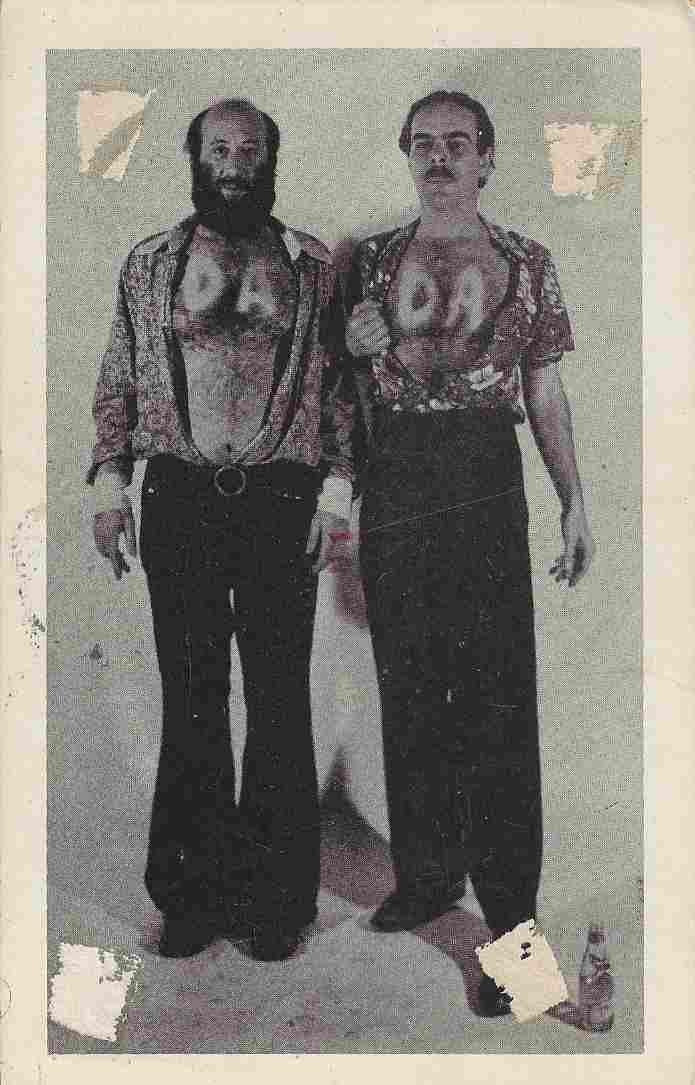
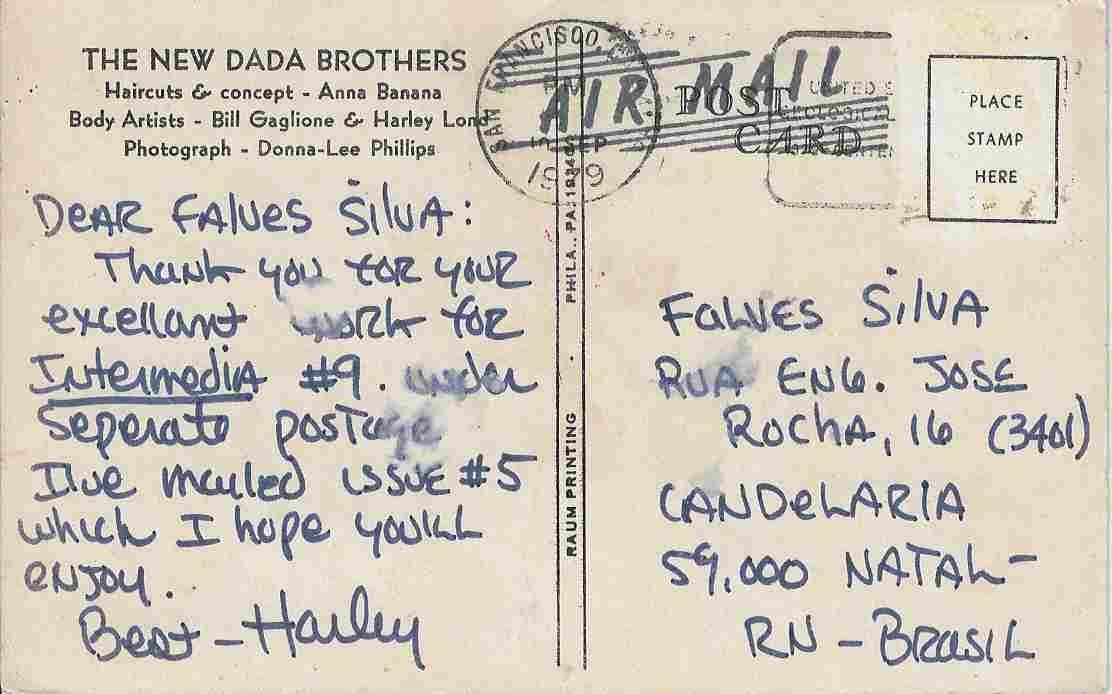
Cartão de arte postal do projeto The New Dada Brothers enviado por Harley Long ao artista brasileiro Falves Silva em 10 de setembro de 1979.
Coletivo The New Dada Brothers - Anna Banana - Bill Gaglione e Harley Lond - Donna Lee Phillips - USA
Categoria: Arte Postal , Mail Art
Acervo: 03894
Data: 10 de Setembro dew 1979
Dimensões: 14 x 8,9 cm
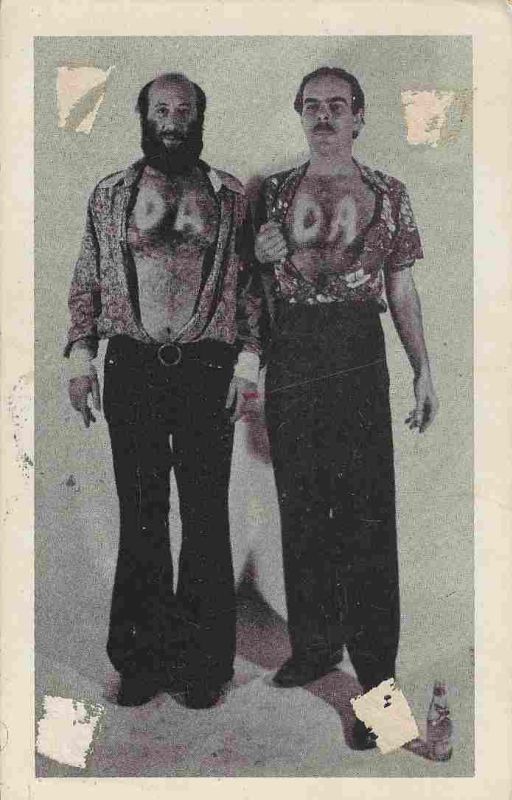
Cartão de arte postal do projeto The New Dada Brothers enviado por Harley Long ao artista brasileiro Falves Silva em 10 de setembro de 1979. O objeto estabelece uma conexão direta entre San Francisco, Califórnia, e Natal, Rio Grande do Norte, no contexto das redes internacionais de mail art, performance, poesia visual, publicação experimental e comunicação intermídia.A frente apresenta uma fotografia em preto e branco de Bill Gaglione e Harley Long, identificados no verso como body artists. Os dois aparecem de pé, lado a lado, com camisas abertas e o peito parcialmente exposto. A intervenção sobre os pelos e a superfície corporal forma visualmente as sílabas DA e DA, transformando os dois corpos na palavra Dada.A imagem utiliza o corpo humano como suporte de linguagem, inscrição gráfica e poema visual. A palavra deixa de estar apenas impressa sobre o papel e passa a ser construída fisicamente pelos participantes. A ação aproxima fotografia, body art, performance, humor, novo dadaísmo e arte conceitual.A identificação impressa no verso informa The New Dada Brothers. Logo abaixo aparecem os créditos Haircuts and concept Anna Banana, Body Artists Bill Gaglione and Harley Long e Photograph Donna Lee Phillips. Esses dados documentam uma criação colaborativa na qual Anna Banana foi responsável pela concepção e pelos cortes de cabelo ou pelos corporais, Bill Gaglione e Harley Long realizaram a ação diante da câmera e Donna Lee Phillips produziu a fotografia.A participação de Anna Banana relaciona o cartão ao ambiente dos Bay Area Dadaists, à mail art, às publicações independentes e às performances humorísticas desenvolvidas em San Francisco durante a década de 1970. Bill Gaglione, também ligado à arte de carimbos, à poesia sonora e às redes de correspondência, aparece como um dos participantes centrais da imagem.Donna Lee Phillips transforma a ação corporal em imagem reproduzível. A fotografia permite que uma performance efêmera se converta em cartão postal, múltiplo impresso, publicação de artista e objeto de circulação internacional.No verso, Harley Long escreve diretamente a Falves Silva. A mensagem começa com um agradecimento pelo excelente trabalho enviado para InterMedia número 9. Em seguida, Harley informa que remeteu separadamente, por outra postagem, um exemplar da edição número 5 e afirma esperar que Falves goste da publicação.A leitura principal da mensagem é a seguinteCaro Falves SilvaObrigado por seu excelente trabalho para InterMedia número 9. Em postagem separada enviei a edição número 5, que espero que você aproveite.AtenciosamenteHarleyA expressão InterMedia refere se a uma publicação experimental relacionada à comunicação artística, à arte intermídia, à poesia, à fotografia, à performance e às redes alternativas. A mensagem demonstra que Falves Silva havia enviado uma contribuição para o número 9 da revista e que Harley Long mantinha com ele um intercâmbio editorial e postal.O cartão também registra o envio da edição número 5 de InterMedia a Falves Silva. Essa informação amplia o valor documental do objeto, pois comprova não apenas a troca de correspondência, mas também a circulação de revistas e publicações experimentais entre os Estados Unidos e o Brasil.O destinatário aparece como Falves Silva, Rua Engenheiro José Rocha, número 16, Candelária, código postal 59000, Natal, Rio Grande do Norte, Brasil. O endereço foi escrito manualmente e ocupa a metade direita do verso.Na parte superior existe um carimbo postal de San Francisco, Califórnia, com data de 10 de setembro de 1979. A impressão postal confirma que o cartão circulou efetivamente pelo sistema de correios. A área destinada ao selo apresenta a indicação impressa Place Stamp Here, mas o selo original não permanece visível no exemplar.Uma linha vertical divide o verso entre a mensagem e o endereço. Junto à linha aparece a identificação Raum Printing, indicando a empresa responsável pela impressão do cartão. A presença dessa informação reforça a condição do objeto como múltiplo produzido para circulação.O cartão reúne diferentes funções. É documentação de uma performance corporal, fotografia conceitual, cartão de artista, correspondência pessoal, comunicação editorial e registro de colaboração internacional. A imagem e a mensagem operam conjuntamente, conectando a identidade The New Dada Brothers à revista InterMedia e à rede de Falves Silva.A relação com o Poema Processo ocorre por meio de Falves Silva. Não há indicação de que The New Dada Brothers tenha integrado formalmente o movimento brasileiro. A conexão estabelece se através da poesia visual, da arte postal, da performance, da publicação experimental e da transformação do corpo em signo.O documento deve ser relacionado à mail art, arte postal, Dada, novo dadaísmo, body art, performance, fotografia conceitual, poesia visual, publicação de artista, InterMedia, Anna Banana, Bill Gaglione, Harley Long, Donna Lee Phillips, Falves Silva e redes internacionais de correspondência.TEXT FOR THE SALSA PROGRAM IN ENGLISHMail art postcard from The New Dada Brothers sent by Harley Long to the Brazilian artist Falves Silva on 10 September 1979. The object documents a direct connection between San Francisco, California, and Natal, Rio Grande do Norte, within international networks of mail art, performance, visual poetry, experimental publishing and intermedia communication.The front contains a black and white photograph of Bill Gaglione and Harley Long, identified on the reverse as body artists. They stand side by side with open shirts and partially exposed chests. Interventions involving body hair and markings visually form the syllables DA and DA, transforming the two bodies into the word Dada.The image uses the human body as a support for language, graphic inscription and visual poetry. The word is no longer presented only on paper but is physically constructed by the participants. The action connects photography, body art, performance, humor, neo Dada and conceptual art.The printed identification on the reverse reads The New Dada Brothers. The credits identify Haircuts and concept Anna Banana, Body Artists Bill Gaglione and Harley Long and Photograph Donna Lee Phillips. These details document a collaborative creation in which Anna Banana developed the concept and bodily hair intervention, Bill Gaglione and Harley Long performed before the camera and Donna Lee Phillips produced the photograph.Anna Banana connects the postcard with the environment of the Bay Area Dadaists, mail art, independent publications and humorous performances developed in San Francisco during the 1970s. Bill Gaglione, also associated with rubber stamp art, sound poetry and correspondence networks, appears as one of the central participants in the image.Donna Lee Phillips transformed the bodily action into a reproducible image. Photography allowed an ephemeral performance to become a postcard, printed multiple, artists publication and object of international circulation.On the reverse, Harley Long writes directly to Falves Silva. The message begins by thanking him for an excellent work submitted for InterMedia number 9. Harley then states that he mailed issue number 5 separately and hopes that Falves will enjoy the publication.The principal reading of the message isDear Falves SilvaThank you for your excellent work for InterMedia number 9. Under separate postage I have mailed issue number 5, which I hope you will enjoy.BestHarleyInterMedia was an experimental publication connected with artistic communication, intermedia practices, poetry, photography, performance and alternative networks. The message demonstrates that Falves Silva had submitted a contribution for issue number 9 and that Harley Long maintained an editorial and postal exchange with him.The card also records the mailing of InterMedia number 5 to Falves Silva. This information increases the documentary value of the object because it confirms not only an exchange of correspondence but also the international circulation of magazines and experimental publications between the United States and Brazil.The recipient is identified as Falves Silva at Rua Engenheiro José Rocha, number 16, Candelária, postal code 59000, Natal, Rio Grande do Norte, Brazil. The address is handwritten on the right side of the reverse.A postal cancellation from San Francisco, California, dated 10 September 1979 appears in the upper section. This confirms that the card circulated through the postal system. The stamp area contains the printed instruction Place Stamp Here, although the original postage stamp is no longer visible.A vertical line separates the message from the address. The identification Raum Printing appears along this division and records the company responsible for producing the postcard. This information reinforces the status of the object as a printed multiple intended for circulation.The postcard performs several functions. It is documentation of a bodily performance, a conceptual photograph, an artists postcard, personal correspondence, editorial communication and evidence of international collaboration. Image and message operate together, connecting The New Dada Brothers with InterMedia and the network of Falves Silva.Its relationship with the Process Poem Movement is established through Falves Silva. There is no indication that The New Dada Brothers formally participated in the Brazilian movement. The connection occurs through visual poetry, mail art, performance, experimental publishing and the transformation of the body into a sign.The document should be associated with mail art, Dada, neo Dada, body art, performance, conceptual photography, visual poetry, artists publications, InterMedia, Anna Banana, Bill Gaglione, Harley Long, Donna Lee Phillips, Falves Silva and international correspondence networks.
TEXTO DE OBSERVAÇÃO EM PORTUGUÊSCartão de arte postal The New Dada Brothers enviado por Harley Long a Falves Silva. O carimbo postal de San Francisco registra a data de 10 de setembro de 1979.A frente apresenta Bill Gaglione e Harley Long com camisas abertas e intervenções corporais formando visualmente DA DA. O verso informa que a concepção e os cortes foram realizados por Anna Banana, que os body artists foram Bill Gaglione e Harley Long e que a fotografia foi produzida por Donna Lee Phillips. O cartão foi impresso pela Raum Printing.Na mensagem, Harley agradece a Falves Silva por um trabalho enviado para InterMedia número 9 e informa que remeteu separadamente um exemplar da edição número 5. O documento comprova intercâmbio direto entre os dois artistas e a participação de Falves Silva na rede editorial de InterMedia.O endereço do destinatário registra Rua Engenheiro José Rocha, número 16, Candelária, Natal, Rio Grande do Norte, Brasil. A área do selo apresenta a inscrição Place Stamp Here, mas o selo postal não permanece visível.A obra deve ser catalogada como arte postal, mail art, cartão de artista, performance, body art, fotografia conceitual, poesia visual, publicação experimental, correspondência editorial e documento da relação entre The New Dada Brothers, Harley Long, InterMedia e Falves Silva.OBSERVATION TEXT IN ENGLISHThe New Dada Brothers mail art postcard sent by Harley Long to Falves Silva. The San Francisco postal cancellation records the date 10 September 1979.The front presents Bill Gaglione and Harley Long with open shirts and bodily interventions visually forming DA DA. The reverse identifies Anna Banana as responsible for the concept and haircuts, Bill Gaglione and Harley Long as body artists and Donna Lee Phillips as the photographer. The postcard was printed by Raum Printing.In the message, Harley thanks Falves Silva for work submitted to InterMedia number 9 and states that he mailed issue number 5 separately. The document confirms a direct exchange between the two artists and Falves Silva participation in the editorial network of InterMedia.The recipient address records Rua Engenheiro José Rocha, number 16, Candelária, Natal, Rio Grande do Norte, Brazil. The postage area contains the printed words Place Stamp Here, but the original stamp is no longer visible.The work should be catalogued as mail art, artists postcard, performance, body art, conceptual photography, visual poetry, experimental publishing, editorial correspondence and a document of the relationship among The New Dada Brothers, Harley Long, InterMedia and Falves Silva.
Proveniência
Coleção Falves SilvaInglês
Mail art postcard from The New Dada Brothers sent by Harley Long to the Brazilian artist Falves Silva on 10 September 1979.
Dimensions: 5,5 x 3,5 in