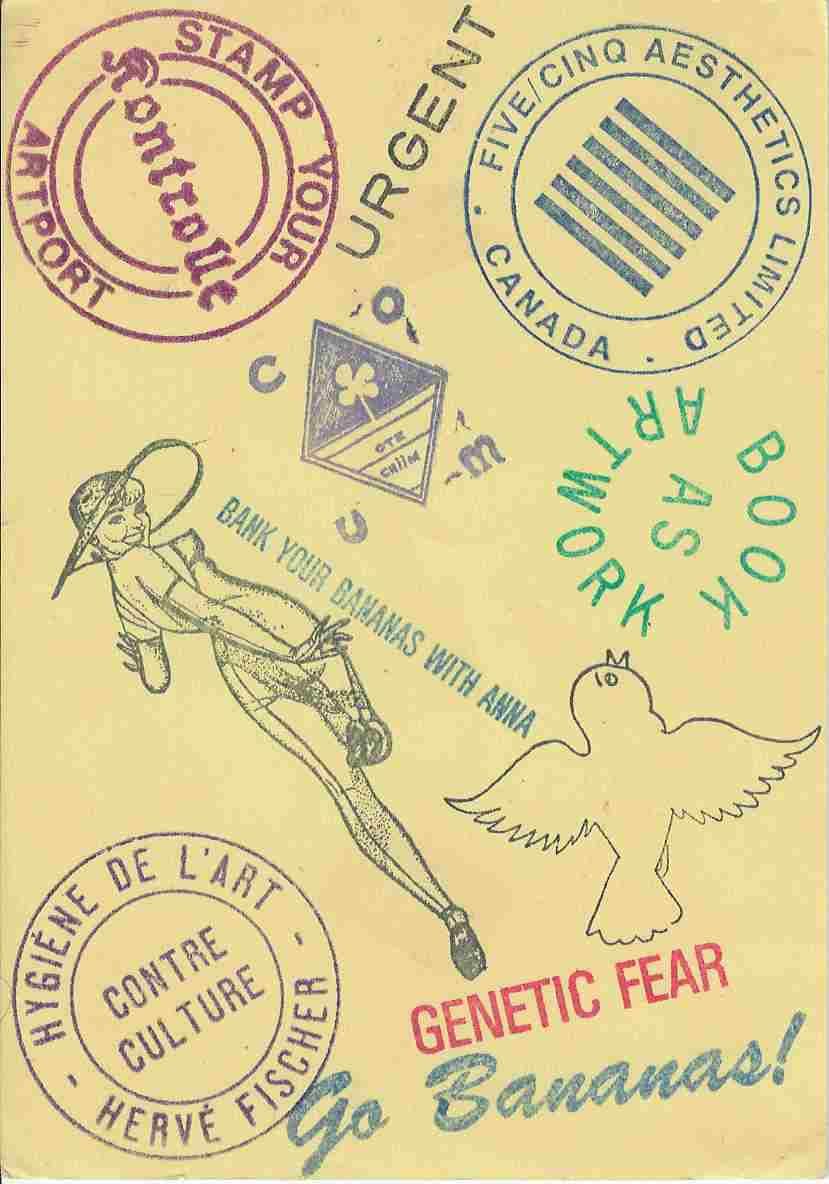
Cartão de arte postal associado ao Collectif Art Sociologique e às redes internacionais de mail art, poesia visual, arte de carimbos e comunicação alternativa.
Collectif Art Sociologique - Collectif d Art Sociologique - Paris - França - Hervé Fischer, Fred Forest e Jean Paul Thénot
Categoria: Mail Art
Acervo: 03892
Data: 1974 - 1980
Dimensões: 10,5 x 15 cm
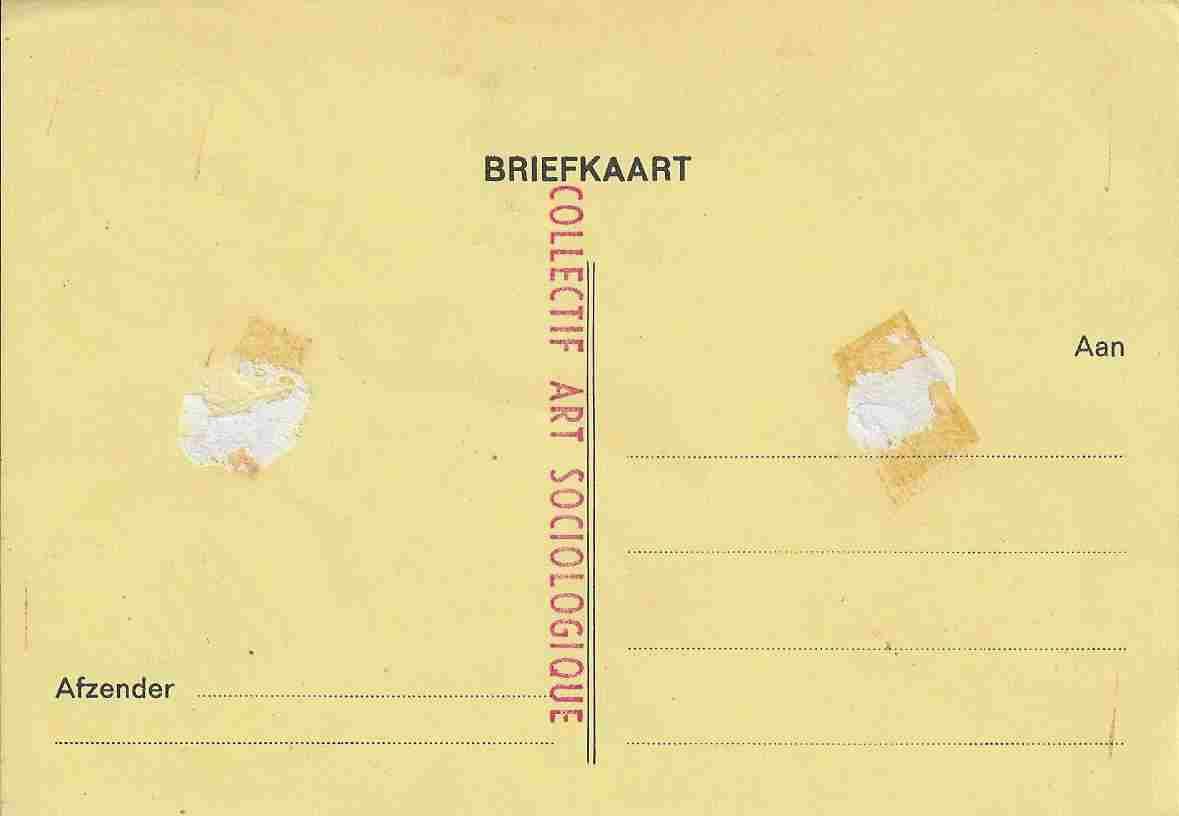
Cartão de arte postal associado ao Collectif Art Sociologique e às redes internacionais de mail art, poesia visual, arte de carimbos e comunicação alternativa. A frente apresenta uma composição formada por múltiplas impressões de carimbos, palavras, slogans, desenhos e marcas provenientes de diferentes artistas, projetos e iniciativas. O suporte é um cartão postal de papel amarelo, utilizado como superfície coletiva de intervenção gráfica.Na região superior esquerda aparece um grande carimbo circular em tinta roxa com as palavras Stamp Your Artport. No centro do carimbo existe uma inscrição manuscrita ou estilizada de leitura difícil. A expressão associa o gesto de carimbar à ideia de porto artístico, circulação, trânsito e intercâmbio internacional de obras.Na região superior direita aparece um carimbo circular em azul com a inscrição Finecino Aesthetics Limited Canada. O centro contém uma forma geométrica composta por linhas paralelas inclinadas. A presença da palavra Canada identifica a origem ou o campo de atuação dessa iniciativa, mas o cartão não permite determinar com segurança o nome completo de seus responsáveis.Entre os dois carimbos superiores encontra se a palavra Urgent, aplicada em posição diagonal. Essa inscrição utiliza uma linguagem característica das comunicações postais e administrativas, transformada em elemento visual e conceitual. Em arte postal, palavras relacionadas a urgência, envio, selo, circulação e entrega frequentemente ultrapassam sua função prática e passam a integrar o significado da obra.Na área central aparece um pequeno carimbo geométrico com a inscrição Art Chile ou expressão semelhante. A leitura não é totalmente segura devido à dimensão e à qualidade da impressão. Ao redor desse elemento existem letras e sinais fragmentados, formando uma composição visual que sugere circulação internacional, identidade gráfica e sobreposição de procedências.À direita, em tinta verde, aparece a inscrição Book as Artwork. As palavras foram distribuídas em orientação circular e irregular. A expressão afirma o livro como obra de arte e aproxima o cartão das práticas de livro de artista, publicação experimental, edição independente e transformação do objeto impresso em suporte conceitual.Na parte central esquerda aparece a imagem de uma mulher em pose performática, acompanhada da frase Dairy Your Bananas with Anna. A referência a Anna pode estar relacionada à artista Anna Banana, importante participante das redes internacionais de arte postal, performance, publicação de artista e cultura alternativa. Entretanto, o cartão não identifica formalmente a autoria dessa imagem, e a associação deve ser tratada como provável referência e não como confirmação absoluta.A figura feminina apresenta traje cênico, chapéu de grandes dimensões e uma postura que combina humor, espetáculo e cultura popular. A frase utiliza um jogo verbal com bananas, elemento recorrente em projetos de Anna Banana e em manifestações da mail art ligadas ao humor, à paródia e à criação de identidades artísticas.Na região inferior central aparece o desenho de uma ave de asas abertas, possivelmente uma pomba. Acima da cabeça há uma pequena inscrição semelhante à letra M ou a um sinal gráfico. A ave pode remeter a comunicação, liberdade, paz, deslocamento e envio, temas frequentes nas práticas postais, mas essa interpretação não está explicitada no documento.Logo abaixo da ave aparece a expressão Genetic Fear em tinta vermelha. A combinação entre imagem, palavra e cor introduz uma dimensão crítica ligada a medo, identidade, hereditariedade, ciência, corpo e comportamento social. O cartão não fornece explicação adicional sobre o projeto ou o artista responsável por essa inscrição.Na parte inferior aparece a frase Go Bananas em escrita gestual azul. A expressão reforça o caráter lúdico e performático da composição e estabelece relação visual com a figura feminina e a referência a Anna. O conjunto transforma a palavra banana em signo de humor, identidade artística, circulação de slogans e participação em redes alternativas.No canto inferior esquerdo encontra se um grande carimbo circular em tinta roxa com as inscrições Hygiène de l Art, Centre Culture e Hervé Fischer. O carimbo relaciona diretamente o cartão ao artista francês Hervé Fischer, um dos fundadores do Collectif Art Sociologique. A expressão Hygiène de l Art corresponde a uma linha de investigação e intervenção desenvolvida por Fischer, voltada à crítica do sistema artístico, das instituições culturais e dos mecanismos de legitimação.O nome Hervé Fischer constitui uma das informações mais importantes do cartão. Sua presença confirma a conexão do objeto com a arte sociológica, a comunicação marginal, a crítica institucional e as redes de arte postal. O carimbo não permite determinar se o cartão foi produzido integralmente por Fischer, pelo coletivo ou por diversos participantes sucessivos.A composição da frente não apresenta uma organização centralizada. Os elementos foram aplicados em diferentes posições, escalas, cores e orientações. Essa estrutura acumulativa é característica de cartões que circulavam entre artistas e recebiam novos carimbos, inscrições e intervenções ao longo do percurso.O verso apresenta a estrutura de um cartão postal em língua neerlandesa. No alto aparece a palavra Briefkaart, que significa cartão postal. À esquerda encontra se Afzender, campo destinado ao remetente, e à direita aparece Aan, campo destinado ao destinatário. Linhas pontilhadas indicam os espaços reservados para nomes, mensagem e endereço.Junto à linha divisória central foi aplicado verticalmente o carimbo Collectif Art Sociologique em tinta avermelhada. Essa inscrição estabelece a associação mais direta do cartão com o coletivo francês. O verso não contém remetente preenchido, destinatário, endereço, mensagem, selo postal ou carimbo de circulação visível.Existem dois resíduos de fita adesiva no verso, um na área esquerda e outro na direita. Esses vestígios podem indicar que o cartão foi fixado em painel, exposição, pasta, arquivo ou publicação. A ausência de marcas postais visíveis impede afirmar se o objeto circulou diretamente pelo correio ou se foi utilizado como contribuição para uma exposição ou coleção.O cartão funciona como uma superfície compartilhada de comunicação e registro. Os carimbos não formam uma declaração única e linear. Em vez disso, documentam o encontro entre artistas, coletivos, projetos, publicações e identidades gráficas da rede internacional de arte postal.A presença do Collectif Art Sociologique e de Hervé Fischer relaciona o objeto à arte sociológica francesa, criada na década de 1970 e voltada à análise das relações entre arte, sociedade, comunicação e instituições. A presença de Book as Artwork, Go Bananas, Genetic Fear, Artport e Finecino Aesthetics Limited Canada amplia o campo de referências e demonstra a natureza transnacional do documento.Os nomes e expressões presentes no cartão não comprovam que todas as iniciativas tenham integrado formalmente o Collectif Art Sociologique. O objeto deve ser compreendido como um documento de circulação compartilhada, no qual marcas de diferentes origens foram reunidas sobre o mesmo suporte.A obra deve ser relacionada à arte postal, mail art, arte sociológica, poesia visual, arte de carimbos, livro de artista, publicação experimental, comunicação marginal, crítica institucional, arte conceitual e redes internacionais de artistas. O cartão constitui uma fonte primária para o estudo da circulação das ideias de Hervé Fischer e do Collectif Art Sociologique em ambientes internacionais de correspondência artística.TEXT FOR THE SALSA PROGRAM IN ENGLISHMail art postcard associated with the Collectif Art Sociologique and with international networks of mail art, visual poetry, rubber stamp art and alternative communication. The front presents a composition made from multiple stamp impressions, words, slogans, drawings and marks originating from different artists, projects and initiatives. The support is a yellow postcard used as a collective surface for graphic intervention.In the upper left area there is a large circular purple stamp bearing the words Stamp Your Artport. A handwritten or stylized inscription appears at its center but is difficult to read. The expression connects the act of stamping with the idea of an artistic port, circulation, transit and international exchange.In the upper right area there is a blue circular stamp reading Finecino Aesthetics Limited Canada. Its center contains a geometric form made of inclined parallel lines. The word Canada indicates the origin or field of activity of the initiative, but the postcard does not securely identify the individuals responsible for it.Between the two upper stamps appears the word Urgent in a diagonal position. This term belongs to the language of postal and administrative communication, but here it becomes a visual and conceptual element. In mail art, words associated with urgency, delivery, postage and circulation frequently become part of the artistic content.Near the center there is a small geometric stamp bearing an inscription that appears to read Art Chile or a similar phrase. The reading is uncertain because of the size and quality of the impression. Fragmented letters and signs around it create a visual field suggesting international circulation, graphic identity and overlapping origins.On the right side, the phrase Book as Artwork appears in green. The words are arranged in a circular and irregular orientation. The statement presents the book as an artwork and connects the postcard with artists books, experimental publishing, independent editing and the transformation of printed matter into a conceptual medium.In the central left area there is an image of a woman in a performative pose accompanied by the phrase Dairy Your Bananas with Anna. The reference to Anna may be connected with Anna Banana, an important participant in international mail art, performance and artists publishing. The postcard, however, does not formally identify the author of the image, so this association should be treated as a probable reference rather than an absolute attribution.The female figure wears a theatrical costume and a large hat and combines humor, spectacle and popular culture. The phrase plays with the word bananas, a recurring element in projects associated with Anna Banana and in mail art practices involving parody, performance and invented artistic identities.In the lower central area there is a drawing of a bird with open wings, possibly a dove. A small sign resembling the letter M appears above its head. The bird may suggest communication, freedom, peace or movement, although the postcard provides no explicit interpretation.Below the bird appears the phrase Genetic Fear in red. The combination of image, language and color introduces possible references to fear, identity, heredity, science, the body and social behavior. No additional explanation identifies the project or artist responsible for this inscription.Near the bottom appears the phrase Go Bananas in gestural blue lettering. The expression reinforces the playful and performative character of the composition and establishes a visual relationship with the female figure and the reference to Anna. The word banana becomes a sign of humor, artistic identity, slogans and participation in alternative networks.In the lower left corner there is a large circular purple stamp containing the words Hygiène de l Art, Centre Culture and Hervé Fischer. This stamp directly connects the postcard with the French artist Hervé Fischer, one of the founders of the Collectif Art Sociologique. Hygiène de l Art refers to a line of investigation and intervention developed by Fischer in relation to the art system, cultural institutions and mechanisms of legitimation.The name Hervé Fischer is one of the most important pieces of information on the postcard. Its presence confirms the connection of the object with sociological art, marginal communication, institutional critique and mail art networks. The stamp does not establish whether the entire postcard was created by Fischer, by the collective or by several successive participants.The front has no single centralized composition. Elements were applied in different positions, scales, colors and orientations. This cumulative structure is characteristic of cards that circulated among artists and received new stamps, inscriptions and interventions over time.The reverse uses the layout of a Dutch language postcard. At the top appears the word Briefkaart, meaning postcard. On the left is Afzender, the field for the sender, and on the right is Aan, the field for the recipient. Dotted lines indicate spaces intended for names, messages and addresses.Along the central dividing line appears the vertical red stamp Collectif Art Sociologique. This inscription provides the clearest direct association with the French collective. The reverse contains no completed sender, recipient, address, message, postage stamp or visible postal cancellation.Two adhesive residues appear on the reverse, one on the left and one on the right. They may indicate that the postcard was once mounted on a panel, exhibited, stored in a folder or attached to another support. The absence of postal markings prevents confirmation that it circulated directly through the postal system.The postcard functions as a shared surface of communication and documentation. Its stamps do not form a single linear statement. Instead, they record an encounter among artists, collectives, projects, publications and graphic identities within the international mail art network.The presence of the Collectif Art Sociologique and Hervé Fischer connects the object with French sociological art and its investigation of the relationships among art, society, communication and institutions. The presence of Book as Artwork, Go Bananas, Genetic Fear, Artport and Finecino Aesthetics Limited Canada expands the field of references and demonstrates the transnational character of the document.The names and expressions on the postcard do not prove that every represented initiative formally belonged to the Collectif Art Sociologique. The object should be understood as a document of shared circulation in which marks from different origins were gathered on the same support.The work should be associated with mail art, sociological art, visual poetry, rubber stamp art, artists books, experimental publishing, marginal communication, institutional critique, conceptual art and international artists networks. The postcard is a primary source for studying the circulation of Hervé Fischer and the Collectif Art Sociologique within international correspondence art contexts.
Cartão postal de arte associado ao Collectif Art Sociologique e a Hervé Fischer. A frente apresenta uma composição de carimbos, desenhos, palavras e slogans aplicados sobre papel amarelo. Entre as inscrições identificadas aparecem Stamp Your Artport, Finecino Aesthetics Limited Canada, Urgent, Book as Artwork, Genetic Fear, Go Bananas, Dairy Your Bananas with Anna, Hygiène de l Art, Centre Culture e Hervé Fischer.O verso utiliza um modelo de cartão postal em língua neerlandesa com as palavras Briefkaart, Afzender e Aan. Junto à divisão central aparece o carimbo Collectif Art Sociologique. Não são visíveis remetente, destinatário, endereço, mensagem, selo postal ou carimbo de circulação.Há resíduos de fita adesiva que podem indicar montagem, exposição ou arquivamento. A autoria integral do cartão não pode ser atribuída com segurança a um único artista. Os diversos carimbos parecem documentar a participação de diferentes agentes da rede internacional de arte postal.A obra deve ser catalogada como arte postal, mail art, arte sociológica, cartão de artista, arte de carimbos, poesia visual, livro de artista, publicação experimental, comunicação marginal e documento de rede internacional.OBSERVATION TEXT IN ENGLISHMail art postcard associated with the Collectif Art Sociologique and Hervé Fischer. The front presents a composition of stamps, drawings, words and slogans applied to yellow card. Identified inscriptions include Stamp Your Artport, Finecino Aesthetics Limited Canada, Urgent, Book as Artwork, Genetic Fear, Go Bananas, Dairy Your Bananas with Anna, Hygiène de l Art, Centre Culture and Hervé Fischer.The reverse uses a Dutch postcard layout with the words Briefkaart, Afzender and Aan. The vertical stamp Collectif Art Sociologique appears beside the central dividing line. No sender, recipient, address, message, postage stamp or postal cancellation is visible.Adhesive residues may indicate previous mounting, exhibition or archival storage. The complete authorship of the postcard cannot be securely attributed to a single artist. Its multiple stamps appear to document the participation of different agents within the international mail art network.The work should be catalogued as mail art, sociological art, artists postcard, rubber stamp art, visual poetry, artists book related material, experimental publishing, marginal communication and a document of an international artistic network.
Proveniência
Coleção Falves SilvaInglês
Mail art postcard associated with the Collectif Art Sociologique and with international networks of mail art, visual poetry, rubber stamp art and alternative communication.
Dimensions: 4,1 x 5,9 in