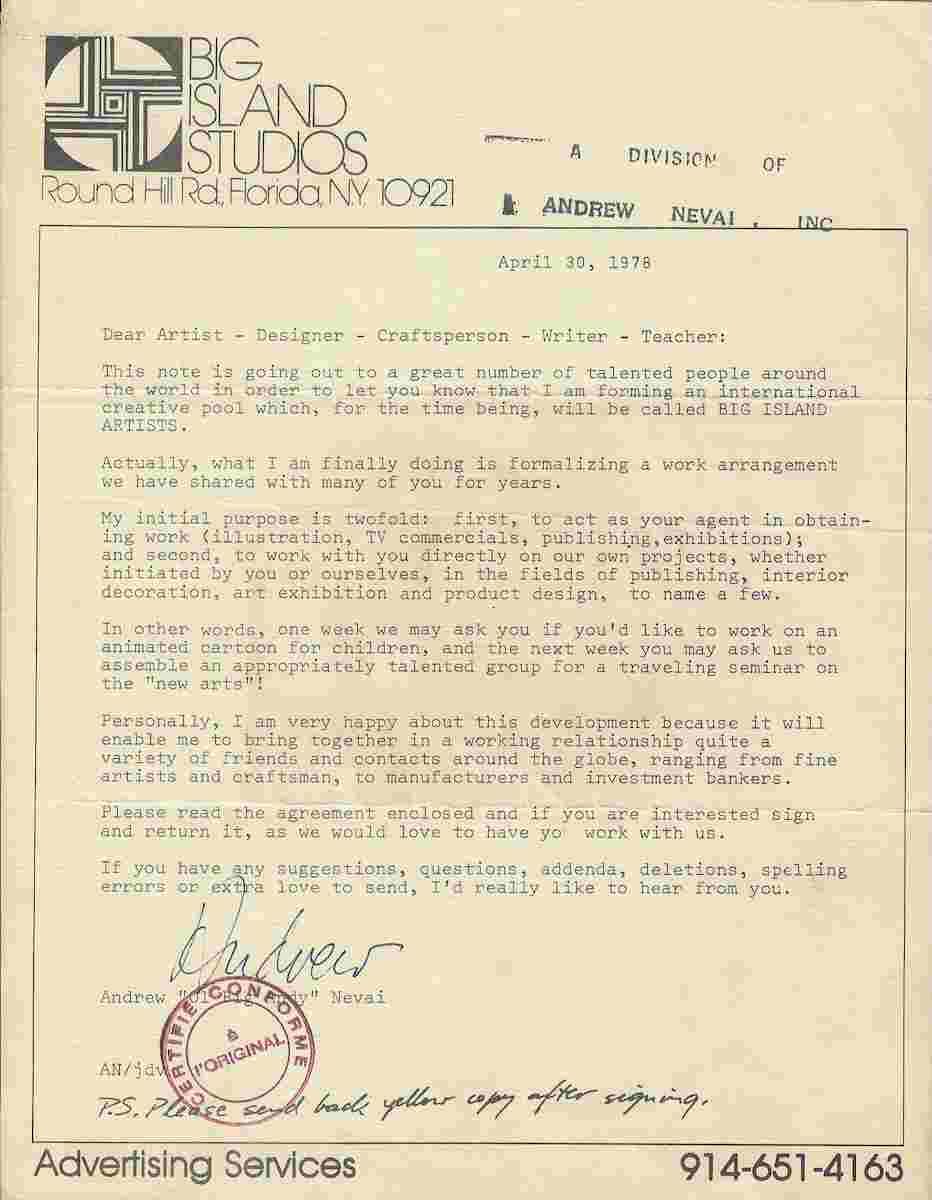
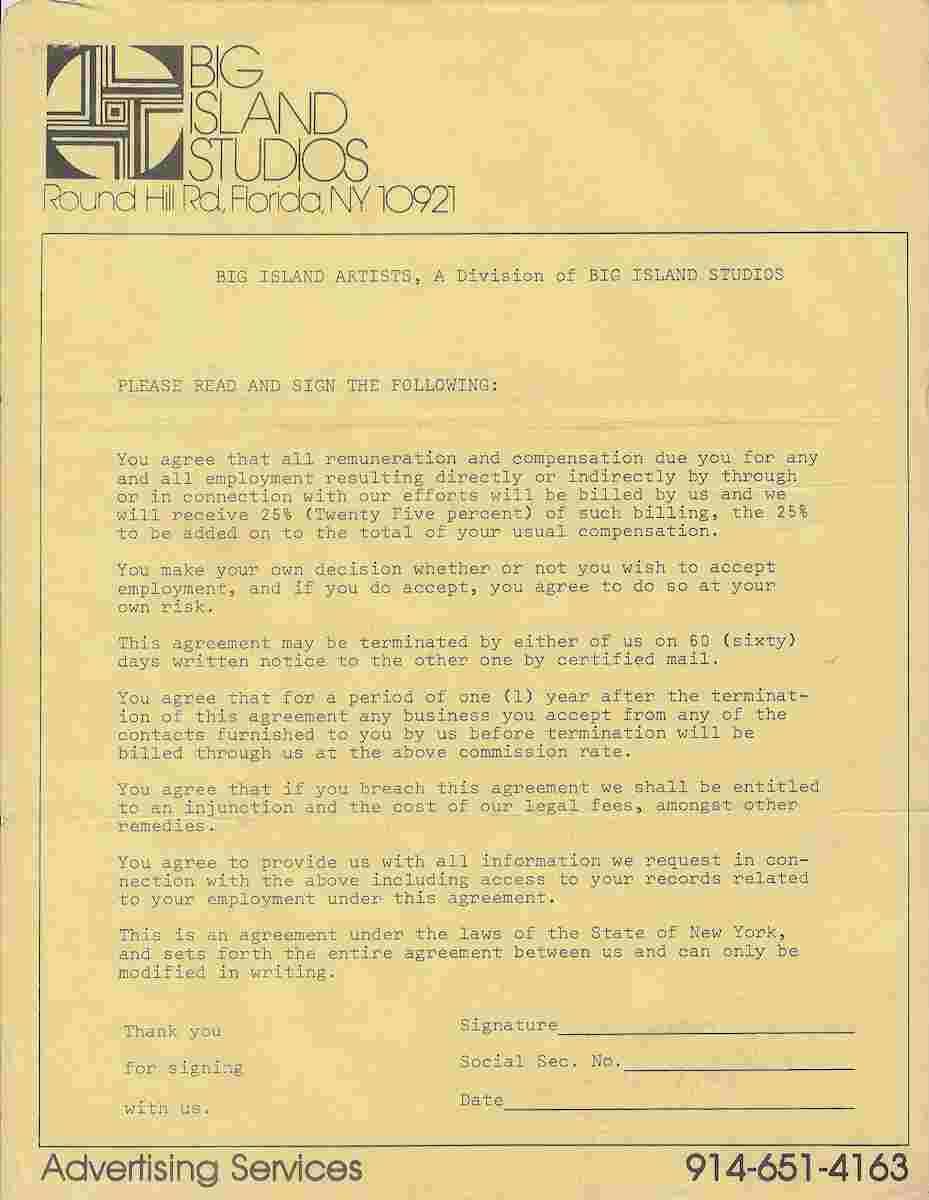
Carta de apresentação acompanhada por contrato de adesão da Big Island Artists, divisão da Big Island Studios, enviada por Andrew Nevai a artistas, designers, artesãos, escritores e professores.
Andrew Conny Nevai - Andrew Nevai - Big Island Studios NY - USA
Categoria: Mail Art
Acervo: 03891
Data: 13 de maio de 1978
Dimensões: 27,8 x 21,7 cm
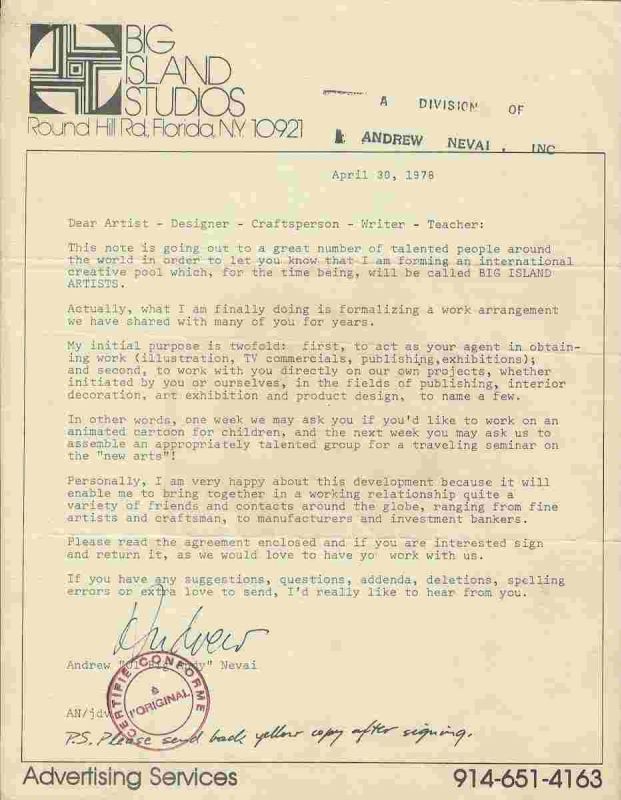
Carta de apresentação acompanhada por contrato de adesão da Big Island Artists, divisão da Big Island Studios, enviada por Andrew Nevai a artistas, designers, artesãos, escritores e professores. O documento foi produzido em Florida, estado de Nova York, Estados Unidos, e apresenta no cabeçalho o endereço Round Hill Road, Florida, New York 10921, além do telefone 914 651 4163 e da identificação Advertising Services.Embora a informação inicial do acervo indique 13 de maio de 1978, a carta apresentada está datada de 30 de abril de 1978. Não existe nas imagens uma inscrição visível correspondente a 13 de maio. Essa segunda data pode estar relacionada ao recebimento, arquivamento ou envio do documento, mas essa hipótese não pode ser confirmada apenas pelas páginas examinadas.O cabeçalho identifica Big Island Studios e informa que a iniciativa funcionava como uma divisão de A. Andrew Nevai, Inc. A segunda página utiliza a denominação Big Island Artists, A Division of Big Island Studios. O conjunto confirma documentalmente que Andrew Nevai estava ligado a uma estrutura profissional de representação, publicidade, produção, edição e intermediação de trabalhos artísticos e comerciais.A carta começa dirigindo se a artistas, designers, artesãos, escritores e professores. Andrew Nevai informa que a comunicação estava sendo enviada a um grande número de pessoas talentosas ao redor do mundo com a finalidade de criar um grupo internacional que, naquele momento, seria denominado Big Island Artists.Nevai explica que estava formalizando uma relação de trabalho que já mantinha havia anos com muitos dos destinatários. A proposta possuía duas finalidades principais. A primeira era atuar como agente dos participantes para obter trabalhos destinados a ilustração, comerciais, publicidade e exposições. A segunda era desenvolver projetos diretamente com os artistas, utilizando suas capacidades criativas em áreas como publicação, decoração de interiores, exposições de arte e design de produtos.A carta apresenta exemplos da diversidade dos projetos pretendidos. Em determinado momento, a organização poderia convidar um artista para trabalhar em um desenho animado destinado ao público infantil. Em outra ocasião, poderia solicitar a montagem de um grupo de artistas para projetar uma exposição itinerante sobre as novas artes. Esses exemplos demonstram o interesse de Andrew Nevai em combinar criação artística, produção editorial, publicidade, exposições e atividades comerciais.Nevai manifesta satisfação com a criação da iniciativa porque ela permitiria reunir em uma relação de trabalho amigos e contatos distribuídos por diferentes partes do mundo. O texto menciona artistas, artesãos, fabricantes e banqueiros de investimento, revelando que a Big Island Artists pretendia operar como intermediária entre profissionais da criação e possíveis clientes, financiadores ou contratantes.O destinatário era convidado a ler o contrato anexo e, caso tivesse interesse, assiná lo e devolvê lo. Andrew Nevai também solicita sugestões, perguntas, adições, exclusões, correções ortográficas e outras observações. A carta termina com assinatura manuscrita e uma nota solicitando o envio de volta da cópia amarela após a assinatura.Próximo à assinatura aparece um carimbo circular com as palavras Big Island Artists, Original e uma identificação central parcialmente legível. Esse carimbo funciona como autenticação administrativa, marca institucional e elemento gráfico do documento.A segunda página apresenta o contrato de adesão da Big Island Artists. O participante concordava que toda remuneração ou compensação recebida por trabalhos obtidos direta ou indiretamente por meio dos esforços da organização seria faturada pela Big Island Studios. A empresa receberia vinte e cinco por cento de comissão, e esse percentual seria acrescentado ao total da remuneração habitual do artista.O contrato preservava formalmente a autonomia do participante para aceitar ou recusar um trabalho. Caso aceitasse, o artista concordava em realizá lo por sua própria conta e risco. Essa disposição indica que a Big Island Studios atuaria principalmente na captação, negociação e intermediação, sem assumir integralmente a execução ou os riscos do trabalho artístico.O acordo poderia ser encerrado por qualquer uma das partes mediante aviso escrito com sessenta dias de antecedência. Entretanto, durante um ano após o encerramento, qualquer atividade comercial aceita pelo artista a partir dos contatos fornecidos pela Big Island Studios continuaria sujeita à mesma comissão.O documento também estabelecia que o descumprimento do contrato poderia dar à empresa o direito de buscar medida judicial e cobrar despesas legais. O participante deveria fornecer todas as informações solicitadas em relação aos trabalhos obtidos por meio do acordo, incluindo acesso a registros relacionados às atividades profissionais desenvolvidas sob esse sistema.O contrato seria regido pelas leis do estado de Nova York. Também declarava constituir o entendimento integral entre as partes e determinava que qualquer alteração só poderia ser realizada por escrito. Na parte inferior aparecem campos destinados à assinatura, número da Previdência Social norte americana e data.O documento amplia de maneira significativa o conhecimento sobre Andrew Nevai e corrige a interpretação anterior de que a denominação Big Island Studios não estava documentada. As duas páginas demonstram que Big Island Studios era uma estrutura real, associada a A. Andrew Nevai, Inc., localizada em Florida, Nova York. Big Island Artists aparece como uma divisão dessa organização destinada à formação e representação de um conjunto internacional de profissionais criativos.O conteúdo também ajuda a distinguir Big Island Studios de Big Island Gallery. A documentação anterior relaciona Andrew Nevai e Lucie Nevai à Big Island Gallery, voltada a carimbos, exposições e atividades experimentais. Esta carta apresenta Big Island Studios como uma estrutura de serviços de publicidade e representação profissional. As duas denominações podem ter coexistido dentro do mesmo ambiente de atuação de Andrew Nevai, mas a relação administrativa exata entre Gallery e Studios exige documentação adicional.A presença do termo international creative pool demonstra que Andrew Nevai pretendia formar uma rede internacional de artistas disponível para projetos editoriais, comerciais, gráficos e expositivos. Essa proposta apresenta afinidades com a organização descentralizada da arte postal, pois dependia de contatos mantidos à distância, circulação de documentos, colaboração internacional e troca de informações entre participantes.Caso este exemplar tenha sido enviado a Falves Silva, como sugere sua preservação no acervo relacionado ao artista brasileiro, o documento registra uma tentativa de incluir Falves em uma rede internacional de representação e produção coordenada por Andrew Nevai. No entanto, as páginas não apresentam o nome do destinatário e o contrato não está preenchido ou assinado. Portanto, não é possível afirmar que Falves Silva tenha aceitado formalmente a proposta.O documento deve ser relacionado a Andrew Nevai, Big Island Studios, Big Island Artists, A. Andrew Nevai, Inc., publicidade, representação de artistas, design gráfico, ilustração, publicação, exposições, arte postal, redes internacionais de colaboração e organização profissional da produção criativa. Além de sua função contratual, ele constitui uma publicação administrativa de artista e um registro da infraestrutura utilizada por participantes das redes alternativas da década de 1970.TEXT FOR THE SALSA PROGRAM IN ENGLISHPresentation letter accompanied by a membership agreement issued by Big Island Artists, a division of Big Island Studios, and sent by Andrew Nevai to artists, designers, craftworkers, writers and teachers. The document was produced in Florida, New York, United States. Its letterhead records the address Round Hill Road, Florida, New York 10921, the telephone number 914 651 4163 and the identification Advertising Services.Although the initial archival information gives the date as 13 May 1978, the letter itself is dated 30 April 1978. No visible inscription corresponding to 13 May appears on the two pages. That later date may refer to receipt, mailing or archival processing, but this cannot be confirmed from the examined document.The letterhead identifies Big Island Studios and states that the initiative operated as a division of A. Andrew Nevai, Inc. The second page uses the name Big Island Artists, A Division of Big Island Studios. The document therefore confirms that Andrew Nevai was connected with a professional structure devoted to representation, advertising, production, publishing and the mediation of artistic and commercial assignments.The letter addresses artists, designers, craftworkers, writers and teachers. Andrew Nevai explains that the communication was being sent to a large number of talented people throughout the world in order to create an international creative pool that would, for the time being, be called Big Island Artists.Nevai states that he was formalizing a working arrangement that had already been shared with many of the recipients for several years. The proposal had two principal purposes. The first was to act as the participant's agent in obtaining assignments in illustration, television commercials, publishing and exhibitions. The second was to work directly with artists on projects initiated by the organization in fields including publishing, interior decoration, art exhibitions and product design.The letter provides examples of the proposed range of activities. During one week, the organization might invite an artist to work on an animated cartoon for children. During another, it might ask participants to assemble a carefully selected group for a traveling seminar or exhibition concerning the new arts. These examples reveal Nevai's interest in combining artistic creation, editorial production, advertising, exhibition making and commercial work.Nevai expresses satisfaction with the development because it would allow him to bring together, within a working relationship, friends and contacts located throughout the world. The text mentions artists, craftworkers, manufacturers and investment bankers, indicating that Big Island Artists intended to serve as an intermediary between creative professionals and possible clients, contractors or financial supporters.Recipients were asked to read the enclosed agreement and, when interested, sign and return it. Andrew Nevai also invited suggestions, questions, additions, deletions, spelling corrections and other comments. The letter concludes with his handwritten signature and a note requesting the return of the yellow copy after signing.A circular stamp appears near the signature and contains the words Big Island Artists and Original, with a partially legible central identification. The stamp functions as administrative authentication, institutional mark and graphic component of the document.The second page presents the Big Island Artists membership agreement. Participants agreed that all remuneration and compensation received for employment obtained directly or indirectly through the efforts of the organization would be billed by Big Island Studios. The company would receive a commission of twenty five percent, which would be added to the total amount of the participant's usual compensation.The agreement formally preserved the participant's freedom to accept or refuse employment. Upon accepting an assignment, however, the artist agreed to undertake it at personal risk. This provision indicates that Big Island Studios would act primarily in securing, negotiating and mediating work rather than assuming full responsibility for its execution.Either party could terminate the agreement by providing sixty days written notice. For one year after termination, however, any business accepted by the participant from contacts originally furnished by Big Island Studios would remain subject to the established commission.The agreement also stated that a breach could entitle the organization to seek an injunction and recover legal fees and other remedies. Participants were required to provide all information requested in connection with assignments obtained through the arrangement, including access to records related to employment performed under the agreement.The contract was governed by the laws of the state of New York. It declared itself to be the entire agreement between the parties and required any modification to be made in writing. The lower section contains blank fields for signature, Social Security number and date.This document significantly expands the available knowledge concerning Andrew Nevai and corrects the earlier interpretation that Big Island Studios was not documented. The two pages demonstrate that Big Island Studios was an actual structure associated with A. Andrew Nevai, Inc. in Florida, New York. Big Island Artists was presented as one of its divisions and was intended to form and represent an international group of creative professionals.The content also helps distinguish Big Island Studios from Big Island Gallery. Earlier documentation connects Andrew Nevai and Lucie Nevai with the Big Island Gallery and its activities involving rubber stamp art, exhibitions and experimental projects. The present letter identifies Big Island Studios as a structure providing advertising and professional representation services. Both names may have coexisted within Nevai's broader activities, although their precise administrative relationship requires further documentation.The phrase international creative pool demonstrates that Nevai intended to establish a transnational network of artists available for editorial, commercial, graphic and exhibition projects. This proposal shared structural features with mail art, since it depended upon distant contacts, circulating documents, international collaboration and the exchange of information among participants.Should this copy have been sent to Falves Silva, as suggested by its preservation in an archive connected with the Brazilian artist, the document records an attempt to include him in an international system of representation and production organized by Andrew Nevai. The pages, however, contain no recipient name, completed signature or acceptance. It therefore cannot be stated that Falves Silva formally joined Big Island Artists.The document should be associated with Andrew Nevai, Big Island Studios, Big Island Artists, A. Andrew Nevai, Inc., advertising, artist representation, graphic design, illustration, publishing, exhibitions, mail art, international collaboration networks and the professional organization of creative production. In addition to its contractual function, it constitutes an administrative artists publication and a record of the infrastructure used by participants in alternative art networks during the 1970s.
TEXTO DE OBSERVAÇÃO EM PORTUGUÊSCarta de apresentação e contrato de adesão da Big Island Artists, divisão da Big Island Studios, vinculada a A. Andrew Nevai, Inc., em Florida, Nova York, Estados Unidos. A carta está datada de 30 de abril de 1978. A data de 13 de maio de 1978 informada pelo acervo não aparece de forma visível nas páginas e pode corresponder ao recebimento ou arquivamento do documento.Andrew Nevai propõe a formação de um grupo internacional de artistas, designers, artesãos, escritores e professores. A organização pretendia atuar como agente para obtenção de trabalhos em ilustração, publicidade, comerciais e exposições, além de desenvolver projetos próprios nas áreas de publicação, decoração de interiores, design de produtos e exposições itinerantes.O contrato previa comissão de vinte e cinco por cento para a Big Island Studios, liberdade do participante para aceitar ou recusar trabalhos, aviso de sessenta dias para encerramento e manutenção da comissão durante um ano sobre atividades provenientes de contatos apresentados pela empresa.O documento não contém nome de destinatário nem assinatura de adesão. Por isso, não comprova que Falves Silva ou outro artista tenha aceitado o contrato. O conjunto deve ser catalogado como carta comercial, proposta de representação artística, contrato de adesão, documento de Big Island Studios, registro da atuação de Andrew Nevai e material relacionado às redes internacionais de arte e comunicação.OBSERVATION TEXT IN ENGLISHPresentation letter and membership agreement issued by Big Island Artists, a division of Big Island Studios associated with A. Andrew Nevai, Inc. in Florida, New York, United States. The letter is dated 30 April 1978. The archival date of 13 May 1978 is not visible on the pages and may refer to receipt or archival processing.Andrew Nevai proposes the formation of an international group of artists, designers, craftworkers, writers and teachers. The organization intended to act as an agent for assignments in illustration, advertising, television commercials and exhibitions, while also developing projects in publishing, interior decoration, product design and traveling exhibitions.The agreement established a twenty five percent commission for Big Island Studios, allowed participants to accept or refuse assignments, required sixty days notice for termination and maintained the commission for one year on business originating from contacts introduced by the organization.The document contains no named recipient and no completed membership signature. It therefore does not prove that Falves Silva or another artist formally accepted the agreement. The material should be catalogued as a commercial letter, proposal for artist representation, membership agreement, Big Island Studios document, record of Andrew Nevai's professional activity and material connected with international networks of art and communication.
Proveniência
Coleção Falves SilvaInglês
Presentation letter accompanied by a membership agreement issued by Big Island Artists, a division of Big Island Studios, and sent by Andrew Nevai to artists, designers, craftworkers, writers and teachers.
Dimensions: 10,9 x 8,5 in